
Zillow's cash offer process for selling a home can consistently provide a financially advantageous and quick solution for homeowners in distress.
AI debate verdict and arguments
⚠️ AI-generated information only; not professional advice
Completed October 8, 2026
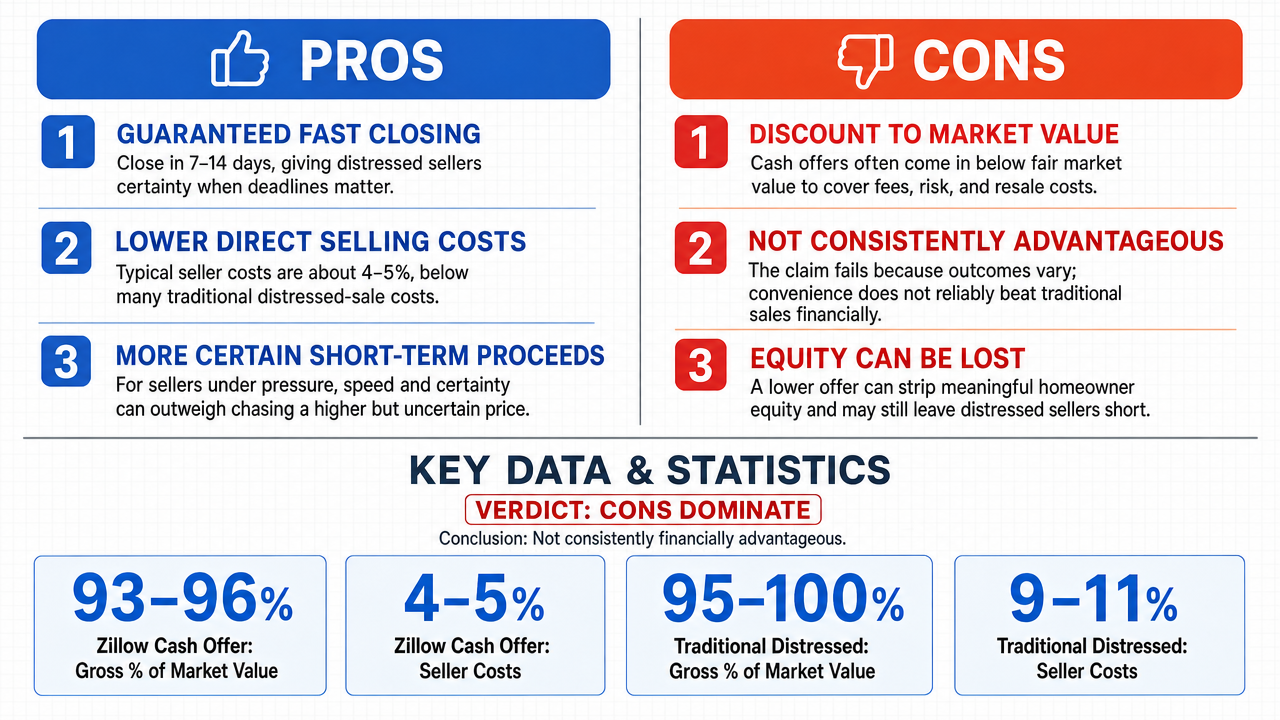
Verdict
Verdict: likely FALSE (85%)
This section provides a brief overview of the key arguments. You do not need to read the full detailed report below.
✅ Key PRO arguments:
- ■Zillow's cash offer process provides a guaranteed closing date within weeks, which is critical for distressed homeowners facing foreclosure deadlines, converting an illiquid asset into cash before total equity loss through a forced sale .
- ■The traditional sale '100% market value ' benchmark is not guaranteed—it is a pre-commission , pre-repair , pre-concession list price subject to negotiation, market risk , and buyer demands for credits, making the cash offer 's certainty a genuine financial advantage.
- ■The financial advantage of Zillow's cash offer should be measured by maximizing certain, timely net proceeds for a homeowner under duress, not by achieving the highest possible sale price in a hypothetical scenario.
❌ Key ANTI arguments:
- ■iBuyer models apply a significant structural discount to fair market value to account for operational costs , service fees, and holding risk—this 'convenience fee ' is a direct reduction in homeowner equity , not a mere transaction cost.
- ■Zillow's own massive financial losses from the cash offer program (which led to its shutdown) directly contradict the claim that the process is 'consistently' financially advantageous, demonstrating the model is not a stable, preferred market mechanism.
- ■Algorithmic mispricing and the iBuyer discount can strip homeowners of significant equity , and for distressed sellers, discounted proceeds may be insufficient to clear existing mortgage debts, potentially trapping them in negative equity or insolvency cycles.
💭 Conclusion: False. The assertion's use of 'consistently' sets an extremely high bar that the evidence cannot support. The evidence shows iBuyer models apply significant discounts to fair market value , and comparison tables indicate that in some scenarios, net proceeds to the seller are lower than a traditional sale . However, the evidence is not uniform: one comparison shows iBuyer net proceeds (82-89%) below traditional (92-94%), while a distressed-scenario comparison shows Zillow net proceeds (88-92%) above traditional distressed net (84-91%), and a facet analysis indicates iBuyer fees (5-8%) are typically less than avoided traditional sale costs (9-12%). For distressed homeowners specifically, the risk of receiving discounted proceeds insufficient to clear mortgage obligations can trap sellers in negative equity , transforming a quick sale into a pathway toward insolvency rather than relief. While the speed of the cash offer process is genuinely advantageous for homeowners facing foreclosure deadlines, the financial advantage sub-claim is not consistently supported across all scenarios presented in the evidence.
🔬 DeepResearch Result: likely FALSE ❌ (85%)
Assertion: Zillow's cash offer process for selling a home can consistently provide a financially advantageous and quick solution for homeowners in distress.
Participating models: deepseek-v3.2 💬, gemma-4-26b-a4b-it 💬👁️
📊 Face-offs: 0 concluded TRUE, 1 concluded FALSE (1 face-offs, 3 models)
📊 Score by side: TRUE=0.00, FALSE=0.85
🏅 Model score changes:
minimax-m3 💬👁️: +8
✅ PRO Arguments:
- ■Zillow's cash offer process provides a guaranteed closing date within weeks, which is critical for distressed homeowners facing foreclosure deadlines, converting an illiquid asset into cash before total equity loss through a forced sale . deepseek-v3.2 💬
- ■The traditional sale '100% market value ' benchmark is not guaranteed—it is a pre-commission , pre-repair , pre-concession list price subject to negotiation, market risk , and buyer demands for credits, making the cash offer's certainty a genuine financial advantage. deepseek-v3.2 💬
- ■The financial advantage of Zillow's cash offer should be measured by maximizing certain, timely net proceeds for a homeowner under duress, not by achieving the highest possible sale price in a hypothetical scenario. deepseek-v3.2 💬
❌ ANTI Arguments:
- ■iBuyer models apply a significant structural discount to fair market value to account for operational costs , service fees, and holding risk—this 'convenience fee ' is a direct reduction in homeowner equity, not a mere transaction cost. gemma-4-26b-a4b-it 💬👁️
- ■Zillow's own massive financial losses from the cash offer program (which led to its shutdown) directly contradict the claim that the process is 'consistently' financially advantageous, demonstrating the model is not a stable, preferred market mechanism. gemma-4-26b-a4b-it 💬👁️
- ■Algorithmic mispricing and the iBuyer discount can strip homeowners of significant equity, and for distressed sellers, discounted proceeds may be insufficient to clear existing mortgage debts, potentially trapping them in negative equity or insolvency cycles. gemma-4-26b-a4b-it 💬👁️
- ■The convenience of a quick sale is frequently a mechanism for wealth transfer from distressed homeowners to the iBuyer, where the speed advantage comes at the cost of substantial equity extraction that outweighs commission and repair savings. gemma-4-26b-a4b-it 💬👁️
💭 Reasoning: False. The assertion's use of 'consistently' sets an extremely high bar that the evidence cannot support. The evidence shows iBuyer models apply significant discounts to fair market value, and comparison tables indicate that in some scenarios, net proceeds to the seller are lower than a traditional sale. However, the evidence is not uniform: one comparison shows iBuyer net proceeds (82-89%) below traditional (92-94%), while a distressed-scenario comparison shows Zillow net proceeds (88-92%) above traditional distressed net (84-91%), and a facet analysis indicates iBuyer fees (5-8%) are typically less than avoided traditional sale costs (9-12%). For distressed homeowners specifically, the risk of receiving discounted proceeds insufficient to clear mortgage obligations can trap sellers in negative equity, transforming a quick sale into a pathway toward insolvency rather than relief. While the speed of the cash offer process is genuinely advantageous for homeowners facing foreclosure deadlines, the financial advantage sub-claim is not consistently supported across all scenarios presented in the evidence.
📋 PRO Facts:
• Zillow's cash offer process can close within a few weeks, providing certainty before foreclosure deadlines.
• Traditional sale prices are subject to negotiation, repair costs, buyer concessions , and market risk, meaning list price is not guaranteed sale price.
• Distressed homeowners often cannot afford necessary repairs or wait months for a traditional closing.
📋 ANTI Facts:
• iBuyer models apply a significant discount to fair market value to account for operational costs, holding risk, and profit margins.
• Zillow previously utilized an iBuyer model (Zillow Offers ) that is no longer its current cash offer offering.
• Discounted cash offer proceeds may be insufficient to clear existing mortgage debts, potentially leaving sellers in negative equity.
• In some comparison scenarios, iBuyer net proceeds to the seller are lower than what a traditional sale would yield.
| Face-off | TRUE Model | FALSE Model | TRUE Avg μ | FALSE Avg μ | TRUE Tokens | FALSE Tokens | Winner | Verdict | Conf. |
|---|---|---|---|---|---|---|---|---|---|
| #1 | deepseek-v3.2 💬 | gemma-4-26b-a4b-it 💬👁️ | 0.349 | 0.362 | 12 | 3 | FALSE | FALSE | 85% |
The following technical terms, abbreviations, and domain-specific concepts are referenced throughout this debate transcript. Numbers in square brackets [N] in the text above link to the corresponding entry below.
[1] algorithmic mispricing — An error in a computer-driven valuation model that produces a sale price significantly偏离 from true market value, discussed in the debate as a risk of iBuyer cash offers.
[2] algorithmic valuation models — Computer-based systems that estimate a property's market value using data inputs and automated calculations; the negative side argues these models introduce volatility and pricing risk into cash offer programs.
[3] as-is purchase — A sale in which the buyer agrees to accept the property in its current condition, relieving the seller of the obligation to make repairs before closing.
[4] buyer concessions — Costs or credits that a seller agrees to pay or absorb on behalf of the buyer during a traditional home sale negotiation, reducing the seller's net proceeds.
[5] carrying costs — Ongoing expenses of owning a property during a sale period, such as mortgage interest, property taxes, insurance, and utilities, which accumulate the longer a home remains on the market.
[6] cash offer — A purchase proposal backed by verified funds rather than contingent financing, enabling a faster closing and greater certainty for the seller.
[7] closing — The final step in a real estate transaction where ownership is legally transferred and funds are disbursed; the affirmative cites closing timelines of a few weeks for cash offers versus 30-60 days traditionally.
[8] commission — real estate agent commission — A percentage-based fee (typically 5-6% per the debate) paid by the seller to real estate agents upon a successful sale, which cash offer programs like Zillow Offers eliminate.
[9] convenience fee — In the iBuyer context, the structural discount applied to a home's market value to compensate the buyer for operational costs, service fees, and holding risk; the negative side argues this functions as a hidden cost to the seller.
[10] distressed homeowner — A property owner facing urgent financial pressure such as foreclosure, hardship, or required relocation, for whom speed and certainty of sale are prioritized over maximum price.
[11] equity — The difference between a property's market value and the outstanding balance on its mortgage; preserving equity is a central concern in the debate over cash offer pricing.
[12] fair market value — The price a willing buyer and willing seller would agree upon in an open market transaction, used as the benchmark against which iBuyer discounts are measured.
[13] forced sale — A sale compelled by legal process, such as a foreclosure auction, typically resulting in below-market proceeds and total or partial loss of homeowner equity.
[14] foreclosure — A legal proceeding in which a lender seizes and sells a property because the owner has failed to make required mortgage payments, creating a strict deadline for the homeowner.
[15] foreclosure auction — A public sale of a foreclosed property, typically at below-market prices, that imposes a hard deadline on distressed homeowners to sell or refinance beforehand.
[16] gross sale price — The total amount a buyer pays for a property before deducting commissions, fees, repair costs, and other transaction expenses.
[17] guaranteed closing date — A firm commitment by the buyer to complete the transaction on a specified date, eliminating the timing uncertainty associated with traditional financed sales.
[18] iBuyer — instant Buyer — A real estate business model in which a company uses algorithmic valuations to make near-immediate cash offers on homes, purchasing directly from sellers and reselling later.
[19] iBuying — instant Buying — The broader practice of algorithm-driven, direct-to-seller home purchasing; the negative side cites Zillow's discontinuation of its iBuying program in late 2021 as evidence of the model's instability.
[20] illiquid asset — An asset, such as real estate, that cannot be quickly converted to cash without significant cost or delay; the affirmative argues cash offers convert illiquid home equity into cash before foreclosure deadlines.
[21] insolvency — A financial state in which an individual or entity cannot meet debt obligations as they come due; the negative side warns that deeply discounted cash offers can push distressed sellers toward insolvency.
[22] list price — The advertised asking price for a home on the market, which the affirmative notes is subject to negotiation, buyer demands, and final sale below the listed amount.
[23] market risk — The possibility that property values or sale conditions will change adversely during the time a traditional sale is pending, potentially reducing the seller's final net proceeds.
[24] market value — The estimated price at which a property would transact between a willing buyer and seller, used as the reference point for evaluating iBuyer offer discounts.
[25] mortgage balance — The remaining principal owed on a home loan; the affirmative argues that for most distressed homeowners, even a discounted cash offer exceeds this balance, preserving some equity.
[26] negative equity — A condition in which a property's market value is less than the outstanding mortgage balance, leaving the seller unable to fully pay off the loan from sale proceeds.
[27] net proceeds — The amount the seller actually receives after deducting commissions, fees, repair costs, concessions, and carrying costs from the gross sale price; the affirmative argues this is the proper measure of financial advantage.
[28] operational costs — The ongoing expenses of running a business, which the negative side argues iBuyers factor into the discounts applied to their cash offers.
[29] positive equity — A condition in which a property's market value exceeds the outstanding mortgage balance, allowing the seller to receive funds above what is owed after closing.
[30] pre-commission — Referring to a sale price figure calculated before real estate agent commissions are deducted, used by the affirmative to argue that headline list prices overstate traditional sellers' actual returns.
[31] pre-repair — Referring to a sale price figure calculated before the cost of required repairs is deducted, used to illustrate that traditional sale prices do not reflect net seller outcomes.
[32] price concessions — Reductions in the sale price or seller-paid credits granted to a buyer during negotiation, identified by the negative side as a structural source of hidden cost in traditional sales.
[33] repair credits — Funds the seller agrees to credit to the buyer at closing in lieu of completing repairs, reducing the seller's net proceeds in a traditional sale.
[34] service fee — A percentage-based charge (cited as approximately 2% in the debate) applied by an iBuyer to a cash offer transaction, distinct from the discount applied to market value.
[35] sheriff's sale — A court-ordered auction of a property to satisfy an unpaid debt, referenced by the affirmative as the catastrophic outcome a timely cash offer can help a homeowner avoid.
[36] staging — home staging — The process of furnishing and decorating a home for showings to prospective buyers, cited as an additional cost borne by sellers in traditional transactions.
[37] traditional sale — A conventional home sale process involving listing, showings, buyer financing, repairs, and agent commissions, contrasted throughout the debate with iBuyer cash offer programs.
[38] transactional costs — All expenses incurred to complete a real estate sale, including commissions, repairs, fees, and carrying costs, which the affirmative argues must be included in any fair financial comparison.
[39] wealth transfer — The negative side's characterization of iBuyer discounts as a mechanism that shifts equity from distressed homeowners to institutional buyers through algorithmic pricing.
[40] Zillow Offers — Zillow's now-discontinued iBuyer program that provided algorithmic cash offers to homeowners, terminated in late 2021 after significant financial losses cited by the negative side.
The following financial data tables were referenced during the debate exchanges:
| Sale Type | Est. Gross Sale % of Market Value | Est. Total Transaction Costs | Net Equity Retention |
|---|---|---|---|
| Traditional Sale | 100% | 6-8% | 92-94% |
| Cash/iBuyer Offer | 85-92% | 2-3% | 82-89% |
Legend: Comparison of estimated net equity retention between traditional and cash-offer models. Values are estimates based on typical market spreads.
| Scenario | Est. Gross % of Market Value | Commission & Seller Costs | Net to Seller | Time to Close |
|---|---|---|---|---|
| Traditional (Distressed) | 95-100% | 9-11% | 84-91% | 60-90 days |
| Zillow Cash Offer | 93-96% | 4-5% | 88-92% | 7-14 days |
Legend: Comparison of net proceeds to seller in distressed scenarios. Traditional costs include 5-6% commission, 2-3% repair credits/concessions, and 1-2% carrying costs. Cash offer costs include service fee and minimal closing costs.
Face-off transcripts
- ■
Ownership & Trade Secrets. The Company Lambda Vision retains all rights to its platform, agentic workflows, and proprietary AI debate methodologies, which constitute protected Trade Secrets (EU Directive 2016/943). Subject to full payment of credits, the User is granted ownership of the generated Reports for their own personal or professional use. Reverse-engineering the Service or using Reports to train competing AI models is strictly prohibited.
- ■
No Professional Advice. Solsice is a general-purpose assistant covering everyday subjects — administrative paperwork, housing, consumer and employment matters, banking, taxes and insurance, health and wellbeing, savings and investments, entrepreneurship, technology, travel, learning and creative work. Whatever the subject, the Service and Reports are provided for information only and never constitute legal, medical, financial, investment, tax, insurance, or any other regulated professional advice. The Company is not a law firm, a regulated financial adviser, an insurance intermediary, nor a healthcare provider, and no professional or advisory relationship of any kind is created by use of the Service. Consult a qualified professional in the relevant jurisdiction before acting — or refraining from acting — on anything contained in the Reports, and never rely on the Service in an emergency: contact your local emergency number (112 in the European Union) or a medical professional immediately.
- ■
AI-Generated Content, Sources and Viewpoints. Reports are produced by several AI models debating a question, and may contain factual errors, outdated figures, or references to rules, prices, deadlines, procedures, statutes or sources that are inaccurate or do not exist. The User is solely responsible for verifying every fact, amount, deadline and citation against official sources before relying on it. Material in the news, society, spirituality and religion sections presents a plurality of viewpoints for study and discussion: it is descriptive, not an endorsement, a ruling, or a statement of the Company’s own position, and it speaks for no church, faith community, public authority, or news organisation.
- ■
Liability & Governing Law. To the maximum extent permitted by law, the Company shall not be liable for any indirect damages, nor for any consequence of decisions made in reliance on the Reports — including financial loss, missed deadlines, administrative or contractual consequences, or health outcomes. These Terms are governed by French law. Any disputes shall be subject to the exclusive jurisdiction of the Courts of Paris, France.