
XRP will outperform Bitcoin by 2026
Multi-agent AI debate verdict and arguments
⚠️ Not an investment advice
Completed April 26, 2026
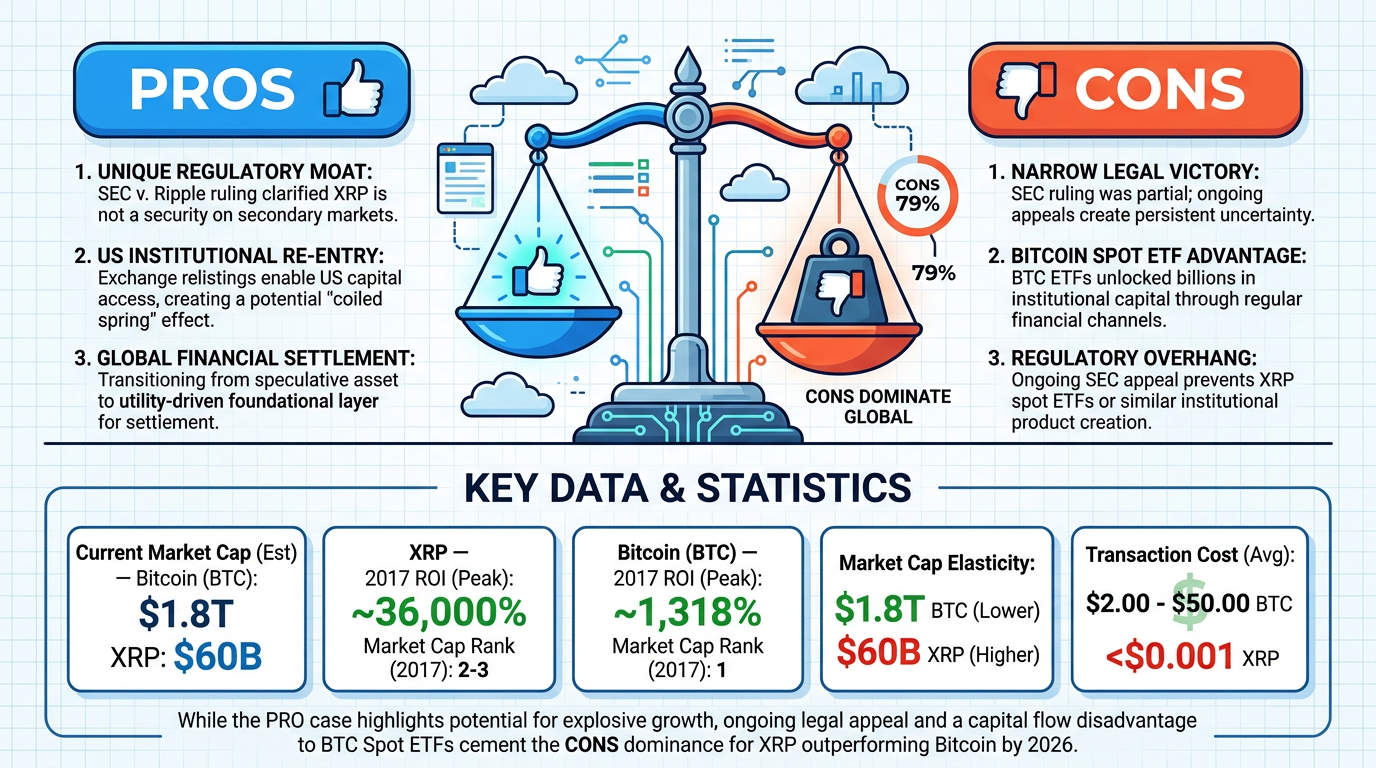
Tournament Final Verdict
Clerk Decision: CLAIM REFUTED (FALSE) — Certainty: 79%
Web Report: https://solsice.com/public/debates/xrp-will-outperform-bitcoin-by-2026-43ccccdb72e8
This section provides a brief overview of the key arguments. You do not need to read the full detailed report below.
✅ Key PRO arguments:
- ■XRP has a unique 'regulatory moat' from the SEC v. Ripple ruling, which clarified that XRP is not a security on secondary markets, creating a safe harbor for institutional investors that most other altcoins lack.
- ■XRP's expanded availability to US institutional investors following exchange relistings creates a 'coiled spring' effect that could drive superior percentage returns as institutional capital flows in.
- ■XRP is transitioning from a speculative asset to a foundational layer for global financial settlement, which could unlock significant utility-driven demand beyond Bitcoin's store-of-value narrative.
❌ Key ANTI arguments:
- ■The SEC v. Ripple ruling was narrow and partial, with the SEC appealing the decision and continuing to pursue claims regarding institutional sales, creating persistent legal uncertainty that undermines the 'regulatory clarity' narrative.
- ■Bitcoin's spot ETF approvals represent a product-level regulatory breakthrough that has unlocked tens of billions in institutional capital through established, regulated financial vehicles—a pathway XRP does not yet have.
- ■The SEC's ongoing appeal and continued litigation against Ripple create a 'regulatory overhang' that prevents the creation of XRP spot ETFs or similar institutional products, limiting capital inflows.
💭 Conclusion: The debate centered on whether XRP's regulatory clarity and institutional adoption potential could drive it to outperform Bitcoin by 2026. The PRO side argued that the SEC v. Ripple ruling created a unique regulatory moat and positioned XRP for significant institutional inflows. However, the ANTI side effectively countered that the ruling was narrow, subject to appeal, and has not yet translated into comparable institutional access products like Bitcoin's spot ETFs. Bitcoin's established dominance, massive ETF-driven institutional capital flows, and network effects present formidable barriers that XRP's partial regulatory clarity is unlikely to overcome. The judge found the FALSE position more persuasive with 79% confidence, reflecting that while XRP has some regulatory advantages, they are insufficient to predict outperformance against Bitcoin's entrenched position.
🔬 DeepResearch Result: FALSE ❌ (79% confidence)
Assertion: XRP will outperform Bitcoin by 2026
📊 Tournament: 0 voted TRUE, 1 voted FALSE (1 debates played, 3 models)
📊 Weighted scores: TRUE=0.00, FALSE=0.79
🏅 Judge Score Changes:
anthropic/claude-opus-4.6: +8
✅ PRO Arguments:
- ■XRP has a unique 'regulatory moat' from the SEC v. Ripple ruling, which clarified that XRP is not a security on secondary markets, creating a safe harbor for institutional investors that most other altcoins lack. [google/gemini-3-flash-preview]
- ■XRP's expanded availability to US institutional investors following exchange relistings creates a 'coiled spring' effect that could drive superior percentage returns as institutional capital flows in. [google/gemini-3-flash-preview]
- ■XRP is transitioning from a speculative asset to a foundational layer for global financial settlement, which could unlock significant utility-driven demand beyond Bitcoin's store-of-value narrative. [google/gemini-3-flash-preview]
- ■The legal certainty around XRP's secondary market status provides a competitive advantage over nearly every other high-market-cap altcoin, positioning it for disproportionate institutional adoption. [google/gemini-3-flash-preview]
❌ ANTI Arguments:
- ■The SEC v. Ripple ruling was narrow and partial, with the SEC appealing the decision and continuing to pursue claims regarding institutional sales, creating persistent legal uncertainty that undermines the 'regulatory clarity' narrative. [deepseek/deepseek-v3.2]
- ■Bitcoin's spot ETF approvals represent a product-level regulatory breakthrough that has unlocked tens of billions in institutional capital through established, regulated financial vehicles—a pathway XRP does not yet have. [deepseek/deepseek-v3.2]
- ■The SEC's ongoing appeal and continued litigation against Ripple create a 'regulatory overhang' that prevents the creation of XRP spot ETFs or similar institutional products, limiting capital inflows. [deepseek/deepseek-v3.2]
- ■Major financial institutions remain hesitant to engage with XRP while legal uncertainty persists, as evidenced by the absence of major bank adoption announcements and limited institutional participation. [deepseek/deepseek-v3.2]
- ■XRP's regulatory and utility advantages are insufficient to overcome Bitcoin's entrenched dominance, network effects, and the massive institutional infrastructure already built around Bitcoin. [deepseek/deepseek-v3.2]
💭 Reasoning: The debate centered on whether XRP's regulatory clarity and institutional adoption potential could drive it to outperform Bitcoin by 2026. The PRO side argued that the SEC v. Ripple ruling created a unique regulatory moat and positioned XRP for significant institutional inflows. However, the ANTI side effectively countered that the ruling was narrow, subject to appeal, and has not yet translated into comparable institutional access products like Bitcoin's spot ETFs. Bitcoin's established dominance, massive ETF-driven institutional capital flows, and network effects present formidable barriers that XRP's partial regulatory clarity is unlikely to overcome. The judge found the FALSE position more persuasive with 79% confidence, reflecting that while XRP has some regulatory advantages, they are insufficient to predict outperformance against Bitcoin's entrenched position.
📋 PRO Facts:
• The SEC v. Ripple court ruling determined that XRP sales on secondary exchanges do not constitute investment contracts.
• Multiple exchanges relisted XRP following the court ruling, expanding its availability to US investors.
• XRP is one of the few digital assets with a court-ruled status clarifying its non-security nature for secondary market sales.
📋 ANTI Facts:
• The SEC has appealed the Ripple ruling, maintaining ongoing legal uncertainty.
• Bitcoin spot ETFs have been approved and have attracted tens of billions in institutional capital.
• No XRP spot ETF has been approved in the United States as of the debate period.
• The court found that Ripple's direct institutional sales were unregistered securities offerings.
• Major banks have not announced significant XRP adoption despite the partial court ruling.
| Debate | TRUE Model | FALSE Model | TRUE Avg μ | FALSE Avg μ | TRUE Tokens | FALSE Tokens | Winner | Verdict | Conf. |
|---|---|---|---|---|---|---|---|---|---|
| #1 | google/gemini-3-flash-preview | deepseek/deepseek-v3.2 | 0.152 | 0.199 | 42 | 9 | FALSE | FALSE | 79% |
The following technical terms, abbreviations, and domain-specific concepts are referenced throughout this debate transcript. Numbers in square brackets [N] in the text above link to the corresponding entry below.
[1] altcoin — Any cryptocurrency other than Bitcoin. The term is short for 'alternative coin' and encompasses thousands of digital assets with varying use cases.
[2] altcoin season — A market phase in cryptocurrency cycles where alternative cryptocurrencies (altcoins) collectively outperform Bitcoin in terms of price gains, often driven by capital rotation out of Bitcoin.
[3] basis points — bps — A unit equal to 1/100th of a percentage point (0.01%), commonly used to express changes in interest rates and bond yields.
[4] bridge currency — A cryptocurrency used as an intermediary in cross-border transactions, converting one fiat currency to the bridge asset and then to the destination currency to facilitate faster and cheaper settlements.
[5] burn mechanism — A feature in certain blockchain protocols where a small amount of the native token is permanently destroyed with each transaction, creating deflationary pressure on the total supply over time.
[6] capital rotation — The movement of investment capital from one asset class or sector to another, typically driven by changing market conditions, valuations, or risk appetite.
[7] CBDCs — Central Bank Digital Currencies — Digital forms of a country's fiat currency issued and regulated by the central bank, designed to function as legal tender in digital form.
[8] CFTC — Commodity Futures Trading Commission — A U.S. federal regulatory agency that oversees the derivatives markets, including futures, swaps, and certain kinds of options, and has asserted jurisdiction over certain cryptocurrencies classified as commodities.
[9] coiled spring effect — A market metaphor describing a situation where an asset's price has been suppressed or consolidated for an extended period, building up potential energy for a sharp upward move once the constraining factor is removed.
[10] cross-border payments — Financial transactions where the payer and the recipient are based in different countries, typically involving currency conversion and multiple intermediary institutions.
[11] deflationary pressure — Economic or tokenomic forces that reduce the supply of an asset over time, which, assuming constant or growing demand, tends to push prices upward.
[12] ETF — Exchange-Traded Fund — An investment fund traded on stock exchanges that holds assets such as stocks, commodities, or cryptocurrencies, allowing investors to gain exposure without directly owning the underlying asset.
[13] ETP — Exchange-Traded Product — A broad category of financial instruments traded on exchanges that derive their value from an underlying asset or benchmark, including ETFs, ETNs, and similar structures.
[14] Goldilocks Zone — In this context, a market capitalization range where an asset is large enough to absorb significant institutional capital without excessive slippage, yet small enough relative to dominant assets to allow for outsized percentage returns.
[15] investment contract — A legal term under U.S. securities law (derived from the Howey Test) referring to a transaction where money is invested in a common enterprise with the expectation of profits derived from the efforts of others, which would classify the asset as a security.
[16] Law of Large Numbers — In a financial context, the principle that as a company or asset grows larger in market capitalization, it becomes increasingly difficult to sustain high percentage growth rates because the absolute capital required for each percentage point of gain increases proportionally.
[17] Liquidity-Inventory Paradox — A concept describing how scaling a real-time payment system requires market makers to hold increasingly large inventories of the bridge asset to prevent slippage, creating persistent demand that removes supply from circulation even though individual transactions are near-instantaneous.
[18] market cap — market capitalization — The total market value of a cryptocurrency or company, calculated by multiplying the current price per unit by the total number of units in circulation.
[19] market dominance — The percentage share of total cryptocurrency market capitalization held by a single asset, most commonly used to track Bitcoin's share relative to all other cryptocurrencies.
[20] ODL — On-Demand Liquidity — A Ripple payment service (now rebranded as Ripple Payments) that uses XRP as a bridge currency to facilitate real-time cross-border transactions without requiring pre-funded accounts in destination currencies.
[21] parabolic growth — A price pattern where an asset's value accelerates upward at an increasing rate, forming a curve that resembles a parabola on a chart, often seen in speculative market phases.
[22] programmatic sales — In the context of the SEC v. Ripple case, sales of XRP conducted through exchanges via automated trading algorithms where buyers did not know they were purchasing from Ripple, distinguished from direct institutional sales.
[23] regulatory moat — A competitive advantage derived from favorable or clear regulatory status that protects an asset or company from competitors who face greater legal uncertainty or compliance burdens.
[24] ROI — Return on Investment — A performance measure calculated as the percentage gain or loss on an investment relative to its initial cost, used to evaluate the efficiency or profitability of an investment.
[25] RWA — Real World Assets — Physical or traditional financial assets (such as real estate, bonds, or commodities) that are tokenized and represented on a blockchain, enabling fractional ownership and programmable trading.
[26] safe harbor — A legal provision that provides protection from liability or regulatory action under specified conditions, giving market participants confidence to engage in certain activities without fear of enforcement.
[27] SEC — Securities and Exchange Commission — The U.S. federal agency responsible for enforcing securities laws, regulating securities markets, and protecting investors from fraud and market manipulation.
[28] slippage — The difference between the expected price of a trade and the actual executed price, typically occurring in markets with insufficient liquidity or during periods of high volatility.
[29] spot ETF — Spot Exchange-Traded Fund — An ETF that directly holds the underlying asset (such as Bitcoin) rather than derivatives contracts, providing investors with more direct price exposure.
[30] Store of Value — An asset that maintains its purchasing power over time without significant depreciation, often applied to Bitcoin as a digital equivalent of gold.
[31] tokenization — The process of converting rights to a real-world or digital asset into a digital token on a blockchain, enabling fractional ownership, programmability, and easier transferability.
[32] TPS — Transactions Per Second — A metric measuring the throughput capacity of a blockchain network, indicating how many transactions the network can process each second.
[33] uncertainty premium — An additional discount applied to an asset's valuation by investors to compensate for unresolved risks, such as ongoing litigation or unclear regulatory status.
[34] XRP/BTC — A cryptocurrency trading pair that measures the value of XRP denominated in Bitcoin, used to track XRP's relative performance against Bitcoin independent of fiat currency movements.
[35] XRPL — XRP Ledger — The decentralized, open-source blockchain that natively supports the XRP cryptocurrency, designed for fast and low-cost payment settlement and increasingly used for tokenization and DeFi applications.
[36] yield curve inversion — A situation where short-term interest rates exceed long-term rates, often considered a leading indicator of economic recession.
The following financial data tables were referenced during the debate exchanges:
| Metric | Bitcoin (BTC) | XRP | Potential Multiplier |
|---|---|---|---|
| Current Market Cap (Est) | $1.8T | $60B | 30x Difference |
| Transaction Speed | 5-7 TPS | 1,500+ TPS | 214x Faster |
| Transaction Cost (Avg) | $2.00 - $50.00 | <$0.001 | 2000x+ Cheaper |
| Regulatory Status (US) | Commodity | Non-Security (Exchange Sales) | Equal/Superior |
Legend: Comparison of market capitalization and core network utility metrics between Bitcoin and XRP as of Q1 2024. TPS = Transactions Per Second.
</FinancialData>
| Asset | 2017 ROI (Peak) | Market Cap Rank (2017) | 2020-2021 ROI (Peak) |
|---|---|---|---|
| Bitcoin (BTC) | ~1,318% | 1 | ~300% |
| XRP | ~36,000% | 2-3 | ~800% |
Legend: Historical percentage ROI comparisons during major bull cycles. XRP has historically demonstrated the capacity for higher percentage gains despite its high market-cap ranking.
</FinancialData>
| Metric | Bitcoin | XRP | Implication |
|---|---|---|---|
| SEC Case Status | No active case | Ongoing appeal & litigation | Persistent legal risk |
| Institutional Product Access | 11+ spot ETFs approved | No spot ETFs approved | Capital flow disadvantage |
| Major Bank Adoption | Multiple custody services | Limited public partnerships | Adoption gap |
| Regulatory Classification | Commodity (CFTC/SEC consensus) | Mixed rulings (ongoing) | Uncertainty premium |
Legend: Comparative regulatory and institutional adoption landscape as of Q1 2024. XRP faces ongoing legal challenges while Bitcoin has established regulatory clarity and product access.
</FinancialData>
| Driver | Bitcoin (BTC) | XRP | Rational for Outperformance |
|---|---|---|---|
| Primary Use Case | Store of Value | Bridge Currency / RWA | Utility scaling > Speculative scaling |
| Regulatory Status | Commodity | Non-Security (Secondary) | Recovering from 3rd-year suppression |
| Network Velocity | 7 TPS | 1,500+ TPS | Higher throughput supports larger volume |
| Market Cap Elasticity | $1.8T (Lower) | $60B (Higher) | Lower cap requires less capital to 2x |
Legend: Comparative analysis of growth catalysts. XRP's lower market cap and high network throughput provide a higher ceiling for percentage ROI compared to Bitcoin's mature valuation.
</FinancialData>
| Regulatory Development Type | Bitcoin (2023-2024) | XRP (2023-2024) | Capital Flow Impact |
|---|---|---|---|
| Product Approval | 11+ Spot ETFs approved | No spot ETFs approved | $40B+ inflows vs $0 |
| Legal Status | Commodity (established) | Mixed rulings (ongoing appeal) | Certainty vs uncertainty |
| Institutional Access | Direct via regulated products | Indirect via exchanges only | Structural advantage |
Legend: Comparison of regulatory developments and their actual capital flow impacts. Bitcoin's regulatory wins translate directly to institutional investment vehicles while XRP's do notFinancialData>
Debate Transcripts
- ■
Ownership & Trade Secrets. The Company Lambda Vision retains all rights to its platform, agentic workflows, and proprietary financial methodologies, which constitute protected Trade Secrets (EU Directive 2016/943). Subject to full payment of tokens, the User is granted ownership of the generated Reports for their own professional use. Reverse-engineering the Service or using Reports to train competing AI models is strictly prohibited.
- ■
No Financial Advice. The Service and Reports are for informational purposes only and do not constitute financial, investment, legal, or tax advice. The Company is not a regulated financial advisor. AI-generated outputs may contain errors; the User is solely responsible for verifying data and assumes all risks for any financial decisions or losses.
- ■
Liability & Governing Law. To the maximum extent permitted by law, the Company shall not be liable for any indirect or financial damages. These Terms are governed by French law. Any disputes shall be subject to the exclusive jurisdiction of the Courts of Paris, France.