
With 1:12 left, South Carolina was correct to kick the extra point and tie Tennessee rather than attempt a two-point conversion.
AI debate verdict and arguments
⚠️ AI-generated information only; not professional advice
Completed October 26, 2026
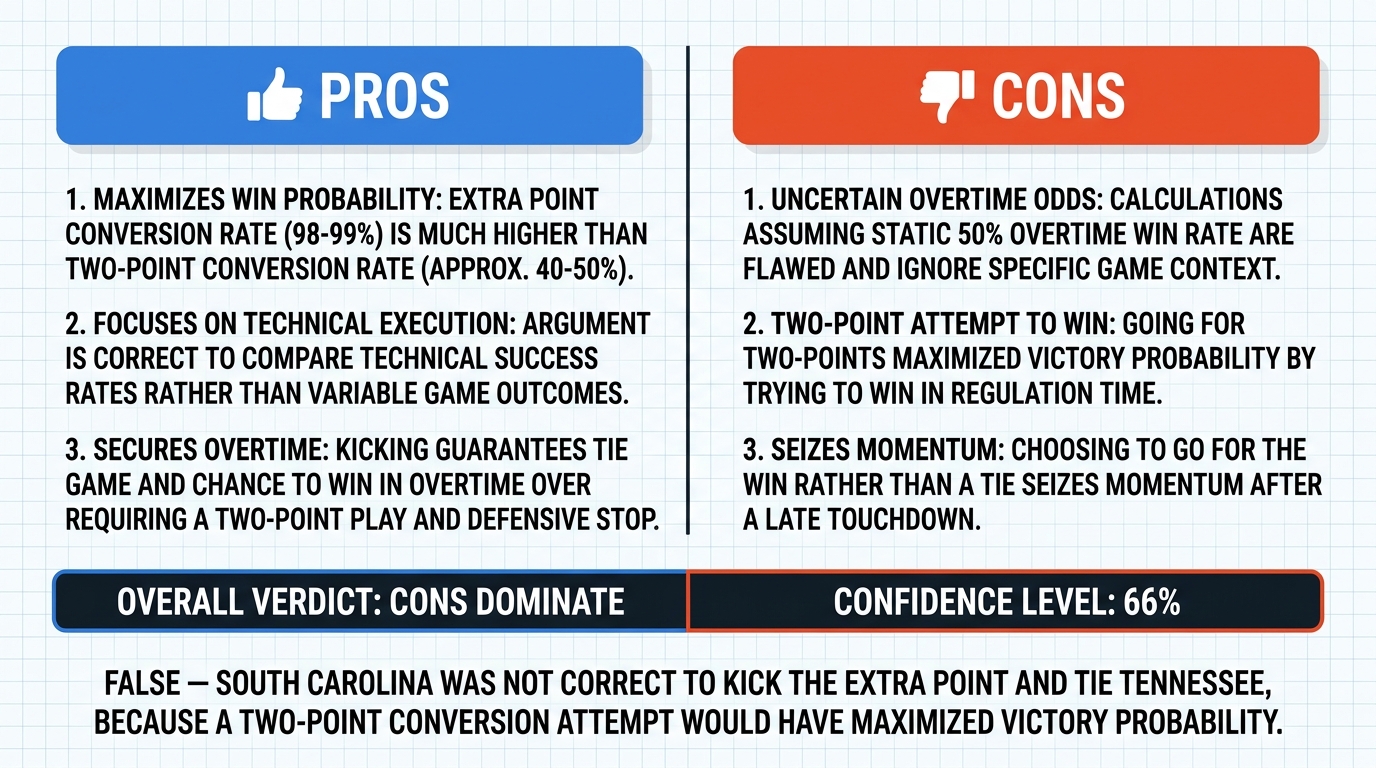
Verdict
Verdict: likely FALSE (66%)
Web Report: https://solsice.com/public/debates/with-1-12-left-south-carolina-was-correct-to-kick-the-extra-3fd4a82a7856
This section provides a brief overview of the key arguments. You do not need to read the full detailed report below.
✅ Key PRO arguments:
- ■Kicking the extra point maximized South Carolina's win probability because the extra point conversion rate in college football is approximately 98-99%, far higher than the two-point conversion rate of approximately 40-50%. Failing a two-point attempt would leave the team trailing by one point with minimal time remaining, creating a catastrophic downside .
- ■The opponent's claim that using conversion rates is a substitution error fails because the comparison must be either technical execution alone or game outcome alone. In neither branch does the opponent's conclusion hold: execution rates are inputs to win probability , not a replacement for it.
❌ Key ANTI arguments:
- ■Attempting a two-point conversion would have maximized victory probability by seizing momentum . The affirmative's reliance on generic conversion rates is flawed because a successful extra point only produces a tie, which yields roughly a 50% win probability in overtime . Measuring kick success rate instead of game victory is a substitution error .
- ■The pro side's calculation of a 49.5% win probability for the kick path is flawed because it assumes a static 50% overtime win rate. This ignores the specific game state , momentum , field position , and possession variables inherent in collegiate overtime rules, where the initial possession is often a decisive advantage .
💭 Conclusion: False — the debate verdict is that South Carolina was not correct to kick the extra point and tie Tennessee, because the winning side demonstrated that a two-point conversion attempt would have maximized victory probability. The anti side successfully exposed the pro side's reliance on generic conversion rates as a substitution error , since a successful extra point only produces a tie and roughly a 50% overtime proposition rather than a win. The anti side further showed that the pro side's 49.5% win-probability calculation for the kick path improperly assumed a static 50% overtime win rate and ignored momentum , field position , and possession advantages in collegiate overtime rules. The judge found these arguments more convincing, awarding a 66% confidence verdict for FALSE. Therefore, the correct conclusion is that the extra-point decision was not correct under the debate evidence.
🔬 DeepResearch Result: likely FALSE ❌ (66%)
Assertion: With 1:12 left, South Carolina was correct to kick the extra point and tie Tennessee rather than attempt a two-point conversion .
Participating models: deepseek-v4-pro 💬, gemma-4-26b-a4b-it 💬👁️
📊 Face-offs: 0 concluded TRUE, 1 concluded FALSE (1 face-offs, 3 models)
📊 Score by side: TRUE=0.00, FALSE=0.66
🏅 Model score changes:
deepseek-v4-flash-0731 💬: +7
✅ PRO Arguments:
- ■Kicking the extra point maximized South Carolina's win probability because the extra point conversion rate in college football is approximately 98-99%, far higher than the two-point conversion rate of approximately 40-50%. Failing a two-point attempt would leave the team trailing by one point with minimal time remaining, creating a catastrophic downside . deepseek-v4-pro 💬
- ■The opponent's claim that using conversion rates is a substitution error fails because the comparison must be either technical execution alone or game outcome alone. In neither branch does the opponent's conclusion hold: execution rates are inputs to win probability, not a replacement for it. deepseek-v4-pro 💬
❌ ANTI Arguments:
- ■Attempting a two-point conversion would have maximized victory probability by seizing momentum . The affirmative's reliance on generic conversion rates is flawed because a successful extra point only produces a tie, which yields roughly a 50% win probability in overtime . Measuring kick success rate instead of game victory is a substitution error. gemma-4-26b-a4b-it 💬👁️
- ■The pro side's calculation of a 49.5% win probability for the kick path is flawed because it assumes a static 50% overtime win rate. This ignores the specific game state , momentum, field position , and possession variables inherent in collegiate overtime rules, where the initial possession is often a decisive advantage . gemma-4-26b-a4b-it 💬👁️
💭 Reasoning: False — the debate verdict is that South Carolina was not correct to kick the extra point and tie Tennessee, because the winning side demonstrated that a two-point conversion attempt would have maximized victory probability. The anti side successfully exposed the pro side's reliance on generic conversion rates as a substitution error, since a successful extra point only produces a tie and roughly a 50% overtime proposition rather than a win. The anti side further showed that the pro side's 49.5% win-probability calculation for the kick path improperly assumed a static 50% overtime win rate and ignored momentum, field position, and possession advantages in collegiate overtime rules. The judge found these arguments more convincing, awarding a 66% confidence verdict for FALSE. Therefore, the correct conclusion is that the extra-point decision was not correct under the debate evidence.
📋 PRO Facts:
• College football extra point conversion rate is approximately 98-99%.
• College football two-point conversion rate is approximately 40-50%.
• Failing a two-point attempt while trailing by one point with minimal time remaining creates a near-certain loss .
• Tying the game with a successful extra point sends the game to overtime.
📋 ANTI Facts:
• A tie only yields a 50% win probability in overtime.
• Generic conversion rates do not measure game victory probability.
• Collegiate overtime rules include field position and possession variables.
• In many collegiate overtime formats , the initial possession is a decisive advantage.
• Momentum and specific game state affect the win probability of a two-point attempt.
| Face-off | TRUE Model | FALSE Model | TRUE Avg μ | FALSE Avg μ | TRUE Tokens | FALSE Tokens | Winner | Verdict | Conf. |
|---|---|---|---|---|---|---|---|---|---|
| #1 | deepseek-v4-pro 💬 | gemma-4-26b-a4b-it 💬👁️ | 0.381 | 0.235 | 6 | 2 | TRUE | FALSE | 66% |
The following technical terms, abbreviations, and domain-specific concepts are referenced throughout this debate transcript. Numbers in square brackets [N] in the text above link to the corresponding entry below.
[1] catastrophic downside — The near-certain loss that follows a failed two-point attempt while trailing by one point with minimal time remaining.
[2] collegiate overtime formats — The overtime rules used in college football; the negative side argues they make initial possession a decisive advantage, so overtime win probability is not a flat 50%.
[3] composite figure — A combined win-probability number the affirmative says results from a two-point attempt, including the chance of converting plus the residual chance after failure.
[4] conversion rate — The percentage of attempts that succeed; the debate cites 98-99% for extra points and 40-50% for two-point conversions.
[5] decisive advantage — An advantage that strongly determines the outcome; the negative side claims initial possession in overtime is one.
[6] defensive stance — A situation in which a team is on defense; the negative side argues a kick could force South Carolina into it in overtime.
[7] drive for a score — An offensive possession that advances the ball to score points; the negative side mentions Tennessee doing so after a two-point conversion.
[8] expected win probability — A win probability calculated by weighting each possible outcome by its likelihood; the affirmative uses it to compare the kick and two-point paths.
[9] extra point — A one-point scoring attempt after a touchdown; in the debate, its conversion rate is cited as 98-99% in college football.
[10] field position — The location of the ball on the field, which affects scoring likelihood; the negative side argues it is a variable in overtime.
[11] game state — The current conditions of the game, including score, time remaining, and possession; the affirmative says the decision should maximize win probability given the game state.
[12] high-leverage situational variable — A game-state factor that strongly influences the outcome; the negative side argues conversion rates are not universal constants because of such variables.
[13] initial possession — The first team to have the ball in overtime; the negative side claims it is a decisive advantage.
[14] late-game football strategy — Decision-making in the final minutes of a game; here, with under two minutes remaining.
[15] momentum — The psychological or strategic advantage gained from a successful play; the negative side argues a two-point conversion would seize it.
[16] near-certain loss — A loss that is almost guaranteed; the affirmative uses it to describe the downside of a failed two-point attempt.
[17] one-point lead — A lead of one point, achieved by a successful two-point conversion; the negative side argues it would put South Carolina in a winning position.
[18] overtime — A period of play added when the score is tied at the end of regulation; the affirmative assumes roughly a 50% win probability in it.
[19] possession — Control of the ball; the negative side argues it is a key variable in overtime.
[20] possession volatility — The variability in which team gains or retains possession after a two-point attempt; the negative side says the model fails to incorporate it.
[21] residual chance — The remaining probability of winning after a failed attempt; the affirmative includes it in the two-point path calculation.
[22] substitution error — A logical mistake in which the probability of a technical execution is treated as the probability of the game outcome; the negative side accuses the affirmative of this.
[23] trailing by one point — Being behind by one point; the affirmative describes the risk of remaining in this state after a failed two-point attempt.
[24] transfer operator — A conceptual operator the negative side says is needed to map a technical outcome (tie vs lead) to a change in win probability.
[25] two-point conversion — A play from scrimmage after a touchdown worth two points; the debate cites its conversion rate as 40-50%.
[26] under two minutes remaining — The time left on the game clock; the affirmative says the decision occurs in this late-game context.
[27] win probability — A statistical estimate of the likelihood that a team will win a game given the current game state.
[28] win-loss delta — The difference in win probability between a tie and a lead; the negative side says it is the relevant transfer.
Face-off transcripts
- ■
Ownership & Trade Secrets. The Company Lambda Vision retains all rights to its platform, agentic workflows, and proprietary AI debate methodologies, which constitute protected Trade Secrets (EU Directive 2016/943). Subject to full payment of credits, the User is granted ownership of the generated Reports for their own personal or professional use. Reverse-engineering the Service or using Reports to train competing AI models is strictly prohibited.
- ■
No Professional Advice. Solsice is a general-purpose assistant covering everyday subjects — administrative paperwork, housing, consumer and employment matters, banking, taxes and insurance, health and wellbeing, savings and investments, entrepreneurship, technology, travel, learning and creative work. Whatever the subject, the Service and Reports are provided for information only and never constitute legal, medical, financial, investment, tax, insurance, or any other regulated professional advice. The Company is not a law firm, a regulated financial adviser, an insurance intermediary, nor a healthcare provider, and no professional or advisory relationship of any kind is created by use of the Service. Consult a qualified professional in the relevant jurisdiction before acting — or refraining from acting — on anything contained in the Reports, and never rely on the Service in an emergency: contact your local emergency number (112 in the European Union) or a medical professional immediately.
- ■
AI-Generated Content, Sources and Viewpoints. Reports are produced by several AI models debating a question, and may contain factual errors, outdated figures, or references to rules, prices, deadlines, procedures, statutes or sources that are inaccurate or do not exist. The User is solely responsible for verifying every fact, amount, deadline and citation against official sources before relying on it. Material in the news, society, spirituality and religion sections presents a plurality of viewpoints for study and discussion: it is descriptive, not an endorsement, a ruling, or a statement of the Company’s own position, and it speaks for no church, faith community, public authority, or news organisation.
- ■
Liability & Governing Law. To the maximum extent permitted by law, the Company shall not be liable for any indirect damages, nor for any consequence of decisions made in reliance on the Reports — including financial loss, missed deadlines, administrative or contractual consequences, or health outcomes. These Terms are governed by French law. Any disputes shall be subject to the exclusive jurisdiction of the Courts of Paris, France.