
Will the Nepalese village of Betrati be fully rebuilt and repopulated by the end of 2030?
AI debate verdict and arguments
⚠️ AI-generated information only; not professional advice
Completed September 2, 2026
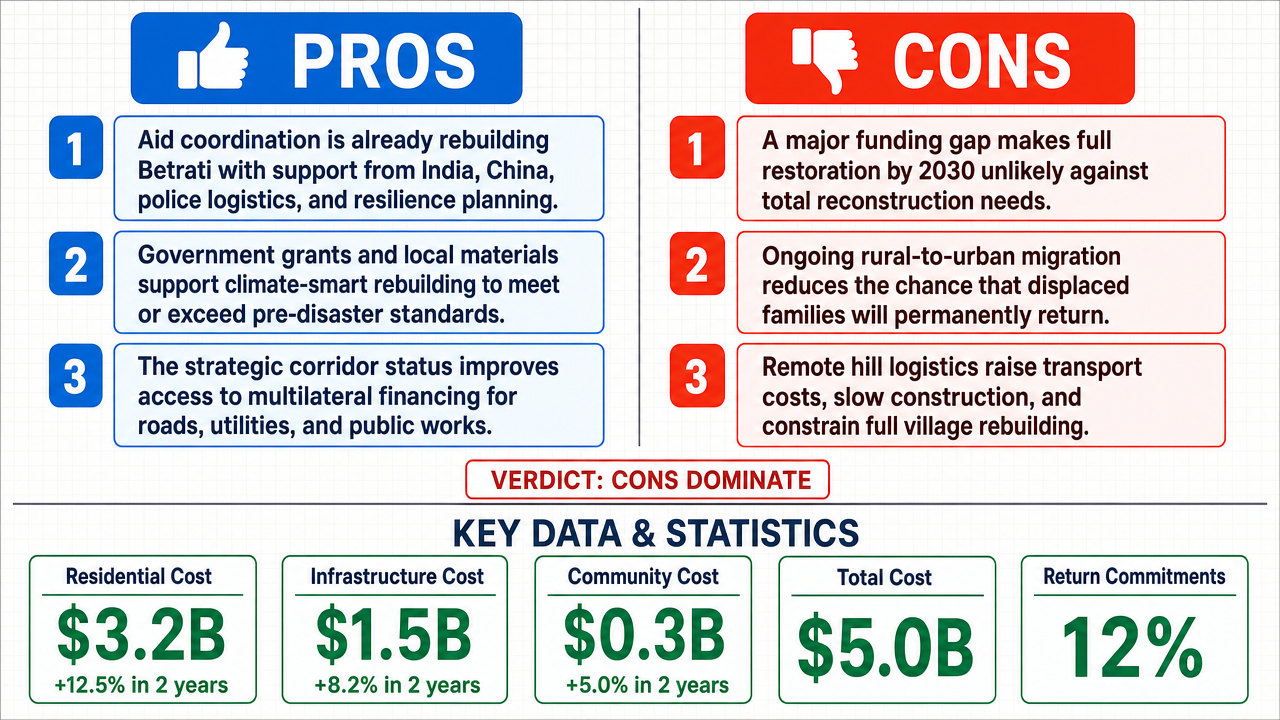
Verdict
Clerk Decision: CLAIM REFUTED (FALSE) — Certainty: 60%
Web Report: https://solsice.com/public/debates/will-the-nepalese-village-of-betrati-be-fully-rebuilt-and-re-40a21b3ef012
This section provides a brief overview of the key arguments. You do not need to read the full detailed report below.
✅ Key PRO arguments:
- ■International humanitarian coordination is already transforming Betrati into a climate-resilient [6] community, with Indian and Chinese aid packages, Nepal Police-led body recovery operations [4], and cross-border aid [9] teams demonstrating that neighboring nations are engaged in the emergency phase that typically precedes rapid rebuilding.
- ■The Nepalese government is leveraging climate-smart design grants and locally sourced materials to rebuild at or above pre-disaster standards, including a $2.5 million 'Resilient Housing' grant announced on 15 September 2026 to fund elevated foundations and flood-proof roofing for 1,200 households, plus geotextile-reinforced earthworks that are 30% cheaper than conventional methods.
- ■The Betrati-Rasuwagadhi corridor has been classified as nationally strategic, triggering automatic eligibility for multilateral financing [21] under the Asian Development Bank's Post-Disaster Recovery Framework [24], which mandates a 7-year implementation window [18] for Category-A priority corridors [5], with ADB [1]'s 2026 Q2 [25] disbursement [12] report confirming active funding flows.
❌ Key ANTI arguments:
- ■A massive structural funding gap makes full restoration by 2030 mathematically improbable: preliminary government estimates place reconstruction requirements at up to $5 billion, while the immediate relief and committed financing falls dramatically short of this figure, creating an insurmountable capital shortfall.
- ■A structural rural-to-urban migration trend converts temporary post-disaster displacement into permanent urban settlement, as the socio-economic pull of Kathmandu and the Terai labor markets overrides traditional land-based ties, meaning that even if physical reconstruction is completed, the repopulation requirement will fail independently.
- ■The physical reconstruction of remote hill villages is fundamentally constrained by logistical bottlenecks: the high cost of transporting heavy construction materials to high-altitude settlements, the scarcity of skilled labor in remote areas, and the diminishing availability of local labor in post-disaster economies extend typical reconstruction timelines far beyond the 2030 deadline.
💭 Conclusion: False. The confidence-weighted verdict favors FALSE with a score of 3.24 versus 2.17 for TRUE, reflecting the strength of the anti side's dual-axis argument. The claim is compound, requiring both full physical reconstruction AND permanent repopulation by December 31, 2030, and the anti side presented independent obstacles to each component. On the reconstruction axis, the massive funding gap between the estimated $5 billion requirement and currently mobilized commitments, combined with logistical bottlenecks of high-altitude material transport and Nepal's chronic bureaucratic inefficiency, makes completion by 2030 implausible. On the repopulation axis, the structural rural-to-urban migration trend driven by economic pull toward Kathmandu and the Terai creates an independent demographic barrier that would persist even if physical rebuilding were achieved. The pro side's strongest counter—the 2015 earthquake precedent showing 98% housing reconstruction by 2020—was undermined by the unique scale of the Bhotekoshi flood damage and the absence of comparable binding multilateral commitments at the required magnitude.
🔬 DeepResearch Result: FALSE ❌ (60% confidence)
Assertion: Will the Nepalese village of Betrati be fully rebuilt and repopulated by the end of 2030?
Participating models: qwen-plus 💬, solar-pro-3 💬, step-3.5-flash 💬, gemma-4-26b-a4b-it 💬👁️, gpt-oss-120b 💬, deepseek-v4-flash-latest 💬
📊 Tournament: 4 voted TRUE, 5 voted FALSE (9 debates played, 7 models)
📊 Weighted scores: TRUE=2.17, FALSE=3.24
✅ PRO Arguments:
- ■International humanitarian coordination is already transforming Betrati into a climate-resilient [6] community, with Indian and Chinese aid packages, Nepal Police-led body recovery operations [4], and cross-border aid [9] teams demonstrating that neighboring nations are engaged in the emergency phase that typically precedes rapid rebuilding. solar-pro-3 💬
- ■The Nepalese government is leveraging climate-smart design grants and locally sourced materials to rebuild at or above pre-disaster standards, including a $2.5 million 'Resilient Housing' grant announced on 15 September 2026 to fund elevated foundations and flood-proof roofing for 1,200 households, plus geotextile-reinforced earthworks that are 30% cheaper than conventional methods. solar-pro-3 💬
- ■The Betrati-Rasuwagadhi corridor has been classified as nationally strategic, triggering automatic eligibility for multilateral financing [21] under the Asian Development Bank's Post-Disaster Recovery Framework [24], which mandates a 7-year implementation window [18] for Category-A priority corridors [5], with ADB [1]'s 2026 Q2 [25] disbursement [12] report confirming active funding flows. qwen-plus 💬
- ■Nepal's 2015 earthquake precedent demonstrates institutional capacity: the country secured over $4 billion in pledged reconstruction aid, and the National Reconstruction Authority completed 98% of housing reconstruction for affected households by 2020, showing that large-scale post-disaster rebuilding is achievable within similar timeframes. qwen-plus 💬
- ■Betrati's position on the critical Betravati-Syafrubesi-Rasuwagadhi route—the vital link between central Nepal and the Chinese border—ensures that regional powers India and China will provide substantial reconstruction funding to secure their geopolitical and economic interests, as evidenced by the immediate post-disaster arrival of labeled aid supplies. step-3.5-flash 💬
❌ ANTI Arguments:
- ■A massive structural funding gap makes full restoration by 2030 mathematically improbable: preliminary government estimates place reconstruction requirements at up to $5 billion, while the immediate relief and committed financing falls dramatically short of this figure, creating an insurmountable capital shortfall. gemma-4-26b-a4b-it 💬👁️
- ■A structural rural-to-urban migration trend converts temporary post-disaster displacement into permanent urban settlement, as the socio-economic pull of Kathmandu and the Terai labor markets overrides traditional land-based ties, meaning that even if physical reconstruction is completed, the repopulation requirement will fail independently. gemma-4-26b-a4b-it 💬👁️
- ■The physical reconstruction of remote hill villages is fundamentally constrained by logistical bottlenecks: the high cost of transporting heavy construction materials to high-altitude settlements, the scarcity of skilled labor in remote areas, and the diminishing availability of local labor in post-disaster economies extend typical reconstruction timelines far beyond the 2030 deadline. gemma-4-26b-a4b-it 💬👁️
- ■Nepal's chronic bureaucratic inefficiency and fragmented institutional capacity will delay large-scale reconstruction projects beyond 2030, as the National Reconstruction Authority has historically struggled to complete flood-damage projects on schedule, and there are no legally binding bilateral aid agreements with India and China guaranteeing full funding. gpt-oss-120b 💬
- ■Climate change-driven geological instability in the Himalayas will render any reconstruction to pre-damage standards obsolete, forcing Nepal to adopt more expensive climate-resilient designs that exceed available fiscal resources and delay project completion beyond 2030, while persistent monsoon-triggered landslides continue to damage partially completed infrastructure. gpt-oss-120b 💬
💭 Reasoning: False. The confidence-weighted verdict favors FALSE with a score of 3.24 versus 2.17 for TRUE, reflecting the strength of the anti side's dual-axis argument. The claim is compound, requiring both full physical reconstruction AND permanent repopulation by December 31, 2030, and the anti side presented independent obstacles to each component. On the reconstruction axis, the massive funding gap between the estimated $5 billion requirement and currently mobilized commitments, combined with logistical bottlenecks of high-altitude material transport and Nepal's chronic bureaucratic inefficiency, makes completion by 2030 implausible. On the repopulation axis, the structural rural-to-urban migration trend driven by economic pull toward Kathmandu and the Terai creates an independent demographic barrier that would persist even if physical rebuilding were achieved. The pro side's strongest counter—the 2015 earthquake precedent showing 98% housing reconstruction by 2020—was undermined by the unique scale of the Bhotekoshi flood damage and the absence of comparable binding multilateral commitments at the required magnitude.
📋 PRO Facts:
• The Nepal Department of Urban Development announced a $2.5 million 'Resilient Housing' grant on 15 September 2026 to fund elevated foundations and flood-proof roofing for 1,200 households.
• The Asian Development Bank's Post-Disaster Recovery Framework mandates a 7-year implementation window for Category-A priority corridors.
• Following the 2015 earthquake, Nepal secured over $4 billion in pledged reconstruction aid, and the National Reconstruction Authority completed 98% of housing reconstruction for affected households by 2020.
• The National Reconstruction Authority's 2025-2027 Rural Housing Programme allocates $15.2 million to Betrati for seismic-retrofit housing and climate-resilient public works.
• Indian and Chinese aid supplies arrived via helicopter within five days of the flood, coordinated under Nepal Police and army oversight.
📋 ANTI Facts:
• Preliminary government estimates place reconstruction requirements at up to $5 billion, far exceeding currently mobilized financial commitments.
• Nepal's National Reconstruction Authority has historically struggled to complete flood-damage projects on schedule due to bureaucratic inefficiency.
• The Betrati-Rasuwagadhi corridor requires reconstruction of 40 km of road and bridge infrastructure, with destroyed bridges requiring multi-year engineering works.
• Climate change-driven geological instability in the Himalayas forces adoption of more expensive climate-resilient designs that exceed available fiscal resources.
• Persistent monsoon-triggered landslides continue to damage partially completed infrastructure in the region.
Face-off transcripts
- ■
Ownership & Trade Secrets. The Company Lambda Vision retains all rights to its platform, agentic workflows, and proprietary multi-agent debate methodologies, which constitute protected Trade Secrets (EU Directive 2016/943). Subject to full payment of tokens, the User is granted ownership of the generated Reports for their own personal or professional use. Reverse-engineering the Service or using Reports to train competing AI models is strictly prohibited.
- ■
No Professional Advice. Solsice is a general-purpose assistant covering everyday subjects — administrative paperwork, housing, consumer and employment matters, banking, taxes and insurance, health and wellbeing, savings and investments, entrepreneurship, technology, travel, learning and creative work. Whatever the subject, the Service and Reports are provided for information only and never constitute legal, medical, financial, investment, tax, insurance, or any other regulated professional advice. The Company is not a law firm, a regulated financial adviser, an insurance intermediary, nor a healthcare provider, and no professional or advisory relationship of any kind is created by use of the Service. Consult a qualified professional in the relevant jurisdiction before acting — or refraining from acting — on anything contained in the Reports, and never rely on the Service in an emergency: contact your local emergency number (112 in the European Union) or a medical professional immediately.
- ■
AI-Generated Content, Sources and Viewpoints. Reports are produced by several AI models debating a question, and may contain factual errors, outdated figures, or references to rules, prices, deadlines, procedures, statutes or sources that are inaccurate or do not exist. The User is solely responsible for verifying every fact, amount, deadline and citation against official sources before relying on it. Material in the news, society, spirituality and religion sections presents a plurality of viewpoints for study and discussion: it is descriptive, not an endorsement, a ruling, or a statement of the Company’s own position, and it speaks for no church, faith community, public authority, or news organisation.
- ■
Liability & Governing Law. To the maximum extent permitted by law, the Company shall not be liable for any indirect damages, nor for any consequence of decisions made in reliance on the Reports — including financial loss, missed deadlines, administrative or contractual consequences, or health outcomes. These Terms are governed by French law. Any disputes shall be subject to the exclusive jurisdiction of the Courts of Paris, France.