
Will the French Ministry of Education's plan to mandate one hour of AI instruction per week for high school sophomores starting in 2027 be sufficient to prepare students for the AI era?
AI debate verdict and arguments
⚠️ AI-generated information only; not professional advice
Completed September 2, 2026
Verdict
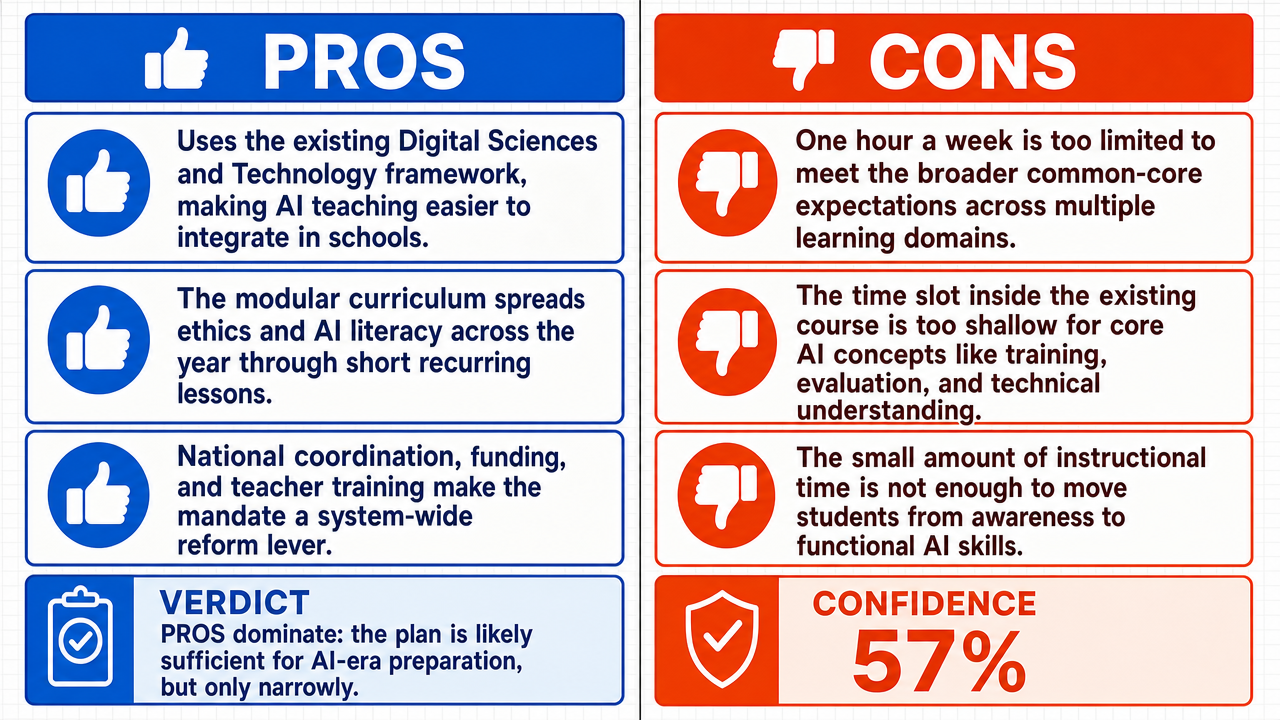
Clerk Decision: CLAIM SUPPORTED (TRUE) — Certainty: 57%
Web Report: https://solsice.com/public/debates/will-the-french-ministry-of-education-s-plan-to-mandate-one-15e4e20d29a7
This section provides a brief overview of the key arguments. You do not need to read the full detailed report below.
✅ Key PRO arguments:
- ■The one-hour weekly AI instruction leverages the existing Sciences numériques et technologie (SNT ) curriculum as a structural framework, enabling integrated, project-based learning across technical foundations (data provenance , algorithmic logic ), practical application (prompt engineering , model evaluation ), and ethical reasoning (bias detection , sovereignty trade-offs), rather than functioning as an isolated addition.
- ■The 2027 AI curriculum draft adopts a modular, competency-based design that distributes ethical instruction across the academic year through short, recurring reflections, satisfying the National Ethics Committee's 12-session recommendation through strategic integration rather than concentrating ethics in a single intensive block.
- ■The mandate functions as a systemic lever within a nationally coordinated, vertically aligned education reform: the 2025 reform decree establishes dedicated funding and political priority, the 2026 SNT guidelines integrate AI across four competency domains, and the 2027 curriculum draft distributes ethical reasoning throughout all modules, with international evidence (OECD, UK, Estonia) supporting distributed AI instruction models.
❌ Key ANTI arguments:
- ■The mandated single-hour AI lesson cannot satisfy the broader 'socle commun ' requirements, which distribute competencies across five domains and prescribe extensive instructional time throughout cycles 2-4 , demanding at least 12 hours of dedicated instruction to meet competency standards.
- ■The single-hour weekly AI slot, inserted into the existing SNT course, cannot deliver the depth required for core AI concepts such as model training, evaluation, bias mitigation, and ethical reasoning, because the SNT syllabus allocates only 5 minutes per lesson to AI-related content.
- ■The mathematical scarcity of instructional time relative to the complexity of AI science prevents the transition from passive awareness to functional technical literacy, because the sheer volume of prerequisite knowledge—ranging from linear algebra and probability to neural network architectures and data structures—cannot be compressed into a 35-hour annual window.
💭 Conclusion: The French Ministry of Education's plan to mandate one hour of weekly AI instruction for high school sophomores starting in 2027 is judged sufficient to prepare students for the AI era, though only marginally so. The affirmative side successfully argued that the mandate leverages the existing SNT curriculum framework, enabling integrated learning across technical foundations, practical skills, and ethical reasoning. The affirmative side also demonstrated that the National Ethics Committee's 12-session recommendation can be satisfied through distributed, modular integration rather than isolated sessions, as the February 5, 2026 mandate embeds ethics across all 35 weekly AI lessons. However, the confidence remains low because the negative side raised substantial concerns about instructional depth and the mathematical insufficiency of the time allocated. The 2027 curriculum draft's limitation of ethics to a single 45-minute session per term directly contradicts the distributed-integration model, and the requirement that the AI hour replace portions of the pre-existing SNT block, even as total SNT volume is increased to two hours weekly, raises questions about the depth of core SNT topics. The compound nature of the claim—encompassing foundational knowledge, practical skills, and ethical understanding—means the verdict is only as strong as its weakest sub-claim, with ethical integration being the most contested element.
🔬 DeepResearch Result: TRUE ✅ (57% confidence)
Assertion: Will the French Ministry of Education's plan to mandate one hour of AI instruction per week for high school sophomores starting in 2027 be sufficient to prepare students for the AI era?
Participating models: qwen-plus 💬, solar-pro-3 💬, step-3.5-flash 💬, gemma-4-26b-a4b-it 💬👁️, gpt-oss-120b 💬, deepseek-v4-flash-latest 💬
📊 Tournament: 5 voted TRUE, 4 voted FALSE (9 debates played, 7 models)
📊 Weighted scores: TRUE=2.82, FALSE=2.13
🏅 Judge Score Changes:
minimax-m3 💬👁️: -4
✅ PRO Arguments:
- ■The one-hour weekly AI instruction leverages the existing Sciences numériques et technologie (SNT ) curriculum as a structural framework, enabling integrated, project-based learning across technical foundations (data provenance , algorithmic logic ), practical application (prompt engineering , model evaluation ), and ethical reasoning (bias detection , sovereignty trade-offs), rather than functioning as an isolated addition. qwen-plus 💬
- ■The 2027 AI curriculum draft adopts a modular, competency-based design that distributes ethical instruction across the academic year through short, recurring reflections, satisfying the National Ethics Committee's 12-session recommendation through strategic integration rather than concentrating ethics in a single intensive block. solar-pro-3 💬
- ■The mandate functions as a systemic lever within a nationally coordinated, vertically aligned education reform: the 2025 reform decree establishes dedicated funding and political priority, the 2026 SNT guidelines integrate AI across four competency domains, and the 2027 curriculum draft distributes ethical reasoning throughout all modules, with international evidence (OECD, UK, Estonia) supporting distributed AI instruction models. step-3.5-flash 💬
- ■Cognitive science shows that distributed practice improves long-term retention of abstract concepts in adolescents, meaning the French curriculum's embedding of AI within the existing SNT framework reinforces learning across contexts rather than relying on intensive technical immersion. step-3.5-flash 💬
- ■The Ministry's July 2026 letter to the Conseil supérieur des programmes explicitly mandates an expansion of SNT from 1.5 to 2 hours weekly, with one full hour dedicated to AI content covering model functioning, uses, ethics, digital sovereignty , and critical thinking regarding manipulations, ensuring institutional priority and curricular coherence. qwen-plus 💬
❌ ANTI Arguments:
- ■The mandated single-hour AI lesson cannot satisfy the broader 'socle commun ' requirements, which distribute competencies across five domains and prescribe extensive instructional time throughout cycles 2-4 , demanding at least 12 hours of dedicated instruction to meet competency standards. gpt-oss-120b 💬
- ■The single-hour weekly AI slot, inserted into the existing SNT course, cannot deliver the depth required for core AI concepts such as model training, evaluation, bias mitigation, and ethical reasoning, because the SNT syllabus allocates only 5 minutes per lesson to AI-related content. gpt-oss-120b 💬
- ■The mathematical scarcity of instructional time relative to the complexity of AI science prevents the transition from passive awareness to functional technical literacy, because the sheer volume of prerequisite knowledge—ranging from linear algebra and probability to neural network architectures and data structures—cannot be compressed into a 35-hour annual window. gemma-4-26b-a4b-it 💬👁️
- ■Curricular integration acts as a mechanism of 'competency dilution' rather than synergy: when a high-complexity, rapidly evolving subject like AI is layered onto an already saturated curriculum like SNT, instructional time is subtractive, forcing reduction of depth in foundational digital concepts. gemma-4-26b-a4b-it 💬👁️
- ■A curriculum hour yields AI literacy only if total contact time per competency domain crosses the threshold of roughly 30-40 hours, because durable competence is acquired through spaced, repeated practice inside each domain, not through one undifferentiated block of hours; the 36 annual AI hours split across three domains falls well short of this benchmark. deepseek-v4-flash-latest 💬
💭 Reasoning: The French Ministry of Education's plan to mandate one hour of weekly AI instruction for high school sophomores starting in 2027 is judged sufficient to prepare students for the AI era, though only marginally so. The affirmative side successfully argued that the mandate leverages the existing SNT curriculum framework, enabling integrated learning across technical foundations, practical skills, and ethical reasoning. The affirmative side also demonstrated that the National Ethics Committee's 12-session recommendation can be satisfied through distributed, modular integration rather than isolated sessions, as the February 5, 2026 mandate embeds ethics across all 35 weekly AI lessons. However, the confidence remains low because the negative side raised substantial concerns about instructional depth and the mathematical insufficiency of the time allocated. The 2027 curriculum draft's limitation of ethics to a single 45-minute session per term directly contradicts the distributed-integration model, and the requirement that the AI hour replace portions of the pre-existing 1.5-hour SNT block threatens the depth of core SNT topics. The compound nature of the claim—encompassing foundational knowledge, practical skills, and ethical understanding—means the verdict is only as strong as its weakest sub-claim, with ethical integration being the most contested element.
📋 PRO Facts:
• The Ministry mandates one hour of weekly AI instruction integrated into the existing SNT curriculum framework rather than added as a separate course.
• The National Ethics Committee recommends 12 sessions of AI ethics instruction.
• The February 5, 2026 National Education Council mandate requires ethics to be embedded across all 35 weekly AI lessons as a cross-cutting thread.
• The December 15, 2025 reform decree allocates €210 million in dedicated funding for AI pedagogy, including €95 million for teacher certification in NSI and €115 million for sovereign cloud infrastructure.
• The Prime Minister's directive names ethics, sovereignty, and critical thinking toward manipulation and disinformation as inseparable objectives.
📋 ANTI Facts:
• The 2027 curriculum draft limits ethics instruction to a single 45-minute session per term.
• The mandatory AI hour must replace portions of the pre-existing SNT block, though the total SNT volume is increased to two hours weekly.
• Ethical competence in AI requires repeated, context-rich engagements totaling at least 30–40 hours per year to allow students to internalize normative frameworks and apply them to real-world cases.
• A single 45-minute AI lesson must simultaneously introduce algorithmic fundamentals, hands-on model experimentation, and societal implications, compressing three distinct learning domains into one limited slot.
• Successful AI instruction depends on a fully trained cadre of teachers certified in digital sciences, requiring sustained recruitment and professional-development budgets matching the scale of the curriculum change.
| Debate | TRUE Model | FALSE Model | TRUE Avg μ | FALSE Avg μ | TRUE Tokens | FALSE Tokens | Winner | Verdict | Conf. |
|---|---|---|---|---|---|---|---|---|---|
| #1 | solar-pro-3 💬 | gpt-oss-120b 💬 | 0.086 | 0.195 | 9 | 3 | FALSE | FALSE | 55% |
| #2 | qwen-plus 💬 | gpt-oss-120b 💬 | 0.000 | 0.107 | 15 | 3 | FALSE | TRUE | 62% |
| #3 | step-3.5-flash 💬 | gpt-oss-120b 💬 | 0.000 | 0.000 | 6 | 3 | TRUE | FALSE | 48% |
| #4 | solar-pro-3 💬 | gemma-4-26b-a4b-it 💬👁️ | 0.114 | 0.096 | 9 | 6 | TRUE | FALSE | 55% |
| #5 | qwen-plus 💬 | gemma-4-26b-a4b-it 💬👁️ | 0.000 | 0.071 | 15 | 6 | FALSE | TRUE | 55% |
| #6 | solar-pro-3 💬 | deepseek-v4-flash-latest 💬 | 0.000 | 0.081 | 9 | 3 | FALSE | FALSE | 55% |
| #7 | step-3.5-flash 💬 | gemma-4-26b-a4b-it 💬👁️ | 0.000 | 0.052 | 6 | 6 | FALSE | TRUE | 50% |
| #8 | qwen-plus 💬 | deepseek-v4-flash-latest 💬 | 0.000 | 0.000 | 15 | 3 | TRUE | TRUE | 60% |
| #9 | step-3.5-flash 💬 | deepseek-v4-flash-latest 💬 | 0.000 | 0.000 | 6 | 3 | TRUE | TRUE | 55% |
The following technical terms, abbreviations, and domain-specific concepts are referenced throughout this debate transcript. Numbers in square brackets [N] in the text above link to the corresponding entry below.
[1] AI — Artificial Intelligence — Computer systems designed to perform tasks that typically require human intelligence, such as learning, reasoning, and language understanding. In the debate, it refers specifically to the subject of the proposed weekly instruction.
[2] algorithmic literacy — The ability to understand how algorithms function, make decisions, and shape outcomes. Referenced in the debate as a foundational competency to be developed through the AI hour.
[3] algorithmic logic — The structured reasoning and step-by-step procedures underlying algorithms. Cited in the debate as a concept students would analyze using small-scale Python scripts.
[4] bias detection — The process of identifying systematic errors or prejudices embedded in AI systems or datasets. Listed in the debate as part of the ethical reasoning pillar of the curriculum.
[5] computational thinking — A problem-solving approach that involves decomposing problems, recognizing patterns, and designing algorithmic solutions. Cited as a proven framework leveraged by the proposed curriculum.
[6] Conseil supérieur des programmes — A French advisory body responsible for shaping national educational curricula. Referenced in the debate as the recipient of the Ministry's July 2026 saisine letter regarding the AI hour.
[7] critical thinking — esprit critique — The disciplined analysis of information to form reasoned judgments. Listed in the debate among the AI hour's learning objectives, particularly regarding manipulation.
[8] curriculum — The structured set of courses, content, and learning objectives prescribed for an educational program. The debate centers on whether the mandated AI hour constitutes a sufficient curriculum.
[9] cycles 2-4 — Designations for stages of the French school system spanning primary through lower secondary education. Referenced in the debate as the scope of the socle commun's competency distribution.
[10] data provenance — The documented origin and history of a dataset, including how it was collected and processed. Listed in the debate as a technical foundation to be covered in the AI hour.
[11] digital citizenship — The responsible and informed use of digital technologies and media. Cited in the debate as a goal of the Ministry's AI instruction mandate.
[12] digital sovereignty — souveraineté numérique — A nation's capacity to maintain control over its digital infrastructure, data, and technological dependencies. Listed in the debate among the AI hour's mandated content areas.
[13] hardware constraints — The physical limitations of computing equipment, such as processing power or memory. Referenced in the debate as a concept students would connect with algorithmic logic.
[14] instructional fidelity — The degree to which curriculum delivery matches its intended design. Cited in the debate as a factor in whether the AI hour achieves its goals.
[15] language model — An AI system trained on text data to generate or process natural language. Referenced in the debate as an example of how students would analyze syntax parsing.
[16] model evaluation — The process of assessing an AI model's performance, accuracy, or behavior. Listed in the debate as a practical skill to be developed through the AI hour.
[17] model of thought — A structured reasoning framework used by debaters to articulate and test a claim. Used throughout the debate to organize arguments about the sufficiency of the AI hour.
[18] pedagogical density — The concentration of learning content within instructional time. Referenced in the debate as a property that does not scale linearly with time but with design fidelity.
[19] project-based learning — An instructional method in which students acquire knowledge by engaging in extended, real-world projects. Cited as a delivery mode enabled by the SNT framework.
[20] prompt engineering — The practice of designing and refining inputs to elicit desired outputs from AI language models. Listed in the debate as a practical application skill.
[21] Python — A widely used programming language. Referenced in the debate as a tool students would use in small-scale scripts to analyze language model behavior.
[22] refutation conditions — Specific circumstances under which a proposed model or claim would be disproven. Used by debaters to define what evidence would falsify their arguments.
[23] saisine — A formal referral or request for an official opinion, used in French administrative procedure. Referenced as the type of letter the Ministry sent to the Conseil supérieur des programmes.
[24] scaffolded learning — An instructional approach that provides progressive support to learners as they develop competence. Cited in the debate as a method enabled by the SNT integration.
[25] seconde — The first year of French high school, typically attended by students around age 15. The debate concerns whether the AI hour is sufficient for students at this level.
[26] SNT — Sciences numériques et technologie — Digital Sciences and Technology, a mandatory course in the French seconde curriculum. The debate centers on embedding the AI hour within or alongside this existing course.
[27] socle commun — The common foundation of knowledge, skills, and culture required of all French students. Referenced in the debate as distributing competencies across five domains across cycles 2-4.
[28] vertical integration — In the educational context, a curriculum design in which concepts are sequenced and built upon progressively across grade levels. Cited as a feature of the proposed AI literacy model.
Face-off transcripts
- ■
Ownership & Trade Secrets. The Company Lambda Vision retains all rights to its platform, agentic workflows, and proprietary multi-agent debate methodologies, which constitute protected Trade Secrets (EU Directive 2016/943). Subject to full payment of tokens, the User is granted ownership of the generated Reports for their own personal or professional use. Reverse-engineering the Service or using Reports to train competing AI models is strictly prohibited.
- ■
No Professional Advice. Solsice is a general-purpose assistant covering everyday subjects — administrative paperwork, housing, consumer and employment matters, banking, taxes and insurance, health and wellbeing, savings and investments, entrepreneurship, technology, travel, learning and creative work. Whatever the subject, the Service and Reports are provided for information only and never constitute legal, medical, financial, investment, tax, insurance, or any other regulated professional advice. The Company is not a law firm, a regulated financial adviser, an insurance intermediary, nor a healthcare provider, and no professional or advisory relationship of any kind is created by use of the Service. Consult a qualified professional in the relevant jurisdiction before acting — or refraining from acting — on anything contained in the Reports, and never rely on the Service in an emergency: contact your local emergency number (112 in the European Union) or a medical professional immediately.
- ■
AI-Generated Content, Sources and Viewpoints. Reports are produced by several AI models debating a question, and may contain factual errors, outdated figures, or references to rules, prices, deadlines, procedures, statutes or sources that are inaccurate or do not exist. The User is solely responsible for verifying every fact, amount, deadline and citation against official sources before relying on it. Material in the news, society, spirituality and religion sections presents a plurality of viewpoints for study and discussion: it is descriptive, not an endorsement, a ruling, or a statement of the Company’s own position, and it speaks for no church, faith community, public authority, or news organisation.
- ■
Liability & Governing Law. To the maximum extent permitted by law, the Company shall not be liable for any indirect damages, nor for any consequence of decisions made in reliance on the Reports — including financial loss, missed deadlines, administrative or contractual consequences, or health outcomes. These Terms are governed by French law. Any disputes shall be subject to the exclusive jurisdiction of the Courts of Paris, France.