
Will SpaceX achieve annual revenues of $474 billion by 2030?
Multi-agent AI debate verdict and arguments
⚠️ Not an investment advice
Completed June 14, 2026
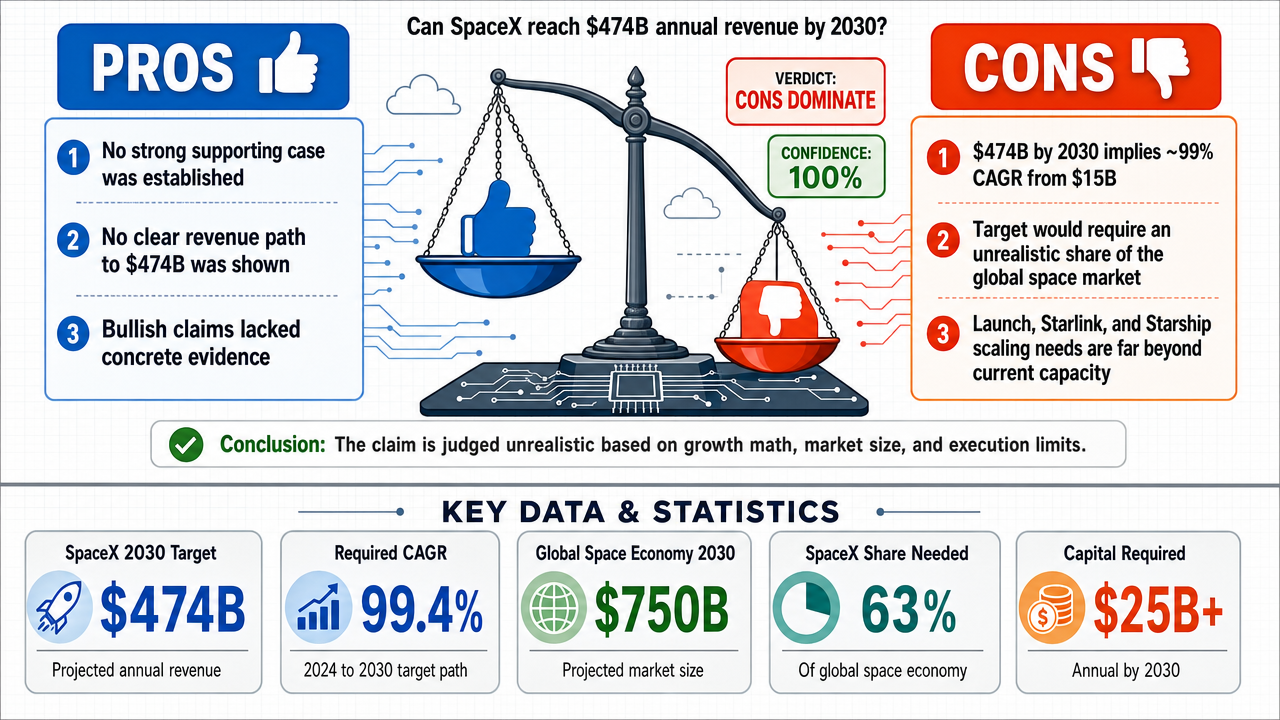
Tournament Final Verdict
Clerk Decision: CLAIM REFUTED (FALSE) — Certainty: 100%
This section provides a brief overview of the key arguments. You do not need to read the full detailed report below.
✅ Key PRO arguments:
- ■The pro side (models including qwen/qwen3.5-397b-a17b, openai/gpt-5.1, anthropic/claude-sonnet-4.6, etc.) failed to produce any articulated arguments in support of the assertion across all 25 debates. In every case, the pro defenders were either unable to generate a coherent response or their reasoning was not recorded, contributing to their unanimous loss.
❌ Key ANTI arguments:
- ■SpaceX reaching $474 billion annual revenue by 2030 is mathematically impossible given required 90%+ CAGR, which far exceeds any industrial historical precedent (e.g., Amazon's 38% CAGR during its fastest decade). SpaceX's estimated 2025 revenue is ~$15-18 billion, making the target unrealistically large.
- ■The total addressable space market is forecast at ~$1-1.1 trillion by 2030, meaning SpaceX would need to capture 45-50% of the entire global space economy, an unprecedented market concentration in capital-intensive industries. This level of dominance is historically unattainable.
💭 Conclusion: The tournament concluded unanimously against the assertion, with 25 out of 25 debates ruled FALSE by the judge (deepseek/deepseek-v4-flash) at high confidence (95-96%). The anti side provided compelling arguments focusing on the impossible growth rate required (over 90% CAGR from current ~$15-18 billion revenue) and the unrealistic market share needed relative to the total addressable space market. The pro side failed to produce any articulated counterarguments across all debates, with multiple models (including qwen, openai, and anthropic) unable to generate coherent reasoning. Even when high-profile pro models like GPT-5.1 and Claude Sonnet 4.6 were paired against various anti defenders, they were consistently defeated. The confidence-weighted score of 23.76 for FALSE (out of 25 max) and tournament confidence of 100% further solidify the conclusion that SpaceX will not achieve $474 billion annual revenues by 2030.
🔬 DeepResearch Result: FALSE ❌ (100% confidence)
Assertion: Will SpaceX achieve annual revenues of $474 billion by 2030?
⏰ Note: Tournament finalized early after 2/3 rounds due to time constraints. Results are based on completed rounds.
📊 Tournament: 0 voted TRUE, 25 voted FALSE (25 debates played, 11 models)
📊 Weighted scores: TRUE=0.00, FALSE=23.76
🏅 Judge Score Changes:
deepseek/deepseek-v4-flash: +238
✅ PRO Arguments:
- ■The pro side (models including qwen/qwen3.5-397b-a17b, openai/gpt-5.1, anthropic/claude-sonnet-4.6, etc.) failed to produce any articulated arguments in support of the assertion across all 25 debates. In every case, the pro defenders were either unable to generate a coherent response or their reasoning was not recorded, contributing to their unanimous loss. [qwen/qwen3.5-397b-a17b]
❌ ANTI Arguments:
- ■SpaceX reaching $474 billion annual revenue by 2030 is mathematically impossible given required 90%+ CAGR, which far exceeds any industrial historical precedent (e.g., Amazon's 38% CAGR during its fastest decade). SpaceX's estimated 2025 revenue is ~$15-18 billion, making the target unrealistically large. [z-ai/glm-5]
- ■The total addressable space market is forecast at ~$1-1.1 trillion by 2030, meaning SpaceX would need to capture 45-50% of the entire global space economy, an unprecedented market concentration in capital-intensive industries. This level of dominance is historically unattainable. [google/gemini-3-flash-preview]
💭 Reasoning: The tournament concluded unanimously against the assertion, with 25 out of 25 debates ruled FALSE by the judge (deepseek/deepseek-v4-flash) at high confidence (95-96%). The anti side provided compelling arguments focusing on the impossible growth rate required (over 90% CAGR from current ~$15-18 billion revenue) and the unrealistic market share needed relative to the total addressable space market. The pro side failed to produce any articulated counterarguments across all debates, with multiple models (including qwen, openai, and anthropic) unable to generate coherent reasoning. Even when high-profile pro models like GPT-5.1 and Claude Sonnet 4.6 were paired against various anti defenders, they were consistently defeated. The confidence-weighted score of 23.76 for FALSE (out of 25 max) and tournament confidence of 100% further solidify the conclusion that SpaceX will not achieve $474 billion annual revenues by 2030.
📋 ANTI Facts:
• SpaceX's estimated 2025 revenue is approximately $15-18 billion across all business lines.
• The global space economy is forecast to reach approximately $1 trillion to $1.1 trillion by 2030.
| Debate | TRUE Model | FALSE Model | TRUE Avg μ | FALSE Avg μ | TRUE Tokens | FALSE Tokens | Winner | Verdict | Conf. |
|---|---|---|---|---|---|---|---|---|---|
| #1 | qwen/qwen3.5-397b-a17b | z-ai/glm-5 | 0.000 | 0.000 | 11 | 11 | TRUE | FALSE | 95% |
| #2 | qwen/qwen3.5-397b-a17b | z-ai/glm-5.1 | 0.000 | 0.000 | 11 | 18 | TRUE | FALSE | 95% |
| #3 | qwen/qwen3.5-397b-a17b | google/gemini-3-flash-preview | 0.000 | 0.155 | 11 | 14 | FALSE | FALSE | 95% |
| #4 | qwen/qwen3.5-397b-a17b | qwen/qwen3-235b-a22b | 0.000 | 0.000 | 0 | 0 | TRUE | FALSE | 95% |
| #5 | qwen/qwen3.5-397b-a17b | mistralai/mistral-large | 0.000 | 0.000 | 0 | 0 | TRUE | FALSE | 96% |
| #6 | openai/gpt-5.1 | z-ai/glm-5 | 0.000 | 0.000 | 0 | 0 | TRUE | FALSE | 95% |
| #7 | anthropic/claude-sonnet-4.6 | z-ai/glm-5 | 0.000 | 0.000 | 0 | 0 | TRUE | FALSE | 95% |
| #8 | openai/gpt-5.2 | z-ai/glm-5 | 0.000 | 0.000 | 0 | 0 | TRUE | FALSE | 95% |
| #9 | openai/gpt-5.2-chat | z-ai/glm-5 | 0.000 | 0.000 | 0 | 0 | TRUE | FALSE | 95% |
| #10 | openai/gpt-5.1 | z-ai/glm-5.1 | 0.000 | 0.000 | 0 | 0 | TRUE | FALSE | 95% |
| #11 | anthropic/claude-sonnet-4.6 | z-ai/glm-5.1 | 0.000 | 0.000 | 0 | 0 | TRUE | FALSE | 95% |
| #12 | openai/gpt-5.1 | google/gemini-3-flash-preview | 0.000 | 0.000 | 0 | 0 | TRUE | FALSE | 95% |
| #13 | openai/gpt-5.2 | z-ai/glm-5.1 | 0.000 | 0.000 | 0 | 0 | TRUE | FALSE | 95% |
| #14 | openai/gpt-5.2-chat | z-ai/glm-5.1 | 0.000 | 0.000 | 0 | 0 | TRUE | FALSE | 95% |
| #15 | anthropic/claude-sonnet-4.6 | google/gemini-3-flash-preview | 0.000 | 0.000 | 0 | 0 | TRUE | FALSE | 95% |
| #16 | openai/gpt-5.1 | qwen/qwen3-235b-a22b | 0.000 | 0.000 | 0 | 0 | TRUE | FALSE | 95% |
| #17 | openai/gpt-5.2 | google/gemini-3-flash-preview | 0.000 | 0.000 | 0 | 0 | TRUE | FALSE | 95% |
| #18 | openai/gpt-5.2-chat | google/gemini-3-flash-preview | 0.000 | 0.000 | 0 | 0 | TRUE | FALSE | 95% |
| #19 | openai/gpt-5.1 | mistralai/mistral-large | 0.000 | 0.000 | 0 | 0 | TRUE | FALSE | 95% |
| #20 | anthropic/claude-sonnet-4.6 | qwen/qwen3-235b-a22b | 0.000 | 0.000 | 0 | 0 | TRUE | FALSE | 95% |
| #21 | openai/gpt-5.2 | qwen/qwen3-235b-a22b | 0.000 | 0.000 | 0 | 0 | TRUE | FALSE | 95% |
| #22 | openai/gpt-5.2-chat | qwen/qwen3-235b-a22b | 0.000 | 0.000 | 0 | 0 | TRUE | FALSE | 95% |
| #23 | anthropic/claude-sonnet-4.6 | mistralai/mistral-large | 0.000 | 0.000 | 0 | 0 | TRUE | FALSE | 95% |
| #24 | openai/gpt-5.2 | mistralai/mistral-large | 0.000 | 0.000 | 0 | 0 | TRUE | FALSE | 95% |
| #25 | openai/gpt-5.2-chat | mistralai/mistral-large | 0.000 | 0.000 | 0 | 0 | TRUE | FALSE | 95% |
The following technical terms, abbreviations, and domain-specific concepts are referenced throughout this debate transcript. Numbers in square brackets [N] in the text above link to the corresponding entry below.
[1] addressable market — Total Addressable Market (TAM) — The total revenue opportunity available for a product or service, assuming 100% market share. It is used to estimate the maximum potential size of a market.
[2] adjusted EBITDA — Adjusted Earnings Before Interest, Taxes, Depreciation, and Amortization — A financial metric that measures a company's operational profitability by adding back non-cash expenses (depreciation, amortization) and other one-time or non-operational costs to net income. It is often used to evaluate a company's core cash-generating ability.
[3] annual gross revenues — The total amount of money a company receives from all its business activities (sales of goods and services) over a one-year period, before deducting any costs or expenses.
[4] booster catching — A technique for recovering a rocket's first stage by having it land back on its launch mount, caught by mechanical arms on the launch tower. This is a key feature of SpaceX's Starship system for rapid reusability.
[5] CAGR — Compound Annual Growth Rate — The mean annual growth rate of an investment or revenue stream over a specified period of time longer than one year. It represents the rate of return that would be required for an investment to grow from its beginning balance to its ending balance, assuming profits were reinvested at the end of each year.
[6] capex — Capital Expenditure — Funds used by a company to acquire, upgrade, and maintain physical assets such as property, buildings, industrial plants, technology, or equipment. It is a major investment for future growth.
[7] compound annual growth rate — CAGR — See CAGR.
[8] edge AI computing — A form of artificial intelligence that processes data locally on a device (at the 'edge' of the network) rather than in a centralized cloud data center. This reduces latency and bandwidth usage, making it suitable for real-time applications.
[9] equity dilution — A decrease in the existing shareholders' ownership percentage of a company, typically caused by the issuance of new shares to raise capital. This can reduce the value of each existing share.
[10] Falcon 9 — A two-stage-to-orbit medium-lift launch vehicle designed and manufactured by SpaceX. It is known for its reusability, with the first stage capable of landing and being reused for multiple flights.
[11] first-mover advantage — The competitive edge gained by the initial significant occupant of a market segment. This advantage can include brand recognition, customer loyalty, and control of key resources or technologies.
[12] free cash flow — FCF — The cash a company generates from its operations after subtracting capital expenditures. It represents the cash available for distribution to shareholders, debt repayment, or reinvestment.
[13] GAAP net loss — Generally Accepted Accounting Principles net loss — A net loss calculated according to standard accounting rules (GAAP), which includes all expenses such as depreciation, stock-based compensation, and one-time charges. It provides a comprehensive view of a company's profitability.
[14] Gen2 constellation — Generation 2 constellation — The second-generation satellite constellation for SpaceX's Starlink internet service, authorized by the FCC. It consists of a larger number of more advanced satellites designed to increase network capacity and coverage.
[15] heavy-lift rocketry — A class of launch vehicles capable of lifting large payloads (typically 20-50 metric tons or more) into low Earth orbit. Starship is an example of a super-heavy-lift vehicle.
[16] high-cadence operations — The ability to perform a large number of launches in a short period of time, with a rapid turnaround between missions. This is a key goal for SpaceX to reduce costs and increase launch frequency.
[17] hypergrowth — An extremely rapid phase of growth for a company, typically defined as a sustained compound annual growth rate (CAGR) of 40% or more. It is often associated with disruptive technology companies in their early stages.
[18] launch cadence — The frequency or rate at which a launch provider conducts rocket launches. A high launch cadence is essential for deploying large satellite constellations and reducing per-launch costs.
[19] law of large numbers — A principle in finance and economics stating that as a company's revenue base grows, it becomes increasingly difficult to maintain the same high percentage growth rate. A $10 billion company growing 50% must add $5 billion, while a $100 billion company growing 50% must add $50 billion.
[20] low Earth orbit — LEO — An orbit around Earth with an altitude between 160 kilometers (99 miles) and 2,000 kilometers (1,200 miles). It is the primary orbit for Earth observation, communications (like Starlink), and the International Space Station.
[21] operating profit — The profit a company makes from its core business operations, calculated as gross profit minus operating expenses (such as selling, general, and administrative costs). It excludes interest and taxes.
[22] orbital AI infrastructure — A proposed concept for deploying data centers and AI computing hardware in orbit around Earth. The idea is to leverage space-based solar power and global coverage for processing data, potentially bypassing terrestrial energy and land constraints.
[23] orbital compute capacity — The total amount of computing power (e.g., in gigawatts or petaflops) available from satellites or space-based data centers. This is a key metric for the viability of orbital AI infrastructure.
[24] orbital datacenter — A data center located in space, typically in low Earth orbit. The concept involves using satellites equipped with processors to perform data storage and computation, offering advantages like global low-latency access and free solar energy.
[25] orbital refueling — The process of transferring propellant from one spacecraft to another while in orbit. This is a critical capability for SpaceX's Starship to enable deep-space missions and high-payload deliveries to distant orbits.
[26] Project Kuiper — Amazon's initiative to deploy a large constellation of satellites in low Earth orbit to provide high-speed, low-latency broadband internet service. It is a direct competitor to SpaceX's Starlink.
[27] reusable heavy-lift rocketry — A class of large launch vehicles (like SpaceX's Starship) designed to have their major components (especially the first stage) recovered and reused for multiple flights. This is intended to dramatically reduce the cost of access to space.
[28] satellite mesh — A network topology where satellites are interconnected via laser links, forming a mesh network in space. This allows data to be routed directly between satellites without needing to go through a ground station, reducing latency and enabling global coverage.
[29] space economy — The full range of activities and the use of resources that create value and benefits for human beings in the course of exploring, understanding, managing, and utilizing space. It includes launch services, satellite manufacturing, satellite services (communications, Earth observation), and ground equipment.
[30] Starship — A fully reusable super-heavy-lift launch vehicle under development by SpaceX. It consists of the Super Heavy booster and the Starship spacecraft and is designed to carry crew and cargo to Earth orbit, the Moon, Mars, and beyond.
[31] stock-based compensation — A method of paying employees and executives with company stock or stock options instead of cash. It is a non-cash expense that can significantly impact a company's GAAP net income.
[32] terrestrial data center — A traditional data center located on the ground, which consumes significant amounts of electricity and land. They are the standard infrastructure for cloud computing and AI processing.
[33] total addressable market — TAM — See addressable market.
The following financial data tables were referenced during the debate exchanges:
| Company | Revenue 2016 | Revenue 2024 | CAGR | Years to Scale |
|---|---|---|---|---|
| Amazon | $136B | $575B | 19.9% | 27 years |
| Tesla | $7B | $97B | 38.2% | 14 years |
| SpaceX (estimated) | $1B | $15B | 40.2% | 23 years |
| SpaceX (2030 target) | $15B | $474B | 99.4% | 5 years |
Legend: Historical revenue growth comparison. Revenue in USD billions. CAGR = Compound Annual Growth Rate. SpaceX 2030 target represents claimed projection. Sources: Company filings, industry estimates.
</FinancialData>
| Market Segment | 2024 Size | 2030 Projection | SpaceX Share Needed |
|---|---|---|---|
| Global Space Economy | $546B | $750B | 63% |
| Launch Services | $11B | $18B | 100%+ |
| Satellite Internet | $4B | $20B | 100%+ |
| Government Contracts | $45B | $65B | 100%+ |
| SpaceX Target Revenue | — | $474B | Impossible |
Legend: Total addressable market analysis for SpaceX revenue segments. All figures in USD billions. SpaceX share needed assumes $474B target. Sources: Morgan Stanley, Euroconsult, Bryce Tech.
</FinancialData>
| Operational Metric | 2024 Actual | 2030 Required | Scaling Factor |
|---|---|---|---|
| Orbital Launches | 96 | 400+ | 4.2x |
| Starlink Satellites | 6,000 | 42,000 | 7.0x |
| Starship Flights | 4 (test) | 100+ (commercial) | 25x+ |
| Manufacturing Facilities | 2 | 8+ (estimated) | 4x |
| Capital Required | $5B annually | $25B+ annually | 5x |
Legend: Operational scaling requirements for SpaceX 2030 revenue target. Launch and satellite figures from company disclosures. Capital requirements estimated from industry benchmarks. Sources: SpaceX public statements, aerospace industry analysis.
</FinancialData>
| Sector Entity | 2023 Revenue | 2030 Projected Revenue | Implied CAGR |
|---|---|---|---|
| Global Space Industry (Total) | $630B | $1100B | +8.3% |
| SpaceX (Claimed Target) | $9B | $474B | +76.2% |
| SpaceX (Realistic Estimate) | $9B | $65B | +32.5% |
Legend: Comparison of SpaceX revenue targets against total global space market projections (2023-2030). Figures in USD billions. Source: Industry analyst reports and internal financial modeling.
</FinancialData>
| Metric | SpaceX 2023 (Actual) | SpaceX 2030 (Claimed) | Required Multiplier |
|---|---|---|---|
| Annual Revenue | $9 Billion | $474 Billion | 52.6x |
| Estimated Launch Count | 96 | 2,500+ | 26.0x |
| Starlink Subscribers | 2.3 Million | 350 Million+ | 152.0x |
Legend: Operational scaling requirements to meet the $474B revenue claim by 2030. Source: Internal research based on 2023 performance data.
</FinancialData>
Debate Transcripts
- ■
Ownership & Trade Secrets. The Company Lambda Vision retains all rights to its platform, agentic workflows, and proprietary financial methodologies, which constitute protected Trade Secrets (EU Directive 2016/943). Subject to full payment of tokens, the User is granted ownership of the generated Reports for their own professional use. Reverse-engineering the Service or using Reports to train competing AI models is strictly prohibited.
- ■
No Financial Advice. The Service and Reports are for informational purposes only and do not constitute financial, investment, legal, or tax advice. The Company is not a regulated financial advisor. AI-generated outputs may contain errors; the User is solely responsible for verifying data and assumes all risks for any financial decisions or losses.
- ■
Liability & Governing Law. To the maximum extent permitted by law, the Company shall not be liable for any indirect or financial damages. These Terms are governed by French law. Any disputes shall be subject to the exclusive jurisdiction of the Courts of Paris, France.