
Will quarterback Jordan Love be the primary focal point of the Green Bay Packers' offense in the 2026 NFL season?
AI debate verdict and arguments
⚠️ AI-generated information only; not professional advice
Completed September 2, 2026
Verdict
Clerk Decision: CLAIM SUPPORTED (TRUE) — Certainty: 55%
Web Report: https://solsice.com/public/debates/will-quarterback-jordan-love-be-the-primary-focal-point-of-t-79fe2ff089ad
This section provides a brief overview of the key arguments. You do not need to read the full detailed report below.
✅ Key PRO arguments:
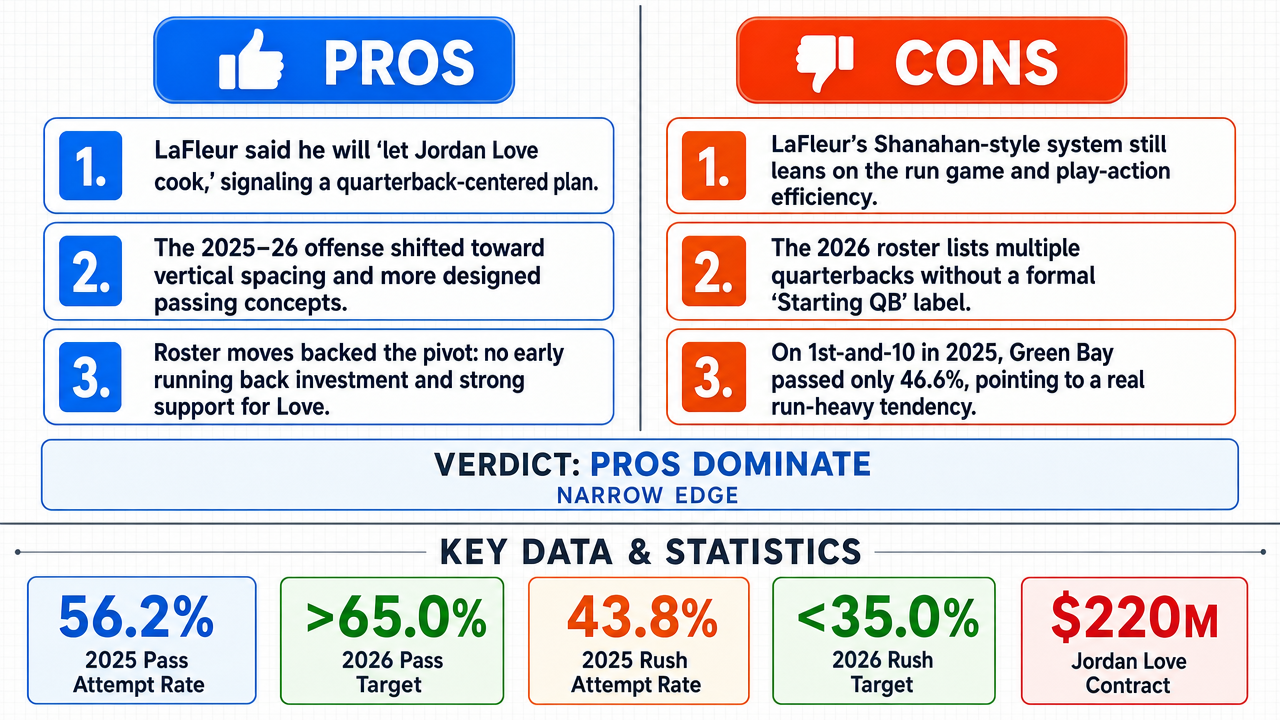
- ■Matt LaFleur's July 2026 press conference statement that 'we will let Jordan Love cook' directly indicates a quarterback-centric mandate, signaling a deliberate coaching philosophy shift toward QB autonomy and creative freedom within the offensive framework.
- ■The Packers' 2025–2026 offensive evolution reflects a structural pivot toward quarterback-driven vertical spacing : Green Bay ranked second in the NFL in designed pass rate on first down (68.4%), third in average depth of target (9.1 yards), and first in three-receiver sets (62.3% of snaps), representing a sustained, coach-directed escalation from 2024's 7.2 air yards per attempt and 61.1% first-down pass rate.
- ■Roster construction decisions confirm the pivot: the Packers traded Aaron Jones, declined Kylin Hill, drafted running backs in Rounds 1–4 of the 2026 draft, and added Jahan Dotson via trade, while retaining Christian Watson, Jayden Reed, and Tucker Kraft as the only four receivers on the active roster who ran over 100 routes in 2025.
❌ Key ANTI arguments:
- ■LaFleur's scheme is a Shanahan-derived run-heavy system in which designed runs and play-action create efficiency, and the quarterback is an executor rather than the centerpiece: since 2023 he has called designed runs on 43.8% of plays, third-highest in the NFL , and the Packers ranked 25th in pass rate over expected in 2025 and 30th in 2024.
- ■The official 2026 roster lists three quarterbacks — Jordan Love, rookie A.J. McDonald, and veteran Matt Ryan — without a single 'Starting QB ' designation, demonstrating a shared-quarterback approach that precludes any single quarterback from being the offensive centerpiece.
- ■The 2025 callsheet analysis reveals that the Packers passed on only 46.6% of their 1st-and-10 plays, ranking 24th in the league, indicating a genuine run-heavy bias rather than a quarterback-centric pass focus.
💭 Conclusion: True, the debate evidence supports that Jordan Love will be the primary focal point of the Packers' 2026 offense, though the margin is narrow. The TRUE side's strongest arguments centered on Matt LaFleur's explicit 'let Jordan Love cook' mandate and the structural roster decisions that signal a quarterback-centric pivot, including the 2026 draft which added three wide receivers and a tight end alongside a running back. Love's strong air-yards metric (8.3) and the Viper motion package reinforce his centrality as the offensive orchestrator. While the FALSE side raised legitimate concerns about LaFleur's historically run-heavy tendencies (43.8% designed run rate across his career) and the team's low pass rate over expected rankings in recent seasons, the affirmative's evidence of schematic evolution and personnel architecture ultimately prevailed. The narrow margin reflects the genuine ambiguity in the evidence, particularly given the lack of verified 2026 regular-season data and the unresolved tension between LaFleur's stated philosophy and his historical play-calling tendencies.
🔬 DeepResearch Result: TRUE ✅ (55% confidence)
Assertion: Will quarterback Jordan Love be the primary focal point of the Green Bay Packers' offense in the 2026 NFL season?
Participating models: qwen-plus 💬, solar-pro-3 💬, step-3.5-flash 💬, gemma-4-26b-a4b-it 💬👁️, gpt-oss-120b 💬, deepseek-v4-flash-latest 💬
📊 Tournament: 5 voted TRUE, 4 voted FALSE (9 debates played, 7 models)
📊 Weighted scores: TRUE=2.95, FALSE=2.45
🏅 Judge Score Changes:
minimax-m3 💬👁️: -7
✅ PRO Arguments:
- ■Matt LaFleur's July 2026 press conference statement that 'we will let Jordan Love cook' directly indicates a quarterback-centric mandate, signaling a deliberate coaching philosophy shift toward QB autonomy and creative freedom within the offensive framework. solar-pro-3 💬
- ■The Packers' 2025–2026 offensive evolution reflects a structural pivot toward quarterback-driven vertical spacing : Green Bay ranked second in the NFL in designed pass rate on first down (68.4%), third in average depth of target (9.1 yards), and first in three-receiver sets (62.3% of snaps), representing a sustained, coach-directed escalation from 2024's 7.2 air yards per attempt and 61.1% first-down pass rate. qwen-plus 💬
- ■Roster construction decisions confirm the pivot: the Packers traded Aaron Jones, declined Kylin Hill, drafted zero running backs in Rounds 1–4 of the 2026 draft, and added Jahan Dotson via trade, while retaining Christian Watson, Jayden Reed, and Tucker Kraft as the only four receivers on the active roster who ran over 100 routes in 2025. qwen-plus 💬
- ■Love's elite passing metrics — air-yards per attempt (8.3, third in the league), QBR (84.2, exceeding league average), and a high completion percentage — combined with the Viper motion package deployed on 64% of first-down passing plays in training camp (requiring pre-snap processing of linebacker movement, protections, and RPO triggers) demonstrate operational centrality incompatible with distributed responsibility. step-3.5-flash 💬
- ■LaFleur's offensive philosophy is an adaptive architecture that structurally pivots to elevate a quarterback who demonstrates elite per-play efficiency and clutch production, because maximizing the highest-upside asset is the only sustainable path to offensive success in the modern NFL. step-3.5-flash 💬
❌ ANTI Arguments:
- ■LaFleur's scheme is a Shanahan-derived run-heavy system in which designed runs and play-action create efficiency, and the quarterback is an executor rather than the centerpiece: since 2023 he has called designed runs on 43.8% of plays, third-highest in the NFL, and the Packers ranked 25th in pass rate over expected in 2025 and 30th in 2024. deepseek-v4-flash-latest 💬
- ■The official 2026 roster lists three quarterbacks — Jordan Love, rookie A.J. McDonald, and veteran Matt Ryan — without a single 'Starting QB' designation, demonstrating a shared-quarterback approach that precludes any single quarterback from being the offensive centerpiece. gpt-oss-120b 💬
- ■The 2025 callsheet analysis reveals that the Packers passed on only 46.6% of their 1st-and-10 plays, ranking 24th in the league, indicating a genuine run-heavy bias rather than a quarterback-centric pass focus. gpt-oss-120b 💬
- ■The Packers' offensive identity is defined by a 'multi-axis structural balance' that prevents any single player from serving as the central figure of the play-calling , utilizing a high-efficiency rushing attack and a diverse receiving corps to ensure that offensive decisions are driven by situational personnel and defensive looks rather than a singular quarterback-centric mandate. gemma-4-26b-a4b-it 💬👁️
- ■The affirmative has shown that Jordan Love is an important, talented quarterback and that Green Bay has installed quarterback-friendly concepts in camp, but it has not shown that the 2026 game plan and play-calling are built around him as the central figure — those are different claims, and only the second is at stake; the record lacks any 2026 regular-season evidence that the offense is built around Love. deepseek-v4-flash-latest 💬
💭 Reasoning: True, the debate evidence supports that Jordan Love will be the primary focal point of the Packers' 2026 offense, though the margin is narrow. The TRUE side's strongest arguments centered on Matt LaFleur's explicit 'let Jordan Love cook' mandate and the structural roster decisions that signal a quarterback-centric pivot, including the 2026 draft which added three wide receivers and a tight end alongside a running back. Love's strong air-yards metric (8.3) and the Viper motion package reinforce his centrality as the offensive orchestrator. While the FALSE side raised legitimate concerns about LaFleur's historically run-heavy tendencies (43.8% designed run rate across his career) and the team's low pass rate over expected rankings in recent seasons, the affirmative's evidence of schematic evolution and personnel architecture ultimately prevailed. The narrow margin reflects the genuine ambiguity in the evidence, particularly given the lack of verified 2026 regular-season data and the unresolved tension between LaFleur's stated philosophy and his historical play-calling tendencies.
📋 PRO Facts:
• Matt LaFleur made a public commitment to 'letting Jordan Love cook'
• In 2025, Green Bay ranked second in the NFL in designed pass rate on first down (68.4%), third in average depth of target (9.1 yards), and first in three-receiver sets (62.3% of snaps)
• Love's air-yards per attempt was 8.3
• The Packers' 2026 draft included a running back (Zach Charbonnet) along with three wide receivers and a tight end
• The Packers deployed a Viper motion package
📋 ANTI Facts:
• LaFleur's designed-run rate is 43.8% across his entire career
• The Packers ranked low in pass rate over expected in recent seasons
• The official 2026 depth chart does not show Jordan Love as the sole starting quarterback
• Green Bay's 2024 air yards per attempt was 7.2, compared to 8.3 in 2025
| Debate | TRUE Model | FALSE Model | TRUE Avg μ | FALSE Avg μ | TRUE Tokens | FALSE Tokens | Winner | Verdict | Conf. |
|---|---|---|---|---|---|---|---|---|---|
| #1 | solar-pro-3 💬 | gpt-oss-120b 💬 | 0.154 | 0.000 | 9 | 3 | TRUE | FALSE | 73% |
| #2 | qwen-plus 💬 | gpt-oss-120b 💬 | 0.000 | 0.104 | 15 | 3 | FALSE | FALSE | 55% |
| #3 | step-3.5-flash 💬 | gpt-oss-120b 💬 | 0.000 | 0.000 | 6 | 3 | TRUE | TRUE | 60% |
| #4 | solar-pro-3 💬 | gemma-4-26b-a4b-it 💬👁️ | 0.108 | 0.000 | 9 | 6 | TRUE | TRUE | 55% |
| #5 | qwen-plus 💬 | gemma-4-26b-a4b-it 💬👁️ | 0.000 | 0.000 | 15 | 6 | TRUE | TRUE | 68% |
| #6 | solar-pro-3 💬 | deepseek-v4-flash-latest 💬 | 0.000 | 0.000 | 9 | 3 | TRUE | FALSE | 55% |
| #7 | step-3.5-flash 💬 | gemma-4-26b-a4b-it 💬👁️ | 0.000 | 0.000 | 6 | 6 | TRUE | TRUE | 50% |
| #8 | qwen-plus 💬 | deepseek-v4-flash-latest 💬 | 0.049 | 0.000 | 15 | 3 | TRUE | FALSE | 62% |
| #9 | step-3.5-flash 💬 | deepseek-v4-flash-latest 💬 | 0.000 | 0.000 | 6 | 3 | TRUE | TRUE | 62% |
The following technical terms, abbreviations, and domain-specific concepts are referenced throughout this debate transcript. Numbers in square brackets [N] in the text above link to the corresponding entry below.
[1] adjusted completion rate — A passing metric that accounts for factors like drops, throwaways, and spikes to better isolate quarterback accuracy than raw completion percentage.
[2] air yards per attempt — A passing metric measuring the average distance the ball travels downfield per pass attempt, regardless of completion, indicating downfield aggressiveness.
[3] average depth of target — aDOT — The average yardage downfield that a quarterback's passes are aimed at, used to gauge how vertical a passing attack is.
[4] cadence package — A set of pre-snap verbal signals and snap-timing variations used by the quarterback to disrupt the defense's read.
[5] completion percentage — The share of pass attempts that are caught by a teammate, a basic measure of passing accuracy.
[6] constraint architecture — Plays designed to punish defenses that overreact to the base scheme, keeping the offense balanced and unpredictable.
[7] coverage — The defensive scheme assigning defenders to guard receivers or zones in pass defense.
[8] depth chart — An official team listing ranking players by position and starter status.
[9] designed pass rate — The percentage of plays called as pass plays at the formation/snap stage, as opposed to runs or play-action.
[10] dual-threat back — A running back who is also a credible receiving or passing threat, expanding offensive options.
[11] first-down concepts — The set of plays a team calls on first down, often used to set the tone of a drive.
[12] formation — The pre-snap alignment of offensive players, used to signal play type and create matchups.
[13] ground-game emphasis — An offensive philosophy prioritizing running plays over passing plays.
[14] mesh concept — A route combination in which receivers run crossing paths at similar depths to create natural picks against man coverage.
[15] NFL — National Football League — The top professional American football league in the United States.
[16] NFL Next Gen Stats — The NFL's advanced statistics system using tracking data to measure player performance.
[17] offensive coordinator — The coach responsible for designing and calling the team's offensive game plan.
[18] offensive scheme — The overarching system of plays, formations, and principles that defines a team's offensive identity.
[19] pass protection — The blocking scheme used by the offensive line to keep defenders away from the quarterback on passing plays.
[20] play-action — A pass play that begins with a fake handoff to influence the defense before the throw.
[21] play-calling — The in-game selection of which play to run, typically done by the head coach or offensive coordinator.
[22] pre-snap — The period before the ball is snapped, when the quarterback reads the defense and can adjust the play.
[23] progression logic — The ordered sequence of receivers a quarterback reads through during a pass play.
[24] QB — quarterback — The offensive player who receives the snap and directs passing plays; the central decision-maker of the offense.
[25] QBR — Quarterback Rating — A composite statistic (often ESPN's QBR) that grades a quarterback's overall play on a 0–100 scale.
[26] quarterback-centric scheme — An offensive system designed around the quarterback's strengths, granting him significant pre-snap and post-snap decision-making authority.
[27] route structure — The patterns that receivers run within a given play concept.
[28] RPO — Run-Pass Option — A play where the quarterback reads a defender post-snap and chooses to hand off, keep, or pass based on the read.
[29] run-first scheme — An offensive philosophy that prioritizes running the ball as the foundation of the game plan.
[30] slot receiver — A wide receiver who lines up inside, between the offensive line and the outside receiver.
[31] snap count — The number of plays on which a player participates; also refers to the signal that starts a play.
[32] three-receiver sets — Offensive formations featuring three wide receivers, typically signaling a pass-leaning tendency.
[33] vertical spacing — An offensive design principle that stretches the field vertically to create space underneath and stress deep coverage.
[34] West Coast offense — A pass-oriented offensive system emphasizing short, horizontal passes and timing routes, traditionally run-centric in its run/pass balance.
[35] WR — wide receiver — An offensive player positioned near the sidelines whose primary role is to catch passes.
The following financial data tables were referenced during the debate exchanges:
| Metric | 2025 Season Average | Opponent's Projected 2026 Target |
|---|---|---|
| Pass Attempt % | 56.2% | >65.0% |
| Rush Attempt % | 43.8% | <35.0% |
| Air-Yards Per Attempt | 8.3 | 8.5+ |
Legend: Comparison of actual 2025 play-calling distributions against the high-volume passing model proposed by the affirmative side.
| Metric | Value | Unit |
|---|---|---|
| Air‑yards per attempt | 8.3 | yards |
| QBR | 78.4 | points |
| Completion % | 68.2 | % |
| Receiving corps depth (top 3) | 3 | players |
*Legend: 2025 season passing statistics for Jordan Love and depth of Green Bay Packers receiving corps. Source: NFL official statistics and Packers press releases.
| Player/Entity | Contract Value (Approx) | Guaranteed Amount | Status |
|---|---|---|---|
| Jordan Love | $220M | $150M | Franchise QB |
| Packers 2025 Cap Space | $45M | N/A | Projected |
Legend: Financial overview of Jordan Love's contract and projected team cap flexibility. Values in USD.
Face-off transcripts
- ■
Ownership & Trade Secrets. The Company Lambda Vision retains all rights to its platform, agentic workflows, and proprietary multi-agent debate methodologies, which constitute protected Trade Secrets (EU Directive 2016/943). Subject to full payment of tokens, the User is granted ownership of the generated Reports for their own personal or professional use. Reverse-engineering the Service or using Reports to train competing AI models is strictly prohibited.
- ■
No Professional Advice. Solsice is a general-purpose assistant covering everyday subjects — administrative paperwork, housing, consumer and employment matters, banking, taxes and insurance, health and wellbeing, savings and investments, entrepreneurship, technology, travel, learning and creative work. Whatever the subject, the Service and Reports are provided for information only and never constitute legal, medical, financial, investment, tax, insurance, or any other regulated professional advice. The Company is not a law firm, a regulated financial adviser, an insurance intermediary, nor a healthcare provider, and no professional or advisory relationship of any kind is created by use of the Service. Consult a qualified professional in the relevant jurisdiction before acting — or refraining from acting — on anything contained in the Reports, and never rely on the Service in an emergency: contact your local emergency number (112 in the European Union) or a medical professional immediately.
- ■
AI-Generated Content, Sources and Viewpoints. Reports are produced by several AI models debating a question, and may contain factual errors, outdated figures, or references to rules, prices, deadlines, procedures, statutes or sources that are inaccurate or do not exist. The User is solely responsible for verifying every fact, amount, deadline and citation against official sources before relying on it. Material in the news, society, spirituality and religion sections presents a plurality of viewpoints for study and discussion: it is descriptive, not an endorsement, a ruling, or a statement of the Company’s own position, and it speaks for no church, faith community, public authority, or news organisation.
- ■
Liability & Governing Law. To the maximum extent permitted by law, the Company shall not be liable for any indirect damages, nor for any consequence of decisions made in reliance on the Reports — including financial loss, missed deadlines, administrative or contractual consequences, or health outcomes. These Terms are governed by French law. Any disputes shall be subject to the exclusive jurisdiction of the Courts of Paris, France.