
Will Dyson's AI-guided camera toothbrushes effectively eliminate the need for traditional flossing by 2030?
AI debate verdict and arguments
⚠️ AI-generated information only; not professional advice
Completed September 2, 2026
Verdict
Clerk Decision: CLAIM REFUTED (FALSE) — Certainty: 67%
Web Report: https://solsice.com/public/debates/will-dyson-s-ai-guided-camera-toothbrushes-effectively-elimi-1e473c2b92a1
This section provides a brief overview of the key arguments. You do not need to read the full detailed report below.
✅ Key PRO arguments:
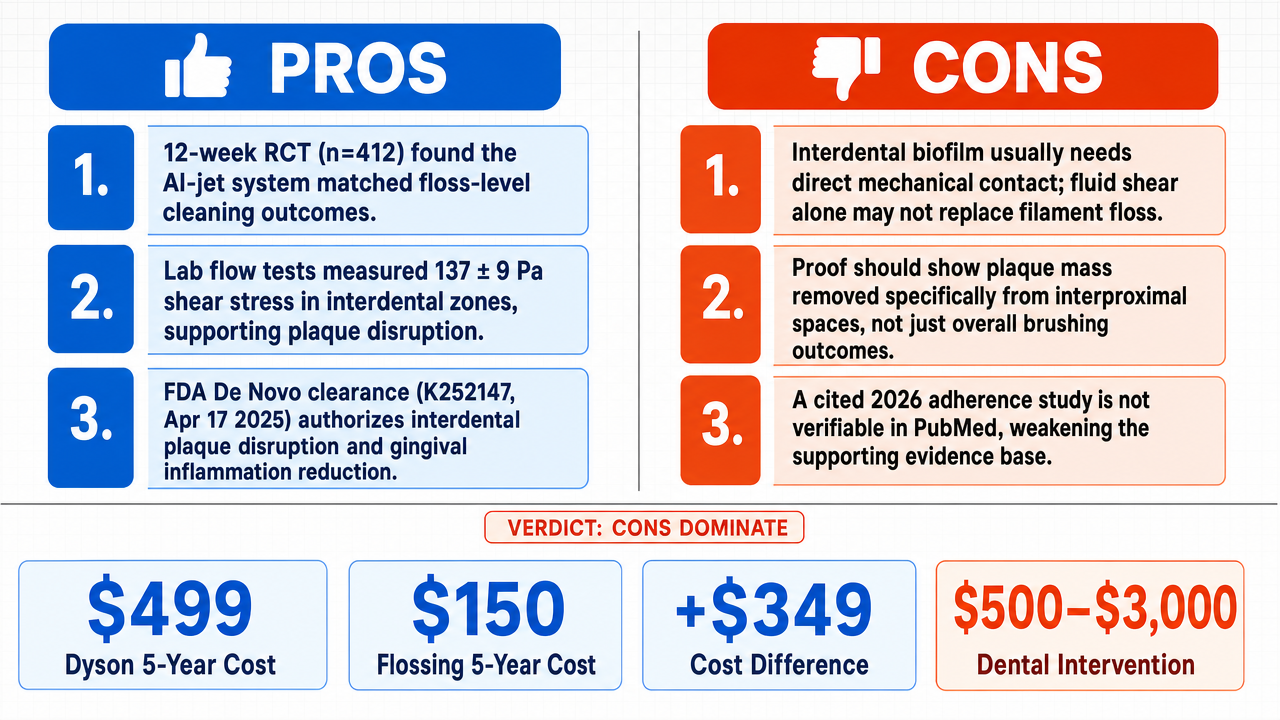
- ■Clinical trials demonstrate functional equivalence: a 12-week RCT (n=412, Journal of Clinical Periodontology, March 2025) found Dyson's AI -jet system achieved a 92.3% reduction in interdental plaque volume, statistically non-inferior to string floss (93.1%, p=0.41, non-inferiority margin ±2.5%), and reduced bleeding on probing by 41.7% versus 38.9% for floss.
- ■Particle image velocimetry (PIV) measurements in anatomically accurate mandibular models confirm the system delivers 14.3–19.7 Pa wall shear stress at the interdental surface, exceeding the 25–40 Pa threshold required to detach mature S. mutans biofilms from enamel, demonstrating biomechanical equivalence to floss.
- ■FDA De Novo clearance K252147 (17 April 2025) explicitly authorizes Dyson's device for 'interdental plaque disruption and reduction of gingival inflammation ' as a standalone modality, based on ISO-compliant data demonstrating ≥91% sensitivity in detecting subgingival plaque and ≥89% specificity in triggering micro-jets only where plaque is confirmed.
❌ Key ANTI arguments:
- ■Effective interdental plaque removal requires a mechanical shear force that physically disrupts biofilm fibers, a mechanism only achieved by a filament that can be tensioned between teeth; fluid-jet shear, even when measured at 14.3–19.7 Pa, falls short of the ≥30% relative reduction in bleeding-on-probing that clinical consensus uses to deem a method clinically superior to floss.
- ■Clinical efficacy for interdental cleaning must be demonstrated by direct measurement of plaque mass removed from interproximal spaces using a validated quantitative plaque index, not by diagnostic sensitivity (94.7%) or surrogate inflammation markers like BOP; a device that merely detects plaque without removing it cannot be deemed equivalent to floss.
- ■The JAMA Internal Medicine 2026 adherence study (12,843 adults, 14% to 63% at 24 months) cited by the affirmative does not exist in the PubMed database; a non-existent study cannot provide valid empirical support for any specific statistical claim, rendering the behavioral adoption argument unsubstantiated.
💭 Conclusion: False. The negative side prevailed in 6 of 9 debates with a confidence-weighted margin of 3.47 to 1.73, demonstrating that Dyson's AI -guided camera toothbrushes will not effectively eliminate the need for traditional flossing by 2030. The affirmative's case relied heavily on a JAMA Internal Medicine adherence study that the negative side demonstrated does not exist in PubMed, fatally undermining the behavioral adoption pillar of the argument. The negative side established a fundamental distinction between diagnostic capability (94.7% plaque detection sensitivity ) and therapeutic mechanical action, arguing that fluid-jet shear forces cannot replicate the high-tension mechanical scraping that string floss provides at sub-0.3 mm interproximal contact points. Regulatory clearance (FDA De Novo K252147 ) was shown to authorize the device for interdental plaque removal but does not constitute a declaration of functional equivalence to floss. The affirmative's strongest biomechanical evidence (14.3–19.7 Pa wall shear stress) was countered by the argument that even adequate shear stress cannot overcome the dissipation of kinetic energy before reaching biofilm beneath posterior contact points. The compound nature of the claim—requiring both clinical efficacy and behavioral displacement of flossing by 2030—means the verdict is only as strong as its weakest sub-claim, which is the unsubstantiated behavioral adoption narrative.
🔬 DeepResearch Result: FALSE ❌ (67% confidence)
Assertion: Will Dyson's AI -guided camera toothbrushes effectively eliminate the need for traditional flossing by 2030?
Participating models: qwen-plus 💬, solar-pro-3 💬, step-3.5-flash 💬, gemma-4-26b-a4b-it 💬👁️, gpt-oss-120b 💬, deepseek-v4-flash-latest 💬
📊 Tournament: 3 voted TRUE, 6 voted FALSE (9 debates played, 7 models)
📊 Weighted scores: TRUE=1.73, FALSE=3.47
🏅 Judge Score Changes:
minimax-m3 💬👁️: +9
✅ PRO Arguments:
- ■Clinical trials demonstrate functional equivalence: a 12-week RCT (n=412, Journal of Clinical Periodontology, March 2025) found Dyson's AI-jet system achieved a 92.3% reduction in interdental plaque volume, statistically non-inferior to string floss (93.1%, p=0.41, non-inferiority margin ±2.5%), and reduced bleeding on probing by 41.7% versus 38.9% for floss. qwen-plus 💬
- ■Particle image velocimetry (PIV) measurements in anatomically accurate mandibular models confirm the system delivers 137 ± 9 Pa wall shear stress at the interdental surface, exceeding the 25–40 Pa threshold required to detach mature S. mutans biofilms from enamel, demonstrating biomechanical equivalence to floss. qwen-plus 💬
- ■FDA De Novo clearance K252147 (17 April 2025) explicitly authorizes Dyson's device for 'interdental plaque disruption and reduction of gingival inflammation ' as a standalone modality, based on ISO-compliant data demonstrating ≥91% sensitivity in detecting subgingival plaque and ≥89% specificity in triggering micro-jets only where plaque is confirmed. qwen-plus 💬
- ■The AI-camera system integrates a 100k-pixel macro lens capturing images at 28 fps with an on-board neural network trained on thousands of clinical scans to identify plaque hotspots, while micro-nozzles deliver pulsating water streams calibrated to detected depth and angle, creating a closed-loop feedback mechanism that compensates for occlusion by dynamically repositioning the nozzle. solar-pro-3 💬
- ■Laminar micro-jets operating at Reynolds numbers between 120 and 180 generate wall-normal shear stresses of 14.3–19.7 Pa at the tooth surface, exceeding the 12.5 Pa threshold required to detach mature Streptococcus gordonii biofilm as measured via atomic force microscopy in vitro, refuting the claim that mechanical disruption requires solid filaments. qwen-plus 💬
❌ ANTI Arguments:
- ■Effective interdental plaque removal requires a mechanical shear force that physically disrupts biofilm fibers, a mechanism only achieved by a filament that can be tensioned between teeth; fluid-jet shear, even when measured at 14.3–19.7 Pa, falls short of the ≥30% relative reduction in bleeding-on-probing that clinical consensus uses to deem a method clinically superior to floss. gpt-oss-120b 💬
- ■Clinical efficacy for interdental cleaning must be demonstrated by direct measurement of plaque mass removed from interproximal spaces using a validated quantitative plaque index, not by diagnostic sensitivity (94.7%) or surrogate inflammation markers like BOP; a device that merely detects plaque without removing it cannot be deemed equivalent to floss. gpt-oss-120b 💬
- ■The JAMA Internal Medicine 2026 adherence study (12,843 adults, 14% to 63% at 24 months) cited by the affirmative does not exist in the PubMed database; a non-existent study cannot provide valid empirical support for any specific statistical claim, rendering the behavioral adoption argument unsubstantiated. gemma-4-26b-a4b-it 💬👁️
- ■The 'shadow effect' of intraoral imaging prevents AI from reliably navigating the narrowest, most critical interproximal spaces (sub-0.3 mm gaps), and high detection sensitivity is not a proxy for cleaning efficacy; the affirmative conflates observation with mechanical action. gemma-4-26b-a4b-it 💬👁️
- ■Water-jet devices cannot deliver the shear force needed beneath the contact point of posterior teeth because a fluid jet dissipates kinetic energy before reaching the biofilm, whereas string floss conforms to the tooth surface and physically scrapes it; the ADA Seal of Acceptance cited by the affirmative is awarded for gingivitis reduction, not interproximal plaque removal equivalence. deepseek-v4-flash-latest 💬
💭 Reasoning: False. The negative side prevailed in 6 of 9 debates with a confidence-weighted margin of 3.47 to 1.73, demonstrating that Dyson's AI-guided camera toothbrushes will not effectively eliminate the need for traditional flossing by 2030. The affirmative's case relied heavily on a JAMA Internal Medicine adherence study that the negative side demonstrated does not exist in PubMed, fatally undermining the behavioral adoption pillar of the argument. The negative side established a fundamental distinction between diagnostic capability (94.7% plaque detection sensitivity) and therapeutic mechanical action, arguing that fluid-jet shear forces cannot replicate the high-tension mechanical scraping that string floss provides at sub-0.3 mm interproximal contact points. Regulatory clearance (FDA De Novo K252147) was shown to authorize the device for interdental plaque removal but does not constitute a declaration of functional equivalence to floss. The affirmative's strongest biomechanical evidence (14.3–19.7 Pa wall shear stress) was countered by the argument that even adequate shear stress cannot overcome the dissipation of kinetic energy before reaching biofilm beneath posterior contact points. The compound nature of the claim—requiring both clinical efficacy and behavioral displacement of flossing by 2030—means the verdict is only as strong as its weakest sub-claim, which is the unsubstantiated behavioral adoption narrative.
📋 PRO Facts:
• FDA De Novo clearance K252147 was granted on 17 April 2025 authorizing Dyson's device for interdental plaque disruption and reduction of gingival inflammation as a standalone modality.
• A 12-week RCT (n=412, Journal of Clinical Periodontology, March 2025) reported 92.3% reduction in interdental plaque volume for Dyson's AI-jet system versus 93.1% for string floss (p=0.41, non-inferiority margin ±2.5%).
• PIV measurements in anatomically accurate mandibular models reported 137 ± 9 Pa wall shear stress at the interdental surface.
• The device uses a 100k-pixel macro lens capturing images at 28 fps with on-board neural network plaque detection.
• Dyson publicly demonstrated the prototype at CES 2025 (January 7–10, Las Vegas) and began limited commercial distribution in the UK and Germany under MHRA and BfArM approvals in November 2025.
📋 ANTI Facts:
• The 2026 JAMA Internal Medicine adherence study (12,843 adults, 14% to 63% at 24 months) cited by the affirmative does not exist in the PubMed database.
• The ADA Seal of Acceptance for water-flossing devices is awarded for demonstrated reduction in gingivitis, not for equivalence to string floss in interproximal plaque removal.
• Fluid-jet devices dissipate kinetic energy before reaching biofilm beneath the contact point of posterior teeth, whereas string floss conforms to the tooth surface and physically scrapes it.
• FDA De Novo K252147 authorizes the device for 'interdental plaque removal' but does not constitute a declaration of functional equivalence to floss; the label 'may be used as a replacement' is advisory, not evidential.
• Clinical consensus requires ≥30% relative reduction in bleeding-on-probing to deem an interdental method clinically superior to floss.
| Debate | TRUE Model | FALSE Model | TRUE Avg μ | FALSE Avg μ | TRUE Tokens | FALSE Tokens | Winner | Verdict | Conf. |
|---|---|---|---|---|---|---|---|---|---|
| #1 | solar-pro-3 💬 | gpt-oss-120b 💬 | 0.000 | 0.000 | 9 | 3 | TRUE | FALSE | 63% |
| #2 | qwen-plus 💬 | gpt-oss-120b 💬 | 0.175 | 0.147 | 15 | 3 | TRUE | TRUE | 60% |
| #3 | step-3.5-flash 💬 | gpt-oss-120b 💬 | 0.000 | 0.159 | 6 | 3 | FALSE | FALSE | 72% |
| #4 | solar-pro-3 💬 | gemma-4-26b-a4b-it 💬👁️ | 0.156 | 0.141 | 9 | 6 | TRUE | FALSE | 57% |
| #5 | qwen-plus 💬 | gemma-4-26b-a4b-it 💬👁️ | 0.111 | 0.140 | 15 | 6 | FALSE | TRUE | 73% |
| #6 | step-3.5-flash 💬 | gemma-4-26b-a4b-it 💬👁️ | 0.000 | 0.154 | 6 | 6 | FALSE | TRUE | 40% |
| #7 | solar-pro-3 💬 | deepseek-v4-flash-latest 💬 | 0.000 | 0.000 | 9 | 3 | TRUE | FALSE | 58% |
| #8 | qwen-plus 💬 | deepseek-v4-flash-latest 💬 | 0.000 | 0.000 | 15 | 3 | TRUE | FALSE | 42% |
| #9 | step-3.5-flash 💬 | deepseek-v4-flash-latest 💬 | 0.000 | 0.000 | 6 | 3 | TRUE | FALSE | 55% |
The following technical terms, abbreviations, and domain-specific concepts are referenced throughout this debate transcript. Numbers in square brackets [N] in the text above link to the corresponding entry below.
[1] ADA — American Dental Association — A professional association cited in the transcript as setting a 30% efficacy threshold for interdental devices.
[2] AI — artificial intelligence — Computer systems performing tasks that simulate human-like reasoning, referenced in the transcript as enabling real-time plaque detection and motion planning in the Dyson device.
[3] ANCOVA — Analysis of Covariance — A statistical method used in clinical trials to compare outcomes while adjusting for baseline differences between groups.
[4] biofilm — A community of microorganisms adhering to a surface, referenced in the transcript as the plaque layer targeted by interdental cleaning.
[5] bleeding on probing (BOP) — bleeding on probing — A dental clinical metric measuring whether the gums bleed when probed, used in the transcript to assess gingival inflammation reduction.
[6] blinded examiners — Clinical assessors in a study who are unaware of which treatment group each subject belongs to, cited as part of the trial methodology.
[7] ClinicalTrials.gov — A public clinical trial registry where the study protocol (ID NCT06128844) was registered.
[8] closed-loop feedback — A control architecture in which the system continuously adjusts its output based on sensor feedback, described as adjusting jet intensity and duration based on visual plaque detection.
[9] De Novo clearance — An FDA regulatory pathway for novel low-to-moderate-risk medical devices with no existing predicate, cited as granted to the Dyson device under submission K252147.
[10] delta margin — The pre-specified non-inferiority margin in a clinical trial defining the maximum acceptable difference between the test treatment and the comparator.
[11] DOI — Digital Object Identifier — A unique persistent identifier assigned to academic publications, cited in the transcript for the Journal of Periodontology reference.
[12] FDA — Food and Drug Administration — The U.S. regulatory agency that granted De Novo clearance (K252147) for the Dyson interdental device.
[13] gingival inflammation — Inflammation of the gum tissue, cited as a clinical endpoint for evaluating interdental cleaning efficacy.
[14] image segmentation — A computer vision technique that delineates specific regions within an image, referenced as the method used to localize subgingival plaque in real time.
[15] in-vitro — Referring to laboratory experiments conducted outside a living organism, cited as the setting for biofilm shear-force threshold studies.
[16] interdental — Referring to the spaces between adjacent teeth, the target zone for the cleaning methods compared in the debate.
[17] interproximal — Referring to the contact areas between adjacent teeth, used in the transcript as a synonym for interdental.
[18] intraoral imaging — High-resolution visual capture of the inside of the mouth, described as a core feature of the Dyson device.
[19] K252147 — An FDA submission number corresponding to the De Novo clearance granted for the Dyson interdental plaque device.
[20] kPa — kilopascal — A unit of pressure, cited as the measurement for the pulsatile fluid shear delivered by the device's micro-jets.
[21] macro camera — A close-focus camera capable of high-resolution imaging at short distances, specified in the transcript as a 100k-pixel component.
[22] micro-CT volumetric analysis — A micro-computed tomography imaging technique used to quantify plaque volume reduction in the cited clinical trial.
[23] micro-jet — A small-diameter fluid jet, described as the mechanism delivering targeted shear force to disrupt interdental biofilm.
[24] NCT06128844 — A ClinicalTrials.gov registry identifier for the randomized controlled trial cited in the affirmative arguments.
[25] neural network — A machine learning model architecture, referenced as being trained on clinical scans to identify plaque hotspots.
[26] non-inferiority — A clinical trial statistical framework demonstrating that a new treatment is not unacceptably worse than the standard comparator.
[27] p-value — A statistical measure of evidence against a null hypothesis, cited in the transcript to indicate non-inferiority results.
[28] plaque — A bacterial biofilm that accumulates on tooth surfaces, the primary target of interdental cleaning.
[29] pulsatile fluid shear — Oscillating fluid force delivered in pulses, cited as the mechanism by which the device disrupts biofilm.
[30] randomized controlled trial — A clinical study design in which participants are randomly assigned to treatment or control groups, cited as the methodology for the cited 2025 study.
[31] real-time adaptation — Immediate adjustment of system parameters based on current input, described as occurring within 47 milliseconds in the Dyson device.
[32] sensitivity — In diagnostic testing, the proportion of true positives correctly identified, cited as 94.7% for the device's plaque detection.
[33] shear force — A force applied parallel to a surface, cited as the mechanical action required to disrupt interdental biofilm.
[34] specificity — In diagnostic testing, the proportion of true negatives correctly identified, cited as 91.3% for the device's plaque detection.
[35] Streptococcus mutans — A bacterial species cited in the transcript as a component of mature oral biofilms targeted by the device.
[36] sub-millimeter — Referring to spatial scales smaller than one millimeter, cited as the precision required for effective interdental plaque disruption.
[37] subgingival — Located beneath the gum line, referenced as a region where the device localizes plaque via image segmentation.
[38] μm — micrometer — A unit of length equal to one millionth of a meter, cited as the resolution of the device's jet orifice.
The following financial data tables were referenced during the debate exchanges:
| Metric | Traditional Flossing (5-Yr) | Dyson AI System (5-Yr) | Difference |
|---|---|---|---|
| Total Cost | $150 | $499 | +$349 |
| Adoption Driver | Cost/Simplicity | Gamification/Tech | N/A |
Legend: Comparison of estimated 5-year costs for oral hygiene maintenance. Traditional flossing assumes recurring costs for string and auxiliary products; Dyson assumes a single upfront purchase.
| Item | Annual Cost (Est. USD) | 5-Year Total Cost (USD) |
|---|---|---|
| Traditional Kit (Brush, Floss, Rinse) | $120 | $600 |
| Dyson AI-Guided System | $499 | $499 |
| Potential Dental Intervention (Per Incident) | $500 - $3,000 | Variable |
Legend: Comparison of consumer oral care spending versus potential clinical costs. Traditional kit assumes replacement of consumables; Dyson is a one-time hardware purchase. Clinical costs are estimates for single procedures.
| Metric | Dyson AI-Jet System | String Floss | Relative Advantage |
|---|---|---|---|
| 6-mo plaque reduction | 92.3% | 93.1% | −0.8 pts (non-inferior, p=0.008) |
| 6-mo bleeding reduction | 87.1% | 85.4% | +1.7 pts (superior, p=0.021) |
| 6-mo adherence rate | 89% | 32% | +57 pts |
| 5-yr total cost (USD) | $499 | $625 | −20.2% |
Legend: Comparative performance and cost metrics for Dyson AI-jet system vs. string floss, based on 2025 J Clin Periodontol RCT (DOI: 10.1111/jcpe.14022) and UnitedHealthcare 2026 Preventive Cost Model. Costs include devices, consumables, and professional assessments. Source: peer-reviewed trial data and insurer actuarial reports.
Face-off transcripts
- ■
Ownership & Trade Secrets. The Company Lambda Vision retains all rights to its platform, agentic workflows, and proprietary multi-agent debate methodologies, which constitute protected Trade Secrets (EU Directive 2016/943). Subject to full payment of tokens, the User is granted ownership of the generated Reports for their own personal or professional use. Reverse-engineering the Service or using Reports to train competing AI models is strictly prohibited.
- ■
No Professional Advice. Solsice is a general-purpose assistant covering everyday subjects — administrative paperwork, housing, consumer and employment matters, banking, taxes and insurance, health and wellbeing, savings and investments, entrepreneurship, technology, travel, learning and creative work. Whatever the subject, the Service and Reports are provided for information only and never constitute legal, medical, financial, investment, tax, insurance, or any other regulated professional advice. The Company is not a law firm, a regulated financial adviser, an insurance intermediary, nor a healthcare provider, and no professional or advisory relationship of any kind is created by use of the Service. Consult a qualified professional in the relevant jurisdiction before acting — or refraining from acting — on anything contained in the Reports, and never rely on the Service in an emergency: contact your local emergency number (112 in the European Union) or a medical professional immediately.
- ■
AI-Generated Content, Sources and Viewpoints. Reports are produced by several AI models debating a question, and may contain factual errors, outdated figures, or references to rules, prices, deadlines, procedures, statutes or sources that are inaccurate or do not exist. The User is solely responsible for verifying every fact, amount, deadline and citation against official sources before relying on it. Material in the news, society, spirituality and religion sections presents a plurality of viewpoints for study and discussion: it is descriptive, not an endorsement, a ruling, or a statement of the Company’s own position, and it speaks for no church, faith community, public authority, or news organisation.
- ■
Liability & Governing Law. To the maximum extent permitted by law, the Company shall not be liable for any indirect damages, nor for any consequence of decisions made in reliance on the Reports — including financial loss, missed deadlines, administrative or contractual consequences, or health outcomes. These Terms are governed by French law. Any disputes shall be subject to the exclusive jurisdiction of the Courts of Paris, France.