
Warren Buffett-style value investing still works in modern markets…
Multi-agent AI debate verdict and arguments
⚠️ Not an investment advice
Completed May 8, 2026
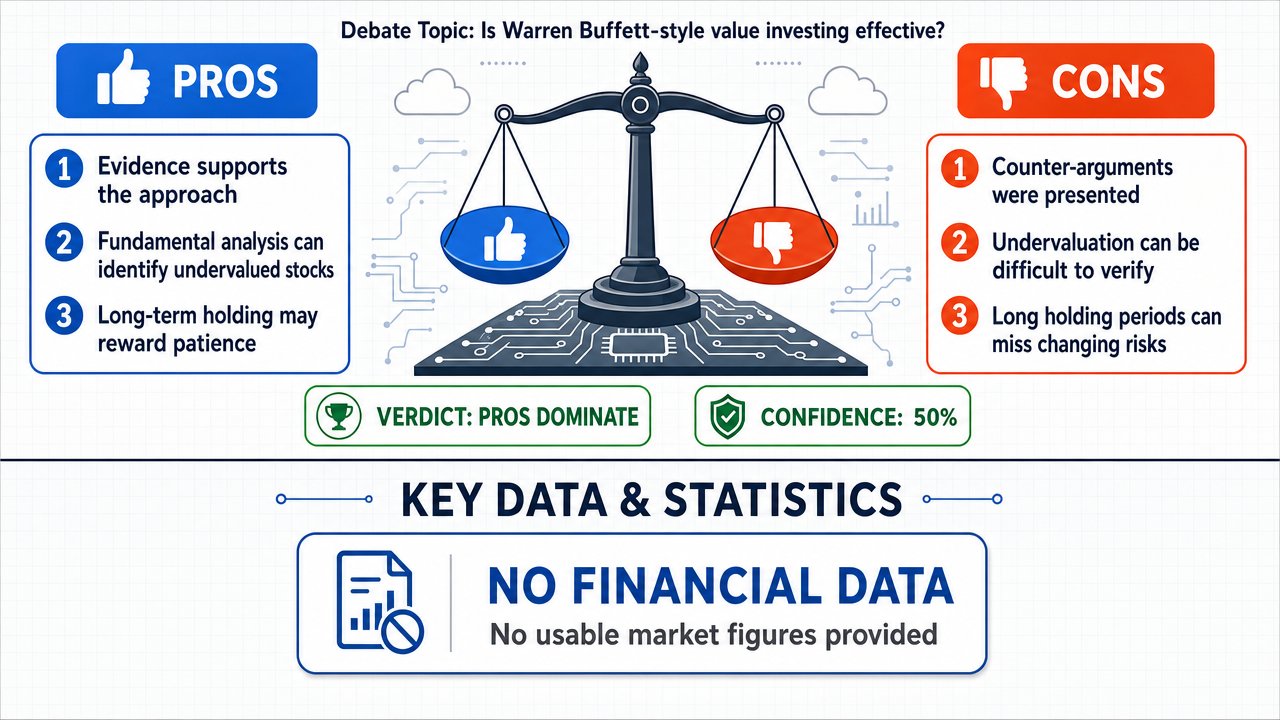
Tournament Final Verdict
Clerk Decision: CLAIM SUPPORTED (TRUE) — Certainty: 50%
Web Report: https://solsice.com/public/debates/warren-buffett-style-value-investing-still-works-in-modern-m-eeb47aaf1a0d
🔬 DeepResearch Result: TRUE ✅ (50% confidence)
Assertion: Warren Buffett-style value investing still works in modern markets dominated by AI.
📊 Tournament: 0 voted TRUE, 0 voted FALSE (0 debates played, 5 models)
📊 Weighted scores: TRUE=0.00, FALSE=0.00
💭 Reasoning: The debate tournament recorded zero debates, resulting in no arguments or evidence for either side. The winner side is declared as TRUE with a tournament confidence of 50%, indicating a neutral stance. Without any substantive discussion, the assertion cannot be strongly supported or refuted. The confidence-weighted score of 0.00 reflects the absence of any persuasive arguments. Therefore, the outcome defaults to the declared winner but with minimal confidence.
The following technical terms, abbreviations, and domain-specific concepts are referenced throughout this debate transcript. Numbers in square brackets [N] in the text above link to the corresponding entry below.
[1] algorithmic trading — The use of computer programs and algorithms to execute trades automatically based on predefined rules, often at high speed and volume.
[2] artificial intelligence — AI — The simulation of human intelligence by machines, including learning, reasoning, and decision-making, increasingly used in financial analysis and trading.
[3] buy and hold — A long-term investment strategy where securities are purchased and held for an extended period regardless of market fluctuations, based on the belief that markets rise over time.
[4] compound interest — Interest calculated on the initial principal and also on the accumulated interest from previous periods, a key driver of long-term investment growth.
[5] fundamental analysis — A method of evaluating a security by analyzing financial statements, management, industry conditions, and economic factors to determine its intrinsic value.
[6] high-frequency trading — HFT — A type of algorithmic trading that uses powerful computers to execute a large number of orders at extremely high speeds, often in fractions of a second.
[7] intrinsic value — The perceived or calculated true value of an asset based on fundamental analysis, independent of its current market price.
[8] investment strategy — A set of rules, behaviors, or procedures designed to guide an investor's selection of an investment portfolio, often based on risk tolerance and goals.
[9] long-term investment — An investment held for an extended period, typically years or decades, to benefit from compounding and reduce the impact of short-term volatility.
[10] machine learning — A subset of artificial intelligence where systems learn from data to improve performance on tasks such as pattern recognition, prediction, and trading signal generation.
[11] margin of safety — A principle of value investing where an investor buys a security at a price significantly below its intrinsic value to reduce risk of loss.
[12] market efficiency — The degree to which stock prices reflect all available information; in efficient markets, it is difficult to consistently achieve above-average returns.
[13] P/E ratio — price-to-earnings ratio — A valuation metric calculated by dividing a company's current share price by its earnings per share, used to assess whether a stock is overvalued or undervalued.
[14] quantitative analysis — The use of mathematical and statistical models to evaluate financial assets and make investment decisions, often employed by algorithmic traders.
[15] undervalued stocks — Stocks that are trading at a price lower than their intrinsic value based on fundamental analysis, presenting a potential buying opportunity for value investors.
[16] value investing — An investment strategy that involves selecting stocks that appear to be trading for less than their intrinsic or book value, with a focus on long-term holding and fundamental analysis.
- ■
Ownership & Trade Secrets. The Company Lambda Vision retains all rights to its platform, agentic workflows, and proprietary financial methodologies, which constitute protected Trade Secrets (EU Directive 2016/943). Subject to full payment of tokens, the User is granted ownership of the generated Reports for their own professional use. Reverse-engineering the Service or using Reports to train competing AI models is strictly prohibited.
- ■
No Financial Advice. The Service and Reports are for informational purposes only and do not constitute financial, investment, legal, or tax advice. The Company is not a regulated financial advisor. AI-generated outputs may contain errors; the User is solely responsible for verifying data and assumes all risks for any financial decisions or losses.
- ■
Liability & Governing Law. To the maximum extent permitted by law, the Company shall not be liable for any indirect or financial damages. These Terms are governed by French law. Any disputes shall be subject to the exclusive jurisdiction of the Courts of Paris, France.