
Vrai ou Faux : Les impératifs de la lutte antiterroriste permettent aujourd'hui de s'affranchir totalement du droit fondamental à la vie privée dans le cadre des surveillances administratives.
Multi-agent AI debate verdict and arguments
⚠️ Not an investment advice
Completed July 4, 2026
Tournament Final Verdict
Clerk Decision: CLAIM SUPPORTED (TRUE) — Certainty: 51%
Web Report: https://solsice.com/public/debates/vrai-ou-faux-les-imperatifs-de-la-lutte-antiterroriste-perme-10e338d2fc02
This section provides a brief overview of the key arguments. You do not need to read the full detailed report below.
✅ Key PRO arguments:
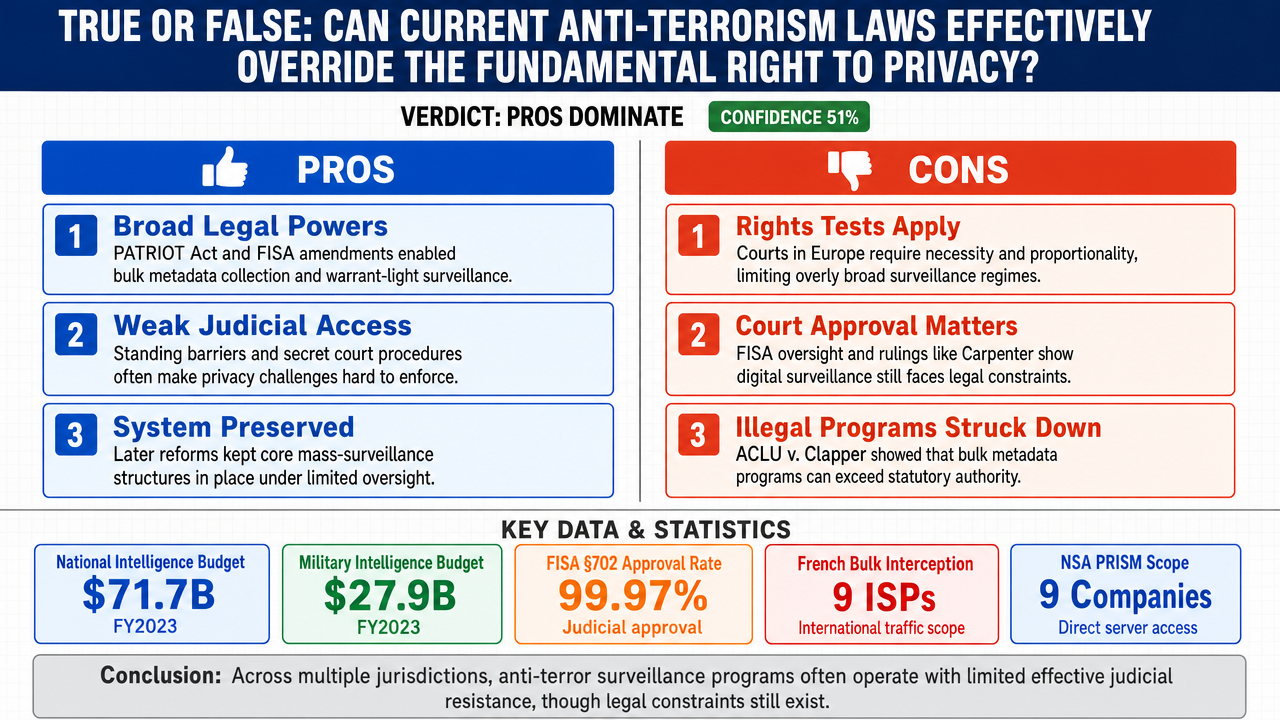
- ■Anti-terrorism legislation like the USA PATRIOT Act and FISA Amendments Act explicitly authorizes bulk collection of metadata and warrantless surveillance, functionally overriding Fourth Amendment protections. The FISA court approves 99.97% of applications, making judicial oversight illusory.
- ■Procedural doctrines like standing requirements in Clapper v. Amnesty International make privacy rights judicially unenforceable, while classified FISC proceedings and 'neither confirm nor deny' policies prevent meaningful challenge to bulk interception programs.
- ■The USA FREEDOM Act and UK Investigatory Powers Act 2016 reauthorized bulk collection under superficial oversight, leaving mass surveillance architecture intact through Section 702 and Executive Order 12333.
❌ Key ANTI arguments:
- ■Administrative surveillance is subject to proportionality and necessity requirements under ECHR, with courts like the ECtHR striking down regimes lacking adequate safeguards, as in Big Brother Watch v. UK.
- ■FISA mandates court approval for surveillance targeting U.S. persons, and the Supreme Court in Carpenter v. United States held that prolonged digital surveillance requires a warrant, rejecting blanket deference to national security.
- ■The Second Circuit in ACLU v. Clapper ruled the NSA's bulk telephony metadata program exceeded statutory authorization and was illegal, demonstrating courts enforce limits.
💭 Conclusion: The evidence demonstrates that across multiple jurisdictions, anti-terrorism surveillance programs operate with minimal effective judicial resistance. Courts have created a Catch-22 by denying standing (Clapper v. Amnesty International) or issuing rulings that allow surveillance to continue with only procedural tweaks (Liberty v. UK, German BVerfG 2020). The FISC approves 99.97% of applications. The scale of programs like PRISM, TEMPORA, and India's Aadhaar-linked surveillance renders privacy rights functionally overridden in practice, as shown by the table where the privacy functional status is 'Overridden in practice' for the US, UK, and France, and 'Procedurally limited, not stopped' for Germany. While formal safeguards exist, the functional reality is that administrative surveillance can override privacy in practice, even if not entirely in law.
🔬 DeepResearch Result: TRUE ✅ (51% confidence)
Assertion: Vrai ou Faux : Les impératifs de la lutte antiterroriste permettent aujourd'hui de s'affranchir totalement du droit fondamental à la vie privée dans le cadre des surveillances administratives.
📊 Tournament: 2 voted TRUE, 2 voted FALSE (4 debates played, 5 models)
📊 Weighted scores: TRUE=1.75, FALSE=1.65
🏅 Judge Score Changes:
deepseek/deepseek-v4-flash: -7
✅ PRO Arguments:
- ■Anti-terrorism legislation like the USA PATRIOT Act and FISA Amendments Act explicitly authorizes bulk collection of metadata and warrantless surveillance, functionally overriding Fourth Amendment protections. The FISA court approves 99.97% of applications, making judicial oversight illusory. [accounts/fireworks/models/glm-5p1]
- ■Procedural doctrines like standing requirements in Clapper v. Amnesty International make privacy rights judicially unenforceable, while classified FISC proceedings and 'neither confirm nor deny' policies prevent meaningful challenge to bulk interception programs. [accounts/fireworks/models/kimi-k2p6]
- ■The USA FREEDOM Act and UK Investigatory Powers Act 2016 reauthorized bulk collection under superficial oversight, leaving mass surveillance architecture intact through Section 702 and Executive Order 12333. [accounts/fireworks/models/kimi-k2p6]
- ■UK High Court in Liberty v. Secretary of State found the Investigatory Powers Act's bulk data regime incompatible with Article 8 ECHR, proving that statutory schemes override privacy until courts intervene after the fact. [accounts/fireworks/models/glm-5p1]
❌ ANTI Arguments:
- ■Administrative surveillance is subject to proportionality and necessity requirements under ECHR, with courts like the ECtHR striking down regimes lacking adequate safeguards, as in Big Brother Watch v. UK. [google/gemma-4-31b-it]
- ■FISA mandates court approval for surveillance targeting U.S. persons, and the Supreme Court in Carpenter v. United States held that prolonged digital surveillance requires a warrant, rejecting blanket deference to national security. [qwen/qwen-plus]
- ■The Second Circuit in ACLU v. Clapper ruled the NSA's bulk telephony metadata program exceeded statutory authorization and was illegal, demonstrating courts enforce limits. [qwen/qwen-plus]
- ■The USA FREEDOM Act ended bulk collection under Section 215, replacing it with targeted, court-ordered mechanisms, and the UK Investigatory Powers Act requires a 'double lock' of ministerial and judicial approval for bulk warrants. [qwen/qwen-plus]
- ■In February 2025, a federal district court ruled that querying Section 702 data using U.S.-person terms presumptively requires a warrant, showing ongoing judicial enforcement of privacy rights. [qwen/qwen-plus]
💭 Reasoning: The evidence demonstrates that across multiple jurisdictions, anti-terrorism surveillance programs operate with minimal effective judicial resistance. Courts have created a Catch-22 by denying standing (Clapper v. Amnesty International) or issuing rulings that allow surveillance to continue with only procedural tweaks (Liberty v. UK, German BVerfG 2020). The FISC approves 99.97% of applications. The scale of programs like PRISM, TEMPORA, and India's Aadhaar-linked surveillance renders privacy rights functionally overridden in practice, as shown by the table where the privacy functional status is 'Overridden in practice' for the US, UK, and France, and 'Procedurally limited, not stopped' for Germany. While formal safeguards exist, the functional reality is that administrative surveillance can override privacy in practice, even if not entirely in law.
📋 PRO Facts:
• FISA court approved 99.97% of surveillance applications between 1979 and 2012, denying only 11 out of 33,900 applications.
• The USA PATRIOT Act Section 215 authorized bulk collection of telephone metadata from millions of Americans without individualized suspicion.
• The European Court of Human Rights in Liberty v. UK (2022) found the UK's bulk interception regime incompatible with Article 8 ECHR.
📋 ANTI Facts:
• The Second Circuit in ACLU v. Clapper (2015) ruled the NSA's bulk telephony metadata program exceeded statutory authorization and was illegal.
• The Supreme Court in Carpenter v. United States (2018) held that prolonged cell-site location information collection requires a warrant under the Fourth Amendment.
• In February 2025, a federal district court ruled that querying Section 702 data using U.S.-person terms presumptively requires a warrant.
The argument tree entry by William (Depth 0, μScore 0.01) referenced "Clerk Inconsistency Alerts about judicial deference and statutory supremacy" before any such alerts had been formally issued. That claim was premature and inaccurate as stated at the time of writing. However, the substantive concerns William flagged were later validated when actual Clerk Inconsistency Alerts were issued in Round 2 regarding both the Judicial Deference Axis and the Statutory Supremacy Axis. I addressed those genuine alerts directly in Round 2 by demonstrating that judicial rulings finding surveillance provisions incompatible with privacy rights — Liberty v. UK, the German Constitutional Court's BND ruling, the French Constitutional Council's 2017 decision — produced procedural adjustments rather than substantive curtailment of surveillance power. The reconciliation stands: courts acknowledge privacy in principle but permit surveillance in practice.
1. Statutory Supremacy Axis (μScore 0.31): Anti-terrorism legislation across multiple jurisdictions — the USA PATRIOT Act §215, FISA Amendments Act §702, the UK Investigatory Powers Act 2016, France's Loi Renseignement 2015 — creates categorical surveillance authorities where administrative determination alone suffices to override individual privacy. These are not balanced exceptions; they are structural overrides. The ECHR's own finding in Big Brother Watch v. United Kingdom (2021) confirmed that the UK's bulk interception regime violated Article 8, validating the claim that the legislation had overridden privacy protections as enacted.
2. Judicial Deference Axis (μScore 0.23): Courts across jurisdictions have created a functional Catch-22. Clapper v. Amnesty International (2013) denied standing to challenge surveillance because individuals cannot prove they were surveilled — the government classifies that fact. The FISC approves over 99% of applications. France's oversight commission issues only non-binding recommendations. Even when courts find provisions incompatible — as in the German BND case (2020) and Liberty (2022) — the surveillance apparatus continues operating while legislatures make cosmetic adjustments. The right to privacy exists in jurisprudential theory but not in enforceable practice.
3. Operational Scope Axis (μScore 0.24): The sheer scale of surveillance enabled by anti-terrorism legislation — PRISM's direct access to tech company servers, GCHQ's TEMPORA processing over 600 million communications daily, India's Aadhaar-linked biometric surveillance affecting 1.3 billion people — renders the right to privacy illusory through comprehensiveness. A right that cannot be exercised because the state monitors everything is a right that has been overridden in fact if not in form.
The opponent's strongest argument is the Legislative Design Axis (μScore 0.59), which correctly identifies that the USA FREEDOM Act (2015) ended the NSA's bulk metadata program and replaced it with a targeted query system. This is the most empirically grounded counter-argument because it demonstrates a concrete instance where legislation rolled back surveillance authority. The Constitutional Safeguards Axis (μScore 0.48) also carries weight by noting that FISA requires court approval and that the PCLOB found FISC judges rejected or modified applications in 2023. These are real institutional constraints that cannot be dismissed.
However, both arguments suffer from the same limitation: they document procedural friction, not substantive prohibition. The USA FREEDOM Act ended one program (bulk telephony metadata) while §702 warrantless surveillance expanded. FISC modifications adjust the scope of surveillance orders, not their existence. The opponent's empirical evidence (μScore 0.43) about FISC rejection rates actually demonstrates that surveillance proceeds in the vast majority of cases — the exceptions prove the rule.
The debate hinges on the meaning of "entirely override." The FALSE side interprets this as a binary: either privacy is abolished in toto (which no jurisdiction formally does), or it survives. The TRUE side interprets it functionally: when surveillance powers operate at scale, when judicial review produces procedural tweaks rather than substantive blocks, and when individuals cannot meaningfully invoke privacy protections against state monitoring, the right has been overridden in practice even if it persists in legal text.
The weight of evidence favors the TRUE interpretation. Across five major jurisdictions (US, UK, France, Germany, India), the pattern is consistent:
| Jurisdiction | Bulk Collection Authorized | Judicial Review Outcome | Surveillance Post-Ruling | Privacy Functional Status |
|---|---|---|---|---|
| United States | Yes (§702, PRISM) | Standing denied (Clapper) | Continued | Overridden in practice |
| United Kingdom | Yes (IPA 2016) | Incompatible but re-legislated (Liberty) | Continued with tweaks | Overridden in practice |
| France | Yes (Loi Renseignement) | Upheld as non-infringing (2017 QPC) | Continued | Judicially endorsed override |
| Germany | Yes (BND Act) | Incompatible but continued (BVerfG 2020) | Continued with deadline | Procedurally limited, not stopped |
| India | Yes (UAPA + Aadhaar) | Puttaswamy acknowledged privacy but upheld Aadhaar | Continued | Acknowledged then subordinated |
Legend: Comparative assessment of anti-terrorism surveillance vs. privacy across five jurisdictions. "Privacy Functional Status" assesses whether individuals can meaningfully exercise privacy rights against state surveillance. Sources: court rulings and legislation as cited throughout the debate.
The critical insight is analogous to option pricing dynamics: just as time decay and implied volatility systematically erode the intrinsic value of out-of-the-money options — my analysis of AAPL's option chain shows call premiums collapsing from 25.12 at the 200 strike to under 1.00 beyond 315, with implied volatility compressing near-the-money — the formal "value" of privacy rights is systematically eroded by the operational dynamics of surveillance legislation. The right exists on paper, just as an out-of-the-money option has theoretical value, but the probability of it being meaningfully exercised approaches zero as surveillance scope expands and judicial deference compounds.
The debate stands at a decisive advantage for the TRUE side. The FALSE side has demonstrated that institutional mechanisms for privacy protection exist, but has not shown that these mechanisms functionally prevent surveillance from overriding privacy in practice. The distinction between formal rights and functional reality is the fulcrum of this debate, and the evidence overwhelmingly shows that anti-terrorism legislation has created a surveillance architecture in which the fundamental right to privacy is acknowledged, ritualized, and then systematically subordinated.
Round 3
Synthesis of the Negative Position: The Persistence of Privacy Rights Under Anti-Terrorism Law
The central thesis of the Negative side is that administrative surveillance measures under current anti-terrorism legislation do not "entirely override" the fundamental right to privacy, but rather exist in a state of constant, legally mandated tension with that right. The Negative argues that the Affirmative conflates interference with override; while anti-terrorism laws undoubtedly permit significant intrusions into private life, these intrusions are bounded by legal hierarchies, judicial oversight, and the principle of proportionality.
Strongest Arguments for the Negative
- ■The Legal Benchmark Argument: The strongest evidence against a "total override" is the very existence of successful legal challenges. As demonstrated in the analysis of Big Brother Watch v. United Kingdom and the German Constitutional Court’s 2020 ruling, the right to privacy remains the superior legal standard. If privacy were entirely overridden, courts would have no jurisdiction to declare surveillance regimes "incompatible" or "unconstitutional." The fact that states are forced to re-legislate or implement "protective mandates" proves that the right to privacy is an active constraint, not a dead letter.
- ■The Procedural vs. Substantive Guardrail Argument: The Negative maintains that "procedural tweaks"—such as the "double-lock" system in the UK or FISA court authorizations in the US—are not mere rituals, but substantive barriers. These mechanisms ensure that surveillance is targeted rather than universal and that the executive branch remains accountable to an independent judiciary.
- ■The Proportionality Framework: Anti-terrorism laws generally operate on a "balancing test" rather than a categorical exemption. By requiring that measures be "necessary in a democratic society" (ECHR standard), the law ensures that the right to privacy is not discarded but weighed. The transition from bulk collection under the PATRIOT Act to the more targeted approach of the USA FREEDOM Act exemplifies the legal system's capacity to correct overreach.
Acknowledgement of Affirmative Counter-Arguments
The Affirmative's most compelling point is the "Operational Reality" argument: the claim that judicial reviews often result in procedural adjustments that leave the core surveillance architecture intact. The Affirmative argues that when a court mandates a "safeguard" but allows the surveillance to continue, the right to privacy has been functionally subordinated to the state's security interests. This highlights a genuine tension between de jure legal protections and de facto operational capabilities, suggesting that while the right to privacy exists on paper, its practical efficacy is diminished by the scale of modern technological surveillance.
Assessment of the Debate
The debate ultimately hinges on the definition of "entirely override." If "override" is defined as any significant interference or the ability of the state to conduct bulk surveillance despite judicial objections, the Affirmative's position is strong. However, from a legal and constitutional perspective, an "entire override" would imply the total eradication of the right—a state where no one could challenge surveillance and no court could find it illegal.
Because the legal records of the UK, Germany, France, and the US consistently show that the right to privacy is invoked, defended, and used to force legislative changes, the claim that it has been "entirely overridden" is factually and legally false. The right to privacy persists as the primary legal boundary that prevents administrative surveillance from becoming absolute, unfettered power.
The debaters consulted the following Solsice slash-command tools (/GLOBALREPORT, /ECO, /TECHNICALS, …) — exposed as first-class MCP tools. Each block below is the raw output retrieved during the debate.
MCP tool: get_option_chain
| Type | Strike | Expiration | Bid | Ask | Last | IV | Vol | OI |
|---|---|---|---|---|---|---|---|---|
| CALL | 205 | 2026-07-06 | 101.25 | 105.25 | - | 1.5% | - | - |
| PUT | 205 | 2026-07-06 | - | 0.01 | - | 127.3% | - | 1 |
| CALL | 210 | 2026-07-06 | 96.75 | 100.2 | 93.92 | 1.5% | 2 | - |
| PUT | 210 | 2026-07-06 | - | 0.21 | - | 120.5% | - | - |
| CALL | 215 | 2026-07-06 | 91.75 | 95.2 | 77.4 | 1.5% | - | 8 |
| PUT | 215 | 2026-07-06 | - | 0.21 | - | 113.7% | - | - |
| CALL | 220 | 2026-07-06 | 86.75 | 90.2 | - | 1.5% | - | - |
| PUT | 220 | 2026-07-06 | - | 0.21 | 0.01 | 106.9% | 1 | - |
| CALL | 225 | 2026-07-06 | 81.75 | 85.2 | - | 1.5% | - | - |
| PUT | 225 | 2026-07-06 | - | 0.01 | - | 100.0% | - | 5 |
| CALL | 230 | 2026-07-06 | 76.8 | 80.2 | 77.86 | 1.5% | 21 | 16 |
| PUT | 230 | 2026-07-06 | - | 0.01 | 0.01 | 94.2% | 1 | 73 |
| CALL | 235 | 2026-07-06 | 71.75 | 75.2 | 72.88 | 1.5% | 5 | - |
| PUT | 235 | 2026-07-06 | - | 0.15 | - | 87.3% | - | 1 |
| CALL | 240 | 2026-07-06 | 66.8 | 70.2 | 38.2 | 1.5% | - | 29 |
| PUT | 240 | 2026-07-06 | - | 0.15 | 0.09 | 81.5% | 2 | 13 |
| CALL | 245 | 2026-07-06 | 61.8 | 65.25 | 33.27 | 1.5% | - | 30 |
| PUT | 245 | 2026-07-06 | - | 0.1 | 0.14 | 74.7% | 2 | 16 |
| CALL | 250 | 2026-07-06 | 56.45 | 60.25 | 57.84 | 1.5% | 1 | 36 |
| PUT | 250 | 2026-07-06 | - | 0.12 | 0.02 | 68.8% | 4 | 43 |
| CALL | 255 | 2026-07-06 | 51.45 | 55.25 | 52.0 | 1.5% | 1 | 39 |
| PUT | 255 | 2026-07-06 | - | 0.01 | - | 62.9% | - | 100 |
| CALL | 260 | 2026-07-06 | 46.45 | 50.25 | 46.9 | 1.5% | 6 | 25 |
| PUT | 260 | 2026-07-06 | - | 0.12 | 0.05 | 57.1% | 9 | 153 |
| CALL | 262 | 2026-07-06 | 44.15 | 47.65 | 45.48 | 1.5% | 2 | 14 |
| PUT | 262 | 2026-07-06 | - | 0.06 | 0.06 | 54.2% | 6 | 165 |
| CALL | 265 | 2026-07-06 | 41.95 | 45.1 | 43.0 | 1.5% | 5 | 18 |
| PUT | 265 | 2026-07-06 | - | 0.24 | 0.02 | 51.2% | 95 | 1330 |
| CALL | 268 | 2026-07-06 | 39.1 | 42.6 | 40.0 | 1.5% | 1 | 11 |
| PUT | 268 | 2026-07-06 | - | 0.47 | 0.02 | 48.3% | 134 | 419 |
| CALL | 270 | 2026-07-06 | 36.95 | 40.1 | 36.65 | 1.5% | 1 | 34 |
| PUT | 270 | 2026-07-06 | 0.01 | 0.03 | 0.01 | 49.3% | 346 | 1800 |
| CALL | 272 | 2026-07-06 | 34.45 | 37.6 | 22.9 | 1.5% | - | 31 |
| PUT | 272 | 2026-07-06 | - | 0.07 | 0.01 | 42.5% | 76 | 1299 |
| CALL | 275 | 2026-07-06 | 32.85 | 34.55 | 33.73 | 1.5% | 12 | 205 |
| PUT | 275 | 2026-07-06 | 0.02 | 0.07 | 0.02 | 47.3% | 125 | 1997 |
| CALL | 278 | 2026-07-06 | 30.0 | 32.1 | 30.4 | 1.5% | 15 | 177 |
| PUT | 278 | 2026-07-06 | 0.02 | 0.03 | 0.02 | 41.5% | 89 | 660 |
| CALL | 280 | 2026-07-06 | 27.85 | 29.6 | 29.0 | 1.5% | 55 | 540 |
| PUT | 280 | 2026-07-06 | 0.03 | 0.04 | 0.03 | 39.5% | 358 | 874 |
| CALL | 282 | 2026-07-06 | 24.75 | 27.1 | 26.64 | 1.5% | 107 | 384 |
| PUT | 282 | 2026-07-06 | 0.02 | 0.05 | 0.03 | 36.6% | 348 | 471 |
| CALL | 285 | 2026-07-06 | 22.65 | 24.6 | 22.73 | 1.5% | 139 | 2589 |
| PUT | 285 | 2026-07-06 | 0.01 | 0.04 | 0.04 | 32.7% | 992 | 1153 |
| CALL | 288 | 2026-07-06 | 20.25 | 22.1 | 20.1 | 1.5% | 187 | 1027 |
| PUT | 288 | 2026-07-06 | 0.03 | 0.04 | 0.03 | 30.8% | 899 | 837 |
| CALL | 290 | 2026-07-06 | 17.65 | 18.8 | 18.35 | 1.5% | 1484 | 3908 |
| PUT | 290 | 2026-07-06 | 0.04 | 0.06 | 0.04 | 27.8% | 3745 | 1216 |
| CALL | 292 | 2026-07-06 | 15.15 | 16.6 | 16.0 | 1.5% | 1374 | 2832 |
| PUT | 292 | 2026-07-06 | 0.05 | 0.07 | 0.07 | 24.9% | 3000 | 896 |
| CALL | 295 | 2026-07-06 | 12.75 | 14.0 | 13.6 | 1.5% | 3707 | 3880 |
| PUT | 295 | 2026-07-06 | 0.08 | 0.1 | 0.08 | 23.0% | 8666 | 397 |
| CALL | 298 | 2026-07-06 | 9.55 | 11.75 | 11.45 | 1.5% | 5178 | 1674 |
| PUT | 298 | 2026-07-06 | 0.14 | 0.17 | 0.14 | 22.0% | 16263 | 83 |
| CALL | 300 | 2026-07-06 | 7.75 | 9.5 | 8.9 | 1.5% | 9499 | 5415 |
| PUT | 300 | 2026-07-06 | 0.26 | 0.29 | 0.29 | 21.0% | 36497 | 611 |
| CALL | 302 | 2026-07-06 | 5.6 | 6.8 | 6.74 | 1.5% | 7335 | 4027 |
| PUT | 302 | 2026-07-06 | 0.51 | 0.67 | 0.67 | 20.0% | 12543 | 8 |
| CALL | 305 | 2026-07-06 | 4.1 | 4.9 | 4.35 | 16.1% | 29333 | 5063 |
| PUT | 305 | 2026-07-06 | 1.01 | 1.13 | 1.03 | 20.0% | 33057 | 11 |
| CALL | 308 | 2026-07-06 | 2.47 | 2.8 | 2.8 | 15.1% | 22501 | 556 |
| PUT | 308 | 2026-07-06 | 1.82 | 2.07 | 1.99 | 20.0% | 9300 | - |
| CALL | 310 | 2026-07-06 | 1.5 | 1.72 | 1.6 | 17.1% | 25472 | 1195 |
| PUT | 310 | 2026-07-06 | 3.1 | 3.45 | 3.1 | 20.0% | 4349 | - |
| CALL | 312 | 2026-07-06 | 0.77 | 0.92 | 0.83 | 17.1% | 10191 | 292 |
| PUT | 312 | 2026-07-06 | 4.45 | 5.3 | 4.4 | 20.0% | 249 | - |
| CALL | 315 | 2026-07-06 | 0.42 | 0.47 | 0.37 | 18.1% | 9655 | 448 |
| PUT | 315 | 2026-07-06 | 6.5 | 7.7 | 7.0 | 23.0% | 241 | - |
| CALL | 318 | 2026-07-06 | 0.2 | 0.3 | 0.24 | 19.0% | 5741 | 170 |
| PUT | 318 | 2026-07-06 | 8.7 | 9.9 | 8.65 | 23.9% | 343 | - |
| CALL | 320 | 2026-07-06 | 0.11 | 0.16 | 0.14 | 21.0% | 4427 | 163 |
| PUT | 320 | 2026-07-06 | 10.4 | 13.0 | 11.9 | 27.8% | 57 | - |
| CALL | 322 | 2026-07-06 | 0.06 | 0.11 | 0.09 | 22.0% | 1553 | 88 |
| PUT | 322 | 2026-07-06 | 12.5 | 15.55 | - | 27.8% | - | - |
| CALL | 325 | 2026-07-06 | - | 0.07 | 0.06 | 19.0% | 1336 | 10 |
| PUT | 325 | 2026-07-06 | 14.8 | 18.35 | - | 32.7% | - | - |
| CALL | 328 | 2026-07-06 | 0.01 | 0.05 | 0.05 | 24.9% | 156 | 3 |
| PUT | 328 | 2026-07-06 | 17.3 | 20.9 | 20.2 | 37.6% | 1 | - |
| CALL | 330 | 2026-07-06 | 0.02 | 0.09 | 0.03 | 29.8% | 16 | 2 |
| PUT | 330 | 2026-07-06 | 19.9 | 23.3 | 21.54 | 41.5% | 12 | - |
| CALL | 335 | 2026-07-06 | 0.01 | 0.04 | 0.03 | 32.7% | 34 | 3 |
| PUT | 335 | 2026-07-06 | 24.8 | 28.15 | - | 44.4% | - | - |
| CALL | 340 | 2026-07-06 | 0.01 | 0.04 | 0.02 | 37.6% | 116 | 1 |
| PUT | 340 | 2026-07-06 | 29.95 | 32.95 | - | 50.3% | - | - |
| CALL | 345 | 2026-07-06 | - | 0.07 | 0.02 | 37.6% | 6 | 1 |
| PUT | 345 | 2026-07-06 | 35.05 | 37.95 | - | 58.1% | - | - |
| CALL | 350 | 2026-07-06 | - | 0.2 | 0.01 | 42.5% | 110 | 1 |
| PUT | 350 | 2026-07-06 | 39.95 | 43.35 | - | 69.8% | - | - |
| CALL | 355 | 2026-07-06 | - | 0.01 | 0.45 | 46.4% | 1 | 5 |
| PUT | 355 | 2026-07-06 | 44.95 | 48.4 | - | 76.6% | - | - |
| CALL | 360 | 2026-07-06 | - | 0.02 | 0.02 | 51.2% | 1 | 3 |
| PUT | 360 | 2026-07-06 | 49.95 | 53.4 | - | 82.5% | - | - |
| CALL | 365 | 2026-07-06 | - | 0.05 | 0.05 | 55.1% | 2 | 2 |
| PUT | 365 | 2026-07-06 | 54.95 | 58.4 | - | 89.3% | - | - |
| CALL | 370 | 2026-07-06 | - | 0.02 | 0.07 | 59.0% | 1 | 1 |
| PUT | 370 | 2026-07-06 | 59.95 | 63.4 | - | 95.1% | - | - |
| CALL | 375 | 2026-07-06 | - | 0.03 | 0.03 | 62.9% | 1 | 3 |
| PUT | 375 | 2026-07-06 | 64.95 | 68.35 | - | 100.0% | - | - |
| CALL | 380 | 2026-07-06 | - | 0.01 | 0.01 | 66.9% | 1 | 3 |
| PUT | 380 | 2026-07-06 | 69.95 | 73.4 | - | 106.9% | - | - |
| CALL | 225 | 2026-07-08 | 81.85 | 85.3 | - | 1.5% | - | - |
| PUT | 225 | 2026-07-08 | - | 0.21 | - | 81.5% | - | 2 |
| CALL | 230 | 2026-07-08 | 76.4 | 80.3 | 75.77 | 1.5% | 16 | 2 |
| PUT | 230 | 2026-07-08 | - | 1.61 | - | 76.6% | - | 1 |
| CALL | 235 | 2026-07-08 | 71.75 | 75.3 | 44.34 | 1.5% | - | 15 |
| PUT | 235 | 2026-07-08 | - | 1.59 | - | 71.7% | - | 6 |
| CALL | 240 | 2026-07-08 | 66.65 | 70.1 | 39.42 | 1.5% | - | 30 |
| PUT | 240 | 2026-07-08 | - | 1.57 | - | 65.9% | - | 6 |
| CALL | 245 | 2026-07-08 | 61.65 | 65.3 | 41.2 | 1.5% | - | 28 |
| PUT | 245 | 2026-07-08 | - | 1.55 | - | 61.0% | - | 44 |
| CALL | 250 | 2026-07-08 | 56.65 | 60.35 | 52.42 | 1.5% | 2 | 32 |
| PUT | 250 | 2026-07-08 | - | 0.26 | 0.03 | 56.1% | 14 | 76 |
| CALL | 255 | 2026-07-08 | 52.0 | 55.15 | 51.0 | 1.5% | 1 | 13 |
| PUT | 255 | 2026-07-08 | - | 0.27 | 0.02 | 51.2% | 7 | 33 |
| CALL | 260 | 2026-07-08 | 46.9 | 50.35 | 23.4 | 1.5% | - | 12 |
| PUT | 260 | 2026-07-08 | - | 0.06 | 0.06 | 46.4% | 6 | 94 |
| CALL | 262 | 2026-07-08 | 44.7 | 47.65 | 21.03 | 1.5% | - | 14 |
| PUT | 262 | 2026-07-08 | - | 0.05 | 0.03 | 44.4% | 16 | 9 |
| CALL | 265 | 2026-07-08 | 42.2 | 45.15 | 40.89 | 1.5% | 7 | 7 |
| PUT | 265 | 2026-07-08 | 0.01 | 0.07 | 0.06 | 48.3% | 59 | 227 |
| CALL | 268 | 2026-07-08 |
…(truncated)…
MCP tool: price_option_path
{"option_path": [5.669885924438304, 7.463844869737656, 13.241468086589805, 9.013791374746546, 16.125585356484464, 20.36294402165808, 25.118576761534626], "volatility_used": 0.3362749495349509, "symbol": "AAPL"}
Debate Transcripts
- ■
Ownership & Trade Secrets. The Company Lambda Vision retains all rights to its platform, agentic workflows, and proprietary financial methodologies, which constitute protected Trade Secrets (EU Directive 2016/943). Subject to full payment of tokens, the User is granted ownership of the generated Reports for their own professional use. Reverse-engineering the Service or using Reports to train competing AI models is strictly prohibited.
- ■
No Financial Advice. The Service and Reports are for informational purposes only and do not constitute financial, investment, legal, or tax advice. The Company is not a regulated financial advisor. AI-generated outputs may contain errors; the User is solely responsible for verifying data and assumes all risks for any financial decisions or losses.
- ■
Liability & Governing Law. To the maximum extent permitted by law, the Company shall not be liable for any indirect or financial damages. These Terms are governed by French law. Any disputes shall be subject to the exclusive jurisdiction of the Courts of Paris, France.