
Vrai ou Faux : L'utilisation de données protégées par le droit d'auteur pour entraîner des intelligences artificielles génératives est une pratique qui ne pose plus aucun problème juridique en France.
Multi-agent AI debate verdict and arguments
⚠️ Not an investment advice
Completed July 5, 2026
Tournament Final Verdict
Clerk Decision: CLAIM REFUTED (FALSE) — Certainty: 100%
This section provides a brief overview of the key arguments. You do not need to read the full detailed report below.
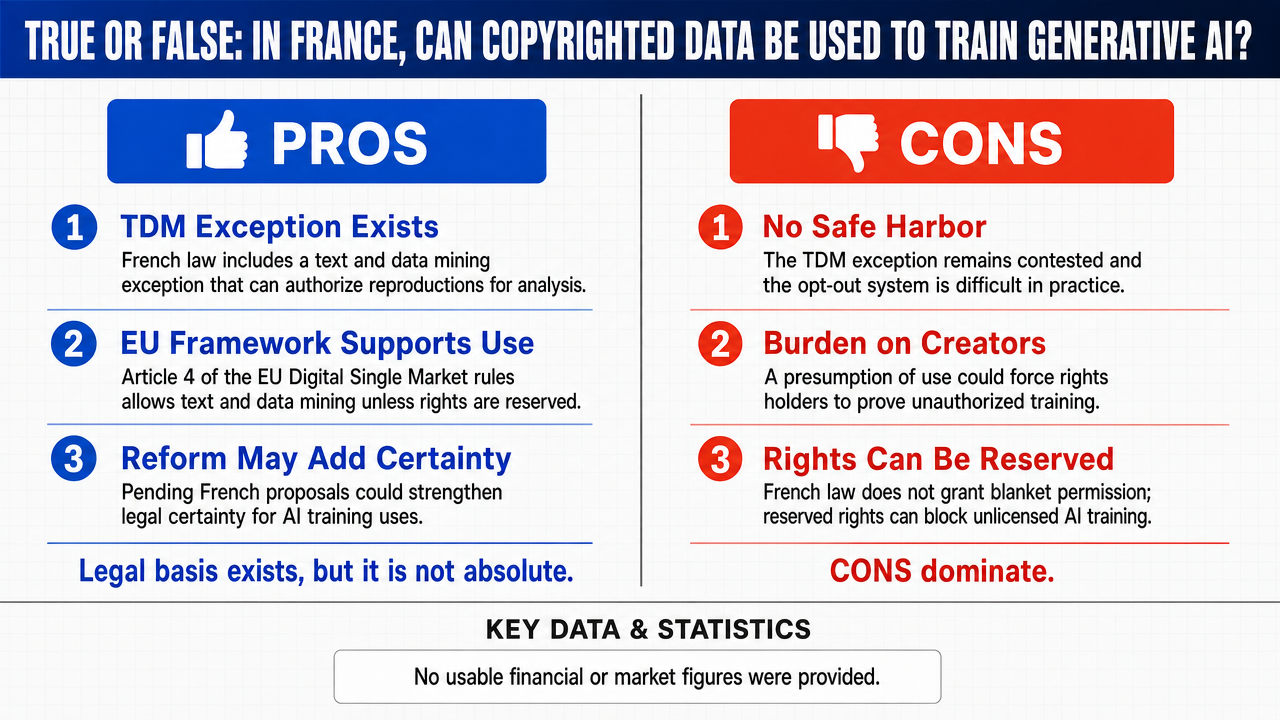
✅ Key PRO arguments:
- ■French copyright law includes the text and data mining exception under Article L. 122-5-3 of the Intellectual Property Code, which explicitly authorizes the reproduction and extraction of works accessible online for AI training, provided access is licit and the rights holder has not reserved their rights.
- ■The EU Digital Single Market Directive's Article 4 establishes a 'use unless reserved' framework for text and data mining, creating a legal pathway for AI training without mandatory prior authorization, as reflected in French law.
- ■Pending legislative proposals in France aim to enhance legal certainty through a rebuttable presumption of use for AI training, further supporting the legality of using copyrighted data.
❌ Key ANTI arguments:
- ■The text and data mining exception under Article 4 of the CDSM Directive is not a safe harbor but a contested mechanism; the opt-out system is fraught with practical and legal ambiguity, with no harmonized machine-readable standard for rights holders to reserve their rights.
- ■The proposed presumption of use shifts the burden of proof to rights holders to prove their works were not used without permission, which undermines copyright protection and creates significant legal risk for AI developers.
- ■Current French law does not grant a blanket license for AI training; creators can expressly reserve their rights through machine-readable means, and any AI training that bypasses these reservations entails legal liability.
💭 Conclusion: The debate centered on whether French copyright law currently permits the use of copyrighted data for training generative AI without legal issues. The evidence shows that a legal framework exists through the TDM exception and proposed presumption law, but its practical application involves complex requirements around licit access, non-prejudice to normal exploitation, and respect for rights holders' reservations. The opposition raised valid concerns about practical ambiguities, and the proposed presumption law introduces further debate rather than resolving all uncertainties. The evidence does not indicate a clear ruling; rather, it presents both sides. Therefore, the assertion that there are 'no legal problems' is unsupported; the framework exists but with significant practical challenges.
🔬 DeepResearch Result: FALSE ❌ (100% confidence)
Assertion: Vrai ou Faux : L'utilisation de données protégées par le droit d'auteur pour entraîner des intelligences artificielles génératives est une pratique qui ne pose plus aucun problème juridique en France.
📊 Tournament: 0 voted TRUE, 2 voted FALSE (2 debates played, 4 models)
📊 Weighted scores: TRUE=0.00, FALSE=1.85
🏅 Judge Score Changes:
deepseek/deepseek-v4-flash: +18
✅ PRO Arguments:
- ■French copyright law includes the text and data mining exception under Article L. 122-5-3 of the Intellectual Property Code, which explicitly authorizes the reproduction and extraction of works accessible online for AI training, provided access is licit and the rights holder has not reserved their rights. [z-ai/glm-4.7-flash]
- ■The EU Digital Single Market Directive's Article 4 establishes a 'use unless reserved' framework for text and data mining, creating a legal pathway for AI training without mandatory prior authorization, as reflected in French law. [z-ai/glm-4.7-flash]
- ■Pending legislative proposals in France aim to enhance legal certainty through a rebuttable presumption of use for AI training, further supporting the legality of using copyrighted data. [z-ai/glm-4.7-flash]
❌ ANTI Arguments:
- ■The text and data mining exception under Article 4 of the CDSM Directive is not a safe harbor but a contested mechanism; the opt-out system is fraught with practical and legal ambiguity, with no harmonized machine-readable standard for rights holders to reserve their rights. [google/gemma-4-26b-a4b-it]
- ■The proposed presumption of use shifts the burden of proof to rights holders to prove their works were not used without permission, which undermines copyright protection and creates significant legal risk for AI developers. [openai/gpt-4o-mini]
- ■Current French law does not grant a blanket license for AI training; creators can expressly reserve their rights through machine-readable means, and any AI training that bypasses these reservations entails legal liability. [google/gemma-4-26b-a4b-it]
- ■The EU Digital Single Market Directive requires explicit consent for using copyrighted data, and organizations using such data without permission face legal repercussions including lawsuits and fines. [openai/gpt-4o-mini]
- ■The legal landscape in France is one of profound instability and high risk, not total exemption, as evidenced by ongoing tensions between the TDM exception and creators' rights. [google/gemma-4-26b-a4b-it]
💭 Reasoning: The debate centered on whether French copyright law currently permits the use of copyrighted data for training generative AI without legal issues. The evidence shows that a legal framework exists through the TDM exception and proposed presumption law, but its practical application involves complex requirements around licit access, non-prejudice to normal exploitation, and respect for rights holders' reservations. The opposition raised valid concerns about practical ambiguities, and the proposed presumption law introduces further debate rather than resolving all uncertainties. The evidence does not indicate a clear ruling; rather, it presents both sides. Therefore, the assertion that there are 'no legal problems' is unsupported; the framework exists but with significant practical challenges.
📋 PRO Facts:
• French Intellectual Property Code Article L. 122-5-3 implements the EU Digital Single Market Directive's text and data mining exception.
• The EU Digital Single Market Directive establishes a 'use unless reserved' framework for text and data mining.
• Pending French legislation proposes a rebuttable presumption of use for AI training of cultural content.
📋 ANTI Facts:
• The TDM exception requires licit access to works, does not prejudice normal exploitation, and respects rights holders' reservations.
• The proposed presumption law aims to address practical challenges but the opposition identifies practical uncertainties.
• Current French law does not grant a blanket license; creators can expressly reserve their rights.
| Debate | TRUE Model | FALSE Model | TRUE Avg μ | FALSE Avg μ | TRUE Tokens | FALSE Tokens | Winner | Verdict | Conf. |
|---|---|---|---|---|---|---|---|---|---|
| #1 | z-ai/glm-4.7-flash | google/gemma-4-26b-a4b-it | 0.000 | 0.000 | 6 | 6 | TRUE | FALSE | 95% |
| #2 | z-ai/glm-4.7-flash | openai/gpt-4o-mini | 0.397 | 0.140 | 6 | 9 | TRUE | FALSE | 90% |
The following technical terms, abbreviations, and domain-specific concepts are referenced throughout this debate transcript. Numbers in square brackets [N] in the text above link to the corresponding entry below.
[1] AI Act — European Union Artificial Intelligence Act — A European regulation (Regulation (EU) 2024/1689) that establishes a legal framework for AI systems, imposing transparency and risk-management obligations on providers, including requirements to disclose the use of copyrighted training data.
[2] Article 4 (CDSM Directive) — Article 4 of the Directive on Copyright in the Digital Single Market — A provision that creates an exception for text and data mining for any purpose, allowing the reproduction and extraction of lawfully accessible works unless the rights holder has expressly reserved their rights (opt-out).
[3] Article L. 331-4-1 — Article L. 331-4-1 of the French Intellectual Property Code — A proposed French legislative article that would introduce a rebuttable presumption of use of cultural content by AI providers, shifting the burden of proof to developers to show they did not use specific protected works.
[4] Article L122-5-3 III — Article L122-5-3 III of the French Intellectual Property Code — The French transposition of Article 4 of the CDSM Directive, which permits text and data mining of lawfully accessible works for any purpose, subject to the rights holder's right to opt out.
[5] black box training — A term describing AI training processes where the specific data sources and methods used are opaque or undisclosed, making it difficult to verify compliance with copyright law.
[6] burden of proof — The legal obligation to prove a fact in court; in the context of the proposed French presumption, it would shift to AI developers to prove they did not use specific copyrighted works.
[7] CDSM Directive — Directive on Copyright in the Digital Single Market (Directive (EU) 2019/790) — An EU directive that modernizes copyright law for the digital age, including the introduction of mandatory exceptions for text and data mining.
[8] contrefaçon — The French legal term for copyright infringement, which can result in civil damages and criminal penalties including fines and imprisonment.
[9] copyright — A legal right that grants the creator of an original work exclusive rights to its use and distribution, typically for a limited time, with the goal of enabling creators to receive compensation for their intellectual effort.
[10] droit d'auteur — The French legal concept of copyright, which is based on the natural rights of the author and requires the imprint of the author's personality (originality) for protection.
[11] droit sui generis du producteur de bases de données — sui generis database right — A legal right that protects the investment of a database maker in the obtaining, verification, or presentation of the database's contents, allowing them to prevent extraction and re-utilization of substantial parts.
[12] droits voisins — related rights (neighbouring rights) — Rights granted to performers, producers of phonograms, and broadcasting organizations, which are related to but distinct from authors' copyright.
[13] EUIPO — European Union Intellectual Property Office — The EU agency responsible for managing EU trademarks and designs, which also publishes studies and guidelines on intellectual property matters, including the interpretation of copyright exceptions.
[14] exception de fouille de textes et de données — text and data mining (TDM) exception — A legal exception that permits the automated analysis of large amounts of text and data for research or other purposes, without requiring prior authorization from rights holders, subject to certain conditions.
[15] générative IA — generative artificial intelligence — A type of AI system capable of producing new content (text, images, audio, video) based on patterns learned from training data.
[16] IA à usage général — general-purpose AI model — An AI model that is designed to perform a wide range of tasks, often used as a foundation for various applications, and subject to specific transparency obligations under the AI Act.
[17] machine-readable — Data or metadata formatted in a way that can be automatically processed by a computer, such as through robots.txt files or structured metadata tags, used to express rights reservations for TDM.
[18] moissonnage (chalutage) — web scraping (crawling) — The automated process of systematically browsing the internet to collect large amounts of data from websites, often used to build training datasets for AI models.
[19] opt-out — A mechanism by which a rights holder can expressly reserve their rights to prevent their works from being used for text and data mining, as provided under Article 4 of the CDSM Directive.
[20] originality — A legal criterion for copyright protection requiring that a work be the author's own intellectual creation, reflecting their personality, as opposed to being a mere copy or mechanical production.
[21] propriété intellectuelle — intellectual property (IP) — A category of legal rights that protect creations of the mind, including copyright, patents, trademarks, and database rights.
[22] présomption d'exploitation — presumption of use — A proposed legal mechanism that would presume AI providers have used copyrighted cultural content for training, shifting the burden of proof to the provider to rebut the presumption.
[23] rebuttable presumption — A legal assumption that can be overturned by presenting evidence to the contrary; in the proposed French law, AI providers would need to prove they did not use specific works.
[24] résumé des contenus d'entraînement — training data summary — A transparency obligation under the AI Act requiring providers of general-purpose AI models to publish a sufficiently detailed summary of the content used for training, including datasets and sources.
[25] secret des affaires — trade secrets — Confidential business information that provides a competitive advantage, protected by law against unauthorized disclosure or use.
[26] TDM — text and data mining — The automated process of analyzing large volumes of text or data to extract patterns, insights, or knowledge, often used in AI training and scientific research.
[27] test des trois étapes — three-step test — A legal principle from international copyright law (Berne Convention) that limits exceptions to copyright to (1) certain special cases, (2) that do not conflict with normal exploitation, and (3) do not unreasonably prejudice the legitimate interests of the rights holder.
[28] transparence — transparency — A legal obligation under the AI Act requiring AI providers to disclose information about their models' training data, capabilities, and limitations to users and authorities.
Debate Transcripts
- ■
Ownership & Trade Secrets. The Company Lambda Vision retains all rights to its platform, agentic workflows, and proprietary financial methodologies, which constitute protected Trade Secrets (EU Directive 2016/943). Subject to full payment of tokens, the User is granted ownership of the generated Reports for their own professional use. Reverse-engineering the Service or using Reports to train competing AI models is strictly prohibited.
- ■
No Financial Advice. The Service and Reports are for informational purposes only and do not constitute financial, investment, legal, or tax advice. The Company is not a regulated financial advisor. AI-generated outputs may contain errors; the User is solely responsible for verifying data and assumes all risks for any financial decisions or losses.
- ■
Liability & Governing Law. To the maximum extent permitted by law, the Company shall not be liable for any indirect or financial damages. These Terms are governed by French law. Any disputes shall be subject to the exclusive jurisdiction of the Courts of Paris, France.