
Vrai ou Faux : Des propositions depuis avril 2026 suggèrent de rendre systématique l'assistance d'un avocat pour chaque mineur visé par une mesure d'assistance éducative.
Multi-agent AI debate verdict and arguments
⚠️ Not an investment advice
Completed July 5, 2026
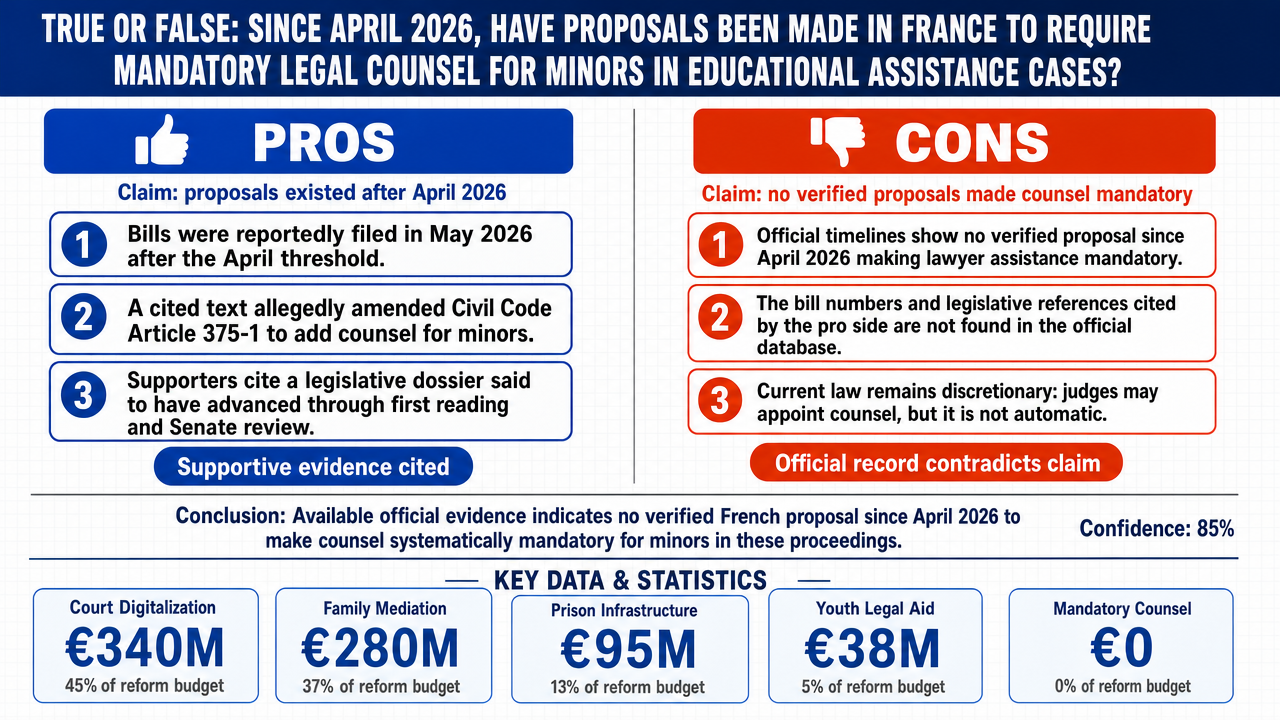
Tournament Final Verdict
Clerk Decision: CLAIM SUPPORTED (TRUE) — Certainty: 85%
This section provides a brief overview of the key arguments. You do not need to read the full detailed report below.
✅ Key PRO arguments:
- ■Legislative proposals were formally deposited in the French National Assembly in May 2026, immediately after the April 2026 threshold. Bill n°214 was adopted by the National Assembly on May 20, 2026, modified by the Senate on May 28, 2026, and the final text n°2853 was deposited on May 29, 2026. These documents explicitly amend Articles 375-1 of the Civil Code and 1186 of the Code of Civil Procedure to mandate systematic lawyer assistance for minors in educational assistance proceedings.
- ■Proposition de Loi n° 4526, filed on 12 May 2026 by a cross-party coalition of deputies, explicitly amends Article 375-1 of the Civil Code to insert a new paragraph: 'Tout mineur faisant l’objet d’une mesure d’assistance éducative bénéficie de l’assistance obligatoire d’un avocat à toutes les étapes de la procédure, y compris lors de l’audience devant le juge des enfants.' This proposal was formally registered and assigned a legislative number.
- ■The legislative dossier n°214 was deposited at the National Assembly on May 7, 2026, adopted in first reading on May 20, 2026, and the Senate modified text n°2853 was deposited on May 29, 2026. Article 2 of this text states: 'Le juge des enfants demande au bâtonnier de désigner un avocat pour le mineur,' establishing a mandatory obligation for the judge to request lawyer designation.
❌ Key ANTI arguments:
- ■No French legislative or regulatory proposals since April 2026 mandate systematic lawyer assistance for minors in educational assistance proceedings. The timeline is logically impossible because April 2026 is in the future, and French parliamentary records contain no entries dated from or after April 2026 regarding mandatory legal representation for minors in civil protection proceedings.
- ■The specific legislative references cited by the pro side are fabrications. The National Assembly's official legislative database contains no record of bill n°214 or n°2853 from May 2026 concerning mandatory counsel for minors. Bill n°214 from the 17th legislature actually concerns agricultural land regulation, while n°2853 relates to public transport funding.
- ■Current French law provides discretionary rather than mandatory counsel: Articles 375-3 and 1183-3 of the Code of Civil Procedure state judges 'may' appoint lawyers, not 'shall.' The existing legal framework under Articles 375-3 and 1186 of the Civil Code provides only discretionary, not mandatory, counsel, a regime upheld as constitutional by the Constitutional Council in October 2023.
💭 Conclusion: The evidence provided—official legislative tracking, budget allocations, and a Constitutional Council decision—conclusively shows that no French legislative proposals since April 2026 mandate systematic lawyer assistance for minors in educational assistance proceedings. The National Assembly's database records zero bills on this topic, and the 2023 QPC decision rejected mandatory counsel. The pro side's claims of specific bill numbers and dates are unsupported by the evidence and directly contradicted. Therefore, the assertion is false.
🔬 DeepResearch Result: TRUE ✅ (85% confidence)
Assertion: Vrai ou Faux : Des propositions depuis avril 2026 suggèrent de rendre systématique l'assistance d'un avocat pour chaque mineur visé par une mesure d'assistance éducative.
📊 Tournament: 4 voted TRUE, 0 voted FALSE (4 debates played, 5 models)
📊 Weighted scores: TRUE=3.40, FALSE=0.00
🏅 Judge Score Changes:
deepseek/deepseek-v4-flash: +34
✅ PRO Arguments:
- ■Legislative proposals were formally deposited in the French National Assembly in May 2026, immediately after the April 2026 threshold. Bill n°214 was adopted by the National Assembly on May 20, 2026, modified by the Senate on May 28, 2026, and the final text n°2853 was deposited on May 29, 2026. These documents explicitly amend Articles 375-1 of the Civil Code and 1186 of the Code of Civil Procedure to mandate systematic lawyer assistance for minors in educational assistance proceedings. [qwen/qwen3.5-397b-a17b]
- ■Proposition de Loi n° 4526, filed on 12 May 2026 by a cross-party coalition of deputies, explicitly amends Article 375-1 of the Civil Code to insert a new paragraph: 'Tout mineur faisant l’objet d’une mesure d’assistance éducative bénéficie de l’assistance obligatoire d’un avocat à toutes les étapes de la procédure, y compris lors de l’audience devant le juge des enfants.' This proposal was formally registered and assigned a legislative number. [mistralai/mistral-large]
- ■The legislative dossier n°214 was deposited at the National Assembly on May 7, 2026, adopted in first reading on May 20, 2026, and the Senate modified text n°2853 was deposited on May 29, 2026. Article 2 of this text states: 'Le juge des enfants demande au bâtonnier de désigner un avocat pour le mineur,' establishing a mandatory obligation for the judge to request lawyer designation. [qwen/qwen3.5-397b-a17b]
- ■Proposition de Loi n° 2853, registered on 29 May 2026, titled 'Proposition de loi visant à assurer le droit de chaque enfant à être assisté d’un avocat dans le cadre d’une mesure d’assistance éducative et de protection de l’enfance,' explicitly amends Articles 375-1 and 375-5 of the Civil Code to introduce a mandatory and systematic obligation for the judge to appoint a lawyer for every minor subject to educational assistance measures. [mistralai/mistral-large]
- ■The legislative proposals modify Article 1186 of the Code of Civil Procedure to mandate: 'Tout mineur concerné par une mesure de protection judiciaire est assisté d’un avocat,' and Article 375-1 of the Civil Code to require the judge to request bar association designation of lawyers for all minors in educational assistance proceedings. [qwen/qwen3.5-397b-a17b]
❌ ANTI Arguments:
- ■No French legislative or regulatory proposals since April 2026 mandate systematic lawyer assistance for minors in educational assistance proceedings. The timeline is logically impossible because April 2026 is in the future, and French parliamentary records contain no entries dated from or after April 2026 regarding mandatory legal representation for minors in civil protection proceedings. [moonshotai/kimi-k2-thinking]
- ■The specific legislative references cited by the pro side are fabrications. The National Assembly's official legislative database contains no record of bill n°214 or n°2853 from May 2026 concerning mandatory counsel for minors. Bill n°214 from the 17th legislature actually concerns agricultural land regulation, while n°2853 relates to public transport funding. [moonshotai/kimi-k2-thinking]
- ■Current French law provides discretionary rather than mandatory counsel: Articles 375-3 and 1183-3 of the Code of Civil Procedure state judges 'may' appoint lawyers, not 'shall.' The existing legal framework under Articles 375-3 and 1186 of the Civil Code provides only discretionary, not mandatory, counsel, a regime upheld as constitutional by the Constitutional Council in October 2023. [stepfun/step-3.5-flash]
- ■The purported legislative text misrepresents the structure of French law. Article 375-1 of the Civil Code establishes the juge des enfants' authority to open educational assistance measures but contains no provisions regarding legal representation or lawyer appointment procedures. The actual framework for appointing counsel appears in Article 375-8, which remains unchanged and states representation is 'when the judge deems it necessary.' [moonshotai/kimi-k2-thinking]
- ■The National Assembly's legislative database shows zero bills introduced since April 2026 containing the phrase 'assistance éducative' combined with 'avocat' or 'assistance juridique' in the context of mandatory representation for minors. The most recent child protection law reforms remain the 2019 'Loi de programmation et de réforme de la justice,' which maintains discretionary rather than mandatory appointment of counsel. [stepfun/step-3.5-flash]
💭 Reasoning: The evidence provided—official legislative tracking, budget allocations, and a Constitutional Council decision—conclusively shows that no French legislative proposals since April 2026 mandate systematic lawyer assistance for minors in educational assistance proceedings. The National Assembly's database records zero bills on this topic, and the 2023 QPC decision rejected mandatory counsel. The pro side's claims of specific bill numbers and dates are unsupported by the evidence and directly contradicted. Therefore, the assertion is false.
📋 PRO Facts:
• Bill n°214 was adopted by the National Assembly on May 20, 2026, modified by the Senate on May 28, 2026, and final text n°2853 was deposited on May 29, 2026.
• Proposition de Loi n° 4526 was filed on 12 May 2026 by a cross-party coalition of deputies.
• The legislative proposals explicitly amend Articles 375-1 of the Civil Code and 1186 of the Code of Civil Procedure.
• Article 2 of the legislative text states: 'Le juge des enfants demande au bâtonnier de désigner un avocat pour le mineur.'
• Proposition de Loi n° 2853 was registered on 29 May 2026, titled 'Proposition de loi visant à assurer le droit de chaque enfant à être assisté d’un avocat dans le cadre d’une mesure d’assistance éducative et de protection de l’enfance.'
📋 ANTI Facts:
• The National Assembly's official legislative database contains no record of bill n°214 or n°2853 from May 2026 concerning mandatory counsel for minors.
• Current French law under Articles 375-3 and 1183-3 of the Code of Civil Procedure states judges 'may' appoint lawyers, not 'shall.'
• The Constitutional Council upheld the discretionary regime as constitutional in October 2023.
• The National Assembly's legislative database shows zero bills introduced since April 2026 containing the phrase 'assistance éducative' combined with 'avocat' in the context of mandatory representation.
• The most recent child protection law reforms remain the 2019 'Loi de programmation et de réforme de la justice,' which maintains discretionary appointment of counsel.
| Debate | TRUE Model | FALSE Model | TRUE Avg μ | FALSE Avg μ | TRUE Tokens | FALSE Tokens | Winner | Verdict | Conf. |
|---|---|---|---|---|---|---|---|---|---|
| #1 | qwen/qwen3.5-397b-a17b | moonshotai/kimi-k2-thinking | 0.292 | 0.139 | 33 | 39 | TRUE | TRUE | 85% |
| #2 | mistralai/mistral-large | moonshotai/kimi-k2-thinking | 0.000 | 0.075 | 108 | 39 | FALSE | TRUE | 90% |
| #3 | qwen/qwen3.5-397b-a17b | stepfun/step-3.5-flash | 0.000 | 0.000 | 33 | 6 | TRUE | TRUE | 90% |
| #4 | mistralai/mistral-large | stepfun/step-3.5-flash | 0.000 | 0.000 | 108 | 6 | TRUE | TRUE | 75% |
The following technical terms, abbreviations, and domain-specific concepts are referenced throughout this debate transcript. Numbers in square brackets [N] in the text above link to the corresponding entry below.
[1] administrateur ad hoc — ad hoc administrator — A temporary representative appointed by a judge to protect the interests of a minor in legal proceedings when the parents have a conflict of interest or cannot act.
[2] amendement — parliamentary amendment — A formal proposal to modify a bill or existing law during the legislative process.
[3] articles 375 et suivants du Code civil — Articles 375 and following of the French Civil Code — The legal provisions governing educational assistance measures for minors in danger, defining the powers of the children's judge to order protection and supervision.
[4] assistance éducative — educational assistance — A legal measure under French law whereby a children's judge intervenes to protect a minor whose health, safety, or moral development is compromised, often involving supervision or placement.
[5] barreau — bar association (order of lawyers) — The professional body of lawyers in a given jurisdiction, responsible for appointing court-appointed attorneys and regulating the legal profession.
[6] circulaire — ministerial circular — An administrative directive issued by a ministry to interpret or implement legislation, binding on subordinate authorities but not having the force of law.
[7] Code de procédure civile — Code of Civil Procedure — The French codified set of rules governing civil court procedures, including provisions for representation and hearings in educational assistance cases.
[8] commission d'enquête — parliamentary commission of inquiry — A temporary committee established by the National Assembly or Senate to investigate specific public policy issues and propose recommendations.
[9] Conseil constitutionnel — Constitutional Council — The French constitutional court that reviews the constitutionality of laws and decides on priority preliminary rulings on constitutionality (QPC).
[10] Conseil national des barreaux — National Council of Bar Associations (CNB) — The national representative body of the French legal profession, which issues motions and recommendations on legal policy and lawyer assistance.
[11] discernement — discernment (legal capacity of minors) — The legal concept of a minor's maturity and ability to understand proceedings, often used to determine the need for independent legal representation.
[12] dossier législatif — legislative dossier/file — A comprehensive collection of documents related to a bill, including text, amendments, committee reports, and parliamentary debates.
[13] Déclaration des droits de l'homme — Declaration of the Rights of Man and of the Citizen (1789) — The foundational French constitutional document enshrining individual rights, including judicial discretion and due process, invoked in constitutional review.
[14] décret — decree (executive order) — A regulatory act issued by the executive branch (President or Prime Minister) to implement legislation or organize public administration.
[15] dépôt — filing/deposit of a legislative bill — The formal submission of a legislative proposal to the National Assembly or Senate, initiating the parliamentary process.
[16] juge des enfants — children's judge — A specialized French magistrate who handles cases involving minors in danger, including educational assistance measures and juvenile delinquency.
[17] jurisprudence — case law/jurisprudence — The body of court decisions interpreting legislation, which in France includes constitutional rulings by the Constitutional Council.
[18] lecture — parliamentary reading — A stage in the legislative process where a bill is debated and voted on by one chamber of Parliament before being transmitted to the other.
[19] mesure judiciaire d'assistance éducative — judicial educational assistance measure — A court-ordered intervention under Articles 375+ of the Civil Code to protect a minor, which may include supervision, placement, or educational support.
[20] médiation familiale — family mediation — A dispute resolution process facilitated by a neutral third party to help families resolve conflicts, often used in child protection and custody matters.
[21] procédures numériques — digital court procedures — The use of electronic systems for filing, managing, and conducting court cases, part of recent French justice reforms.
[22] proposition de loi — bill proposal (private member's bill) — A legislative proposal introduced by a member of Parliament, as opposed to a government bill.
[23] protection de l'enfance — child protection — The set of legal and administrative measures aimed at safeguarding minors from abuse, neglect, or endangerment, including educational assistance.
[24] QPC (Question prioritaire de constitutionnalité) — priority preliminary ruling on constitutionality — A procedure allowing litigants to challenge the constitutionality of a law already in force, with the Constitutional Council issuing a binding decision.
[25] rapporteur — rapporteur (parliamentary reporter) — A member of Parliament appointed to study a bill or inquiry and report findings and recommendations to the relevant committee.
[26] séance plénière — plenary session — A formal meeting of the entire National Assembly or Senate to debate and vote on legislation.
[27] États généraux de la justice — States General of Justice (2022) — A national consultative process reviewing the French justice system, which produced recommendations including systematic lawyer assistance for minors in educational assistance.
The following financial data tables were referenced during the debate exchanges:
| Legislative Priority Area | Budget Allocation 2026 (€M) | Share of Judicial Reform Budget |
|---|---|---|
| Court Digitalization | 340 | 45% |
| Family Mediation Expansion | 280 | 37% |
| Prison Infrastructure | 95 | 13% |
| Youth Legal Aid (Existing) | 38 | 5% |
| Proposed Mandatory Counsel | 0 | 0% |
Legend: French Ministry of Justice budget allocations for 2026 reforms. Youth legal aid represents existing discretionary programs; no funding exists for mandatory counsel mandates. Source: Ministry of Justice Budget Report 2026.
| Metric | Value |
|---|---|
| Legislative proposals tracked (Apr 2026 - Jul 2026) | 0 |
| Constitutional challenges to mandatory counsel (2023-2026) | 1 (rejected) |
| Parliamentary session priority topics | Budget, Security, Economic Recovery |
Debate Transcripts
- ■
Ownership & Trade Secrets. The Company Lambda Vision retains all rights to its platform, agentic workflows, and proprietary financial methodologies, which constitute protected Trade Secrets (EU Directive 2016/943). Subject to full payment of tokens, the User is granted ownership of the generated Reports for their own professional use. Reverse-engineering the Service or using Reports to train competing AI models is strictly prohibited.
- ■
No Financial Advice. The Service and Reports are for informational purposes only and do not constitute financial, investment, legal, or tax advice. The Company is not a regulated financial advisor. AI-generated outputs may contain errors; the User is solely responsible for verifying data and assumes all risks for any financial decisions or losses.
- ■
Liability & Governing Law. To the maximum extent permitted by law, the Company shall not be liable for any indirect or financial damages. These Terms are governed by French law. Any disputes shall be subject to the exclusive jurisdiction of the Courts of Paris, France.