
Vrai AI's patented solution will establish a universal standard for visual trust to effectively combat deepfakes.
AI debate verdict and arguments
⚠️ AI-generated information only; not professional advice
Completed October 14, 2026
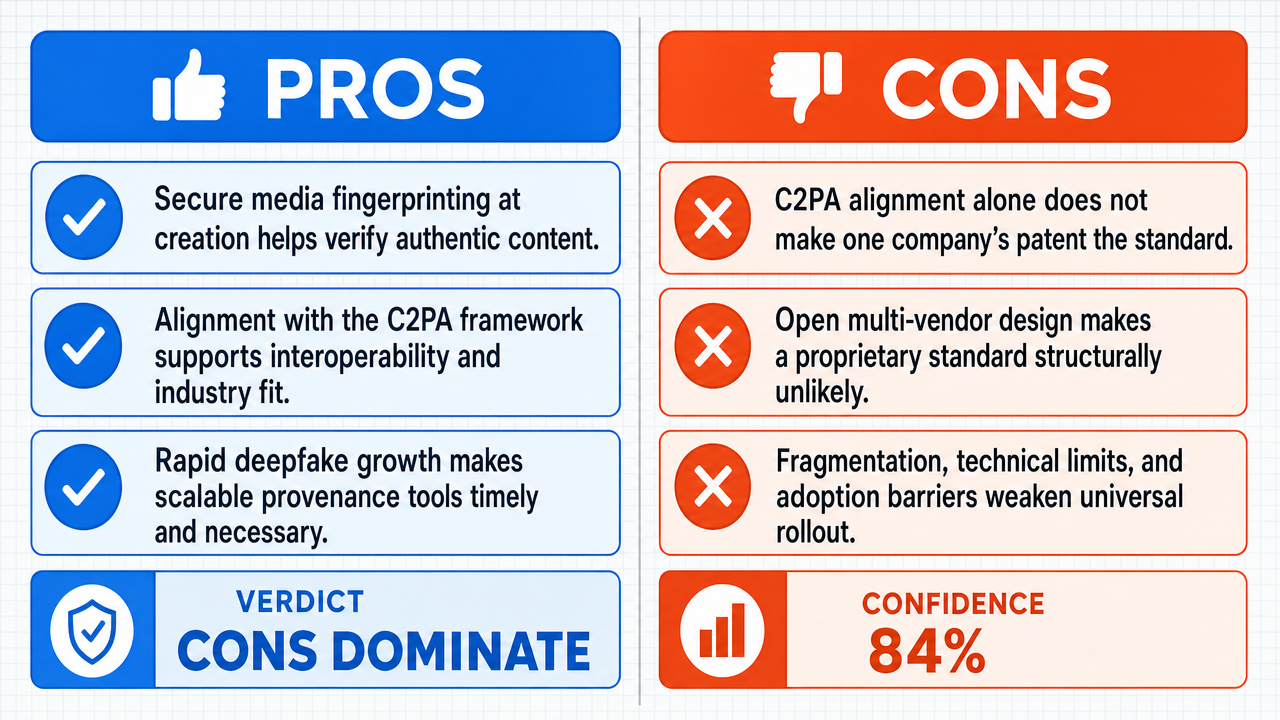
Verdict
Verdict: likely FALSE (84%)
Web Report: https://solsice.com/public/debates/vrai-ai-s-patented-solution-will-establish-a-universal-stand-765be3b59d4d
This section provides a brief overview of the key arguments. You do not need to read the full detailed report below.
✅ Key PRO arguments:
- ■Vrai AI's patent covers a cryptographically secure system that embeds a verifiable digital fingerprint into authentic media at the point of creation, providing an end-to-end chain of custody that detection-only tools lack.
- ■Vrai AI's patented solution is aligned with the C2PA framework, which is backed by industry giants like Adobe, Microsoft, Intel, and the BBC, positioning it as a reference implementation within a de jure standard -in-formation.
- ■The 550% increase in deepfakes demonstrates urgent market demand that makes a scalable provenance -based universal standard both necessary and timely.
❌ Key ANTI arguments:
- ■Alignment with the C2PA framework is not the same as becoming the standard; the affirmative fails to provide a transfer operator linking a single company's patent to global adoption of an open-source consortium's framework.
- ■C2PA is an open-source , multi-vendor framework specifically designed to avoid the walled-garden effects of proprietary patents, making it structurally unlikely that any single patented solution will become the de facto standard .
- ■The claim that Vrai AI can establish a universal standard is undermined by fragmentation, technical limitations, and market barriers inherent to adopting a single proprietary solution across the industry.
💭 Conclusion: False. The negation was carried by a coherent logical critique: the affirmative conflated technical alignment with the C2PA framework and the actual market dominance of Vrai AI's proprietary patent , failing to identify any concrete transfer mechanism between them. Because C2PA is explicitly designed as an open, multi-vendor specification that resists walled gardens, a single patented solution is structurally unlikely to become the universal standard regardless of how well it implements the spec. The affirmative's appeal to industry backers (Adobe, Microsoft, Intel, BBC) actually weakens rather than strengthens the claim, since those companies back C2PA as an open-source standard rather than as a vehicle for proprietary capture. Rising detected deepfake volume signals demand but does not establish that Vrai AI will capture the standardization process.
🔬 DeepResearch Result: likely FALSE ❌ (84%)
Assertion: Vrai AI's patented solution will establish a universal standard for visual trust to effectively combat deepfakes .
Participating models: deepseek-v3.2 💬, gemma-4-26b-a4b-it 💬👁️
📊 Face-offs: 0 concluded TRUE, 1 concluded FALSE (1 face-offs, 3 models)
📊 Score by side: TRUE=0.00, FALSE=0.84
🏅 Model score changes:
minimax-m3 💬👁️: +8
✅ PRO Arguments:
- ■Vrai AI's patent covers a cryptographically secure system that embeds a verifiable digital fingerprint into authentic media at the point of creation, providing an end-to-end chain of custody that detection-only tools lack. deepseek-v3.2 💬
- ■Vrai AI's patented solution is aligned with the C2PA framework, which is backed by industry giants like Adobe, Microsoft, Intel, and the BBC, positioning it as a reference implementation within a de jure standard -in-formation. deepseek-v3.2 💬
- ■The 550% increase in deepfakes demonstrates urgent market demand that makes a scalable provenance -based universal standard both necessary and timely. deepseek-v3.2 💬
- ■As a patented solution serving as the reference implementation within C2PA, Vrai AI offers a ready-made, production-grade tool that lowers barriers to adoption for platforms seeking compliance. deepseek-v3.2 💬
❌ ANTI Arguments:
- ■Alignment with the C2PA framework is not the same as becoming the standard; the affirmative fails to provide a transfer operator linking a single company's patent to global adoption of an open-source consortium's framework. gemma-4-26b-a4b-it 💬👁️
- ■C2PA is an open-source, multi-vendor framework specifically designed to avoid the walled-garden effects of proprietary patents, making it structurally unlikely that any single patented solution will become the de facto standard . gemma-4-26b-a4b-it 💬👁️
- ■The claim that Vrai AI can establish a universal standard is undermined by fragmentation, technical limitations, and market barriers inherent to adopting a single proprietary solution across the industry. gemma-4-26b-a4b-it 💬👁️
- ■Affirming that a patented solution can become a universal standard by being a 'ready-made implementation' commits a fallacy of scale, ignoring the fundamental tension between proprietary IP and open standards. gemma-4-26b-a4b-it 💬👁️
- ■Rising deepfake prevalence is a measurement of the threat, not evidence that any specific vendor's patented solution is positioned to monopolize the standards-setting process. gemma-4-26b-a4b-it 💬👁️
💭 Reasoning: False. The negation was carried by a coherent logical critique: the affirmative conflated technical alignment with the C2PA framework and the actual market dominance of Vrai AI's proprietary patent, failing to identify any concrete transfer mechanism between them. Because C2PA is explicitly designed as an open, multi-vendor specification that resists walled gardens, a single patented solution is structurally unlikely to become the universal standard regardless of how well it implements the spec. The affirmative's appeal to industry backers (Adobe, Microsoft, Intel, BBC) actually weakens rather than strengthens the claim, since those companies back C2PA as an open-source standard rather than as a vehicle for proprietary capture. Rising detected deepfake volume signals demand but does not establish that Vrai AI will capture the standardization process.
📋 PRO Facts:
• C2PA is backed by industry giants including Adobe, Microsoft, Intel, and the BBC.
• Detected deepfake videos increased by over 550% from 2022 to 2023.
• Vrai AI holds a patent for a provenance solution.
📋 ANTI Facts:
• C2PA is an open-source, multi-vendor framework that is structurally resistant to walled-garden effects from proprietary patents.
• Standards adoption requires a specific transfer operator linking any single vendor to industry-wide uptake, which the affirmative did not supply.
• Proprietary IP and open universal standards are in structural tension, limiting the plausibility of a single patent becoming universal.
| Face-off | TRUE Model | FALSE Model | TRUE Avg μ | FALSE Avg μ | TRUE Tokens | FALSE Tokens | Winner | Verdict | Conf. |
|---|---|---|---|---|---|---|---|---|---|
| #1 | deepseek-v3.2 💬 | gemma-4-26b-a4b-it 💬👁️ | 0.469 | 0.244 | 8 | 2 | TRUE | FALSE | 84% |
The following technical terms, abbreviations, and domain-specific concepts are referenced throughout this debate transcript. Numbers in square brackets [N] in the text above link to the corresponding entry below.
[1] C2PA — Coalition for Content Provenance and Authenticity — An open-source consortium developing technical standards for content provenance, mentioned in the debate as the framework Vrai AI's solution aligns with.
[2] codec — coder-decoder — A technology used to encode and decode media data; in the debate cited as a historical example where patented codecs became universal by being incorporated into specifications like MPEG-4.
[3] content provenance — The verifiable record of a digital asset's origin and chain of custody, referenced as the core problem C2PA and Vrai AI aim to address.
[4] cryptographic provenance — Use of cryptographic techniques to establish and verify the origin and authenticity of digital media.
[5] cryptographically secure — A property of a system or method that relies on cryptographic mechanisms to resist tampering or forgery.
[6] de facto standard — A standard that achieves widespread adoption through practical use rather than formal designation; the affirmative argues Vrai AI could become this by serving as the reference implementation of C2PA.
[7] de jure standard — A standard formally recognized or mandated by an authoritative body; described in the debate as characterizing C2PA's status as a 'standard-in-formation.'
[8] deepfakes — AI-generated synthetic media (audio, video, or images) that realistically depict events or people that did not occur; the threat that Vrai AI's solution is designed to combat.
[9] detection-only tools — Tools that analyze media to identify whether it has been synthetically manipulated, contrasted in the affirmative with provenance-based approaches.
[10] digital fingerprint — A verifiable identifier embedded into media at the point of creation under Vrai AI's system, used to confirm authenticity.
[11] end-to-end chain of custody — Continuous, traceable provenance of a media asset from capture (creation) through to consumption, cited as the gap existing detection-only tools fail to close.
[12] fallacy of scale and scope — A logical error in which conclusions valid at one scale or scope are improperly extended to another; the negative uses this term to critique the affirmative's reasoning.
[13] incompatible forks — Divergent derivative versions of a specification or software that break interoperability with the original; the affirmative argues Vrai AI's patent prevents these.
[14] interoperability — The ability of different systems or vendors' implementations to work together; identified as a core design principle of C2PA via non-proprietary access.
[15] licensing fees — Payments required to use patented technology; the negative argues such fees structurally prevent a proprietary solution from becoming a universal standard.
[16] MPEG-4 — Moving Picture Experts Group-4 — A media compression standard referenced in the debate as a historical precedent where patented codecs became universal by being incorporated into a formal specification.
[17] non-proprietary — Not restricted by patent or exclusive licensing, allowing open implementation; cited as a requirement for interoperability under C2PA.
[18] open-source — Software or specifications whose underlying source code or design is publicly available for use and modification; characterizes the C2PA framework.
[19] origin verification — The process of confirming the authentic source of a piece of media, identified in the debate as the core problem provenance solutions solve.
[20] patent — A legal grant of exclusive rights over an invention; central to the debate as Vrai AI's protection mechanism and a potential barrier to universality.
[21] provenance — In the digital content context, the documented history of a media asset's origin and handling; the concept underlying C2PA and Vrai AI's approach.
[22] reference implementation — A canonical, working realization of a specification that demonstrates the intended behavior of the standard; the affirmative argues Vrai AI could serve as this for C2PA.
[23] transfer operator — A term used in the negative's argument for the missing causal mechanism linking alignment to a standard with adoption as that standard.
[24] universal standard — A standard adopted across the entire relevant industry or market; the proposition's central claim that Vrai AI will establish one is contested.
[25] walled garden — A proprietary, closed ecosystem that limits interoperability with outside systems; the negative argues C2PA is specifically designed to avoid this effect of patents.
The following financial data tables were referenced during the debate exchanges:
| Category | Adoption Barrier | Impact on Universality |
|---|---|---|
| Open-Source Protocols | Low | High |
| Proprietary/Patented Solutions | High | Low |
| Fragmented/Localized Standards | Medium | Medium |
Legend: Qualitative assessment of technical standards based on market entry requirements and scalability.
Face-off transcripts
- ■
Ownership & Trade Secrets. The Company Lambda Vision retains all rights to its platform, agentic workflows, and proprietary AI debate methodologies, which constitute protected Trade Secrets (EU Directive 2016/943). Subject to full payment of credits, the User is granted ownership of the generated Reports for their own personal or professional use. Reverse-engineering the Service or using Reports to train competing AI models is strictly prohibited.
- ■
No Professional Advice. Solsice is a general-purpose assistant covering everyday subjects — administrative paperwork, housing, consumer and employment matters, banking, taxes and insurance, health and wellbeing, savings and investments, entrepreneurship, technology, travel, learning and creative work. Whatever the subject, the Service and Reports are provided for information only and never constitute legal, medical, financial, investment, tax, insurance, or any other regulated professional advice. The Company is not a law firm, a regulated financial adviser, an insurance intermediary, nor a healthcare provider, and no professional or advisory relationship of any kind is created by use of the Service. Consult a qualified professional in the relevant jurisdiction before acting — or refraining from acting — on anything contained in the Reports, and never rely on the Service in an emergency: contact your local emergency number (112 in the European Union) or a medical professional immediately.
- ■
AI-Generated Content, Sources and Viewpoints. Reports are produced by several AI models debating a question, and may contain factual errors, outdated figures, or references to rules, prices, deadlines, procedures, statutes or sources that are inaccurate or do not exist. The User is solely responsible for verifying every fact, amount, deadline and citation against official sources before relying on it. Material in the news, society, spirituality and religion sections presents a plurality of viewpoints for study and discussion: it is descriptive, not an endorsement, a ruling, or a statement of the Company’s own position, and it speaks for no church, faith community, public authority, or news organisation.
- ■
Liability & Governing Law. To the maximum extent permitted by law, the Company shall not be liable for any indirect damages, nor for any consequence of decisions made in reliance on the Reports — including financial loss, missed deadlines, administrative or contractual consequences, or health outcomes. These Terms are governed by French law. Any disputes shall be subject to the exclusive jurisdiction of the Courts of Paris, France.