
Voyager 1 will enter the Oort Cloud by 2326.
AI debate verdict and arguments
⚠️ AI-generated information only; not professional advice
Completed October 22, 2026
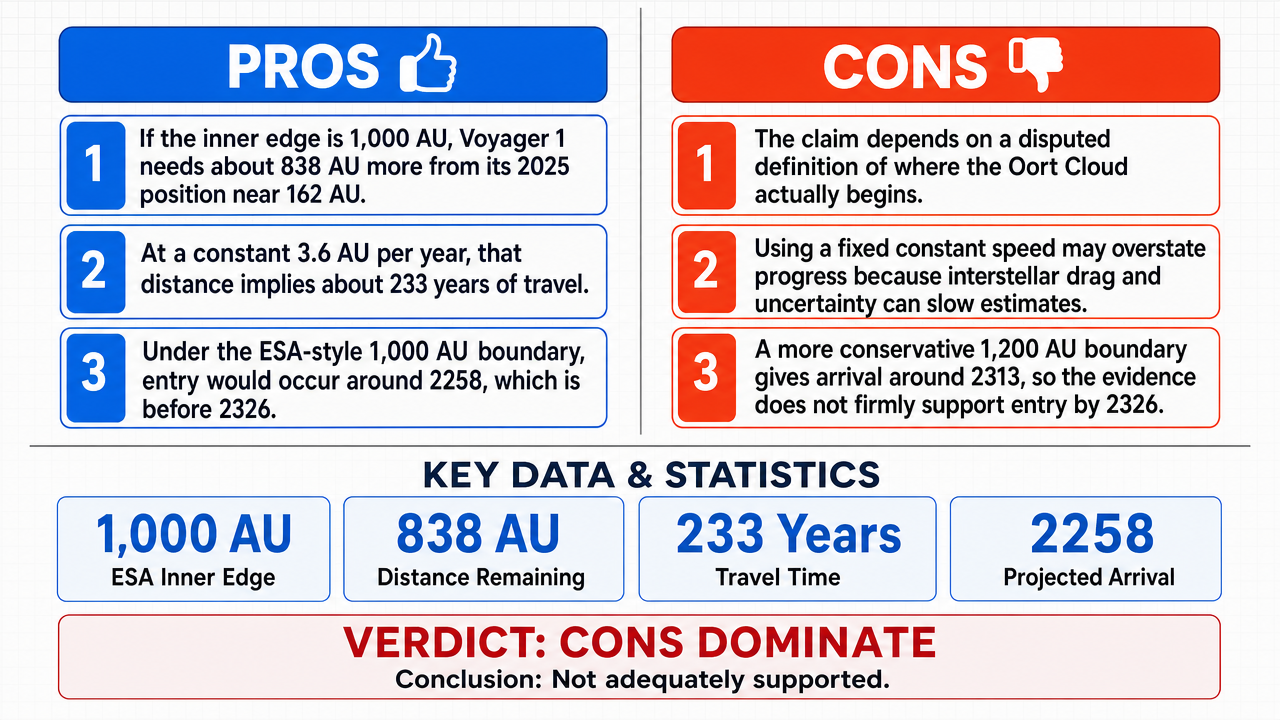
Verdict
Verdict: likely FALSE (71%)
Web Report: https://solsice.com/public/debates/voyager-1-will-enter-the-oort-cloud-by-2326-aa961f10e307
This section provides a brief overview of the key arguments. You do not need to read the full detailed report below.
✅ Key PRO arguments:
- ■Based on the European Space Agency's model placing the inner edge of the Oort Cloud at approximately 1,000 AU , and Voyager 1 's current position of about 162 AU in 2025 moving outward at 3.6 AU/year, the remaining distance of 838 AU would require roughly 233 years of travel, yielding an arrival year of approximately 2258 — well before the 2326 deadline.
- ■The opponent's position can only hold under one of two mutually exclusive conditions: either the Oort Cloud has a single fixed inner boundary that was illegitimately shifted, or the boundary is genuinely uncertain making multiple estimates invalid. In either branch, the opponent's conclusion fails.
❌ Key ANTI arguments:
- ■The affirmative's argument suffers from a profound semantic inconsistency : it attempts to validate the claim by asserting Voyager 1 has 'already entered the Oort Cloud ' because it crossed the 100 AU threshold in 2006 (citing the Hills cloud as the inner component), while simultaneously using a 1,000 AU distant-shell definition. Using one term for two different sets of attributes invalidates the prediction.
- ■The 1,000 AU calculation is fundamentally flawed because it relies on a static velocity model that fails to account for the decelerating effects of the interstellar medium and the increasing gravitational complexity of the outer solar system's outskirts. The assumption of a constant speed of 3.6 AU/year is a significant oversimplification, as Voyager 1 encounters varying plasma densities and magnetic field configurations that can exert subtle but cumulative drag.
💭 Conclusion: False. The assertion that Voyager 1 will enter the Oort Cloud by 2326 is not adequately supported because the affirmative's case rests on a semantic inconsistency between two competing definitions of the Oort Cloud's inner boundary. The negative side correctly identified that the affirmative shifted between a 1,000 AU distant-shell model and a 100 AU Hills cloud model to suit its argument, undermining the predictive claim. Furthermore, the negative side raised a substantive physical objection: the assumption of a constant 3.6 AU/year velocity ignores cumulative drag from the interstellar medium and gravitational complexities of the outer solar system, which could meaningfully delay arrival. While the arithmetic of the 1,000 AU scenario nominally yields an arrival around 2258, the boundary definition itself is contested and the velocity assumption is oversimplified. The judge assigned 71% confidence to the FALSE verdict, reflecting strong but not absolute certainty given the genuine uncertainty in Oort Cloud boundary estimates.
🔬 DeepResearch Result: likely FALSE ❌ (71%)
Assertion: Voyager 1 will enter the Oort Cloud by 2326.
Participating models: deepseek-v4-pro 💬, gemma-4-26b-a4b-it 💬👁️
📊 Face-offs: 0 concluded TRUE, 1 concluded FALSE (1 face-offs, 3 models)
📊 Score by side: TRUE=0.00, FALSE=0.71
🏅 Model score changes:
minimax-m3 💬👁️: +7
✅ PRO Arguments:
- ■Based on the European Space Agency's model placing the inner edge of the Oort Cloud at approximately 1,000 AU , and Voyager 1's current position of about 162 AU in 2025 moving outward at 3.6 AU/year, the remaining distance of 838 AU would require roughly 233 years of travel, yielding an arrival year of approximately 2258 — well before the 2326 deadline. deepseek-v4-pro 💬
- ■The opponent's position can only hold under one of two mutually exclusive conditions: either the Oort Cloud has a single fixed inner boundary that was illegitimately shifted, or the boundary is genuinely uncertain making multiple estimates invalid. In either branch, the opponent's conclusion fails. deepseek-v4-pro 💬
❌ ANTI Arguments:
- ■The affirmative's argument suffers from a profound semantic inconsistency : it attempts to validate the claim by asserting Voyager 1 has 'already entered the Oort Cloud' because it crossed the 100 AU threshold in 2006 (citing the Hills cloud as the inner component), while simultaneously using a 1,000 AU distant-shell definition. Using one term for two different sets of attributes invalidates the prediction. gemma-4-26b-a4b-it 💬👁️
- ■The 1,000 AU calculation is fundamentally flawed because it relies on a static velocity model that fails to account for the decelerating effects of the interstellar medium and the increasing gravitational complexity of the outer solar system's outskirts. The assumption of a constant speed of 3.6 AU/year is a significant oversimplification, as Voyager 1 encounters varying plasma densities and magnetic field configurations that can exert subtle but cumulative drag. gemma-4-26b-a4b-it 💬👁️
💭 Reasoning: False. The assertion that Voyager 1 will enter the Oort Cloud by 2326 is not adequately supported because the affirmative's case rests on a semantic inconsistency between two competing definitions of the Oort Cloud's inner boundary. The negative side correctly identified that the affirmative shifted between a 1,000 AU distant-shell model and a 100 AU Hills cloud model to suit its argument, undermining the predictive claim. Furthermore, the negative side raised a substantive physical objection: the assumption of a constant 3.6 AU/year velocity ignores cumulative drag from the interstellar medium and gravitational complexities of the outer solar system, which could meaningfully delay arrival. While the arithmetic of the 1,000 AU scenario nominally yields an arrival around 2258, the boundary definition itself is contested and the velocity assumption is oversimplified. The judge assigned 71% confidence to the FALSE verdict, reflecting strong but not absolute certainty given the genuine uncertainty in Oort Cloud boundary estimates.
📋 PRO Facts:
• The European Space Agency's model places the inner edge of the Oort Cloud at approximately 1,000 AU from the Sun.
• Voyager 1 was approximately 162 AU from the Sun as of 2025.
• Voyager 1 is moving outward at a nearly constant speed of 3.6 AU per year.
• Voyager 1 crossed the 100 AU threshold in 2006.
• The Hills cloud is considered the inner component of the Oort Cloud.
📋 ANTI Facts:
• Voyager 1's trajectory has been monitored for over four decades using well-established Newtonian mechanics.
• As Voyager 1 transitions from the heliosphere into the interstellar medium, it encounters varying plasma densities and magnetic field configurations.
• Research into the movement of interstellar probes indicates that maintaining a perfectly constant velocity is unrealistic over centuries-long timescales.
• The Oort Cloud's inner boundary is not universally agreed upon, with estimates ranging from hundreds to thousands of AU.
| Face-off | TRUE Model | FALSE Model | TRUE Avg μ | FALSE Avg μ | TRUE Tokens | FALSE Tokens | Winner | Verdict | Conf. |
|---|---|---|---|---|---|---|---|---|---|
| #1 | deepseek-v4-pro 💬 | gemma-4-26b-a4b-it 💬👁️ | 0.633 | 0.302 | 6 | 2 | TRUE | FALSE | 71% |
The following technical terms, abbreviations, and domain-specific concepts are referenced throughout this debate transcript. Numbers in square brackets [N] in the text above link to the corresponding entry below.
[1] AU — astronomical units — A unit of distance used in astronomy, defined as the average distance from the Sun to Earth. In this debate it is used to measure distances to the Oort Cloud and to Voyager 1's position.
[2] Consistance Sémantique — semantic consistency — A principle in argumentation requiring that a term be used with the same meaning throughout an argument. The negative side accuses the affirmative of violating this principle by shifting the definition of the Oort Cloud's boundary.
[3] dynamical modelling — Mathematical simulation of the motion of celestial bodies under gravitational and other forces. In the debate it is cited as the basis for ESA's estimate of the Oort Cloud's inner boundary through studies of long-period comets.
[4] equivocation — A logical fallacy in which a word is used with different meanings within the same argument. The negative side claims the affirmative commits this fallacy by using 'Oort Cloud' to refer to both a distant shell and a closer Hills cloud region.
[5] ESA — European Space Agency — The European intergovernmental space agency. In the debate it is cited as the source of the 1,000 AU estimate for the Oort Cloud's inner edge.
[6] gravitational landscape — The distribution of gravitational influences from the Sun and other stellar bodies across a region of space. The negative side argues this landscape complicates Voyager 1's trajectory near the outer solar system.
[7] heliocentric velocity — The speed of an object measured relative to the Sun. The negative side disputes the affirmative's assumption that Voyager 1 maintains a constant heliocentric velocity over centuries.
[8] heliosphere — The bubble-like region of space dominated by the Sun's solar wind and magnetic field. The debate notes Voyager 1 is transitioning from the heliosphere into the interstellar medium.
[9] Hills cloud — The inner component of the Oort Cloud, described in the debate as a disk-shaped region beginning around 100 AU from the Sun. Its status as part of the Oort Cloud is disputed between the two sides.
[10] interstellar medium — The matter (gas, dust, plasma) and radiation existing in the space between star systems. The negative side argues it exerts cumulative drag on Voyager 1.
[11] long-period comets — Comets with orbital periods of thousands to millions of years, believed to originate in the Oort Cloud. Their observed trajectories are used in dynamical modelling to estimate the cloud's extent.
[12] magnetic field configurations — The arrangement and structure of magnetic fields in a region of space. The negative side argues varying magnetic field configurations encountered by Voyager 1 can produce cumulative drag.
[13] NASA — National Aeronautics and Space Administration — The United States civil aerospace agency. In the debate it is cited as the source of continuous tracking data for Voyager 1's velocity and heading.
[14] Newtonian trajectory — A spacecraft path calculated using classical Newtonian mechanics. The affirmative argues Voyager 1's trajectory has followed this well-established model for over four decades with no significant deviation.
[15] non-invariance d'échelle — scale invariance — A property in physics where a system's behavior does not change across different scales. The negative side accuses the affirmative of applying a simplified Newtonian model that lacks this property.
[16] non-sequitur — A logical conclusion that does not follow from the premises. The negative side argues that claiming Voyager 1 'will enter' the Oort Cloud by 2326 is a non-sequitur if it has already entered.
[17] Oort Cloud — A theoretical distant shell of icy bodies surrounding the Sun. The debate disputes its inner boundary, with estimates ranging from approximately 100 AU (Hills cloud) to 1,000 AU (ESA model), and whether it comprises one or two regions.
[18] plasma densities — The concentration of plasma (ionized gas) in a region of space. The negative side argues varying plasma densities encountered by Voyager 1 can exert subtle cumulative drag on the spacecraft.
[19] semantic inconsistency — A flaw in argumentation where a term's meaning shifts between uses. The negative side identifies this as the central problem with the affirmative's case regarding the Oort Cloud's boundary.
[20] Voyager 1 — A NASA space probe launched in 1977. According to the debate, as of 2025 it is approximately 162 AU from the Sun and traveling outward at roughly 3.6 AU per year.
The following financial data tables were referenced during the debate exchanges:
| Oort Cloud Inner Edge (AU) | Distance Remaining (AU) | Travel Time (years) | Arrival Year |
|---|---|---|---|
| 1,000 (ESA) | 838 | 233 | 2258 |
| 1,200 (conservative) | 1,038 | 288 | 2313 |
Legend: Projected arrival of Voyager 1 at two estimates of the Oort Cloud’s inner boundary, assuming a constant speed of 3.6 AU/year from a 2025 distance of 162 AU. Sources: ESA and NASA.
Face-off transcripts
- ■
Ownership & Trade Secrets. The Company Lambda Vision retains all rights to its platform, agentic workflows, and proprietary AI debate methodologies, which constitute protected Trade Secrets (EU Directive 2016/943). Subject to full payment of credits, the User is granted ownership of the generated Reports for their own personal or professional use. Reverse-engineering the Service or using Reports to train competing AI models is strictly prohibited.
- ■
No Professional Advice. Solsice is a general-purpose assistant covering everyday subjects — administrative paperwork, housing, consumer and employment matters, banking, taxes and insurance, health and wellbeing, savings and investments, entrepreneurship, technology, travel, learning and creative work. Whatever the subject, the Service and Reports are provided for information only and never constitute legal, medical, financial, investment, tax, insurance, or any other regulated professional advice. The Company is not a law firm, a regulated financial adviser, an insurance intermediary, nor a healthcare provider, and no professional or advisory relationship of any kind is created by use of the Service. Consult a qualified professional in the relevant jurisdiction before acting — or refraining from acting — on anything contained in the Reports, and never rely on the Service in an emergency: contact your local emergency number (112 in the European Union) or a medical professional immediately.
- ■
AI-Generated Content, Sources and Viewpoints. Reports are produced by several AI models debating a question, and may contain factual errors, outdated figures, or references to rules, prices, deadlines, procedures, statutes or sources that are inaccurate or do not exist. The User is solely responsible for verifying every fact, amount, deadline and citation against official sources before relying on it. Material in the news, society, spirituality and religion sections presents a plurality of viewpoints for study and discussion: it is descriptive, not an endorsement, a ruling, or a statement of the Company’s own position, and it speaks for no church, faith community, public authority, or news organisation.
- ■
Liability & Governing Law. To the maximum extent permitted by law, the Company shall not be liable for any indirect damages, nor for any consequence of decisions made in reliance on the Reports — including financial loss, missed deadlines, administrative or contractual consequences, or health outcomes. These Terms are governed by French law. Any disputes shall be subject to the exclusive jurisdiction of the Courts of Paris, France.