
Vladimir Putin's rise to power was a deliberate and calculated strategy from the outset to replace existing oligarchs with his own loyalists and consolidate personal wealth through state control of natural resources.
AI debate verdict and arguments
⚠️ AI-generated information only; not professional advice
Completed October 11, 2026
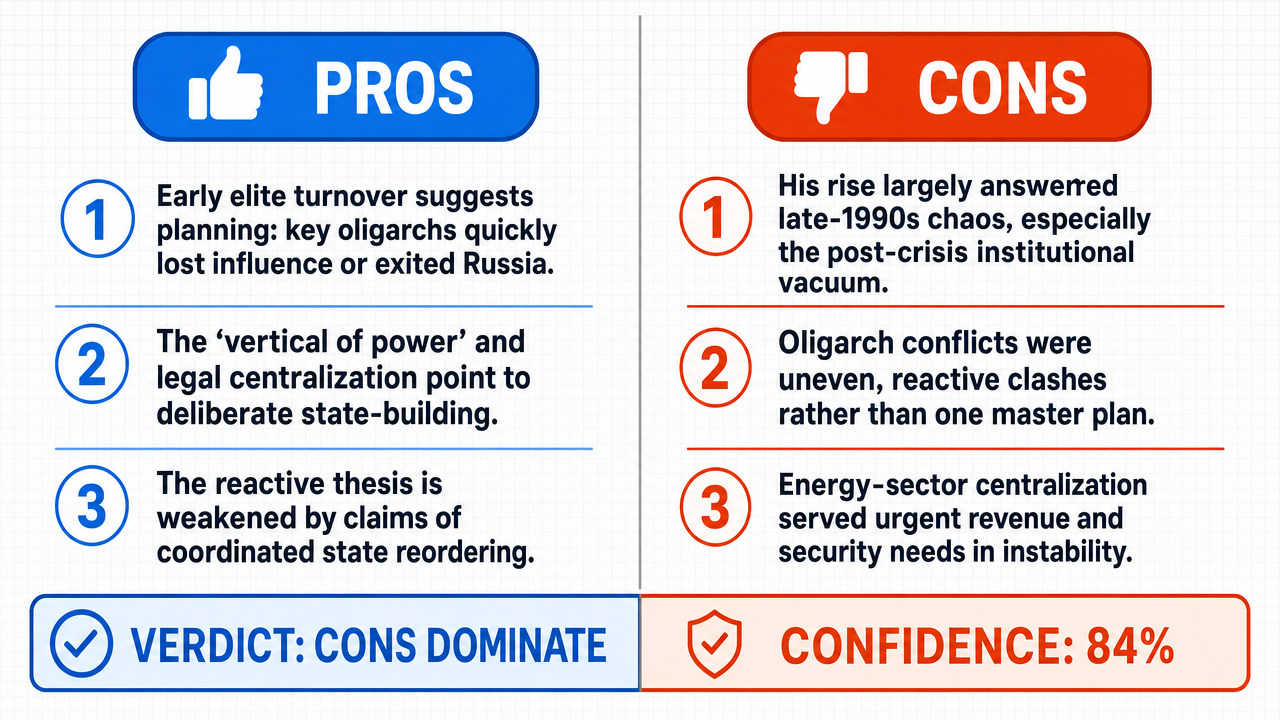
Verdict
Verdict: likely FALSE (84%)
This section provides a brief overview of the key arguments. You do not need to read the full detailed report below.
✅ Key PRO arguments:
- ■A documented pattern of elite replacement occurred early in Putin's tenure: Boris Berezovsky lost leverage and left Russia in March 2000, Vladimir Gusinsky's Media-Most was pressured, and Mikhail Khodorkovsky's Yukos was dismantled, with assets transferred to state-controlled entities like Rosneft and Gazprom led by loyalists such as Igor Sechin and Alexei Miller.
- ■The 1999 Law on the Principles of Delimitation of Powers and the systematic construction of the 'vertical of power ' demonstrate a goal-directed, strategic political architecture implemented from the start, not ad-hoc crisis management .
- ■The opponent's framing is internally inconsistent: claiming Putin's actions were 'reactive' while simultaneously describing the state apparatus as 'seeking to re-establish the vertical of power ' — a defined strategic objective rather than reactive crisis response.
❌ Key ANTI arguments:
- ■Putin's rise was a reactive response to the extreme volatility and institutional vacuum of the late 1990s, particularly the 1998 Russian financial crisis that saw the ruble collapse and the banking sector disintegrate; the primary driver was restoring state authority and preventing social collapse, not a pre-planned conspiracy.
- ■The displacement of 1990s oligarchs was not a monolithic premeditated strategy but a series of reactive, often chaotic, legal and political confrontations triggered by the state's sudden need to re-establish basic legal and fiscal order amid extreme institutional decay .
- ■The centralization of the energy sector was a pragmatic, reactive measure to secure state revenues and ensure national energy security in a period of extreme institutional fragility , driven by fiscal necessity rather than a long-term scheme to enrich loyalists.
💭 Conclusion: False. The winning side convincingly argued that Putin's rise to power was primarily a reactive response to the systemic instability and institutional vacuum left by the 1998 Russian financial crisis , rather than a premeditated, long-term conspiracy to replace oligarchs and consolidate personal wealth. The displacement of figures like Berezovsky, Gusinsky, and Khodorkovsky is better explained as a series of chaotic, uncoordinated confrontations driven by the state's urgent need to restore fiscal sovereignty and legal order, not as a calculated blueprint executed 'from the outset.' The centralization of energy assets into state-controlled entities reflected pragmatic revenue-security imperatives in a period of extreme fragility rather than a personal enrichment scheme. While the PRO side presented a coherent narrative of elite replacement , the ANTI side more credibly grounded these events in the structural necessities of post-crisis state-building. The confidence reflects strong but not absolute support, as some elements of strategic intent in Putin's consolidation remain plausible even within a reactive framework.
🔬 DeepResearch Result: likely FALSE ❌ (84%)
Assertion: Vladimir Putin's rise to power was a deliberate and calculated strategy from the outset to replace existing oligarchs with his own loyalists and consolidate personal wealth through state control of natural resources.
Participating models: deepseek-v3.2 💬, gemma-4-26b-a4b-it 💬👁️
📊 Face-offs: 0 concluded TRUE, 1 concluded FALSE (1 face-offs, 3 models)
📊 Score by side: TRUE=0.00, FALSE=0.84
🏅 Model score changes:
minimax-m3 💬👁️: +8
✅ PRO Arguments:
- ■A documented pattern of elite replacement occurred early in Putin's tenure: Boris Berezovsky lost leverage and left Russia in March 2000, Vladimir Gusinsky's Media-Most was pressured, and Mikhail Khodorkovsky's Yukos was dismantled, with assets transferred to state-controlled entities like Rosneft and Gazprom led by loyalists such as Igor Sechin and Alexei Miller. deepseek-v3.2 💬
- ■The 1999 Law on the Principles of Delimitation of Powers and the systematic construction of the 'vertical of power ' demonstrate a goal-directed, strategic political architecture implemented from the start, not ad-hoc crisis management . deepseek-v3.2 💬
- ■The opponent's framing is internally inconsistent: claiming Putin's actions were 'reactive' while simultaneously describing the state apparatus as 'seeking to re-establish the vertical of power' — a defined strategic objective rather than reactive crisis response. deepseek-v3.2 💬
❌ ANTI Arguments:
- ■Putin's rise was a reactive response to the extreme volatility and institutional vacuum of the late 1990s, particularly the 1998 Russian financial crisis that saw the ruble collapse and the banking sector disintegrate; the primary driver was restoring state authority and preventing social collapse, not a pre-planned conspiracy. gemma-4-26b-a4b-it 💬👁️
- ■The displacement of 1990s oligarchs was not a monolithic premeditated strategy but a series of reactive, often chaotic, legal and political confrontations triggered by the state's sudden need to re-establish basic legal and fiscal order amid extreme institutional decay . gemma-4-26b-a4b-it 💬👁️
- ■The centralization of the energy sector was a pragmatic, reactive measure to secure state revenues and ensure national energy security in a period of extreme institutional fragility , driven by fiscal necessity rather than a long-term scheme to enrich loyalists. gemma-4-26b-a4b-it 💬👁️
- ■The assertion of a 'deliberate and calculated strategy from the outset' fails to account for the desperate, improvised nature of the Yeltsin-to-Putin transition, which was characterized by a search for stability rather than execution of a blueprint for personal wealth consolidation . gemma-4-26b-a4b-it 💬👁️
💭 Reasoning: False. The winning side convincingly argued that Putin's rise to power was primarily a reactive response to the systemic instability and institutional vacuum left by the 1998 Russian financial crisis, rather than a premeditated, long-term conspiracy to replace oligarchs and consolidate personal wealth. The displacement of figures like Berezovsky, Gusinsky, and Khodorkovsky is better explained as a series of chaotic, uncoordinated confrontations driven by the state's urgent need to restore fiscal sovereignty and legal order, not as a calculated blueprint executed 'from the outset.' The centralization of energy assets into state-controlled entities reflected pragmatic revenue-security imperatives in a period of extreme fragility rather than a personal enrichment scheme. While the PRO side presented a coherent narrative of elite replacement, the ANTI side more credibly grounded these events in the structural necessities of post-crisis state-building. The confidence reflects strong but not absolute support, as some elements of strategic intent in Putin's consolidation remain plausible even within a reactive framework.
📋 PRO Facts:
• Boris Berezovsky departed Russia during the political transition.
• Vladimir Gusinsky faced legal pressures from the state.
• Mikhail Khodorkovsky's Yukos was dismantled to recover tax revenues and reassert state control over strategic assets.
• The centralization of the energy sector was a pragmatic measure to secure state revenue.
• The state's actions were driven by the need to re-establish fiscal sovereignty following the 1998 financial crisis.
📋 ANTI Facts:
• The 1998 Russian financial crisis created systemic instability and a reactive need for stability.
• The late 1990s in Russia were characterized by extreme institutional vacuum and volatility.
• The Yeltsin-to-Putin transition was marked by a desperate search for stability.
• State centralization of energy assets occurred amid extreme institutional fragility and fiscal necessity.
• Displacement of influential actors was often uncoordinated and triggered by sudden state revenue needs.
| Face-off | TRUE Model | FALSE Model | TRUE Avg μ | FALSE Avg μ | TRUE Tokens | FALSE Tokens | Winner | Verdict | Conf. |
|---|---|---|---|---|---|---|---|---|---|
| #1 | deepseek-v3.2 💬 | gemma-4-26b-a4b-it 💬👁️ | 0.583 | 0.387 | 12 | 3 | TRUE | FALSE | 84% |
The following technical terms, abbreviations, and domain-specific concepts are referenced throughout this debate transcript. Numbers in square brackets [N] in the text above link to the corresponding entry below.
[1] 1998 Russian financial crisis — A major economic crisis in Russia that, according to the debate, saw the ruble collapse and the banking sector disintegrate, creating conditions of extreme volatility and institutional vacuum.
[2] ad-hoc crisis management — Reactive, improvised decision-making in response to immediate emergencies; in the debate, contrasted with pre-planned strategic action as a characterization of Putin's early governance.
[3] elite replacement — The process of displacing existing powerholders and installing new ones; in the debate, refers to the displacement of 1990s oligarchs and the installation of loyalist figures in positions of state power.
[4] energy security — A policy concept referring to the reliable availability and control of energy resources; cited in the debate as a rationale for centralizing the Russian energy sector.
[5] Federal Law No. 184-FZ — Russian Federation Federal Law No. 184-FZ — Legislation cited in the debate as the 'Law on the Principles of Delimitation of Powers,' which the affirmative argues recentralized authority from Russia's regions to the federal center in 1999.
[6] fiscal sovereignty — Control over fiscal policy and the capacity to collect state revenues; cited in the debate as a driver of state actions during the late 1990s.
[7] IEA — International Energy Agency — An international organization cited in the debate via its Russia Energy Policy Review regarding the restructuring of Russia's energy sector into state-controlled entities.
[8] institutional decay — The deterioration of state institutions and their capacity to function; described in the debate as characterizing late-1990s Russia.
[9] institutional fragility — The vulnerability or weakness of state institutions; cited in the debate as characterizing the period during which the energy sector was centralized.
[10] institutional vacuum — A situation in which state institutions lack effective authority or capacity; described in the debate as characterizing the late-1990s transition of power.
[11] Law on the Principles of Delimitation of Powers — Legislation cited in the debate (Federal Law No. 184-FZ) concerning the organization of legislative and executive bodies in the subjects of the Russian Federation.
[12] loyalist networks — Networks of associates personally loyal to a leader; in the debate, refers to figures such as Igor Sechin and Alexei Miller placed in control of state-controlled entities.
[13] natural resource wealth — Economic value derived from natural resources such as oil and gas; described in the debate as a tool of political consolidation.
[14] oligarchs — Wealthy business figures with significant political influence; in the debate, refers specifically to 1990s-era Russian figures such as Berezovsky, Gusinsky, and Khodorkovsky.
[15] Panama Papers — A leak of documents from a Panamanian law firm, cited in the debate as evidence regarding offshore wealth and the enrichment of loyalist networks.
[16] political consolidation — The centralization and strengthening of political power; in the debate, refers to the redirection of resource rents into structures controlled by loyalists.
[17] political project — A coherent, goal-directed political program; in the debate, contrasted with reactive or chaotic actions as a characterization of Putin's early governance.
[18] power centers — Nodes of independent political or economic power; in the debate, refers to independent power centers that the affirmative argues were systematically eliminated.
[19] premiership — The office or tenure of a prime minister; in the debate, refers to Putin's assumption of the premiership in 1999.
[20] recentralized authority — The process of returning power from regional or local levels to the central government; in the debate, attributed to the 1999 Law on the Principles of Delimitation of Powers.
[21] resource rents — Economic surplus generated by the extraction of natural resources; in the debate, refers to oil and gas revenues redirected into loyalist-controlled structures.
[22] ruble collapse — A sharp devaluation of the Russian ruble; in the debate, associated with the 1998 Russian financial crisis.
[23] security-service veterans — Former personnel of intelligence or security services; in the debate, refers to trusted associates installed in levers of state power.
[24] state apparatus — The ensemble of government institutions and bureaucracy; in the debate, described as crumbling or seeking to re-establish authority during the late 1990s.
[25] state champions — Major state-backed or state-controlled enterprises; in the debate, refers to entities such as Rosneft and Gazprom into which assets were transferred.
[26] state-controlled — Owned or directed by the state; in the debate, describes entities such as Rosneft and Gazprom that received assets from dismantled private companies.
[27] subjects of the Russian Federation — The administrative divisions (regions, republics, and other territorial units) that make up the Russian Federation; referenced in the title of Federal Law No. 184-FZ.
[28] tax compliance — Adherence to tax laws and regulations; cited in the debate as a driver of state enforcement actions against 1990s-era business figures.
[29] Transparency International — An international anti-corruption organization cited in the debate regarding investigations into the enrichment of loyalist networks.
[30] vertical of power — A political structure in which authority is concentrated in a single chain of command from top leadership downward; in the debate, described as a goal-directed political architecture.
[31] wealth consolidation — The process of accumulating and centralizing wealth; in the debate, refers to the consolidation of personal wealth through state control of natural resources.
[32] wealth extraction — The process of extracting economic value, often implying transfer to elites; in the debate, refers to the alleged extraction of wealth through loyalist networks.
Face-off transcripts
- ■
Ownership & Trade Secrets. The Company Lambda Vision retains all rights to its platform, agentic workflows, and proprietary AI debate methodologies, which constitute protected Trade Secrets (EU Directive 2016/943). Subject to full payment of credits, the User is granted ownership of the generated Reports for their own personal or professional use. Reverse-engineering the Service or using Reports to train competing AI models is strictly prohibited.
- ■
No Professional Advice. Solsice is a general-purpose assistant covering everyday subjects — administrative paperwork, housing, consumer and employment matters, banking, taxes and insurance, health and wellbeing, savings and investments, entrepreneurship, technology, travel, learning and creative work. Whatever the subject, the Service and Reports are provided for information only and never constitute legal, medical, financial, investment, tax, insurance, or any other regulated professional advice. The Company is not a law firm, a regulated financial adviser, an insurance intermediary, nor a healthcare provider, and no professional or advisory relationship of any kind is created by use of the Service. Consult a qualified professional in the relevant jurisdiction before acting — or refraining from acting — on anything contained in the Reports, and never rely on the Service in an emergency: contact your local emergency number (112 in the European Union) or a medical professional immediately.
- ■
AI-Generated Content, Sources and Viewpoints. Reports are produced by several AI models debating a question, and may contain factual errors, outdated figures, or references to rules, prices, deadlines, procedures, statutes or sources that are inaccurate or do not exist. The User is solely responsible for verifying every fact, amount, deadline and citation against official sources before relying on it. Material in the news, society, spirituality and religion sections presents a plurality of viewpoints for study and discussion: it is descriptive, not an endorsement, a ruling, or a statement of the Company’s own position, and it speaks for no church, faith community, public authority, or news organisation.
- ■
Liability & Governing Law. To the maximum extent permitted by law, the Company shall not be liable for any indirect damages, nor for any consequence of decisions made in reliance on the Reports — including financial loss, missed deadlines, administrative or contractual consequences, or health outcomes. These Terms are governed by French law. Any disputes shall be subject to the exclusive jurisdiction of the Courts of Paris, France.