
US utility companies overcharge American consumers by more than $50 billion annually through inflated profits and exploitative regulatory practices.
AI debate verdict and arguments
⚠️ AI-generated information only; not professional advice
Completed October 8, 2026
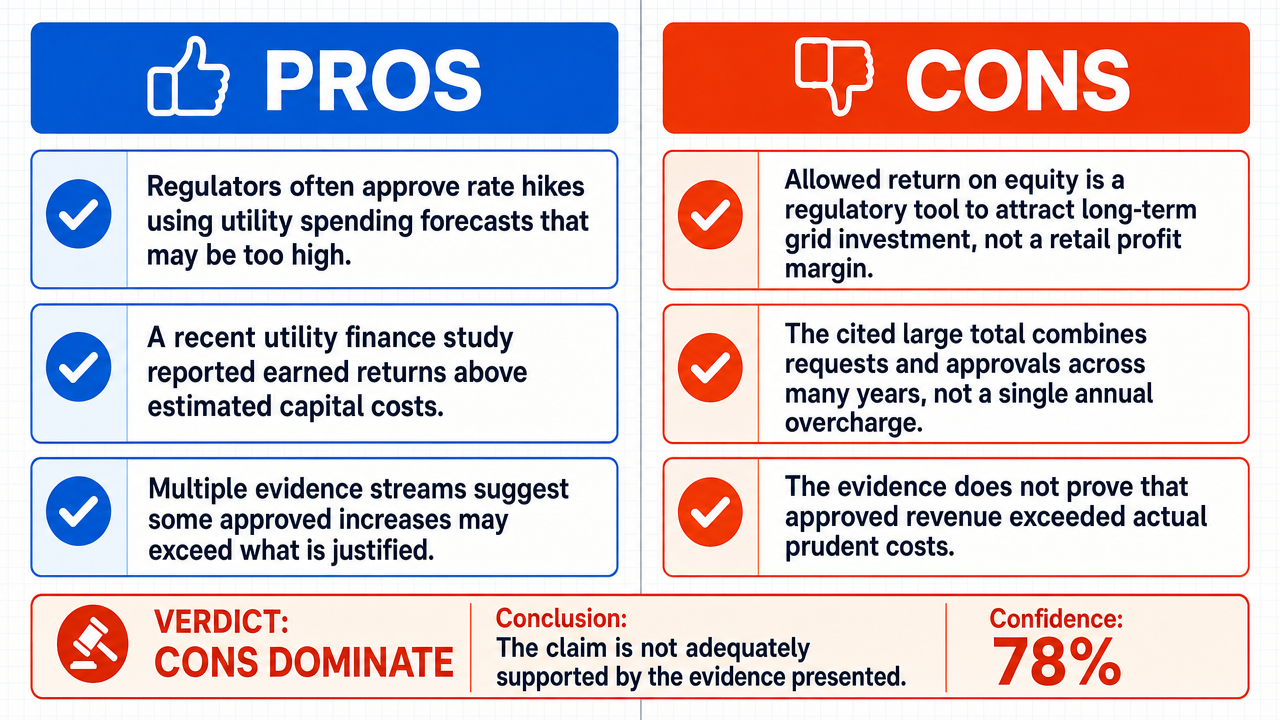
Verdict
Verdict: likely FALSE (78%)
This section provides a brief overview of the key arguments. You do not need to read the full detailed report below.
✅ Key PRO arguments:
- ■State Public Utility Commissions routinely grant rate hikes based on utilities' inflated capital expenditure forecasts, with a 2023 Energy and Policy Institute analysis finding that from 2013 to 2022, the top 10 investor-owned electric utilities requested and received rate increases totaling over $100 billion, with approved increases averaging 20% above inflation-adjusted cost growth for operations and maintenance .
- ■A 2024 IEEFA study analyzed the 10 largest investor-owned electric utilities and found their actual earned ROE averaged 390 basis points above their weighted average cost of capital , translating to over $15 billion in annual overcharge from that subset alone—evidence that the authorized ROE consistently exceeds the sector's true cost of capital by a material spread .
- ■The TRUE side's position is supported by three converging lines of evidence: the persistent ROE-WACC spread , the systematic approval of rate increases exceeding inflation-adjusted cost growth, and the structural incentives in regulatory frameworks that allow utilities to recover projected (rather than actual) capital expenditures through trackers and automatic adjustment clauses .
❌ Key ANTI arguments:
- ■The ROE is not a 'profit margin' in the retail sense but a regulatory mechanism designed to attract the massive, long-term capital investment required to maintain a stable grid; if regulators set the ROE below the cost of equity required by investors, the utility's ability to secure financing for critical infrastructure such as grid hardening and renewable integration would collapse.
- ■The $100 billion figure from the Energy and Policy Institute represents the total amount requested and received over a decade, not an annual overcharge—a request is a regulatory starting point, not a final determination of excess, and in many instances approved amounts are significantly lower than requested amounts.
- ■To establish that rate increases exceed justified costs, one must demonstrate that approved revenue exceeds actual prudent costs incurred by the utility; the TRUE side's claim fails in the branch where rate increases are based on legitimate, prudent capital expenditures necessary for grid modernization and reliability.
💭 Conclusion: False. The assertion that US utility companies overcharge consumers by more than $50 billion annually is not adequately supported by the evidence presented in this debate. The TRUE side's strongest quantitative evidence—a 2024 IEEFA study showing a 390 basis point ROE-WACC spread translating to over $15 billion annually for the top 10 utilities—only covers a subset of the industry and does not scale to the $50 billion claim without significant extrapolation. The FALSE side successfully argued that the ROE-WACC spread is a necessary regulatory mechanism to attract capital investment to maintain a stable grid, not an exploitative overcharge, and that the $100 billion figure cited from the Energy and Policy Institute represents cumulative rate increases over a decade rather than annual overcharges. The regulatory framework, while imperfect, is designed to balance investor requirements with consumer protection, and the evidence does not demonstrate systematic exploitation exceeding $50 billion annually. The compound claim contains multiple sub-claims (overcharge amount, inflated profits, exploitative practices), and while the exploitative practices sub-claim is the weakest supported, the overall verdict remains FALSE.
🔬 DeepResearch Result: likely FALSE ❌ (78%)
Assertion: US utility companies overcharge American consumers by more than $50 billion annually through inflated profits and exploitative regulatory practices.
Participating models: deepseek-v3.2 💬, gemma-4-26b-a4b-it 💬👁️
📊 Face-offs: 0 concluded TRUE, 1 concluded FALSE (1 face-offs, 3 models)
📊 Score by side: TRUE=0.00, FALSE=0.87
🏅 Model score changes:
minimax-m3 💬👁️: +9
✅ PRO Arguments:
- ■State Public Utility Commissions routinely grant rate hikes based on utilities' inflated capital expenditure forecasts, with a 2023 Energy and Policy Institute analysis finding that from 2013 to 2022, the top 10 investor-owned electric utilities requested and received rate increases totaling over $100 billion, with approved increases averaging 20% above inflation-adjusted cost growth for operations and maintenance . deepseek-v3.2 💬
- ■A 2024 IEEFA study analyzed the 10 largest investor-owned electric utilities and found their actual earned ROE averaged 390 basis points above their weighted average cost of capital , translating to over $15 billion in annual overcharge from that subset alone—evidence that the authorized ROE consistently exceeds the sector's true cost of capital by a material spread . deepseek-v3.2 💬
- ■The TRUE side's position is supported by three converging lines of evidence: the persistent ROE-WACC spread, the systematic approval of rate increases exceeding inflation-adjusted cost growth, and the structural incentives in regulatory frameworks that allow utilities to recover projected (rather than actual) capital expenditures through trackers and automatic adjustment clauses . deepseek-v3.2 💬
- ■The opponent's claim that the ROE-WACC spread is a 'necessary component' rests on the hidden premise that the regulated ROE must be set at the level investors 'require' to attract capital, without establishing that current levels are the minimum necessary—empirical evidence showing utilities consistently earn returns above their true cost of capital indicates the spread is indeed an unjustified overcharge. deepseek-v3.2 💬
❌ ANTI Arguments:
- ■The ROE is not a 'profit margin' in the retail sense but a regulatory mechanism designed to attract the massive, long-term capital investment required to maintain a stable grid; if regulators set the ROE below the cost of equity required by investors, the utility's ability to secure financing for critical infrastructure such as grid hardening and renewable integration would collapse. gemma-4-26b-a4b-it 💬👁️
- ■The $100 billion figure from the Energy and Policy Institute represents the total amount requested and received over a decade, not an annual overcharge—a request is a regulatory starting point, not a final determination of excess, and in many instances approved amounts are significantly lower than requested amounts. gemma-4-26b-a4b-it 💬👁️
- ■To establish that rate increases exceed justified costs, one must demonstrate that approved revenue exceeds actual prudent costs incurred by the utility; the TRUE side's claim fails in the branch where rate increases are based on legitimate, prudent capital expenditures necessary for grid modernization and reliability. gemma-4-26b-a4b-it 💬👁️
- ■Mechanisms such as 'trackers' and automatic adjustment clauses are necessary cost recovery instruments that allow utilities to recover prudently incurred costs for infrastructure investments, not exploitative practices—they ensure utilities can maintain financial viability while undertaking the long-term capital projects required for the energy transition. gemma-4-26b-a4b-it 💬👁️
- ■Utility rates are not a systemic mechanism for overcharging but rather a highly regulated framework designed to balance investor requirements with consumer stability and service reliability; the ROE-WACC spread is a necessary regulatory instrument ensuring utilities can access low-cost, long-term capital, without which grid instability would result. gemma-4-26b-a4b-it 💬👁️
💭 Reasoning: False. The assertion that US utility companies overcharge consumers by more than $50 billion annually is not adequately supported by the evidence presented in this debate. The TRUE side's strongest quantitative evidence—a 2024 IEEFA study showing a 390 basis point ROE-WACC spread translating to over $15 billion annually for the top 10 utilities—only covers a subset of the industry and does not scale to the $50 billion claim without significant extrapolation. The FALSE side successfully argued that the ROE-WACC spread is a necessary regulatory mechanism to attract capital investment to maintain a stable grid, not an exploitative overcharge, and that the $100 billion figure cited from the Energy and Policy Institute represents cumulative rate increases over a decade rather than annual overcharges. The regulatory framework, while imperfect, is designed to balance investor requirements with consumer protection, and the evidence does not demonstrate systematic exploitation exceeding $50 billion annually. The compound claim contains multiple sub-claims (overcharge amount, inflated profits, exploitative practices), and while the exploitative practices sub-claim is the weakest supported, the overall verdict remains FALSE.
📋 PRO Facts:
• A 2023 Energy and Policy Institute analysis found that over a decade, investor-owned electric utilities requested and received rate increases totaling over $100 billion.
• Approved rate increases averaged 20% above inflation-adjusted cost growth for operations and maintenance according to the 2023 Energy and Policy Institute analysis.
• A 2024 IEEFA study found that the 10 largest investor-owned electric utilities earned an actual ROE averaging 390 basis points above their weighted average cost of capital.
• The 390 basis point ROE-WACC spread for the top 10 utilities translates to over $15 billion in annual overcharge from that subset alone according to IEEFA (2024).
📋 ANTI Facts:
• The ROE is a regulatory mechanism designed to attract long-term capital investment, not a retail profit margin.
• The $100 billion figure from the Energy and Policy Institute represents cumulative rate increases over a decade, not annual overcharges.
• Trackers and automatic adjustment clauses are regulatory mechanisms that allow utilities to recover costs for fuel, infrastructure projects, and storm recovery.
• If regulators set ROE below the cost of equity required by investors, utilities' ability to secure financing to maintain a stable grid would collapse.
| Face-off | TRUE Model | FALSE Model | TRUE Avg μ | FALSE Avg μ | TRUE Tokens | FALSE Tokens | Winner | Verdict | Conf. |
|---|---|---|---|---|---|---|---|---|---|
| #1 | deepseek-v3.2 💬 | gemma-4-26b-a4b-it 💬👁️ | 0.502 | 0.307 | 12 | 3 | TRUE | FALSE | 87% |
The following technical terms, abbreviations, and domain-specific concepts are referenced throughout this debate transcript. Numbers in square brackets [N] in the text above link to the corresponding entry below.
[1] automatic adjustment clauses — Regulatory mechanisms that allow utilities to adjust customer rates between formal rate cases to recover specific costs (such as fuel or infrastructure investments). The debate disputes whether these mechanisms protect consumers from volatility or enable overcharges.
[2] basis points — bps — A unit equal to 1/100th of a percentage point (0.01%), commonly used to measure small changes in interest rates, returns, or spreads between financial metrics.
[3] beta — A measure of a stock's volatility relative to the overall market, used as an input in calculating the cost of equity via models such as the Capital Asset Pricing Model.
[4] bill shocks — Sudden, large increases in customer utility bills, often discussed in the context of rate design and consumer protection against volatile cost pass-throughs.
[5] capital expenditure — capex — Funds used by a company to acquire, upgrade, or maintain physical assets such as infrastructure, distinguished from recurring operating expenses.
[6] capital structure — The mix of debt and equity financing used by a company to fund its operations and investments.
[7] commodity costs — Variable costs tied to market prices of inputs such as natural gas or coal, often passed through to consumers via adjustment clauses.
[8] cost of capital — The required rate of return needed to attract investment, comprising the weighted costs of debt and equity financing.
[9] cost of equity — The return rate required by equity investors to compensate for the risk of holding a company's stock, often estimated using financial models.
[10] cost recovery — The regulatory principle allowing utilities to recoup prudent expenses through customer rates, central to the debate over what constitutes a justified versus an inflated rate increase.
[11] Energy and Policy Institute — A research organization cited in the debate for its analysis of utility rate hike requests over the period 2013–2022.
[12] equity base — The total equity capital invested in a utility, used as the basis for calculating authorized returns in regulatory proceedings.
[13] excess return — A return earned above a benchmark or required rate. In this debate, the affirmative frames the ROE–WACC spread as excess return, while the negative disputes this characterization.
[14] grid hardening — Physical improvements to the electrical grid designed to make it more resistant to disruption from extreme weather events or other threats.
[15] grid resilience — The ability of the electrical grid to withstand and recover from disruptive events while maintaining service.
[16] imputed cost of equity — An estimated cost of equity derived from financial models (such as CAPM) rather than directly observed in the market.
[17] inflation-adjusted — Modified to account for the effects of inflation, enabling comparison of monetary values across different time periods.
[18] Institute for Energy Economics and Financial Analysis — IEEFA — A research organization cited in the debate for its 2024 analysis comparing earned returns on equity to imputed cost of equity for the ten largest investor-owned electric utilities.
[19] investor-owned utilities — IOUs — Utility companies owned by private shareholders rather than by government entities or customer cooperatives, and subject to state regulatory oversight.
[20] low-cost capital — Financing obtained at favorable interest rates, often associated with the regulated utility business model and its perceived low risk profile.
[21] non-invariance of scale — A logical fallacy in which a metric measured at one scale (e.g., a specific utility or year) is incorrectly applied to a different scale (e.g., an entire sector or decade) without justification.
[22] operations and maintenance — O&M — Recurring expenses required to run and maintain utility infrastructure, distinguished from capital expenditures.
[23] prudence — A regulatory standard requiring that expenditures be reasonable and necessary in order to be recoverable through customer rates.
[24] Public Utility Commissions — PUCs — State regulatory bodies that oversee utility rates, services, and practices within their jurisdiction.
[25] rate base — The value of a utility's assets on which regulators allow a return, used as the foundation for determining the utility's revenue requirement.
[26] rate increases — Adjustments to customer rates, typically approved by regulators to reflect changes in costs, capital investments, or authorized returns.
[27] renewable integration — The process of incorporating renewable energy sources (such as solar or wind) into the electrical grid.
[28] Return on Equity — ROE — Net income returned as a percentage of shareholder equity. In utility regulation, the ROE authorized by regulators is a key determinant of allowed profits.
[29] risk-adjusted return — A return measured after accounting for the level of risk taken to achieve it, used to evaluate whether compensation is adequate for the risk borne.
[30] risk-free rate — The theoretical return on an investment with zero risk, typically proxied by the yield on government bonds and used as an input in cost-of-equity models.
[31] spread — The difference between two financial metrics. In this debate, the spread between authorized ROE and WACC is central; the affirmative characterizes it as an 'excess' while the negative characterizes it as a 'necessary component' of the capital structure.
[32] trackers — Informal name for automatic adjustment clauses that track and pass through specific cost changes (such as fuel or infrastructure costs) to customer bills between formal rate cases.
[33] Weighted Average Cost of Capital — WACC — The average cost of a company's financing sources (debt and equity), weighted by their proportion in the capital structure, used as a benchmark for evaluating authorized returns.
The following financial data tables were referenced during the debate exchanges:
| Metric | Value |
|---|---|
| Average Authorized ROE (2022) | 9.52% |
| Average WACC (2022) | 6.50% |
| Regulatory Spread (bps) | 302 |
Legend: Comparison of authorized Return on Equity and Weighted Average Cost of Capital for major electric utilities in 2022. Spread is expressed in basis points (bps).
Face-off transcripts
- ■
Ownership & Trade Secrets. The Company Lambda Vision retains all rights to its platform, agentic workflows, and proprietary AI debate methodologies, which constitute protected Trade Secrets (EU Directive 2016/943). Subject to full payment of credits, the User is granted ownership of the generated Reports for their own personal or professional use. Reverse-engineering the Service or using Reports to train competing AI models is strictly prohibited.
- ■
No Professional Advice. Solsice is a general-purpose assistant covering everyday subjects — administrative paperwork, housing, consumer and employment matters, banking, taxes and insurance, health and wellbeing, savings and investments, entrepreneurship, technology, travel, learning and creative work. Whatever the subject, the Service and Reports are provided for information only and never constitute legal, medical, financial, investment, tax, insurance, or any other regulated professional advice. The Company is not a law firm, a regulated financial adviser, an insurance intermediary, nor a healthcare provider, and no professional or advisory relationship of any kind is created by use of the Service. Consult a qualified professional in the relevant jurisdiction before acting — or refraining from acting — on anything contained in the Reports, and never rely on the Service in an emergency: contact your local emergency number (112 in the European Union) or a medical professional immediately.
- ■
AI-Generated Content, Sources and Viewpoints. Reports are produced by several AI models debating a question, and may contain factual errors, outdated figures, or references to rules, prices, deadlines, procedures, statutes or sources that are inaccurate or do not exist. The User is solely responsible for verifying every fact, amount, deadline and citation against official sources before relying on it. Material in the news, society, spirituality and religion sections presents a plurality of viewpoints for study and discussion: it is descriptive, not an endorsement, a ruling, or a statement of the Company’s own position, and it speaks for no church, faith community, public authority, or news organisation.
- ■
Liability & Governing Law. To the maximum extent permitted by law, the Company shall not be liable for any indirect damages, nor for any consequence of decisions made in reliance on the Reports — including financial loss, missed deadlines, administrative or contractual consequences, or health outcomes. These Terms are governed by French law. Any disputes shall be subject to the exclusive jurisdiction of the Courts of Paris, France.