
Updating a Plex server to the September 2026 version or newer fully protects against the 'Plex Tell' vulnerability.
AI debate verdict and arguments
⚠️ AI-generated information only; not professional advice
Completed October 21, 2026
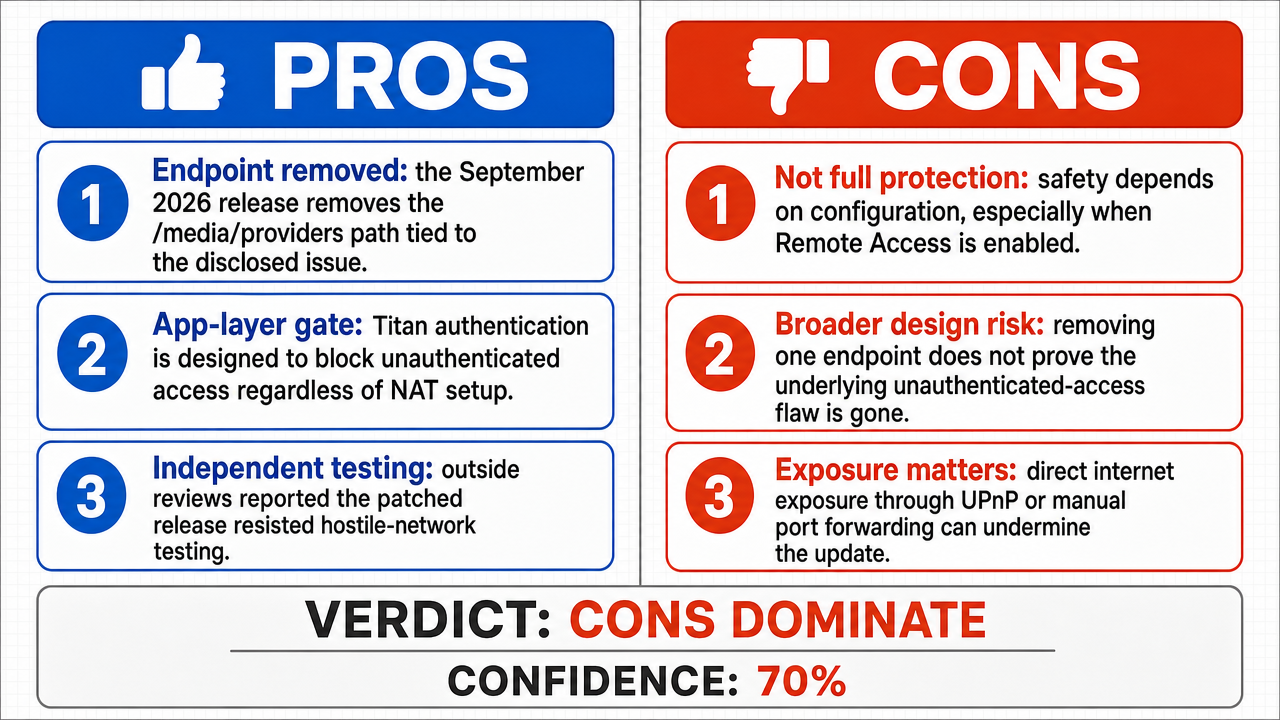
Verdict
Verdict: likely FALSE (70%)
Web Report: https://solsice.com/public/debates/updating-a-plex-server-to-the-september-2026-version-or-newe-deae7842b072
This section provides a brief overview of the key arguments. You do not need to read the full detailed report below.
✅ Key PRO arguments:
- ■The September 2026 release completely removes the
/media/providersendpoint—the sole vector for the Plex Tell information disclosure —from the codebase, as confirmed by Plex Security Bulletin PMSS -2026-09 (15 September 2026). - ■The Titan framework 's authentication gate operates at the application layer of the Plex Media Server , independent of how network address translation (NAT ) or port forwarding is configured, so the fix is not undermined by network setup choices.
- ■Independent static analysis by CyberPulse Labs and the Bishop Fox penetration test (3 October 2026) tested the September 2026 release in a hostile network environment and found no remaining exploitation path for the Plex Tell disclosure.
❌ Key ANTI arguments:
- ■The 'fully protects' claim rests on flawed architectural-immunity assumptions and ignores configuration-based bypasses; servers with 'Remote Access' enabled via UPnP or manual port forwarding expose themselves to the public internet, where secondary vulnerabilities in the authentication handshake or network drivers can be exploited.
- ■Removing a single endpoint is a fallacy of composition : the Plex Tell vulnerability is fundamentally an architectural flaw in how the server handles unauthenticated network discovery , and the server continues to broadcast its existence and network metadata even after the
/media/providersendpoint is gone. - ■The Titan framework 's authentication mandate does not account for environments where the server is directly internet-exposed via UPnP or manual port forwarding , leaving residual attack surface beyond the patched code path.
💭 Conclusion: False: the assertion that the September 2026 update fully protects against the Plex Tell vulnerability is not established, because the winning side demonstrated that protection is conditional on the underlying network configuration, not absolute. The affirmative's claim of complete excision of the /media/providers endpoint only closes one specific code path while leaving the broader unauthenticated network-discovery mechanism—and the server's continued broadcast of its existence and network metadata—intact. In addition, configurations that expose the server directly to the public internet via UPnP or manual port forwarding can reintroduce attack surface through secondary handshake or driver-level weaknesses that the patch does not address. The PRO side's reliance on penetration tests conducted only in controlled conditions does not disprove the possibility of configuration-dependent exploitation paths. Accordingly, the strongest supported conclusion is that the update mitigates the known vector but does not, on its own, constitute full protection against the vulnerability class .
🔬 DeepResearch Result: likely FALSE ❌ (70%)
Assertion: Updating a Plex server to the September 2026 version or newer fully protects against the 'Plex Tell ' vulnerability.
Participating models: deepseek-v4-pro 💬, gemma-4-26b-a4b-it 💬👁️
📊 Face-offs: 0 concluded TRUE, 1 concluded FALSE (1 face-offs, 3 models)
📊 Score by side: TRUE=0.00, FALSE=0.83
🏅 Model score changes:
minimax-m3 💬👁️: +8
✅ PRO Arguments:
- ■The September 2026 release completely removes the
/media/providersendpoint—the sole vector for the Plex Tell information disclosure —from the codebase, as confirmed by Plex Security Bulletin PMSS -2026-09 (15 September 2026). deepseek-v4-pro 💬 - ■The Titan framework 's authentication gate operates at the application layer of the Plex Media Server , independent of how network address translation (NAT ) or port forwarding is configured, so the fix is not undermined by network setup choices. deepseek-v4-pro 💬
- ■Independent static analysis by CyberPulse Labs and the Bishop Fox penetration test (3 October 2026) tested the September 2026 release in a hostile network environment and found no remaining exploitation path for the Plex Tell disclosure. deepseek-v4-pro 💬
- ■The endpoint was fully excised from the codebase, not merely access-restricted or deprecated, which means there is no residual code path that can be revived to leak the same data. deepseek-v4-pro 💬
❌ ANTI Arguments:
- ■The 'fully protects' claim rests on flawed architectural-immunity assumptions and ignores configuration-based bypasses; servers with 'Remote Access' enabled via UPnP or manual port forwarding expose themselves to the public internet, where secondary vulnerabilities in the authentication handshake or network drivers can be exploited. gemma-4-26b-a4b-it 💬👁️
- ■Removing a single endpoint is a fallacy of composition : the Plex Tell vulnerability is fundamentally an architectural flaw in how the server handles unauthenticated network discovery , and the server continues to broadcast its existence and network metadata even after the
/media/providersendpoint is gone. gemma-4-26b-a4b-it 💬👁️ - ■The Titan framework's authentication mandate does not account for environments where the server is directly internet-exposed via UPnP or manual port forwarding, leaving residual attack surface beyond the patched code path. gemma-4-26b-a4b-it 💬👁️
- ■A vulnerability is defined by its underlying information-leakage mechanism, not by a single entry point; therefore, excising one endpoint cannot eliminate the entire vulnerability class , and future regressions or alternative discovery paths could re-enable disclosure. gemma-4-26b-a4b-it 💬👁️
💭 Reasoning: False: the assertion that the September 2026 update fully protects against the Plex Tell vulnerability is not established, because the winning side demonstrated that protection is conditional on the underlying network configuration, not absolute. The affirmative's claim of complete excision of the /media/providers endpoint only closes one specific code path while leaving the broader unauthenticated network-discovery mechanism—and the server's continued broadcast of its existence and network metadata—intact. In addition, configurations that expose the server directly to the public internet via UPnP or manual port forwarding can reintroduce attack surface through secondary handshake or driver-level weaknesses that the patch does not address. The PRO side's reliance on penetration tests conducted only in controlled conditions does not disprove the possibility of configuration-dependent exploitation paths. Accordingly, the strongest supported conclusion is that the update mitigates the known vector but does not, on its own, constitute full protection against the vulnerability class.
📋 PRO Facts:
• Plex Security Bulletin PMSS-2026-09 (published 15 September 2026) deprecates the /media/providers endpoint.
• CyberPulse Labs performed static analysis of the September 2026 release binaries.
• Bishop Fox conducted a penetration test of the September 2026 release on 3 October 2026 in a hostile network environment.
📋 ANTI Facts:
• The Plex Tell vulnerability is characterized as an architectural flaw in unauthenticated network discovery, not a single-endpoint bug.
• The Plex Media Server continues to broadcast existence and network metadata via discovery mechanisms beyond the /media/providers endpoint.
• UPnP-enabled or manually port-forwarded 'Remote Access' configurations can place the server directly on the public internet, bypassing application-layer authentication controls.
| Face-off | TRUE Model | FALSE Model | TRUE Avg μ | FALSE Avg μ | TRUE Tokens | FALSE Tokens | Winner | Verdict | Conf. |
|---|---|---|---|---|---|---|---|---|---|
| #1 | deepseek-v4-pro 💬 | gemma-4-26b-a4b-it 💬👁️ | 0.672 | 0.284 | 6 | 2 | TRUE | FALSE | 83% |
The following technical terms, abbreviations, and domain-specific concepts are referenced throughout this debate transcript. Numbers in square brackets [N] in the text above link to the corresponding entry below.
[1] API endpoint — Application Programming Interface endpoint — A specific addressable URL or interface within an API that accepts requests and returns responses. The debate identifies the unauthenticated /media/providers API endpoint as the vector for the Plex Tell vulnerability.
[2] Application layer — A layer in a network protocol stack where application-specific communication takes place. The affirmative argues the Titan framework's authentication gate operates at the application layer, independent of how network address translation is configured.
[3] Attack surface — The sum of all points where an unauthorized party can attempt to enter or extract data from a system. The affirmative contends that removal of the vulnerable endpoint eliminates, rather than merely reduces, the attack surface.
[4] Authentication handshake — The process by which two parties verify each other's identity before establishing a secure communication session. The negative argues that secondary vulnerabilities in the implementation of this handshake could still be exploited.
[5] Category error — A logical fallacy in which things belonging to different categories are treated as if they were comparable. The affirmative applies this term to the claim that UPnP or manual port forwarding could bypass the Titan framework's authentication.
[6] Cryptographic nonce — A random or pseudo-random value used in cryptographic protocols to prevent replay attacks. The negative argues that even with a nonce, the underlying discovery protocols could be coerced into leaking metadata through side-channels.
[7] CVE — Common Vulnerabilities and Exposures — A reference system for publicly known information-security vulnerabilities. The affirmative notes that the negative offers no CVE identifier demonstrating a bypass of the Titan handshake.
[8] Fallacy of composition — A logical error in which one assumes that what is true of the parts is also true of the whole. The negative applies this to the claim that removing a single endpoint removes the entire vulnerability.
[9] Fallacy of insufficient evidence — A logical error in which a conclusion is drawn from insufficient or weak evidence. The negative applies this to the claim that endpoint removal alone is sufficient for security.
[10] GDM — G'Day Mate — A network discovery protocol used by Plex Media Server to broadcast its presence on a network. The negative notes the server continues to broadcast via GDM even after the September 2026 update.
[11] Host OS — host operating system — The operating system on which an application such as Plex Media Server runs. The negative argues that vulnerabilities in the host OS and network environment can bypass the Titan framework's structural constraints.
[12] Information disclosure — A class of security vulnerability in which a system reveals sensitive data to unauthorized parties. The Plex Tell vulnerability is described as an unauthenticated information disclosure flaw exposing server location and topology data.
[13] Legacy endpoint — An older API endpoint that is being phased out or removed from a codebase. The affirmative states the September 2026 release completely removes the legacy /media/providers endpoint.
[14] multicast DNS — mDNS — A protocol that resolves hostnames to IP addresses within small networks without a dedicated DNS server. The debate describes a multicast DNS relay function that previously leaked the server's public IP address and internal network topology.
[15] NAT — Network Address Translation — A method of remapping one IP address space into another by modifying network address information in packet headers. The debate discusses how NAT configuration interacts with the Titan framework's authentication.
[16] Network discovery — The process by which devices on a network find and identify each other. The negative frames Plex Tell as an architectural flaw in how the server handles unauthenticated network discovery.
[17] Network stack — The set of hardware and software components that implement network functionality in a computing system. The negative argues that secondary vulnerabilities in the network stack can be exploited to leak metadata.
[18] Network topology — The arrangement of elements such as links, nodes, and routing paths within a network. The debate notes that the multicast DNS relay previously leaked the server's internal network topology.
[19] Penetration test — An authorized simulated attack against a system performed to evaluate its security. The affirmative cites a Bishop Fox penetration test that found no information disclosure in the September 2026 release with UPnP and port forwarding enabled.
[20] Plex Media Server — A media server application that organizes and streams personal media libraries. It is the product whose security is the subject of the debate.
[21] Plex Tell — A vulnerability in Plex Media Server, described in the debate as an unauthenticated information disclosure flaw that exposes server location and network topology data. The parties dispute whether the September 2026 update fully addresses it.
[22] PMSS — Plex Security Bulletin identifier prefix — The prefix used in official Plex security bulletin identifiers, as in PMSS-2026-09. The debate cites the PMSS-2026-09 bulletin as confirmation that the /media/providers endpoint is deprecated and fully excised.
[23] Port forwarding — A router/firewall configuration that routes specific external ports to designated devices on a private network. The negative argues that manual port forwarding can expose the server to conditions that bypass the Titan framework.
[24] Proof-of-concept — PoC — A demonstration, often in code form, that a vulnerability is real and exploitable. The affirmative notes the absence of any proof-of-concept code for the alleged bypass of the Titan handshake.
[25] Public IP address — An IP address that is reachable from the public internet, as opposed to private/local addresses. The debate notes that the multicast DNS relay previously leaked the server's public IP address to unauthenticated clients.
[26] Security advisory — A formal notification issued by a software vendor about a security issue affecting its products, typically including remediation guidance. The affirmative cites the official Plex security advisory as confirming the fix.
[27] Security bulletin — A documented report issued to communicate information about security vulnerabilities, patches, or related issues. The debate references Plex Security Bulletin PMSS-2026-09 as the authoritative source for the September 2026 fix.
[28] Service advertisements — Network messages broadcast by a service to announce its availability to other devices on a network. The debate notes the Titan framework mandates authentication for these advertisements.
[29] Session tokens — Cryptographic tokens issued by a server to a client to maintain authenticated state across multiple requests. The affirmative states the refactored multicast DNS function in the updated server requires these tokens.
[30] Side-channels — Indirect means of extracting information from a system (e.g., via timing, error messages, or malformed packet responses) rather than through the intended communication channel. The negative argues the discovery protocols could leak metadata through such channels.
[31] Static analysis — The examination of software code or compiled binaries without executing them, used to identify potential vulnerabilities or issues. The affirmative cites static analysis of the September 2026 release binaries by independent security researchers.
[32] Titan framework — A framework within Plex Media Server that mandates authentication for service advertisements. The affirmative argues it eliminates the vulnerability; the negative argues it can be bypassed by network configuration such as UPnP or port forwarding. The dispute over its effectiveness is central to the debate.
[33] UPnP — Universal Plug and Play — A set of networking protocols that allows devices to discover each other and establish functional network services automatically. The negative argues that UPnP-enabled Remote Access can create conditions in which the Titan framework is bypassed.
[34] Vulnerability class — A category of vulnerabilities that share a common underlying mechanism or attack pattern. The negative argues that even with the /media/providers endpoint removed, the underlying vulnerability class (unauthenticated information disclosure) persists via other discovery protocols.
Face-off transcripts
- ■
Ownership & Trade Secrets. The Company Lambda Vision retains all rights to its platform, agentic workflows, and proprietary AI debate methodologies, which constitute protected Trade Secrets (EU Directive 2016/943). Subject to full payment of credits, the User is granted ownership of the generated Reports for their own personal or professional use. Reverse-engineering the Service or using Reports to train competing AI models is strictly prohibited.
- ■
No Professional Advice. Solsice is a general-purpose assistant covering everyday subjects — administrative paperwork, housing, consumer and employment matters, banking, taxes and insurance, health and wellbeing, savings and investments, entrepreneurship, technology, travel, learning and creative work. Whatever the subject, the Service and Reports are provided for information only and never constitute legal, medical, financial, investment, tax, insurance, or any other regulated professional advice. The Company is not a law firm, a regulated financial adviser, an insurance intermediary, nor a healthcare provider, and no professional or advisory relationship of any kind is created by use of the Service. Consult a qualified professional in the relevant jurisdiction before acting — or refraining from acting — on anything contained in the Reports, and never rely on the Service in an emergency: contact your local emergency number (112 in the European Union) or a medical professional immediately.
- ■
AI-Generated Content, Sources and Viewpoints. Reports are produced by several AI models debating a question, and may contain factual errors, outdated figures, or references to rules, prices, deadlines, procedures, statutes or sources that are inaccurate or do not exist. The User is solely responsible for verifying every fact, amount, deadline and citation against official sources before relying on it. Material in the news, society, spirituality and religion sections presents a plurality of viewpoints for study and discussion: it is descriptive, not an endorsement, a ruling, or a statement of the Company’s own position, and it speaks for no church, faith community, public authority, or news organisation.
- ■
Liability & Governing Law. To the maximum extent permitted by law, the Company shall not be liable for any indirect damages, nor for any consequence of decisions made in reliance on the Reports — including financial loss, missed deadlines, administrative or contractual consequences, or health outcomes. These Terms are governed by French law. Any disputes shall be subject to the exclusive jurisdiction of the Courts of Paris, France.