
UNIA will provide a significant and equitable initial user base for all Korean companies that integrate with it.
AI debate verdict and arguments
⚠️ AI-generated information only; not professional advice
Completed October 11, 2026
Verdict
Verdict: likely FALSE (87%)
This section provides a brief overview of the key arguments. You do not need to read the full detailed report below.
✅ Key PRO arguments:
- ■UNIA 's design as a unified national digital identity and data platform inherently creates a large, pre-vetted user base, giving integrating companies immediate access to a significant portion of South Korea's digitally active population and eliminating substantial marketing and onboarding costs.
- ■OpenID Connect Core 1.0 provides a known technical transfer operator : a user authenticated by an identity provider can grant a third-party application access to verified identity claims in a single consented flow, making the pathway from UNIA to integrating apps a proven protocol rather than a vague hope.
- ■Read as a general rule rather than a literal promise of equal market success, 'significant' refers to the size of the addressable verified-user pool in Korea's digital economy , while 'equitable' refers to equal entry conditions—the same consented authentication or data-sharing pathway —not the same revenue outcome.
❌ Key ANTI arguments:
- ■The affirmative commits a fallacy of scale and substitution by treating the aggregate scale of South Korea's digital population as a proxy for the specific user base available to any single integrating company; there is no established transfer operator or proven conversion coefficient mapping total UNIA users to actual app users.
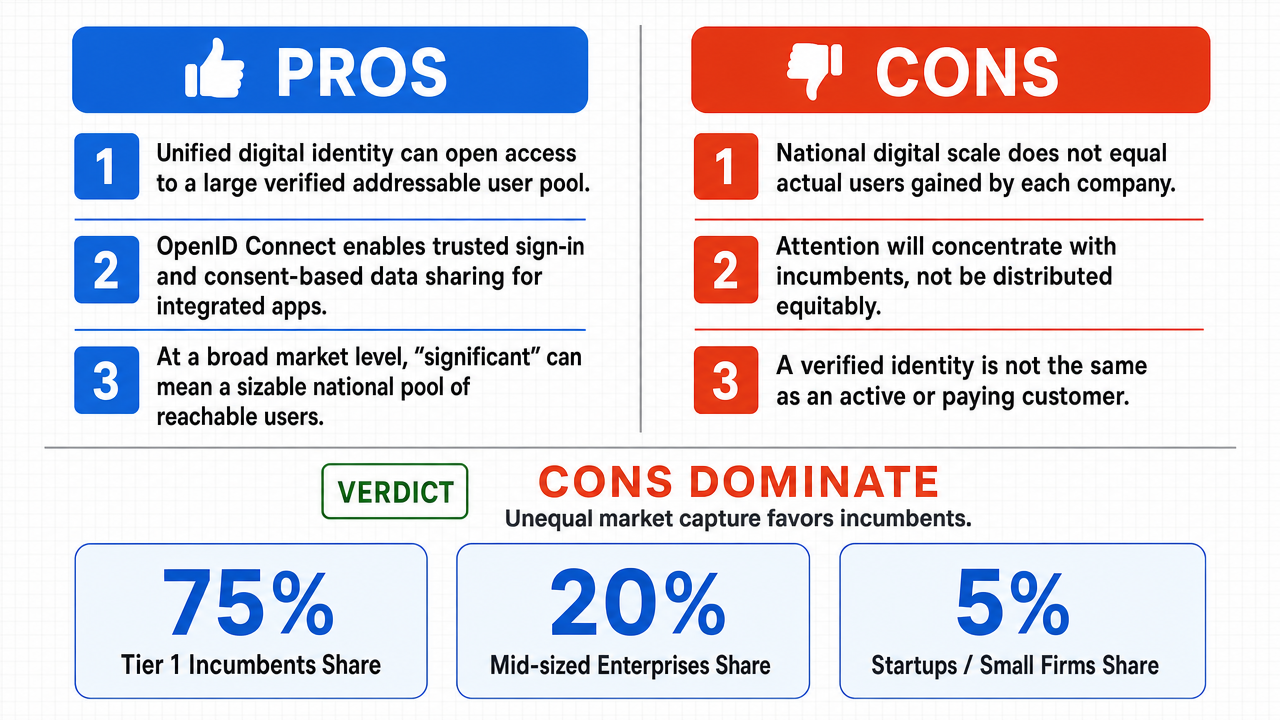
- ■Even with a common gateway , winner-take-most dynamics mean that visibility and engagement will naturally concentrate among incumbents and well-known brands, undermining the promise of equity for all integrating companies regardless of size or marketing budget.
- ■The affirmative's claim of a 'pre-vetted ' user base is an empty predicate : the argument never specifies what 'vetted' means, by whom, against what criteria, or how administrative identity verification translates into commercial availability or purchasing intent .
💭 Conclusion: False. The negative side convincingly demonstrated that the affirmative's case rests on a fallacy of scale , conflating South Korea's aggregate digital population with the actual user base any single integrating company can convert. The absence of any proven conversion coefficient between UNIA -authenticated users and active app users means 'significant' access is not guaranteed. Furthermore, winner-take-most market dynamics and the distinction between administrative identity and commercial intent undermine the 'equitable' sub-claim, since equal technical access does not translate to equal commercial outcomes. Because the assertion is compound (requiring both significance and equity), and the equity sub-claim is particularly weakly supported, confidence is set at a high level reflecting the least-supported component.
🔬 DeepResearch Result: likely FALSE ❌ (87%)
Assertion: UNIA will provide a significant and equitable initial user base for all Korean companies that integrate with it.
Participating models: deepseek-v3.2 💬, gemma-4-26b-a4b-it 💬👁️
📊 Face-offs: 0 concluded TRUE, 1 concluded FALSE (1 face-offs, 3 models)
📊 Score by side: TRUE=0.00, FALSE=0.87
🏅 Model score changes:
minimax-m3 💬👁️: +9
✅ PRO Arguments:
- ■UNIA's design as a unified national digital identity and data platform inherently creates a large, pre-vetted user base, giving integrating companies immediate access to a significant portion of South Korea's digitally active population and eliminating substantial marketing and onboarding costs. deepseek-v3.2 💬
- ■OpenID Connect Core 1.0 provides a known technical transfer operator : a user authenticated by an identity provider can grant a third-party application access to verified identity claims in a single consented flow, making the pathway from UNIA to integrating apps a proven protocol rather than a vague hope. deepseek-v3.2 💬
- ■Read as a general rule rather than a literal promise of equal market success, 'significant' refers to the size of the addressable verified-user pool in Korea's digital economy , while 'equitable' refers to equal entry conditions—the same consented authentication or data-sharing pathway —not the same revenue outcome. deepseek-v3.2 💬
❌ ANTI Arguments:
- ■The affirmative commits a fallacy of scale and substitution by treating the aggregate scale of South Korea's digital population as a proxy for the specific user base available to any single integrating company; there is no established transfer operator or proven conversion coefficient mapping total UNIA users to actual app users. gemma-4-26b-a4b-it 💬👁️
- ■Even with a common gateway , winner-take-most dynamics mean that visibility and engagement will naturally concentrate among incumbents and well-known brands, undermining the promise of equity for all integrating companies regardless of size or marketing budget. gemma-4-26b-a4b-it 💬👁️
- ■The affirmative's claim of a 'pre-vetted' user base is an empty predicate : the argument never specifies what 'vetted' means, by whom, against what criteria, or how administrative identity verification translates into commercial availability or purchasing intent . gemma-4-26b-a4b-it 💬👁️
- ■There is a critical distinction between administrative identity (being authenticated by a government system) and commercial intent (being a willing customer of a third-party app); UNIA proves who a user is, not that they want to use any particular integrating service. gemma-4-26b-a4b-it 💬👁️
💭 Reasoning: False. The negative side convincingly demonstrated that the affirmative's case rests on a fallacy of scale, conflating South Korea's aggregate digital population with the actual user base any single integrating company can convert. The absence of any proven conversion coefficient between UNIA-authenticated users and active app users means 'significant' access is not guaranteed. Furthermore, winner-take-most market dynamics and the distinction between administrative identity and commercial intent undermine the 'equitable' sub-claim, since equal technical access does not translate to equal commercial outcomes. Because the assertion is compound (requiring both significance and equity), and the equity sub-claim is particularly weakly supported, confidence is set at a high level reflecting the least-supported component.
📋 PRO Facts:
• South Korea has pursued digital transformation initiatives relevant to widespread adoption of national digital identity infrastructure.
📋 ANTI Facts:
• No established conversion coefficient exists mapping total UNIA-authenticated users to actual third-party app users.
• Winner-take-most dynamics in digital marketplaces cause visibility and engagement to concentrate among incumbents even when technical access is equal.
• Administrative identity verification (proving who a user is) is functionally distinct from commercial intent (willingness to use a specific service).
| Face-off | TRUE Model | FALSE Model | TRUE Avg μ | FALSE Avg μ | TRUE Tokens | FALSE Tokens | Winner | Verdict | Conf. |
|---|---|---|---|---|---|---|---|---|---|
| #1 | deepseek-v3.2 💬 | gemma-4-26b-a4b-it 💬👁️ | 0.201 | 0.237 | 12 | 3 | FALSE | FALSE | 87% |
The following technical terms, abbreviations, and domain-specific concepts are referenced throughout this debate transcript. Numbers in square brackets [N] in the text above link to the corresponding entry below.
[1] active user acquisition — The process of converting available users into active users of a specific enterprise's service, distinguished in the debate from aggregate national user counts.
[2] addressable pool — The pool of potential users that a service could theoretically reach, referenced in the debate as the 'addressable verified-user pool' in Korea's digital economy.
[3] addressable verified-user pool — The set of users whose identities have been verified through a consented identity platform and who could potentially be reached by integrating services.
[4] administrative identity — An identity established for governmental or administrative purposes (e.g., age or nationality verification), distinguished in the debate from commercial identity attributes.
[5] authentication — The technical process of verifying a user's identity, referenced in the debate as part of consented identity protocols.
[6] common gateway — A shared access point through which multiple parties can reach users; in the debate, UNIA is described as a common gateway that levels the playing field between companies.
[7] consent-based authorization — An authorization framework in which a user explicitly grants a third-party application permission to access identity or data, standardized by OAuth 2.0.
[8] consented authentication — Authentication that occurs only after the user has explicitly consented to share identity or data with a relying party.
[9] consented identity protocols — Technical protocols (such as OpenID Connect and OAuth 2.0) that rely on explicit user consent to transmit identity information.
[10] conversion coefficient — A metric that would map the total number of identity-platform users to the actual active users acquired by a specific integrating enterprise; the negative argues no such coefficient has been demonstrated.
[11] conversion costs — The costs incurred in converting available users into active customers, referenced alongside customer acquisition costs.
[12] conversion rate — The proportion of available users who actually become active users of a given service, distinguished in the debate from aggregate national digital adoption.
[13] creditworthiness — A borrower's ability to repay debt, cited in the debate as an example of a commercial attribute that identity vetting for age or nationality does not establish.
[14] customer acquisition — The business process of gaining new customers, which the affirmative argues UNIA reduces by providing pre-existing user access.
[15] customer acquisition costs — CAC — The costs a company incurs to attract and convert new customers, referenced as a barrier that UNIA allegedly eliminates.
[16] data-sharing pathway — The technical route through which verified personal data moves from public or financial institutions into private services via explicit consent.
[17] digital adoption — The extent to which a population uses digital technologies, referenced as a measure of national digital maturity rather than per-service usage.
[18] digital economy — Economic activity conducted through digital technologies, cited as the context in which UNIA's addressable user pool is material.
[19] digital identity — An electronic representation of a person's identity used for authentication and verification, central to UNIA's design.
[20] digital maturity — The level of development of a country's digital infrastructure and population's digital usage, distinguished in the debate from sectoral service usage.
[21] digital transformation — The adoption of digital technology by organizations or governments, cited as the South Korean government's broader push that includes MyData.
[22] empty predicate — A logical term used by the negative to argue that 'pre-vetted' is undefined and therefore carries no verifiable content.
[23] explicit consent — A clear, affirmative authorization given by a user to share personal data or identity claims, required by MyData and consent-based protocols.
[24] fallacy of scale — A logical error identified by the negative in which the aggregate size of a national digital population is treated as a proxy for any single company's user base.
[25] fallacy of substitution — A logical error identified by the negative in which one measure (national digital adoption) is substituted for another (specific enterprise user acquisition).
[26] identity provider — IdP — An entity that authenticates a user's identity and issues identity claims to relying parties, as referenced in OpenID Connect.
[27] incumbents — Established companies already dominant in a market, cited in the debate as the beneficiaries of winner-take-most dynamics.
[28] KISA — Korea Internet & Security Agency — A Korean government agency referenced in connection with the MyData initiative.
[29] market share — A company's portion of total sales in a market, distinguished in the debate from technical access to a user pool.
[30] MyData — A Korean infrastructure initiative under which users can move verified personal data from public and financial institutions into private services through explicit consent.
[31] OAuth 2.0 — Open Authorization 2.0 — An authorization framework that standardizes consent-based authorization for connecting identity platforms to relying-party services.
[32] onboarding — The process of integrating new users into a service, cited as a cost that UNIA allegedly eliminates.
[33] OpenID Connect — OIDC — An authentication protocol built on OAuth 2.0 that lets a user authenticated by an identity provider grant a third-party application access to verified identity claims in a single consented flow.
[34] personal data — Information relating to an identified or identifiable individual, whose movement between institutions and services is governed by consent under MyData.
[35] pre-vetted — Describing users whose identity has already been verified through a platform; the negative disputes whether such vetting transfers to commercial contexts.
[36] purchasing intent — A consumer's likelihood to buy, cited as a commercial attribute that administrative identity vetting does not establish.
[37] relying party — RP — A third-party application that receives verified identity claims from an identity provider after user consent, as defined in OpenID Connect and OAuth 2.0.
[38] sectoral service usage — The actual usage of services within a specific industry sector, distinguished in the debate from aggregate national digital adoption.
[39] third-party application — An external application that receives identity or data from an identity provider via consent-based protocols.
[40] transfer operator — A mechanism that maps one population (e.g., national identity users) to another (e.g., a specific enterprise's active users); the negative argues no such operator has been demonstrated.
[41] UNIA — A unified national digital identity and data platform in South Korea, described in the debate as a consented identity/data gateway designed for widespread adoption.
[42] user acquisition — The process of gaining new users for a service, referenced as a cost that UNIA allegedly reduces for integrating companies.
[43] value proposition — The set of benefits a product or service offers, cited in the debate as including the equitable distribution of UNIA's user base.
[44] verified identity claims — Statements about a user's identity (e.g., age, nationality) that have been authenticated by an identity provider and transmitted to a relying party.
[45] winner-take-most — A market dynamic in which visibility and engagement concentrate among a few dominant players, cited by the negative as undermining the equity of a common gateway.
The following financial data tables were referenced during the debate exchanges:
| Segment | Projected Market Share Capture | Relative Growth Potential |
|---|---|---|
| Tier 1 Incumbents | 75% | High |
| Mid-sized Enterprises | 20% | Moderate |
| Startups/Small Firms | 5% | Low |
Legend: Estimated distribution of user attention/engagement within unified digital identity gateways. Values represent qualitative market concentration tiers.
| User State | Conversion Effort Required | Cost Driver |
|---|---|---|
| Verified Identity (UNIA) | Low | Authentication Protocol |
| Active App User | High | Marketing & UX |
| Paying Customer | Very High | Value Proposition & Retention |
Legend: The progression from a technical identity to a commercial customer. Note that "verification" does not eliminate the costs associated with the subsequent stages of the customer lifecycle.
Face-off transcripts
- ■
Ownership & Trade Secrets. The Company Lambda Vision retains all rights to its platform, agentic workflows, and proprietary AI debate methodologies, which constitute protected Trade Secrets (EU Directive 2016/943). Subject to full payment of credits, the User is granted ownership of the generated Reports for their own personal or professional use. Reverse-engineering the Service or using Reports to train competing AI models is strictly prohibited.
- ■
No Professional Advice. Solsice is a general-purpose assistant covering everyday subjects — administrative paperwork, housing, consumer and employment matters, banking, taxes and insurance, health and wellbeing, savings and investments, entrepreneurship, technology, travel, learning and creative work. Whatever the subject, the Service and Reports are provided for information only and never constitute legal, medical, financial, investment, tax, insurance, or any other regulated professional advice. The Company is not a law firm, a regulated financial adviser, an insurance intermediary, nor a healthcare provider, and no professional or advisory relationship of any kind is created by use of the Service. Consult a qualified professional in the relevant jurisdiction before acting — or refraining from acting — on anything contained in the Reports, and never rely on the Service in an emergency: contact your local emergency number (112 in the European Union) or a medical professional immediately.
- ■
AI-Generated Content, Sources and Viewpoints. Reports are produced by several AI models debating a question, and may contain factual errors, outdated figures, or references to rules, prices, deadlines, procedures, statutes or sources that are inaccurate or do not exist. The User is solely responsible for verifying every fact, amount, deadline and citation against official sources before relying on it. Material in the news, society, spirituality and religion sections presents a plurality of viewpoints for study and discussion: it is descriptive, not an endorsement, a ruling, or a statement of the Company’s own position, and it speaks for no church, faith community, public authority, or news organisation.
- ■
Liability & Governing Law. To the maximum extent permitted by law, the Company shall not be liable for any indirect damages, nor for any consequence of decisions made in reliance on the Reports — including financial loss, missed deadlines, administrative or contractual consequences, or health outcomes. These Terms are governed by French law. Any disputes shall be subject to the exclusive jurisdiction of the Courts of Paris, France.