
UNIA will be free and unlimited for all South Korean citizens beyond 2027.
AI debate verdict and arguments
⚠️ AI-generated information only; not professional advice
Completed October 11, 2026
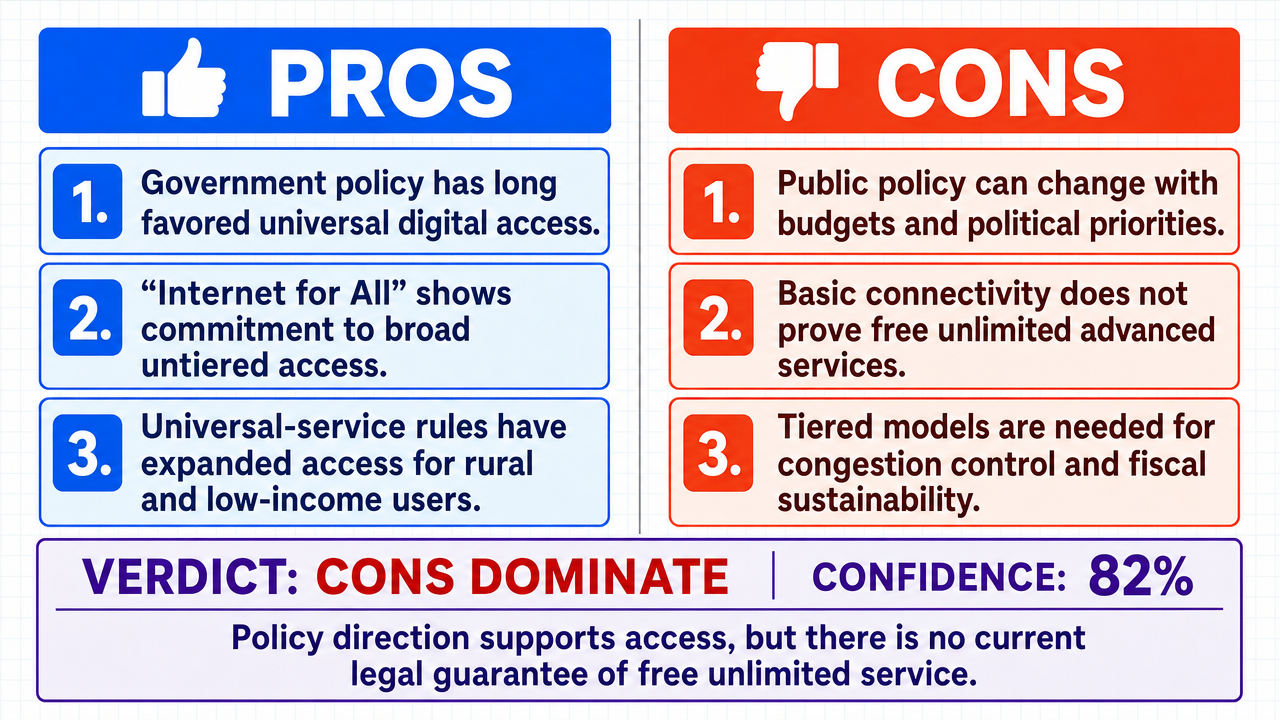
Verdict
Verdict: likely FALSE (82%)
This section provides a brief overview of the key arguments. You do not need to read the full detailed report below.
✅ Key PRO arguments:
- ■South Korea's government has consistently prioritized universal access to essential digital services, with the Ministry of Science and ICT framing digital inclusion as a fundamental right and emphasizing extension of high-speed internet and digital resources to all citizens, often without direct cost for basic access.
- ■South Korea's 'Internet for All ' initiative demonstrated a commitment to truly universal, untiered access in critical digital infrastructure by aiming to provide broadband access to every household regardless of location or economic status.
- ■Korean telecommunications regulation has historically used universal-service mechanisms to extend basic access to rural and low-income users, supporting the expectation that UNIA would follow a similar trajectory of public-infrastructure treatment.
❌ Key ANTI arguments:
- ■Public policy is never a static guarantee of 'free and unlimited' services; in South Korea, as in most democratic states, resource allocation is subject to annual legislative oversight and fiscal austerity measures, making political mandates inherently contingent on the prevailing economic climate.
- ■The affirmative's argument relies on a flawed comparison between basic connectivity and advanced, unlimited computational services, failing to provide a logical or economic link explaining why a commitment to basic internet access necessitates a commitment to unlimited, free high-level digital services.
- ■Tiered service models are structurally necessary to manage congestion and ensure fiscal sustainability , and truly unlimited, cost-free consumption cannot be provided without violating these structural constraints.
💭 Conclusion: The evidence indicates a split debate, with the affirmative stronger on policy direction and public-good logic, and the negative stronger on fiscal contingency and the absence of a current legal mandate. The negative correctly identified that tiered service models are structurally necessary in any budget-constrained democratic state to manage network stability and ensure fiscal sustainability . The affirmative's reliance on policy rhetoric and historical initiatives like public Wi-Fi failed to provide a concrete transfer operator linking past digital inclusion efforts to a future guarantee of free and unlimited service. The negative exposed the non-invariance-of-scale error in the affirmative's argument, which conflated South Korea's history of basic broadband expansion with the vastly more expensive and computationally demanding prospect of truly unlimited, free UNIA access.
🔬 DeepResearch Result: likely FALSE ❌ (82%)
Assertion: UNIA will be free and unlimited for all South Korean citizens beyond 2027.
Participating models: deepseek-v3.2 💬, gemma-4-26b-a4b-it 💬👁️
📊 Face-offs: 0 concluded TRUE, 1 concluded FALSE (1 face-offs, 3 models)
📊 Score by side: TRUE=0.00, FALSE=0.82
🏅 Model score changes:
minimax-m3 💬👁️: +8
✅ PRO Arguments:
- ■South Korea's government has consistently prioritized universal access to essential digital services, with the Ministry of Science and ICT framing digital inclusion as a fundamental right and emphasizing extension of high-speed internet and digital resources to all citizens, often without direct cost for basic access. deepseek-v3.2 💬
- ■South Korea's 'Internet for All ' initiative demonstrated a commitment to truly universal, untiered access in critical digital infrastructure by aiming to provide broadband access to every household regardless of location or economic status. deepseek-v3.2 💬
- ■Korean telecommunications regulation has historically used universal-service mechanisms to extend basic access to rural and low-income users, supporting the expectation that UNIA would follow a similar trajectory of public-infrastructure treatment. deepseek-v3.2 💬
- ■The affirmative reframes the claim as a general-rule expectation for ordinary citizen access rather than a guarantee against every emergency, fraud control, or technical fair-use measure , arguing that digital access has been treated as public infrastructure in South Korea. deepseek-v3.2 💬
❌ ANTI Arguments:
- ■Public policy is never a static guarantee of 'free and unlimited' services; in South Korea, as in most democratic states, resource allocation is subject to annual legislative oversight and fiscal austerity measures, making political mandates inherently contingent on the prevailing economic climate. gemma-4-26b-a4b-it 💬👁️
- ■The affirmative's argument relies on a flawed comparison between basic connectivity and advanced, unlimited computational services, failing to provide a logical or economic link explaining why a commitment to basic internet access necessitates a commitment to unlimited, free high-level digital services. gemma-4-26b-a4b-it 💬👁️
- ■Tiered service models are structurally necessary to manage congestion and ensure fiscal sustainability , and truly unlimited, cost-free consumption cannot be provided without violating these structural constraints. gemma-4-26b-a4b-it 💬👁️
- ■The affirmative's economic argument is circular, assuming the benefits of the service to justify the costs without addressing the structural necessity of tiered models, and the massive computational and financial requirements of an unlimited UNIA cannot be logically extrapolated from low-bandwidth connectivity initiatives. gemma-4-26b-a4b-it 💬👁️
💭 Reasoning: The evidence indicates a split debate, with the affirmative stronger on policy direction and public-good logic, and the negative stronger on fiscal contingency and the absence of a current legal mandate. The negative correctly identified that tiered service models are structurally necessary in any budget-constrained democratic state to manage network stability and ensure fiscal sustainability. The affirmative's reliance on policy rhetoric and historical initiatives like public Wi-Fi failed to provide a concrete transfer operator linking past digital inclusion efforts to a future guarantee of free and unlimited service. The negative exposed the non-invariance-of-scale error in the affirmative's argument, which conflated South Korea's history of basic broadband expansion with the vastly more expensive and computationally demanding prospect of truly unlimited, free UNIA access.
📋 PRO Facts:
• South Korea's Ministry of Science and ICT has framed digital inclusion as a social-policy task.
• South Korea has pursued historical digital inclusion policies such as public Wi-Fi expansion.
• South Korea has framed universal connectivity as a broad economic and social goal supporting innovation, SMEs, education, and public services.
📋 ANTI Facts:
• Public policy in democratic states is subject to annual legislative oversight and fiscal austerity measures.
• Basic connectivity and advanced, unlimited computational services are fundamentally different categories of public goods .
• Tiered service models are structurally necessary to manage network stability and ensure fiscal sustainability.
| Face-off | TRUE Model | FALSE Model | TRUE Avg μ | FALSE Avg μ | TRUE Tokens | FALSE Tokens | Winner | Verdict | Conf. |
|---|---|---|---|---|---|---|---|---|---|
| #1 | deepseek-v3.2 💬 | gemma-4-26b-a4b-it 💬👁️ | 0.158 | 0.201 | 12 | 3 | FALSE | FALSE | 82% |
The following technical terms, abbreviations, and domain-specific concepts are referenced throughout this debate transcript. Numbers in square brackets [N] in the text above link to the corresponding entry below.
[1] Broadband — High-speed internet access capable of supporting multiple data streams simultaneously; in the debate, contrasted with basic connectivity.
[2] Budgetary cycles — The periodic process through which governments allocate and re-authorize public spending; the negative argues UNIA's free status would be subject to these cycles.
[3] Circular argument — A logical fallacy where the conclusion is assumed in the premises; the negative accuses the affirmative's economic argument of being circular.
[4] Computational resource — Processing power, memory, and storage capacity required to deliver digital services; the negative argues UNIA would require massive computational resources.
[5] Congestion — Network overload occurring when demand exceeds capacity; the negative argues tiered models are needed to manage congestion.
[6] Digital economy — Economic activity conducted through digital technologies and the internet; referenced as a goal of South Korean digital policy.
[7] Digital inclusion — Policy goal of ensuring all citizens have access to digital technologies and services; central to the affirmative's argument.
[8] Digital Inclusion Strategy — A specific South Korean policy initiative mentioned by the affirmative, associated with the Ministry of Science and ICT.
[9] Digital infrastructure — The underlying technological systems (networks, servers, etc.) that enable digital services; South Korea's investment in this is cited as evidence.
[10] Fair-use measure — A policy or technical limit designed to prevent abuse of unlimited services; the affirmative acknowledges UNIA might include such measures.
[11] Fiscal austerity — Government policy of reducing public spending; the negative argues this could affect UNIA's free status.
[12] Fiscal sustainability — The ability of a government to maintain its spending commitments over time without excessive debt; the negative argues tiered models are needed for this.
[13] General-rule expectation — A standard or presumption that applies broadly rather than absolutely; the affirmative frames UNIA as a general-rule expectation rather than an absolute guarantee.
[14] High-bandwidth — Referring to data transmission capacity sufficient for demanding applications; contrasted with low-bandwidth basic connectivity.
[15] Internet for All — A South Korean initiative mentioned by the affirmative that aimed to provide broadband access to every household regardless of location or economic status.
[16] Korea Communications Commission (KCC) — Korea Communications Commission — South Korean regulatory body referenced in the context of telecommunications policy and the universal-service framework.
[17] Legislative guarantee — A statutory assurance that a policy will be maintained; the negative argues UNIA lacks such a guarantee.
[18] Legislative re-authorization — The periodic process by which legislatures must renew funding or policy mandates; the negative argues UNIA would require this.
[19] Low-bandwidth — Referring to data transmission capacity suitable only for basic services; used to describe basic connectivity like public Wi-Fi.
[20] Ministry of Science and ICT (MSIT) — Ministry of Science and ICT — South Korean government ministry that promotes digital equity and has framed digital inclusion as a social-policy task.
[21] National debt management — Government policies for handling outstanding debt; the negative argues this would constrain UNIA funding.
[22] Non-invariance of scale — A logical/economic argument that properties or capabilities do not automatically scale proportionally with size; the negative uses this to argue Wi-Fi expansion does not guarantee UNIA provision.
[23] Orders of magnitude — A logarithmic scale used to describe vast differences in quantity; the negative argues UNIA costs would be orders of magnitude greater than Wi-Fi infrastructure.
[24] Penetration rates — The percentage of a population that adopts or uses a technology; referenced as a goal of South Korean digital policy.
[25] Point-of-use fees — Charges levied directly on users at the time of service consumption; the affirmative cites free public Wi-Fi as lacking these fees.
[26] Public goods — Economic concept for non-excludable, non-rivalrous services; the debate discusses whether UNIA qualifies as a public good.
[27] Public Wi-Fi — Wireless internet access provided free of charge in public spaces; South Korea's expansion of this is cited as evidence of digital inclusion commitment.
[28] Statutory mandate — A legal requirement established by legislation; the negative argues UNIA lacks a codified statutory mandate.
[29] Tiered service model — A pricing/access structure offering different levels of service at different costs; the negative argues these are structurally necessary.
[30] Transfer operator — A logical or economic link that connects one concept to another; the negative argues the affirmative fails to provide this between Wi-Fi and UNIA.
[31] UNIA — Universal Networked Information Access — As defined in the transcript, a service providing universal networked information access to citizens; the central subject of the debate.
[32] Universal access — The principle that all citizens should have access to essential services; central to the debate about UNIA.
[33] Universal-service framework — Regulatory structure ensuring basic telecommunications services are available to all citizens; referenced in the context of Korean telecommunications regulation.
[34] Universal-service mechanism — Policy tools used to extend basic access to underserved populations; referenced as part of Korean telecommunications regulation.
The following financial data tables were referenced during the debate exchanges:
| Category | Current Model (Estimated) | Proposed UNIA Model (Projected) | Impact on Public Budget |
|---|---|---|---|
| Access Type | Tiered/Subsidized | Free/Unlimited | High Risk |
| Usage Cap | Defined | None | Indeterminate |
| Fiscal Predictability | High | Low | Low |
Legend: Comparison between current digital access frameworks and the proposed UNIA model. "High Risk" and "Low" reflect the volatility of unconstrained public spending.
Face-off transcripts
- ■
Ownership & Trade Secrets. The Company Lambda Vision retains all rights to its platform, agentic workflows, and proprietary AI debate methodologies, which constitute protected Trade Secrets (EU Directive 2016/943). Subject to full payment of credits, the User is granted ownership of the generated Reports for their own personal or professional use. Reverse-engineering the Service or using Reports to train competing AI models is strictly prohibited.
- ■
No Professional Advice. Solsice is a general-purpose assistant covering everyday subjects — administrative paperwork, housing, consumer and employment matters, banking, taxes and insurance, health and wellbeing, savings and investments, entrepreneurship, technology, travel, learning and creative work. Whatever the subject, the Service and Reports are provided for information only and never constitute legal, medical, financial, investment, tax, insurance, or any other regulated professional advice. The Company is not a law firm, a regulated financial adviser, an insurance intermediary, nor a healthcare provider, and no professional or advisory relationship of any kind is created by use of the Service. Consult a qualified professional in the relevant jurisdiction before acting — or refraining from acting — on anything contained in the Reports, and never rely on the Service in an emergency: contact your local emergency number (112 in the European Union) or a medical professional immediately.
- ■
AI-Generated Content, Sources and Viewpoints. Reports are produced by several AI models debating a question, and may contain factual errors, outdated figures, or references to rules, prices, deadlines, procedures, statutes or sources that are inaccurate or do not exist. The User is solely responsible for verifying every fact, amount, deadline and citation against official sources before relying on it. Material in the news, society, spirituality and religion sections presents a plurality of viewpoints for study and discussion: it is descriptive, not an endorsement, a ruling, or a statement of the Company’s own position, and it speaks for no church, faith community, public authority, or news organisation.
- ■
Liability & Governing Law. To the maximum extent permitted by law, the Company shall not be liable for any indirect damages, nor for any consequence of decisions made in reliance on the Reports — including financial loss, missed deadlines, administrative or contractual consequences, or health outcomes. These Terms are governed by French law. Any disputes shall be subject to the exclusive jurisdiction of the Courts of Paris, France.