
UNIA's integration with KakaoTalk will guarantee its widespread adoption and success among South Korean citizens.
AI debate verdict and arguments
⚠️ AI-generated information only; not professional advice
Completed October 11, 2026
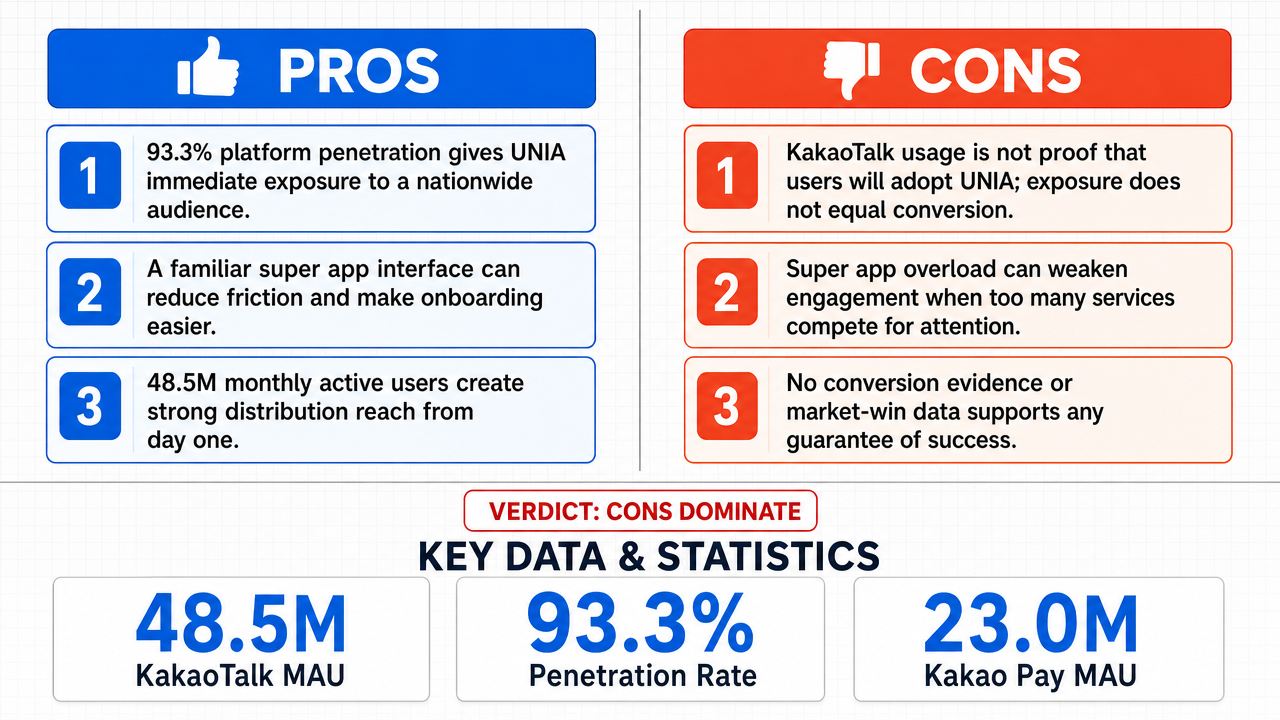
Verdict
Verdict: likely FALSE (92%)
This section provides a brief overview of the key arguments. You do not need to read the full detailed report below.
✅ Key PRO arguments:
- ■KakaoTalk 's dominant market penetration, with over 90% of the South Korean population using the platform, provides UNIA with immediate access to a massive pre-existing user base, eliminating significant barriers to entry and user acquisition costs while leveraging established network effects .
- ■KakaoTalk 's super app model is designed to enhance user convenience by centralizing diverse services within a familiar interface, reducing cognitive load ; the success of integrated services like Kakao Pay and Kakao T demonstrates that users actively embrace new functionalities when seamlessly woven into the existing ecosystem.
- ■KakaoTalk 's 48.5 million monthly active users in Q4 2023 places UNIA before more than 90% of South Korea's population, and the affirmative frames 'guarantee' as a practical market guarantee contingent on legal compliance and non-redundant utility, with regulatory bans or outages being exceptions rather than the ordinary case.
❌ Key ANTI arguments:
- ■The affirmative commits a fallacy of substitution by using KakaoTalk 's Monthly Active Users as a proxy for UNIA 's adoption potential; high exposure is not synonymous with high conversion, and no transfer operator (conversion rate , engagement coefficient , or user acquisition cost reduction metric) was provided to bridge the gap.
- ■Platform fatigue undermines super app integration because users experience diminishing returns and disengagement when overloaded with services within a single platform, meaning mere presence in KakaoTalk does not translate into actual usage or success for UNIA .
- ■Market competition from existing alternatives and the absence of demonstrated conversion data mean that KakaoTalk integration cannot guarantee success; the affirmative's position rests on unproven logical leaps and flawed analogies between KakaoTalk's MAU and UNIA 's actual adoption outcomes.
💭 Conclusion: The negative exposed a critical logical flaw in the affirmative's reasoning: the affirmative relied on KakaoTalk 's massive user base (48.5 million MAU in Q4 2023) as evidence that UNIA would succeed, but failed to provide any transfer operator —such as conversion rates, engagement coefficients, or user acquisition cost reductions—to demonstrate that platform access actually translates into adoption. The negative correctly argued that high exposure is not synonymous with high conversion, and that platform fatigue and market competition further undermine any guarantee. The affirmative's evidence measured a proxy (KakaoTalk's MAU) rather than UNIA's actual adoption, constituting a substitution fallacy.
🔬 DeepResearch Result: likely FALSE ❌ (92%)
Assertion: UNIA 's integration with KakaoTalk will guarantee its widespread adoption and success among South Korean citizens.
Participating models: deepseek-v3.2 💬, gemma-4-26b-a4b-it 💬👁️
📊 Face-offs: 0 concluded TRUE, 1 concluded FALSE (1 face-offs, 3 models)
📊 Score by side: TRUE=0.00, FALSE=0.92
🏅 Model score changes:
minimax-m3 💬👁️: +9
✅ PRO Arguments:
- ■KakaoTalk's dominant market penetration, with over 90% of the South Korean population using the platform, provides UNIA with immediate access to a massive pre-existing user base, eliminating significant barriers to entry and user acquisition costs while leveraging established network effects . deepseek-v3.2 💬
- ■KakaoTalk's super app model is designed to enhance user convenience by centralizing diverse services within a familiar interface, reducing cognitive load ; the success of integrated services like Kakao Pay and Kakao T demonstrates that users actively embrace new functionalities when seamlessly woven into the existing ecosystem. deepseek-v3.2 💬
- ■KakaoTalk's 48.5 million monthly active users in Q4 2023 places UNIA before more than 90% of South Korea's population, and the affirmative frames 'guarantee' as a practical market guarantee contingent on legal compliance and non-redundant utility, with regulatory bans or outages being exceptions rather than the ordinary case. deepseek-v3.2 💬
❌ ANTI Arguments:
- ■The affirmative commits a fallacy of substitution by using KakaoTalk's Monthly Active Users as a proxy for UNIA's adoption potential; high exposure is not synonymous with high conversion, and no transfer operator (conversion rate , engagement coefficient , or user acquisition cost reduction metric) was provided to bridge the gap. gemma-4-26b-a4b-it 💬👁️
- ■Platform fatigue undermines super app integration because users experience diminishing returns and disengagement when overloaded with services within a single platform, meaning mere presence in KakaoTalk does not translate into actual usage or success for UNIA. gemma-4-26b-a4b-it 💬👁️
- ■Market competition from existing alternatives and the absence of demonstrated conversion data mean that KakaoTalk integration cannot guarantee success; the affirmative's position rests on unproven logical leaps and flawed analogies between KakaoTalk's MAU and UNIA's actual adoption outcomes. gemma-4-26b-a4b-it 💬👁️
💭 Reasoning: The negative exposed a critical logical flaw in the affirmative's reasoning: the affirmative relied on KakaoTalk's massive user base (48.5 million MAU in Q4 2023) as evidence that UNIA would succeed, but failed to provide any transfer operator—such as conversion rates, engagement coefficients, or user acquisition cost reductions—to demonstrate that platform access actually translates into adoption. The negative correctly argued that high exposure is not synonymous with high conversion, and that platform fatigue and market competition further undermine any guarantee. The affirmative's evidence measured a proxy (KakaoTalk's MAU) rather than UNIA's actual adoption, constituting a substitution fallacy.
📋 PRO Facts:
• KakaoTalk had 48.5 million monthly active users in Q4 2023 according to Kakao Corp. Q4 2023 Earnings Release .
• Over 90% of the South Korean population uses KakaoTalk.
• Kakao has successfully integrated services such as Kakao Pay and Kakao T into its ecosystem.
📋 ANTI Facts:
• The affirmative provided no conversion rate, engagement coefficient, or user acquisition cost reduction metric to link KakaoTalk's MAU to UNIA's adoption.
• Platform fatigue is a documented phenomenon that can reduce user engagement when multiple services are bundled into a single application.
• Market competition from existing alternatives can prevent new integrated services from achieving widespread adoption regardless of platform access.
| Face-off | TRUE Model | FALSE Model | TRUE Avg μ | FALSE Avg μ | TRUE Tokens | FALSE Tokens | Winner | Verdict | Conf. |
|---|---|---|---|---|---|---|---|---|---|
| #1 | deepseek-v3.2 💬 | gemma-4-26b-a4b-it 💬👁️ | 0.400 | 0.303 | 12 | 3 | TRUE | FALSE | 92% |
The following technical terms, abbreviations, and domain-specific concepts are referenced throughout this debate transcript. Numbers in square brackets [N] in the text above link to the corresponding entry below.
[1] CAC — user acquisition cost — A business metric representing the cost of acquiring a new user or customer, cited in the debate as a missing transfer operator.
[2] cognitive load — The mental effort required to process information or use an interface, mentioned in the debate as a barrier that KakaoTalk's super app model aims to reduce.
[3] cointegration analysis — A statistical method for analyzing long-term equilibrium relationships between variables, mentioned in the debate as a missing analysis.
[4] conversion beta — A statistical measure mentioned in the debate as a missing transfer operator to relate platform exposure to service adoption.
[5] conversion rate — The percentage of users who take a desired action, mentioned in the debate as a missing metric to bridge KakaoTalk's user base to UNIA's adoption.
[6] correlation coefficient — A statistical measure of the strength and direction of a relationship between two variables, mentioned in the debate as a missing transfer operator.
[7] crypto-assets — Digital assets based on cryptographic technology, mentioned in the debate as a trust-dependent sector where the super app model may not scale linearly.
[8] earnings release — A formal report issued by a publicly traded company detailing its financial results, cited in the debate as the source for KakaoTalk's Q4 2023 user data.
[9] engagement coefficient — A metric measuring the degree of user interaction with a service, mentioned in the debate as a missing transfer operator.
[10] fallacy of substitution — A logical error in which a proxy variable is measured in place of the actual subject of inquiry, alleged in the debate against the affirmative's use of KakaoTalk's MAU.
[11] IR — Investor Relations — The corporate function responsible for communicating financial information to investors and shareholders, referenced in the debate via Kakao Corp.'s IR webpage.
[12] Kakao Pay — A payment service within the Kakao ecosystem, cited in the debate as an example of successful in-platform integration reaching 23.0 million monthly active users.
[13] Kakao T — A transportation service within the Kakao ecosystem, cited in the debate as an example of successful in-platform integration.
[14] KakaoTalk — A South Korean messaging platform cited in the debate as having 48.5 million monthly active users and 93.3% market penetration in South Korea.
[15] MAU — Monthly Active Users — A metric measuring the number of unique users who engage with a platform within a given month, cited in the debate as 48.5 million for KakaoTalk.
[16] network effects — The phenomenon by which a service becomes more valuable to each user as more people use it, cited in the debate as a benefit of KakaoTalk's established user base.
[17] penetration rate — The percentage of a target population that uses a particular product or service, cited in the debate as 93.3% for KakaoTalk in South Korea.
[18] platform fatigue — User exhaustion or disengagement resulting from an overload of features or services on a single platform, cited in the debate as a barrier to adopting new integrated services.
[19] proxy — A variable used as a substitute for the actual subject of measurement, cited in the debate as the alleged misuse of KakaoTalk's MAU to argue for UNIA's adoption.
[20] social graph — The network of social connections and relationships between users on a platform, mentioned in the debate as a resource for offering personalized services.
[21] super app — A platform model that integrates multiple diverse services and features into a single application, cited in the debate as KakaoTalk's approach to centralizing services.
[22] transfer operator — A bridging metric or analytical tool used to relate one variable to another, mentioned in the debate as missing from the affirmative's argument connecting KakaoTalk's exposure to UNIA's adoption.
[23] UNIA — The service or platform at the center of the debate, whose integration with KakaoTalk is being argued as a guarantee of widespread adoption in South Korea.
The following financial data tables were referenced during the debate exchanges:
| Platform | Monthly Active Users (MAU) | Penetration Rate |
|---|---|---|
| KakaoTalk | 48.5 million | 93.3% |
| Naver | 42.0 million | 80.9% |
| 12.0 million | 23.1% |
Legend: Monthly Active Users and penetration rates for major messaging and social platforms in South Korea as of Q4 2023. Source: Statista, Kakao Corp. earnings reports.
| Service | Monthly Active Users (2023) | Annual Transaction Volume (2023) |
|---|---|---|
| Kakao Pay | 23.0 million | $104 billion |
| Kakao T | 30.0 million | N/A |
Legend: Monthly Active Users and Annual Transaction Volume for key Kakao integrated services in South Korea. Source: Kakao Corp. Q4 2023 Earnings Report.
| Service | Monthly Active Users (millions) |
|---|---|
| KakaoTalk | 48.5 |
| Kakao Pay | 23.0 |
*Legend: Monthly active users for KakaoTalk and Kakao Pay as reported in Kakao Corp. Q4 2023 earnings materials. Source: Kakao Corp. Q4 2023 Earnings Release,
Face-off transcripts
- ■
Ownership & Trade Secrets. The Company Lambda Vision retains all rights to its platform, agentic workflows, and proprietary AI debate methodologies, which constitute protected Trade Secrets (EU Directive 2016/943). Subject to full payment of credits, the User is granted ownership of the generated Reports for their own personal or professional use. Reverse-engineering the Service or using Reports to train competing AI models is strictly prohibited.
- ■
No Professional Advice. Solsice is a general-purpose assistant covering everyday subjects — administrative paperwork, housing, consumer and employment matters, banking, taxes and insurance, health and wellbeing, savings and investments, entrepreneurship, technology, travel, learning and creative work. Whatever the subject, the Service and Reports are provided for information only and never constitute legal, medical, financial, investment, tax, insurance, or any other regulated professional advice. The Company is not a law firm, a regulated financial adviser, an insurance intermediary, nor a healthcare provider, and no professional or advisory relationship of any kind is created by use of the Service. Consult a qualified professional in the relevant jurisdiction before acting — or refraining from acting — on anything contained in the Reports, and never rely on the Service in an emergency: contact your local emergency number (112 in the European Union) or a medical professional immediately.
- ■
AI-Generated Content, Sources and Viewpoints. Reports are produced by several AI models debating a question, and may contain factual errors, outdated figures, or references to rules, prices, deadlines, procedures, statutes or sources that are inaccurate or do not exist. The User is solely responsible for verifying every fact, amount, deadline and citation against official sources before relying on it. Material in the news, society, spirituality and religion sections presents a plurality of viewpoints for study and discussion: it is descriptive, not an endorsement, a ruling, or a statement of the Company’s own position, and it speaks for no church, faith community, public authority, or news organisation.
- ■
Liability & Governing Law. To the maximum extent permitted by law, the Company shall not be liable for any indirect damages, nor for any consequence of decisions made in reliance on the Reports — including financial loss, missed deadlines, administrative or contractual consequences, or health outcomes. These Terms are governed by French law. Any disputes shall be subject to the exclusive jurisdiction of the Courts of Paris, France.