
Un plan d'action de 30-60-90 jours est un document indispensable à présenter pour réussir la plupart des entretiens d'embauche
AI debate verdict and arguments
⚠️ AI-generated information only; not professional advice
Completed October 25, 2026
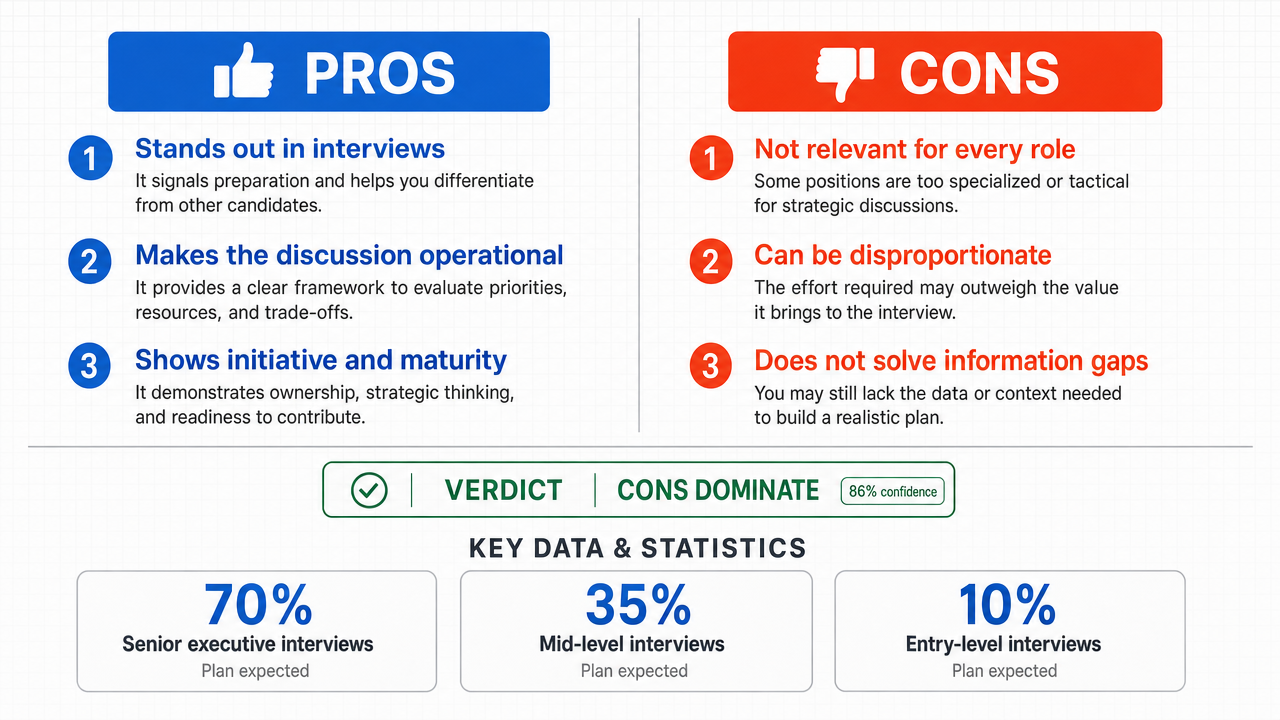
Verdict
Verdict: Mostly FALSE (86%)
Online report: https://solsice.com/public/debates/un-plan-d-action-de-30-60-90-jours-est-un-document-indispens-c6b2abd59d32
This section provides a brief overview of the key arguments. It is not necessary to read the detailed report below.
✅ Key PRO arguments:
- ■The 30-60-90 day action plan acts as a powerful cognitive differentiation lever during the selection process , transforming a theoretical discussion about skills into a concrete demonstration of execution.
- ■This document allows the recruiter to immediately project into an operational reality , turning the potential assessment interview into a real performance simulation .
- ■The proactive approach signals higher professional maturity , proving that the candidate does not just answer questions but offers a structured vision.
❌ Key CON arguments:
- ■The claim ignores the diversity of roles and industries: for entry-level positions , specialized technical roles, or high-turnover positions , emphasis is placed on proven technical skills and adaptability, not on a strategic 90-day vision.
- ■Requiring such a plan for these roles would be disproportionate and could even discourage qualified candidates who prefer to demonstrate their practical skills.
- ■The plan does not reduce information asymmetry , it artificially creates it: the real asymmetry lies in internal processes and tacit culture that the candidate is unaware of initially, making a pre-established plan often based on false assumptions.
💭 Conclusion: The debate demonstrates that the 30-60-90 day action plan is not essential for the majority of job interviews, as many positions — especially entry-level roles — prioritize demonstrated technical skills over a prospective strategic vision. The argument that this plan would reduce information asymmetry is fragile, since the candidate does not have the internal knowledge necessary to produce a realistic plan before joining . Data shows that only 70% of interviews for senior executives expect such a plan, compared to only 10% for entry-level positions and 35% for intermediate roles . Finally, systematically demanding such a plan could discourage qualified candidates and be disproportionate depending on the context of the targeted position.
🔬 Verdict: Mostly FALSE ❌ (86%)
Claim: A 30-60-90 day action plan is an essential document to present to succeed in most job interviews
Participating models: gemma-4-26b-a4b-it 💬👁️, glm-4.7-flash 💬
📊 Confrontations: 0 concluded TRUE, 1 concluded FALSE (1 confrontation, 3 models)
📊 Score by camp: TRUE=0.00, FALSE=0.86
🏅 Model score evolution:
minimax-m3 💬👁️: +9
✅ PRO arguments:
- ■The 30-60-90 day action plan acts as a powerful cognitive differentiation lever during the selection process , transforming a theoretical discussion about skills into a concrete demonstration of execution. gemma-4-26b-a4b-it 💬👁️
- ■This document allows the recruiter to immediately project into an operational reality , turning the potential assessment interview into a real performance simulation . gemma-4-26b-a4b-it 💬👁️
- ■The proactive approach signals higher professional maturity , proving that the candidate does not just answer questions but offers a structured vision. gemma-4-26b-a4b-it 💬👁️
- ■A tool can be indispensable to ensure success and differentiation, even if it is not a sine qua non condition for admission; the absence of explicit expectation does not mean lack of intrinsic value. gemma-4-26b-a4b-it 💬👁️
❌ CON arguments:
- ■The claim ignores the diversity of roles and industries: for entry-level positions , specialized technical roles, or high-turnover positions , emphasis is placed on proven technical skills and adaptability, not on a strategic 90-day vision. glm-4.7-flash 💬
- ■Requiring such a plan for these roles would be disproportionate and could even discourage qualified candidates who prefer to demonstrate their practical skills. glm-4.7-flash 💬
- ■The plan does not reduce information asymmetry , it creates it artificially: the real asymmetry lies in internal processes and tacit culture that the candidate is unaware of initially, making a pre-established plan often based on false assumptions. glm-4.7-flash 💬
- ■Employers rely more on actual integration and peer feedback than on a theoretical 90-day vision; structured onboarding programs are more effective than a document presented during an interview. glm-4.7-flash 💬
💭 Reasoning: The debate demonstrates that the 30-60-90 day action plan is not indispensable for most job interviews, as many positions — especially entry-level roles — prioritize demonstrated technical skills over a prospective strategic vision. The argument that this plan would reduce information asymmetry is fragile, since the candidate does not have the internal knowledge necessary to produce a realistic plan before joining. Data shows that only 70% of interviews for senior executives expect such a plan, compared to only 10% for entry-level positions and 35% for intermediate roles . Finally, systematically demanding such a plan could discourage qualified candidates and be disproportionate depending on the context of the targeted position.
📋 PRO facts:
• The 30-60-90 day plan can serve as a cognitive differentiation tool by transforming a theoretical discussion into a concrete demonstration of execution.
• A strategic document can signal higher professional maturity in the candidate.
📋 CON facts:
• The usefulness of the 30-60-90 day plan varies greatly depending on the type of position.
• Structured onboarding programs are more effective than a theoretical 90-day vision presented during an interview.
• For entry-level positions, recruiters prioritize proven technical skills and adaptability.
| Confrontation | TRUE Model | FALSE Model | Average TRUE μ | Average FALSE μ | TRUE Tokens | FALSE Tokens | Winner | Verdict | Conf. |
|---|---|---|---|---|---|---|---|---|---|
| #1 | gemma-4-26b-a4b-it 💬👁️ | glm-4.7-flash 💬 | 0.171 | 0.363 | 4 | 4 | FALSE | FALSE | 86% |
The following technical terms, abbreviations, and specialized concepts are used in this transcript. The numbers in brackets [N] in the text above refer to the corresponding entries below.
[1] information asymmetry — An economic concept describing a situation where one party in a transaction (here, hiring) has more or better information than the other. In the debate, its role is contested: the affirmative argues that the 30-60-90 day plan reduces it, while the negative claims it creates it artificially based on false assumptions.
[2] senior executives — A category of high-level management positions within an organization. According to the cited data in the debate, 70% of interviews for this type of position would involve expecting a 30-60-90 day plan.
[3] technical skills — Specialized knowledge and know-how specific to a particular professional field. The debate contrasts the value of these skills with that of a strategic plan for certain types of positions.
[4] sine qua non — Latin expression meaning "an indispensable condition," indicating an absolutely necessary requirement. The affirmative uses it to distinguish the intrinsic value of a tool from its systematic requirement.
[5] learning curve — A graphical or conceptual representation of the progression in acquiring skills over time. The affirmative mentions it as one of the hiring barriers that the 30-60-90 day plan could help reassure.
[6] cognitive differentiation — A distinction made in the recruiter's mind between candidates, based on how they structure and present their reasoning. The affirmative sees it as a key effect of the 30-60-90 day plan.
[7] peer feedbacks — Evaluation feedback provided by colleagues at the same hierarchical level. The negative cites this mechanism, which it prefers over an individual plan, to assess the integration of a new employee.
[8] risk management — A process involving identifying, assessing, and mitigating uncertainties affecting a decision. The affirmative places the 30-60-90 day plan within a logic of reducing hiring risk for the employer.
[9] integration — The process by which a new employee is supported in taking on their role within the organization. The negative opposes structured onboarding programs to the individual plans presented by candidates.
[10] differentiation lever — A strategic element allowing a candidate to stand out from other applicants. The affirmative describes the 30-60-90 day plan as a cognitive differentiation lever during the selection process.
[11] professional maturity — The level of development of behaviors, attitudes, and reflexes expected in a work environment. The affirmative sees it as a signal sent by proactively presenting an action plan.
[12] performance norm — A criterion measuring results achieved in executing a task. The affirmative distinguishes this norm from the procedural norm to defend the complementarity between technical skills and planning.
[13] procedural norm — A rule defining the formal steps to follow in a process. The affirmative criticizes the negative for confusing compliance with this norm with achieving the performance norm.
[14] 30-60-90 day action plan — A document structuring the objectives and priorities of a candidate or new employee over three time horizons (30, 60, and 90 days). Its "indispensable" nature for succeeding in a job interview is debated.
[15] entry-level positions — Positions intended for candidates at the start of their careers, requiring little prior experience. According to the debate data, only 10% of interviews for these positions would expect a 30-60-90 day plan.
[16] mid-level positions — Positions between entry-level and senior management roles. The cited data indicate that 35% of interviews for these roles would involve expecting such a plan.
[17] high-turnover positions — Positions characterized by high employee turnover. The negative cites these among roles for which a 30-60-90 day plan would be disproportionate.
[18] selection process — The series of steps through which an employer evaluates and chooses a candidate. The affirmative places the 30-60-90 day plan within this process as an operational projection tool.
[19] operational reality — The concrete conditions of daily job performance, as opposed to a theoretical discussion. The affirmative argues that the plan allows the recruiter to project into this reality.
[20] SHRM — Society for Human Resource Management — An American professional organization comprising HR specialists. The negative cites a SHRM study indicating that structured onboarding programs are more effective than individual candidate plans in reducing dropout rates.
[21] performance simulation — A situational test to evaluate a candidate's ability to produce concrete results. The affirmative equates presenting the plan to such a simulation during the interview.
[22] Dropout Rate — The proportion of employees leaving an organization or a process over a given period. The negative uses this rate to assess the relative effectiveness of onboarding programs and individual plans.
[23] Strategic Vision — The ability to anticipate and articulate medium-term objectives in connection with an organization's mission. The negative considers that demanding such a vision is disproportionate for entry-level or technical positions.
The following financial data tables were cited during the debate exchanges:
| Job Type | % of interviews where a plan is expected |
|---|---|
| Senior executives | 70% |
| Middle management | 35% |
| Entry-level positions | 10% |
Legend: Expectations regarding the presentation of a 30-60-90 day plan by job type. Source: Recruiter survey (2023).
Face-off transcripts
- ■
Ownership & Trade Secrets. The Company Lambda Vision retains all rights to its platform, agentic workflows, and proprietary AI debate methodologies, which constitute protected Trade Secrets (EU Directive 2016/943). Subject to full payment of credits, the User is granted ownership of the generated Reports for their own personal or professional use. Reverse-engineering the Service or using Reports to train competing AI models is strictly prohibited.
- ■
No Professional Advice. Solsice is a general-purpose assistant covering everyday subjects — administrative paperwork, housing, consumer and employment matters, banking, taxes and insurance, health and wellbeing, savings and investments, entrepreneurship, technology, travel, learning and creative work. Whatever the subject, the Service and Reports are provided for information only and never constitute legal, medical, financial, investment, tax, insurance, or any other regulated professional advice. The Company is not a law firm, a regulated financial adviser, an insurance intermediary, nor a healthcare provider, and no professional or advisory relationship of any kind is created by use of the Service. Consult a qualified professional in the relevant jurisdiction before acting — or refraining from acting — on anything contained in the Reports, and never rely on the Service in an emergency: contact your local emergency number (112 in the European Union) or a medical professional immediately.
- ■
AI-Generated Content, Sources and Viewpoints. Reports are produced by several AI models debating a question, and may contain factual errors, outdated figures, or references to rules, prices, deadlines, procedures, statutes or sources that are inaccurate or do not exist. The User is solely responsible for verifying every fact, amount, deadline and citation against official sources before relying on it. Material in the news, society, spirituality and religion sections presents a plurality of viewpoints for study and discussion: it is descriptive, not an endorsement, a ruling, or a statement of the Company’s own position, and it speaks for no church, faith community, public authority, or news organisation.
- ■
Liability & Governing Law. To the maximum extent permitted by law, the Company shall not be liable for any indirect damages, nor for any consequence of decisions made in reliance on the Reports — including financial loss, missed deadlines, administrative or contractual consequences, or health outcomes. These Terms are governed by French law. Any disputes shall be subject to the exclusive jurisdiction of the Courts of Paris, France.