
Un conseiller clientèle bancaire ne peut jamais gérer des clients professionnels, ces derniers étant exclusivement pris en charge par des chargés d'affaires spécialisés.
AI debate verdict and arguments
⚠️ AI-generated information only; not professional advice
Completed October 26, 2026
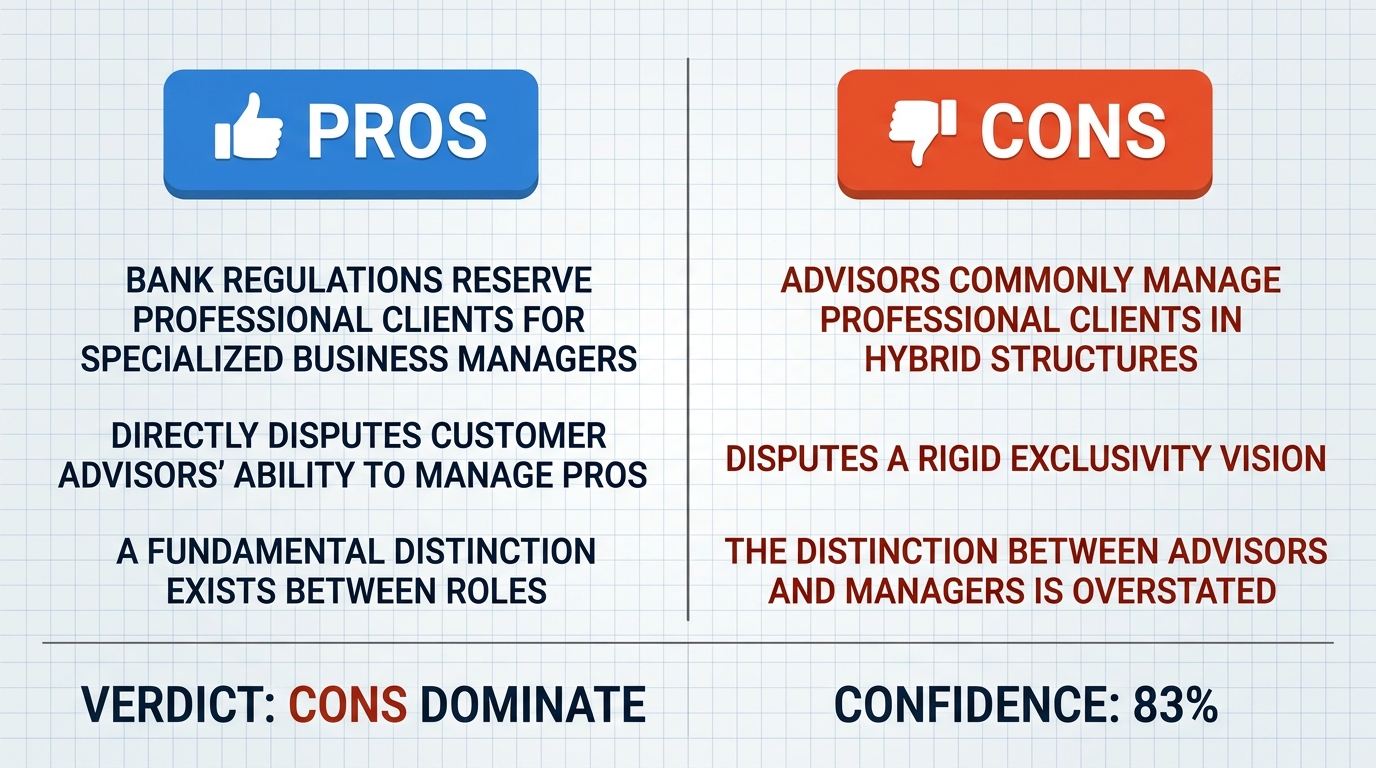
Verdict
Verdict: Mostly FALSE (83%)
Online report: https://solsice.com/public/debates/a-bank-customer-advisor-can-never-manage-customer-29ce9c5ddad0
This section provides a brief overview of the key arguments. It is not necessary to read the detailed report below.
✅ Key PRO arguments:
- ■The management of professional clients is reserved for specialized relationship managers . French banking regulations establish a fundamental distinction between retail clients and professional clients, a distinction that results in a strict separation of responsibilities within institutions. The Prudential Supervision and Resolution Authority (ACPR ) defines in its order of November 3, 2014 related to internal control of credit institutions that advisory functions must be performed by persons with skills appropriate to the nature and complexity of the transactions handled. A banking customer advisor , whose scope of intervention is limited to retail clients...
- ■The management of professional clients is reserved for specialized relationship managers . I directly contest the claim that customer advisors regularly manage professional clients within hybrid structures, and that the model of local banking relies on a structural porosity between segments . This thesis confuses two legally and operationally distinct realities: the status of professional and the size of the activity. It uses the term "professional" in an expanded and colloquial sense to refer to micro-entrepreneurs, while claiming to challenge the regulatory framework that precisely defines this term. Yet, it is this very framework that establishes exclusivity.
❌ Key COUNTER arguments:
- ■Customer advisors regularly manage professional clients within hybrid structures. The argument of exclusivity relies on a rigid and outdated view of banking structures. In reality, the 'local bank ' model is based on a structural porosity between segments . Many institutions employ 'multi-purpose' or 'multi-segment' advisors capable of managing micro-enterprises , artisans , and liberal professions . These clients, although legally 'professional,' have cash flow management and operational credit needs that closely resemble those of affluent retail clients . The idea of a strict compartmentalization is contradicted by evolving practices.
- ■Customer advisors regularly manage professional clients within hybrid structures. I contest the assertion that the distinction between retail and professional clients requires a strict and insurmountable separation of skills and IT access. The opponent makes a reasoning error by claiming that the conventional classification (IDCC 2120 ) or ACPR directives create an absolute operational barrier that would make it impossible for a customer advisor to manage a professional. However, the existence of professional classifications does not dictate the impermeability of information systems nor the prohibition of handling certain client segments .
💭 Conclusion: False, the verdict is based on the demonstration that customer advisors can indeed manage professional clients within hybrid structures. The opposing side has shown that the local bank model relies on a structural porosity between segments , with versatile or multi-segment advisors managing micro-enterprises , artisans , and liberal professions . The argument that IDCC 2120 classification or ACPR directives would create an insurmountable operational barrier has been refuted, as these texts do not impose the impermeability of information systems nor the prohibition of handling certain segments. The thesis of absolute exclusivity of specialized relationship managers is therefore contradicted by the common practice of institutions. The judge issued a verdict of FALSE with 83% confidence, confirming the weakness of the initial claim.
🔬 Verdict: Mostly FALSE ❌ (83%)
Statement: A banking customer advisor can never manage professional clients , as these are exclusively handled by specialized account managers .
Participating models: deepseek-v4-pro 💬, gemma-4-26b-a4b-it 💬👁️
📊 Confrontations: 0 concluded TRUE, 1 concluded FALSE (1 confrontation, 3 models)
📊 Score per side: TRUE=0.00, FALSE=0.83
🏅 Model score evolution:
deepseek-v4-flash-0731 💬: +8
✅ PRO Arguments:
- ■Management of professional clients is reserved for specialized account managers. French banking regulations establish a fundamental distinction between retail clients and professional clients, a distinction that results in a strict separation of responsibilities within institutions. The Prudential Control and Resolution Authority (ACPR ) defines in its order of November 3, 2014 concerning internal control of credit institutions that advisory functions must be performed by persons with skills appropriate to the nature and complexity of the operations handled. A banking customer advisor, whose scope of intervention is limited to individuals... deepseek-v4-pro 💬
- ■Management of professional clients is reserved for specialized account managers. I directly contest the claim that customer advisors regularly manage professional clients within hybrid structures, and that the proximity bank model relies on a structural permeability between segments . This thesis confuses two legally and operationally distinct realities: the status of professional and the size of the activity. It uses the term “professional” in an expanded and colloquial sense to refer to micro-entrepreneurs, while claiming to challenge the regulatory framework that precisely defines this term. It is precisely this framework that establishes exclusivity. deepseek-v4-pro 💬
❌ CON Arguments:
- ■Customer advisors regularly manage professional clients within hybrid structures. The argument of exclusivity relies on a rigid and outdated view of banking structures. In reality, the proximity bank model is based on a structural permeability between segments. Many institutions employ 'multi-purpose' or 'multi-segment' advisors capable of managing micro-enterprises , artisans , and liberal professions . These clients, although legally 'professional', have cash flow management and operational credit needs that closely resemble those of affluent individuals . The idea of a sealed compartment is contradicted by evolving practices. gemma-4-26b-a4b-it 💬👁️
- ■Customer advisors regularly manage professional clients within hybrid structures. I contest the assertion that the distinction between retail and professional clients requires a strict and insurmountable separation of skills and IT access. The opponent makes a reasoning error by claiming that the conventional classification (IDCC 2120 ) or ACPR directives create an absolute operational barrier that makes it impossible for a customer advisor to manage a professional. However, the existence of professional classifications does not dictate the impermeability of information systems nor the prohibition of handling certain client segments. gemma-4-26b-a4b-it 💬👁️
💭 Reasoning: False, the verdict is based on the demonstration that customer advisors can indeed manage professional clients within hybrid structures. The opposing side has shown that the proximity bank model relies on a structural permeability between segments, with polyvalent or multi-segment advisors managing micro-enterprises, artisans, and liberal professions. The argument that the IDCC 2120 classification or ACPR directives create an insurmountable operational barrier has been refuted, as these texts do not impose the impermeability of information systems nor prohibit handling certain client segments. The thesis of absolute exclusivity of specialized account managers is therefore contradicted by current practices. The judge rendered a FALSE verdict with 83% confidence, confirming the weakness of the initial claim.
📋 Facts IN FAVOR:
• The ACPR requires skills appropriate to the nature and complexity of operations (order of November 3, 2014).
• French regulations distinguish retail clients from professional clients.
• The defender states that the scope of intervention of the customer advisor is limited to individuals.
📋 Facts AGAINST:
• The proximity bank model relies on a structural permeability between segments.
• Polyvalent or multi-segment advisors manage micro-enterprises, artisans, and liberal professions.
• The IDCC 2120 classification does not create an absolute operational barrier.
• ACPR directives do not dictate the impermeability of information systems.
| Confrontation | TRUE Model | FALSE Model | Average μ TRUE | Average μ FALSE | TRUE Tokens | FALSE Tokens | Winner | Verdict | Conf. |
|---|---|---|---|---|---|---|---|---|---|
| #1 | deepseek-v4-pro 💬 | gemma-4-26b-a4b-it 💬👁️ | 0.467 | 0.354 | 6 | 2 | TRUE | FALSE | 83% |
The following technical terms, abbreviations, and specialized concepts are used in this transcript. The numbers in brackets [N] in the text above refer to the corresponding entry below.
[1] ACPR — Autorité de Contrôle Prudentiel et de Résolution — French authority for banking and insurance regulation, mentioned in the debate.
[2] Order of November 3, 2014 — French regulation concerning internal control of credit institutions, mentioned in the debate.
[3] artisans — Independent workers practicing manual trades, considered as professional clients in the debate.
[4] retail banking — Banking segment aimed at individuals and small businesses, discussed in the debate.
[5] local banking — Retail banking model based on a network of local branches, mentioned in the debate.
[6] working capital needs — Short-term cash flow needs of a company to finance its ongoing activities.
[7] financial statements — Financial documents summarizing a company's assets and liabilities, used to analyze its financial health.
[8] specialized account managers — Bankers dedicated to managing professional and corporate clients, according to the debate.
[9] professional classifications — Job categories defined by the collective agreement, determining skills and responsibilities.
[10] non-salaried clients — Individuals practicing an independent activity without an employment contract, considered as professionals.
[11] professional clients — Banking clientele composed of companies, merchants, artisans, and liberal professions, as opposed to individuals.
[12] strict compartmentalization — Strict and unbreachable separation between segments or functions, a concept discussed in the debate.
[13] bank customer advisor — Bank employee responsible for client relations, whose scope (individuals or professionals) is contested in the debate.
[14] multi-purpose advisor — Bank advisor capable of managing multiple client segments, including professionals, according to the debate.
[15] internal control — Set of procedures and systems aimed at managing risks within a credit institution.
[16] National Collective Agreement of Banking — Collective agreement setting classifications and working conditions in the French banking sector.
[17] Corporate Banking — Banking activity dedicated to large corporations, distinct from retail banking, mentioned in the debate.
[18] operational loans — Short-term loans to finance a company's working cycle.
[19] job description — Document describing the duties and responsibilities of a position, used to define a advisor's scope.
[20] cash flow management — Management of fund movements and payment operations on behalf of clients.
[21] risk and needs profile management — Method of organizing clients based on risk and needs rather than legal status, discussed in the debate.
[22] regulatory authorization — Permission or qualification required by regulation to perform certain banking functions.
[23] IDCC 2120 — Identifier of the Collective Agreement 2120 — Identifier of the National Collective Agreement of Banking, number 2120, cited in the debate.
[24] micro-enterprises — Very small businesses, often sole proprietorships, whose management can be entrusted to local advisors.
[25] scoring tools — Automated risk assessment instruments used to decide on granting a loan.
[26] affluent individuals — High-income retail client segment with needs close to some professionals.
[27] structural porosity — Permeability between segments or functions, a concept used to describe the local bank model.
[28] liberal professions — Independent non-commercial activities (lawyers, doctors, etc.), considered as professional clients.
[29] risk profile — Assessment of the level of risk presented by a client or operation, used for client management.
[30] mutual networks — Cooperative or mutual banks, often organized as a network of local branches.
[31] scoring — Risk rating technique based on statistical models.
[32] segments — Distinct client categories (individuals, professionals, companies) in banking organization.
[33] information systems — Set of IT tools and data used by a bank to manage its operations.
[34] treasury — Management of liquidity and fund flows of a company or client.
[35] credit institutions — Financial institutions authorized to carry out banking operations, such as banks.
Face-off transcripts
- ■
Ownership & Trade Secrets. Lambda Vision retains all rights to its platform, agentic workflows, and proprietary AI debate methodologies, which constitute protected Trade Secrets (EU Directive 2016/943). Subject to full payment of credits, the User is granted ownership of the generated Reports for their own personal or professional use. Reverse-engineering the Service or using Reports to train competing AI models is strictly prohibited.
- ■
No Professional Advice. Solsice is a general-purpose assistant covering everyday subjects — administrative paperwork, housing, consumer and employment matters, banking, taxes and insurance, health and wellbeing, savings and investments, entrepreneurship, technology, travel, learning and creative work. Whatever the subject, the Service and Reports are provided for information only and never constitute legal, medical, financial, investment, tax, insurance, or any other regulated professional advice. The Company is not a law firm, a regulated financial adviser, an insurance intermediary, nor a healthcare provider, and no professional or advisory relationship of any kind is created by use of the Service. Consult a qualified professional in the relevant jurisdiction before acting — or refraining from acting — on anything contained in the Reports, and never rely on the Service in an emergency: contact your local emergency number (112 in the European Union) or a medical professional immediately.
- ■
AI-Generated Content, Sources and Viewpoints. Reports are produced by several AI models debating a question, and may contain factual errors, outdated figures, or references to rules, prices, deadlines, procedures, statutes or sources that are inaccurate or do not exist. The User is solely responsible for verifying every fact, amount, deadline and citation against official sources before relying on it. Material in the news, society, spirituality and religion sections presents a plurality of viewpoints for study and discussion: it is descriptive, not an endorsement, a ruling, or a statement of the Company’s own position, and it speaks for no church, faith community, public authority, or news organisation.
- ■
Liability & Governing Law. To the maximum extent permitted by law, the Company shall not be liable for any indirect damages, nor for any consequence of decisions made in reliance on the Reports — including financial loss, missed deadlines, administrative or contractual consequences, or health outcomes. These Terms are governed by French law. Any disputes shall be subject to the exclusive jurisdiction of the Courts of Paris, France.