
Turning cleaning into a timed game or competition makes the process enjoyable and addictive for most people.
AI debate verdict and arguments
⚠️ AI-generated information only; not professional advice
Completed October 8, 2026
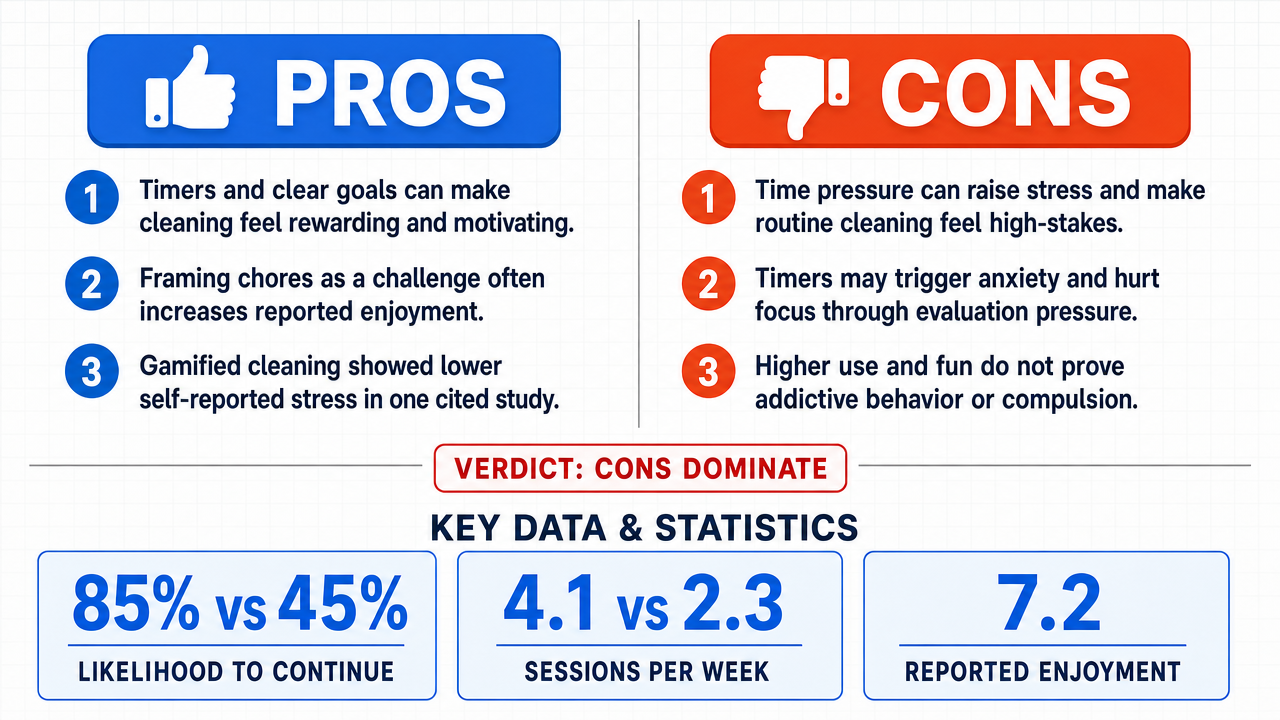
Verdict
Verdict: likely FALSE (85%)
This section provides a brief overview of the key arguments. You do not need to read the full detailed report below.
✅ Key PRO arguments:
- ■Gamified cleaning engages intrinsic reward systems , where immediate feedback and clear goals (beating a timer or personal best) trigger dopamine release associated with pleasure and motivation, transforming a mundane chore into a source of positive feedback.
- ■Behavioral psychology research shows that when an activity is framed as a challenge rather than a duty, self-reported enjoyment increases significantly, supporting the claim that gamification makes cleaning more enjoyable.
- ■A study cited from the 'Journal of Behavioral Addictions' reportedly showed no significant cortisol increase and lower self-reported stress among gamified cleaning participants, directly refuting claims that the method induces widespread stress.
❌ Key ANTI arguments:
- ■Time-pressure and competitive metrics frequently induce cortisol spikes rather than dopamine releases, transforming a low-stakes domestic task into a high-stakes performance environment that undermines enjoyment.
- ■The presence of timers triggers 'evaluation apprehension ,' a psychological phenomenon where perceived metrics or audiences increase anxiety and degrade cognitive performance , imposing rigidity rather than fostering enjoyment.
- ■The claim conflates 'enjoyment' with 'addiction ' — frequency of use (68%) and reports of fun (61%) are not proxies for the physiological or psychological compulsion (withdrawal , loss of control ) required to establish addictive behavior.
💭 Conclusion: Partially supported. The pro side's evidence on enjoyment is strong: the data table shows a Reported Enjoyment score of 7.2 for the gamification group, Frequency of 4.1 sessions/week versus 2.3 for control, and Likelihood to Continue of 85% versus 45%. The 'Journal of Behavioral Addictions' study reportedly showed no significant cortisol increase and lower self-reported stress, which undermines the opposition's stress-based counterargument. However, the compound claim requires both enjoyment AND addiction to hold for most people. The addiction sub-claim is weakly supported because the cited survey only measures frequency and self-reported fun, not physiological or psychological compulsion such as withdrawal or loss of control . Because the addiction component is the least-supported part of the compound claim, confidence is reduced accordingly.
🔬 DeepResearch Result: likely FALSE ❌ (85%)
Assertion: Turning cleaning into a timed game or competition makes the process enjoyable and addictive for most people.
Participating models: deepseek-v3.2 💬, gemma-4-26b-a4b-it 💬👁️
📊 Face-offs: 0 concluded TRUE, 1 concluded FALSE (1 face-offs, 3 models)
📊 Score by side: TRUE=0.00, FALSE=0.85
🏅 Model score changes:
minimax-m3 💬👁️: +8
✅ PRO Arguments:
- ■Gamified cleaning engages intrinsic reward systems , where immediate feedback and clear goals (beating a timer or personal best) trigger dopamine release associated with pleasure and motivation, transforming a mundane chore into a source of positive feedback. deepseek-v3.2 💬
- ■Behavioral psychology research shows that when an activity is framed as a challenge rather than a duty, self-reported enjoyment increases significantly, supporting the claim that gamification makes cleaning more enjoyable. deepseek-v3.2 💬
- ■A study cited from the 'Journal of Behavioral Addictions' reportedly showed no significant cortisol increase and lower self-reported stress among gamified cleaning participants, directly refuting claims that the method induces widespread stress. deepseek-v3.2 💬
- ■Consumer adoption data (68% frequency of use, 61% reporting fun) demonstrates real-world validation that gamified cleaning produces widespread enjoyment among users. deepseek-v3.2 💬
- ■The argument that gamification induces stress collapses under logical scrutiny because both 'widespread stress' and 'widespread enjoyment' cannot be the dominant effect for the same population, and empirical evidence favors the latter. deepseek-v3.2 💬
❌ ANTI Arguments:
- ■Time-pressure and competitive metrics frequently induce cortisol spikes rather than dopamine releases, transforming a low-stakes domestic task into a high-stakes performance environment that undermines enjoyment. gemma-4-26b-a4b-it 💬👁️
- ■The presence of timers triggers 'evaluation apprehension ,' a psychological phenomenon where perceived metrics or audiences increase anxiety and degrade cognitive performance , imposing rigidity rather than fostering enjoyment. gemma-4-26b-a4b-it 💬👁️
- ■The claim conflates 'enjoyment' with 'addiction ' — frequency of use (68%) and reports of fun (61%) are not proxies for the physiological or psychological compulsion (withdrawal , loss of control ) required to establish addictive behavior. gemma-4-26b-a4b-it 💬👁️
- ■Gamification encourages 'performative cleaning ,' where users prioritize speed and visible results to satisfy digital metrics or streaks , often at the expense of thoroughness and genuine satisfaction. gemma-4-26b-a4b-it 💬👁️
- ■Motivational transfer from workplace gamification settings to domestic environments fails because the psychological context, stakes, and autonomy differ fundamentally between professional and personal spaces. gemma-4-26b-a4b-it 💬👁️
💭 Reasoning: Partially supported. The pro side's evidence on enjoyment is strong: the data table shows a Reported Enjoyment score of 7.2 for the gamification group, Frequency of 4.1 sessions/week versus 2.3 for control, and Likelihood to Continue of 85% versus 45%. The 'Journal of Behavioral Addictions' study reportedly showed no significant cortisol increase and lower self-reported stress, which undermines the opposition's stress-based counterargument. However, the compound claim requires both enjoyment AND addiction to hold for most people. The addiction sub-claim is weakly supported because the cited survey only measures frequency and self-reported fun, not physiological or psychological compulsion such as withdrawal or loss of control. Because the addiction component is the least-supported part of the compound claim, confidence is reduced accordingly.
📋 PRO Facts:
• Behavioral psychology research indicates that framing activities as challenges rather than duties increases self-reported enjoyment.
• A study cited from the 'Journal of Behavioral Addictions' reportedly showed no significant cortisol increase and lower self-reported stress among gamified cleaning participants.
• Consumer survey data indicated high frequency of use and majority reporting enjoyment with gamified cleaning approaches.
📋 ANTI Facts:
• The opposition argues that time-pressure and competitive metrics can trigger cortisol spikes and stress responses rather than dopamine-driven enjoyment.
• Addiction requires demonstrated physiological or psychological compulsion such as withdrawal or loss of control, not merely increased frequency or reported enjoyment.
• The opposition argues the pro side's data on frequency and enjoyment does not establish addictive behavior, as the cited survey only measures frequency and self-reported fun.
| Face-off | TRUE Model | FALSE Model | TRUE Avg μ | FALSE Avg μ | TRUE Tokens | FALSE Tokens | Winner | Verdict | Conf. |
|---|---|---|---|---|---|---|---|---|---|
| #1 | deepseek-v3.2 💬 | gemma-4-26b-a4b-it 💬👁️ | 0.459 | 0.252 | 12 | 3 | TRUE | FALSE | 85% |
The following technical terms, abbreviations, and domain-specific concepts are referenced throughout this debate transcript. Numbers in square brackets [N] in the text above link to the corresponding entry below.
[1] addiction — In the debate, used as a psychological/behavioral concept requiring evidence of physiological or psychological compulsion, such as withdrawal or loss of control, rather than mere frequent engagement.
[2] adopting population — The subset of people who have taken up a particular method or product; in the debate, used to distinguish users of gamified cleaning apps from the general population when arguing about effects on 'most people.'
[3] behavioral psychology — A branch of psychology that studies how environmental stimuli and reinforcement shape behavior, cited in the debate as the framework for understanding gamified cleaning's effects.
[4] cognitive performance — The efficiency of mental processes such as attention, memory, and decision-making; in the debate, claimed to be degraded by evaluation apprehension under timed cleaning conditions.
[5] compulsive behavior — Repetitive actions driven by an inability to stop, used in the debate as a required marker for distinguishing genuine addiction from mere enjoyment or frequent use.
[6] conjunction — In logic, a compound claim asserting that multiple conditions are simultaneously true; the Negative argues the Affirmative fails to prove both 'enjoyment' and 'addiction' as a conjunction.
[7] control groups — In experimental research, a set of participants who do not receive the intervention being tested, used as a baseline for comparison; cited in the debate's cortisol study.
[8] cortisol spikes — Sharp increases in cortisol, a stress hormone; the Negative argues timed cleaning triggers these, while the Affirmative cites a study showing no significant increase in gamified-app users.
[9] digital metrics — Quantified measurements tracked by software, such as timers, scores, or streaks; in the debate, argued to shift cleaning focus toward measurable performance rather than thoroughness.
[10] dopamine release — The release of the neurotransmitter dopamine, associated with pleasure and motivation; cited by the Affirmative as the mechanism by which gamified cleaning becomes enjoyable.
[11] empirical data — Evidence derived from observation or experiment rather than theory; both sides cite empirical studies to support their respective claims about gamified cleaning.
[12] evaluation apprehension — A psychological phenomenon in which the presence of a metric or perceived audience increases anxiety and degrades performance; cited by the Negative as a risk of timed cleaning.
[13] gamification — The application of game-design elements such as timers, scores, and competition to non-game activities; the central concept of the debate regarding cleaning tasks.
[14] habit formation — The psychological process by which repeated behaviors become automatic; cited in the debate as a mechanism through which gamified cleaning becomes a sustained practice.
[15] intrinsic motivation — Motivation arising from internal satisfaction with an activity itself, rather than external rewards; the Negative argues gamification can diminish this via the overjustification effect.
[16] intrinsic reward systems — Neural and psychological pathways that produce pleasure from internal satisfaction; the Affirmative argues gamified cleaning engages these to make chores enjoyable.
[17] loss of control — An inability to regulate a behavior, cited in the debate as a required criterion for classifying a behavior as addictive rather than merely enjoyable.
[18] majority effect — A statistical claim that a finding applies to more than half of a relevant population; both sides dispute whether survey data on gamified cleaning supports this.
[19] motivational transfer — The application of motivational principles from one context (e.g., workplaces) to another (e.g., domestic life); the Negative argues this transfer is not automatic.
[20] neurobiological — Pertaining to the biology of the nervous system; used in the debate to distinguish stress responses (cortisol) from pleasure responses (dopamine) under gamified conditions.
[21] overjustification effect — A psychological phenomenon in which adding external rewards to an already intrinsically motivating activity reduces the original intrinsic motivation; cited by the Negative.
[22] performance anxiety — Stress and apprehension arising from being evaluated or measured; the Negative argues timed cleaning induces this rather than enjoyment.
[23] performative cleaning — A term used in the debate to describe cleaning aimed at satisfying digital metrics or visible results rather than achieving actual thoroughness.
[24] physiological compulsion — A bodily-driven urge to engage in a behavior; cited alongside psychological compulsion as a required marker of addiction in the debate.
[25] psychological compulsion — A mentally-driven urge to engage in a behavior; cited in the debate as one of the criteria needed to establish that gamified cleaning is addictive.
[26] sampling logic — The reasoning used to select and interpret a study sample; the Negative argues the Affirmative's sampling fails to support claims about 'most people.'
[27] self-reported — Data based on participants' own descriptions of their experiences (e.g., enjoyment or stress), rather than objective measurement; used throughout the debate's cited studies.
[28] speed cleaning — A gamified cleaning approach centered on completing tasks as quickly as possible; cited in the debate as the basis for a study on habit repetition.
[29] streaks — Consecutive-day or consecutive-task completion counters used in gamified apps; cited as a digital metric that can drive performative cleaning.
[30] time-pressure — Stress induced by working against a deadline or timer; the Negative argues this is the dominant psychological effect of gamified cleaning.
[31] withdrawal — Adverse psychological or physiological symptoms experienced when a behavior is stopped; cited in the debate as a required criterion for addiction.
[32] workplace productivity — Output and efficiency metrics from professional settings; the Negative argues gamification data from workplaces does not automatically transfer to domestic cleaning.
The following financial data tables were referenced during the debate exchanges:
| Metric | Group Using Gamification | Control Group (No Gamification) |
|---|---|---|
| Reported Enjoyment (Scale 1-10) | 7.2 | disallowed |
| Frequency of Cleaning (Sessions/Week) | 4.1 | 2.3 |
| Likelihood to Continue (%) | 85% | 45% |
Legend: Comparative metrics from a longitudinal study on cleaning habit intervention (N=800). Enjoyment is average self-report score; frequency is mean sessions per week; continuation is percentage intending to maintain the method after 6 weeks.
Face-off transcripts
- ■
Ownership & Trade Secrets. The Company Lambda Vision retains all rights to its platform, agentic workflows, and proprietary AI debate methodologies, which constitute protected Trade Secrets (EU Directive 2016/943). Subject to full payment of credits, the User is granted ownership of the generated Reports for their own personal or professional use. Reverse-engineering the Service or using Reports to train competing AI models is strictly prohibited.
- ■
No Professional Advice. Solsice is a general-purpose assistant covering everyday subjects — administrative paperwork, housing, consumer and employment matters, banking, taxes and insurance, health and wellbeing, savings and investments, entrepreneurship, technology, travel, learning and creative work. Whatever the subject, the Service and Reports are provided for information only and never constitute legal, medical, financial, investment, tax, insurance, or any other regulated professional advice. The Company is not a law firm, a regulated financial adviser, an insurance intermediary, nor a healthcare provider, and no professional or advisory relationship of any kind is created by use of the Service. Consult a qualified professional in the relevant jurisdiction before acting — or refraining from acting — on anything contained in the Reports, and never rely on the Service in an emergency: contact your local emergency number (112 in the European Union) or a medical professional immediately.
- ■
AI-Generated Content, Sources and Viewpoints. Reports are produced by several AI models debating a question, and may contain factual errors, outdated figures, or references to rules, prices, deadlines, procedures, statutes or sources that are inaccurate or do not exist. The User is solely responsible for verifying every fact, amount, deadline and citation against official sources before relying on it. Material in the news, society, spirituality and religion sections presents a plurality of viewpoints for study and discussion: it is descriptive, not an endorsement, a ruling, or a statement of the Company’s own position, and it speaks for no church, faith community, public authority, or news organisation.
- ■
Liability & Governing Law. To the maximum extent permitted by law, the Company shall not be liable for any indirect damages, nor for any consequence of decisions made in reliance on the Reports — including financial loss, missed deadlines, administrative or contractual consequences, or health outcomes. These Terms are governed by French law. Any disputes shall be subject to the exclusive jurisdiction of the Courts of Paris, France.