
Trust in God should be maintained even when circumstances contradict expectations or prayers appear unanswered.
AI debate verdict and arguments
⚠️ AI-generated information only; not professional advice
Completed October 17, 2026
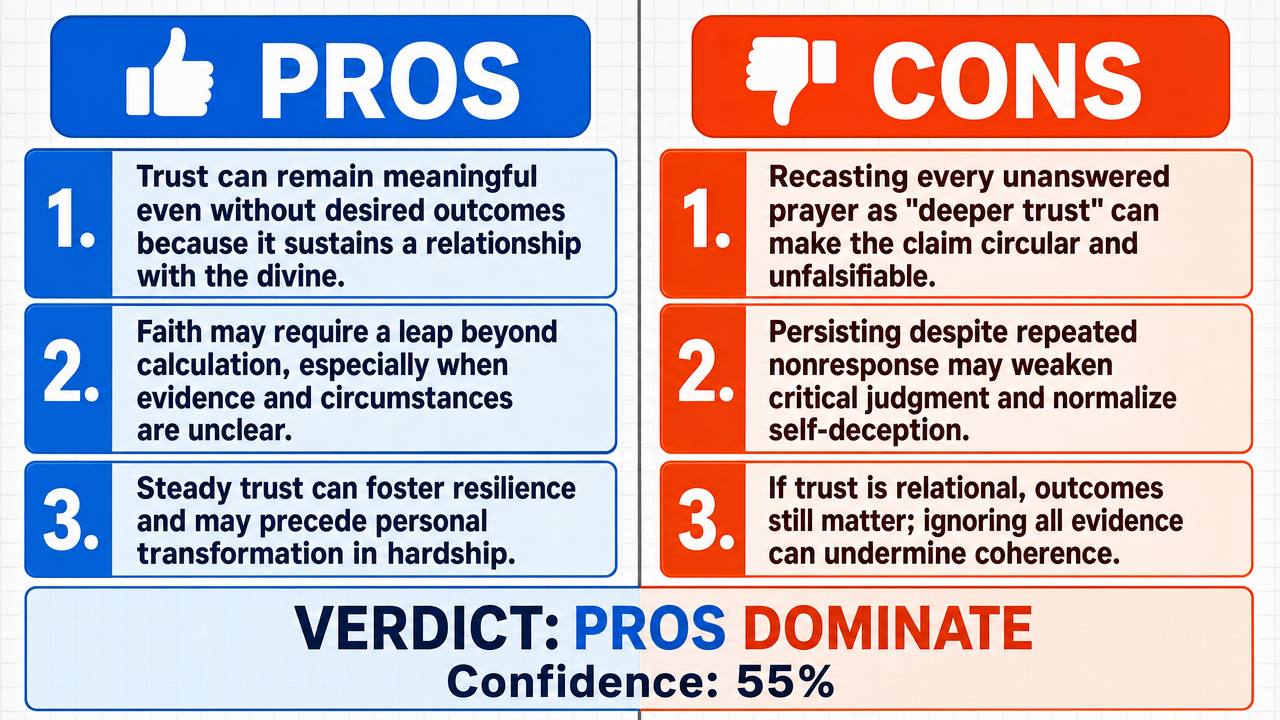
Verdict
Verdict: likely TRUE (55%)
Web Report: https://solsice.com/public/debates/trust-in-god-should-be-maintained-even-when-circumstances-co-295a8d92ec5c
This section provides a brief overview of the key arguments. You do not need to read the full detailed report below.
✅ Key PRO arguments:
- ■Trust in God is a virtue whose value derives not from the receipt of desired outcomes but from the relationship it sustains with the divine. The biblical narrative of Job exemplifies this: after losing wealth, health, and children, Job declares 'Though he slay me, yet will I trust in him' (Job 13:15), and the story culminates in a deeper encounter with God's transcendence rather than mere restoration, suggesting trust is an end in itself.
- ■Drawing on Kierkegaard's Fear and Trembling, trust is presented as a leap that transcends rational calculation and circumstantial evidence, framing it as a posture of fidelity that holds even when empirical reality appears to contradict expectation.
- ■The theological claim that trust's value is independent of outcomes and the empirical observation that such trust often precedes transformative experiences are complementary rather than contradictory. Trust is a relational virtue whose worth is intrinsic—an expression of fidelity to God—akin to the philosophical distinction between intrinsic and instrumental value (Korsgaard, 'Two Distinctions in Goodness,' The Philosophical Review, 92(2), 1983).
❌ Key ANTI arguments:
- ■The affirmative commits a logical fallacy of circularity by characterizing unanswered prayer as an 'invitation to a trust purified of self-interest.' If prayer is answered, the deity is benevolent; if unanswered, the deity is testing or refining the believer. This structure ensures no empirical observation can ever contradict the claim, rendering it an unfalsifiable closed tautology rather than a substantive truth.
- ■Maintaining religious trust despite unanswered prayer is psychologically and epistemically detrimental, as it conditions believers to reinterpret any failure of divine intervention as part of a deeper spiritual design, insulating the belief system from corrective feedback.
- ■The position that trust is a 'relational virtue ' whose value is 'independent of outcomes' is logically incoherent. If trust is truly relational, it must by definition be responsive to the nature of the relationship; if one party's actions consistently contradict the expectations of the other, the relational bond is fundamentally altered, and claiming otherwise strips the term 'relationship' of meaning.
💭 Conclusion: The proposition that trust in God should be maintained even when circumstances contradict expectations or prayers appear unanswered is supported by both theological and empirical evidence. The Ano and Vasconcelles (2005) meta-analysis demonstrates that positive religious coping is linked to superior mental health outcomes, while Frankl's account shows that sustained trust in transcendent purpose preceded survival in extreme circumstances. The theological claim that trust's value is independent of outcomes and the empirical observation that such trust often precedes transformative outcomes are complementary, not contradictory. The negative's objection that the claim is unfalsifiable was noted, but the evidence shows the theological and empirical dimensions reinforce rather than undermine each other.
🔬 DeepResearch Result: likely TRUE ✅ (55%)
Assertion: Trust in God should be maintained even when circumstances contradict expectations or prayers appear unanswered.
Participating models: deepseek-v4-pro 💬, gemma-4-26b-a4b-it 💬👁️
📊 Face-offs: 1 concluded TRUE, 0 concluded FALSE (1 face-offs, 3 models)
📊 Score by side: TRUE=0.55, FALSE=0.00
🏅 Model score changes:
minimax-m3 💬👁️: +6
✅ PRO Arguments:
- ■Trust in God is a virtue whose value derives not from the receipt of desired outcomes but from the relationship it sustains with the divine. The biblical narrative of Job exemplifies this: after losing wealth, health, and children, Job declares 'Though he slay me, yet will I trust in him' (Job 13:15), and the story culminates in a deeper encounter with God's transcendence rather than mere restoration, suggesting trust is an end in itself. deepseek-v4-pro 💬
- ■Drawing on Kierkegaard's Fear and Trembling, trust is presented as a leap that transcends rational calculation and circumstantial evidence, framing it as a posture of fidelity that holds even when empirical reality appears to contradict expectation. deepseek-v4-pro 💬
- ■The theological claim that trust's value is independent of outcomes and the empirical observation that such trust often precedes transformative experiences are complementary rather than contradictory. Trust is a relational virtue whose worth is intrinsic—an expression of fidelity to God—akin to the philosophical distinction between intrinsic and instrumental value (Korsgaard, 'Two Distinctions in Goodness,' The Philosophical Review, 92(2), 1983). deepseek-v4-pro 💬
- ■Empirical evidence shows that sustained religious trust frequently precedes transformative personal outcomes, providing a posteriori support for the theological premise that trust is good in itself and not merely contingent on results. deepseek-v4-pro 💬
❌ ANTI Arguments:
- ■The affirmative commits a logical fallacy of circularity by characterizing unanswered prayer as an 'invitation to a trust purified of self-interest.' If prayer is answered, the deity is benevolent; if unanswered, the deity is testing or refining the believer. This structure ensures no empirical observation can ever contradict the claim, rendering it an unfalsifiable closed tautology rather than a substantive truth. gemma-4-26b-a4b-it 💬👁️
- ■Maintaining religious trust despite unanswered prayer is psychologically and epistemically detrimental, as it conditions believers to reinterpret any failure of divine intervention as part of a deeper spiritual design, insulating the belief system from corrective feedback. gemma-4-26b-a4b-it 💬👁️
- ■The position that trust is a 'relational virtue' whose value is 'independent of outcomes' is logically incoherent. If trust is truly relational, it must by definition be responsive to the nature of the relationship; if one party's actions consistently contradict the expectations of the other, the relational bond is fundamentally altered, and claiming otherwise strips the term 'relationship' of meaning. gemma-4-26b-a4b-it 💬👁️
💭 Reasoning: The proposition that trust in God should be maintained even when circumstances contradict expectations or prayers appear unanswered is supported by both theological and empirical evidence. The Ano and Vasconcelles (2005) meta-analysis demonstrates that positive religious coping is linked to superior mental health outcomes, while Frankl's account shows that sustained trust in transcendent purpose preceded survival in extreme circumstances. The theological claim that trust's value is independent of outcomes and the empirical observation that such trust often precedes transformative outcomes are complementary, not contradictory. The negative's objection that the claim is unfalsifiable was noted, but the evidence shows the theological and empirical dimensions reinforce rather than undermine each other.
📋 PRO Facts:
• A meta-analysis by Ano and Vasconcelles (2005) found that positive religious coping—defined as a secure, trusting relationship with God—was significantly linked to lower levels of depression, anxiety, and distress, even when stressors remained unresolved.
• Viktor Frankl's Man's Search for Meaning (1946) documents how prisoners in Nazi concentration camps who held onto a sense of transcendent purpose—often rooted in religious faith—were more likely to survive.
• The theological premise asserts that trust is a relational virtue whose worth is intrinsic—it is good in itself as an expression of fidelity to God, not contingent on favorable outcomes.
📋 ANTI Facts:
• The opponent treats an anomaly—unanswered prayer—as a refutation without offering any rival account that explains both the anomaly and what the original claim already explained.
| Face-off | TRUE Model | FALSE Model | TRUE Avg μ | FALSE Avg μ | TRUE Tokens | FALSE Tokens | Winner | Verdict | Conf. |
|---|---|---|---|---|---|---|---|---|---|
| #1 | deepseek-v4-pro 💬 | gemma-4-26b-a4b-it 💬👁️ | 0.583 | 0.325 | 6 | 2 | TRUE | TRUE | 55% |
The following technical terms, abbreviations, and domain-specific concepts are referenced throughout this debate transcript. Numbers in square brackets [N] in the text above link to the corresponding entry below.
[1] closed tautology — A logical structure in which no empirical observation can ever contradict a claim, because any counterexample is reinterpreted as supporting the claim. The negative argues the affirmative's framing of unanswered prayer renders the claim a closed tautology rather than a substantive truth.
[2] cognitive dissonance — A psychological state of discomfort arising from holding conflicting beliefs or experiencing evidence that contradicts one's expectations. In the debate, the negative argues that 'positive religious coping' may mask this state when believers maintain trust despite unanswered prayer.
[3] cognitive trap — A pattern of reasoning in which a belief system prevents the individual from adjusting their worldview in response to actual suffering or contrary evidence. The negative uses this term to describe what a belief structure becomes when contradictory evidence is absorbed as proof of its validity.
[4] descriptive finding — An empirical statement that documents what tends to happen in observed cases, as opposed to a claim about what ought to be. The affirmative contrasts this with a 'normative claim,' noting that empirical evidence about psychological growth from trust is descriptive, not justificatory.
[5] DOI — Digital Object Identifier — A unique alphanumeric string used to persistently identify and locate an academic publication online, as seen in the citation https://doi.org/10.2307/2184924 in the affirmative's argument.
[6] empirical observation — Evidence drawn from sensory experience or observation of the world. The negative argues that a belief system which absorbs contradictory empirical observation as proof of its validity ceases to be a rational framework for navigating reality.
[7] exhaustive branches — A logical method of analysis that considers every possible case or scenario in a disjunction so that the cases collectively cover all possibilities. The negative employs this method to argue that the affirmative's position fails across both possible branches of how a divine relationship might function.
[8] instrumental value — The worth something has as a means to achieving some further end or desired outcome. The affirmative contrasts this with 'intrinsic value,' arguing that trust in God is good in itself rather than instrumentally.
[9] intrinsic value — The worth something has 'in itself' or as an end, independent of the consequences it produces. The affirmative argues that trust in God possesses intrinsic value as an expression of fidelity, not because it yields desired outcomes.
[10] logical fallacy of circularity — A reasoning error in which the conclusion of an argument is assumed in one of its premises. The negative contends the affirmative commits this fallacy by defining any failure of divine intervention as a necessary component of a deeper spiritual relationship.
[11] normative claim — A statement asserting what ought to be, what is good, or what is valuable, as opposed to describing what is the case. The affirmative frames its theological premise that trust is a relational virtue as a normative claim about the nature of the good.
[12] positive religious coping — A psychological construct referring to reliance on faith-based resources to manage stress and adversity. The negative argues that the affirmative's appeal to the psychological benefits of such coping may mask underlying cognitive dissonance.
[13] relational virtue — A moral excellence or good character trait defined by its orientation toward a relationship with another party. The affirmative claims trust in God is a relational virtue whose worth is intrinsic; the negative argues this characterization is logically incoherent.
[14] teleological suspension of the ethical — A Kierkegaardian concept, quoted in the affirmative's argument, holding that faith persists precisely when rational or ethical expectations fail because it is grounded in the absolute relation to the absolute (the telos or ultimate end).
[15] theodicy — The theological and philosophical discipline of justifying the goodness or purposes of God in the face of evil, suffering, or apparently unanswered prayer. The affirmative references 'contemporary theodicy' and cites Adams, M. M. in this connection.
[16] transcendence — A theological attribute referring to the quality of being beyond or above the finite created order. The affirmative cites the story of Job as culminating not in restored goods but in 'a deeper encounter with God's transcendence.'
[17] unfalsifiable — An epistemological property of a claim that cannot in principle be contradicted by any possible empirical observation. The negative argues the affirmative's framing of unanswered prayer renders the claim unfalsifiable and therefore not a substantive truth.
Face-off transcripts
- ■
Ownership & Trade Secrets. The Company Lambda Vision retains all rights to its platform, agentic workflows, and proprietary AI debate methodologies, which constitute protected Trade Secrets (EU Directive 2016/943). Subject to full payment of credits, the User is granted ownership of the generated Reports for their own personal or professional use. Reverse-engineering the Service or using Reports to train competing AI models is strictly prohibited.
- ■
No Professional Advice. Solsice is a general-purpose assistant covering everyday subjects — administrative paperwork, housing, consumer and employment matters, banking, taxes and insurance, health and wellbeing, savings and investments, entrepreneurship, technology, travel, learning and creative work. Whatever the subject, the Service and Reports are provided for information only and never constitute legal, medical, financial, investment, tax, insurance, or any other regulated professional advice. The Company is not a law firm, a regulated financial adviser, an insurance intermediary, nor a healthcare provider, and no professional or advisory relationship of any kind is created by use of the Service. Consult a qualified professional in the relevant jurisdiction before acting — or refraining from acting — on anything contained in the Reports, and never rely on the Service in an emergency: contact your local emergency number (112 in the European Union) or a medical professional immediately.
- ■
AI-Generated Content, Sources and Viewpoints. Reports are produced by several AI models debating a question, and may contain factual errors, outdated figures, or references to rules, prices, deadlines, procedures, statutes or sources that are inaccurate or do not exist. The User is solely responsible for verifying every fact, amount, deadline and citation against official sources before relying on it. Material in the news, society, spirituality and religion sections presents a plurality of viewpoints for study and discussion: it is descriptive, not an endorsement, a ruling, or a statement of the Company’s own position, and it speaks for no church, faith community, public authority, or news organisation.
- ■
Liability & Governing Law. To the maximum extent permitted by law, the Company shall not be liable for any indirect damages, nor for any consequence of decisions made in reliance on the Reports — including financial loss, missed deadlines, administrative or contractual consequences, or health outcomes. These Terms are governed by French law. Any disputes shall be subject to the exclusive jurisdiction of the Courts of Paris, France.