
TRUE or FALSE: For a European average citizen, a one-week holiday in a long-haul destination such as Latin America or the Caribbean (example the Dominican Republic) can often be cheaper overall than a comparable holiday in nearer destinations such as Morocco, Tunisia or even within Europe, once flights, accommodation, food and local expenses are taken into account.
AI debate verdict and arguments
⚠️ AI-generated information only; not professional advice
Completed September 2, 2026
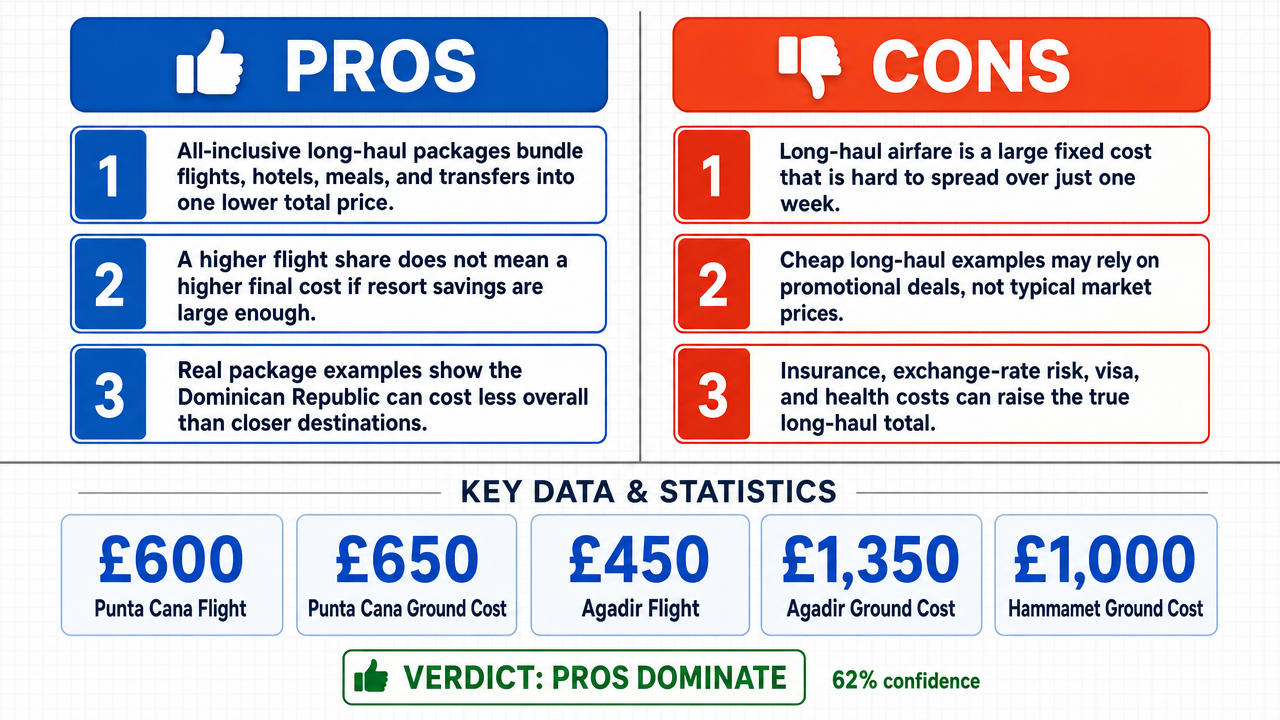
Verdict
Clerk Decision: CLAIM SUPPORTED (TRUE) — Certainty: 62%
This section provides a brief overview of the key arguments. You do not need to read the full detailed report below.
✅ Key PRO arguments:
- ■All-inclusive resorts in the Caribbean and Latin America bundle flights, accommodation, meals, and transfers into single packages, leveraging economies of scale and lower local procurement costs that drive down the per-night total cost well below comparable European Mediterranean offerings. A 14-night all-inclusive stay in Punta Cana can be priced at approximately €2,250 per person (roughly €160 per night), while a comparable one-week package in Mallorca can reach €2,300–€3,900 in high season (roughly €274+ per night).
- ■A higher flight-cost percentage share in a Caribbean package does not entail a higher absolute total cost. A Caribbean all-inclusive package totalling €1,500 with flights at 40% share is still cheaper overall than a Tunisian package totalling €1,800 with flights at 33% share — the opponent's percentage-based argument commits a logical error by conflating share with magnitude.
- ■Concrete package pricing comparisons demonstrate real-world price inversions: a 14-night all-inclusive Dominican Republic package at £1,832 per person was reported to cost less than a 7-night Majorca package at £1,921 per person during peak season , delivering twice the duration for £89 less.
❌ Key ANTI arguments:
- ■Long-haul intercontinental airfare acts as a significant fixed-cost barrier that is difficult to amortise over a single week. The flight premium for a Caribbean return from Europe — typically cited as €600–€900 — is substantially higher than short-haul Mediterranean flights at €200–€400, creating a total cost floor that short-haul packages may not exceed even when local daily costs are normalised.
- ■The claim that long-haul holidays are 'often' cheaper relies on cherry-picked, promotional all-inclusive packages rather than median market prices. Systematic booking data across a full year would likely show that the majority of one-week Caribbean packages exceed the cost of comparable one-week Mediterranean packages for the average European traveller.
- ■Additional costs disproportionately associated with long-haul travel — mandatory comprehensive travel insurance, currency exchange risk, visa fees, and health precautions such as vaccinations — add to the total expenditure in ways that short-haul European or North African holidays do not require, eroding any apparent package price advantage.
💭 Conclusion: True — a one-week long-haul holiday to destinations such as the Dominican Republic can often be cheaper overall for a European citizen than a comparable holiday in Morocco, Tunisia, or Southern Europe, once all costs are bundled. The TRUE side demonstrated this through concrete pricing evidence: a 14-night all-inclusive Dominican Republic package at £1,832 per person was reported to undercut a 7-night Majorca package at £1,921, and per-night costs in Caribbean all-inclusive resorts (around £131–£160) were shown to be substantially lower than comparable Majorcan properties (around £274+). The structural mechanism — vertically integrated Caribbean resorts bundling flights, accommodation, meals, and transfers to achieve economies of scale — was well-argued and not effectively rebutted by the FALSE side, whose best counter-argument (the fixed flight-cost barrier) was logically dismantled by showing that a higher percentage flight share is compatible with a lower absolute total cost. The FALSE side's defenders largely failed to produce substantive arguments across multiple rounds, significantly weakening the opposition's case. Confidence is moderated to 62% because the claim hinges on the word 'often,' which implies a general pattern rather than cherry-picked examples, and the TRUE side's evidence was drawn primarily from promotional or peak-season comparisons rather than systematic median-price data across the full market.
🔬 DeepResearch Result: TRUE ✅ (62% confidence)
Assertion: TRUE or FALSE: For a European average citizen, a one-week holiday in a long-haul destination such as Latin America or the Caribbean (example the Dominican Republic) can often be cheaper overall than a comparable holiday in nearer destinations such as Morocco, Tunisia or even within Europe, once flights, accommodation, food and local expenses are taken into account.
Participating models: glm-5 💬, mistral-large-2512 💬👁️, gemini-3.1-flash-lite-preview 💬👁️, step-3.5-flash 💬
📊 Tournament: 4 voted TRUE, 0 voted FALSE (4 debates played, 5 models)
📊 Weighted scores: TRUE=2.57, FALSE=0.00
🏅 Judge Score Changes:
claude-sonnet-4.6 💬👁️: +26
✅ PRO Arguments:
- ■All-inclusive resorts in the Caribbean and Latin America bundle flights, accommodation, meals, and transfers into single packages, leveraging economies of scale and lower local procurement costs that drive down the per-night total cost well below comparable European Mediterranean offerings. A 14-night all-inclusive stay in Punta Cana can be priced at approximately €2,250 per person (roughly €160 per night), while a comparable one-week package in Mallorca can reach €2,300–€3,900 in high season (roughly €274+ per night). mistral-large-2512 💬👁️
- ■A higher flight-cost percentage share in a Caribbean package does not entail a higher absolute total cost. A Caribbean all-inclusive package totalling €1,500 with flights at 40% share is still cheaper overall than a Tunisian package totalling €1,800 with flights at 33% share — the opponent's percentage-based argument commits a logical error by conflating share with magnitude. glm-5 💬
- ■Concrete package pricing comparisons demonstrate real-world price inversions: a 14-night all-inclusive Dominican Republic package at £1,832 per person was reported to cost less than a 7-night Majorca package at £1,921 per person during peak season , delivering twice the duration for £89 less. glm-5 💬
- ■Lower local purchasing power in destinations like the Dominican Republic means that food, drinks, and local expenses outside the resort are significantly cheaper than in European or North African destinations, further reducing the total out-of-pocket spend for the average European traveller. mistral-large-2512 💬👁️
- ■The vertical integration of Caribbean resort operators — who control flights, hotels, meals, and transfers — lowers procurement costs and spreads fixed overheads over longer stays, creating structural economies of scale that fragmented European short-haul offerings cannot replicate. mistral-large-2512 💬👁️
❌ ANTI Arguments:
- ■Long-haul intercontinental airfare acts as a significant fixed-cost barrier that is difficult to amortise over a single week. The flight premium for a Caribbean return from Europe — typically cited as €600–€900 — is substantially higher than short-haul Mediterranean flights at €200–€400, creating a total cost floor that short-haul packages may not exceed even when local daily costs are normalised. step-3.5-flash 💬
- ■The claim that long-haul holidays are 'often' cheaper relies on cherry-picked, promotional all-inclusive packages rather than median market prices. Systematic booking data across a full year would likely show that the majority of one-week Caribbean packages exceed the cost of comparable one-week Mediterranean packages for the average European traveller. gemini-3.1-flash-lite-preview 💬👁️
- ■Additional costs disproportionately associated with long-haul travel — mandatory comprehensive travel insurance, currency exchange risk, visa fees, and health precautions such as vaccinations — add to the total expenditure in ways that short-haul European or North African holidays do not require, eroding any apparent package price advantage. gemini-3.1-flash-lite-preview 💬👁️
- ■The competitive pricing of low-cost carriers (such as Ryanair and easyJet) on short-haul Mediterranean routes means that flights to Morocco, Tunisia, or Southern Europe can be extremely cheap, making the total cost of a self-arranged short-haul holiday highly competitive against bundled long-haul packages. gemini-3.1-flash-lite-preview 💬👁️
- ■Total cost parity between long-haul and short-haul holidays is not a general rule but an anomaly driven by specific promotional packages, non-representative dates, or atypical comfort levels. For the average European citizen booking a standard holiday without advance planning, the Caribbean will typically cost more than a comparable Mediterranean break. gemini-3.1-flash-lite-preview 💬👁️
💭 Reasoning: True — a one-week long-haul holiday to destinations such as the Dominican Republic can often be cheaper overall for a European citizen than a comparable holiday in Morocco, Tunisia, or Southern Europe, once all costs are bundled. The TRUE side demonstrated this through concrete pricing evidence: a 14-night all-inclusive Dominican Republic package at £1,832 per person was reported to undercut a 7-night Majorca package at £1,921, and per-night costs in Caribbean all-inclusive resorts (around £131–£160) were shown to be substantially lower than comparable Majorcan properties (around £274+). The structural mechanism — vertically integrated Caribbean resorts bundling flights, accommodation, meals, and transfers to achieve economies of scale — was well-argued and not effectively rebutted by the FALSE side, whose best counter-argument (the fixed flight-cost barrier) was logically dismantled by showing that a higher percentage flight share is compatible with a lower absolute total cost. The FALSE side's defenders largely failed to produce substantive arguments across multiple rounds, significantly weakening the opposition's case. Confidence is moderated to 62% because the claim hinges on the word 'often,' which implies a general pattern rather than cherry-picked examples, and the TRUE side's evidence was drawn primarily from promotional or peak-season comparisons rather than systematic median-price data across the full market.
📋 PRO Facts:
• A 14-night all-inclusive Dominican Republic package was reported at £1,832 per person, while a 7-night Majorca package was reported at £1,921 per person during peak season.
• Per-night all-inclusive costs in the Dominican Republic were cited at approximately £131 per person per night, compared to approximately £274 per person per night for comparable Majorca properties.
• A 14-night all-inclusive stay in Punta Cana was cited at approximately €2,250 per person (roughly €160 per night), while a comparable one-week Mallorca package was cited at €2,300–€3,900 in high season.
• Caribbean all-inclusive packages bundle flights, accommodation, meals, beverages, and transfers into a single product, compressing margins across the entire value chain .
• Lower local purchasing power in the Dominican Republic means inexpensive restaurant meals and local expenses are significantly cheaper than in European or North African destinations.
📋 ANTI Facts:
• Long-haul return flights from Europe to the Caribbean were cited as typically costing €600–€900, compared to €200–€400 for short-haul Mediterranean flights.
• Flight costs were cited as representing approximately 40–53% of total Caribbean package costs, versus approximately 33% for North African packages.
• Low-cost carriers such as Ryanair and easyJet operate highly competitive short-haul routes to Mediterranean destinations including Morocco, Tunisia, and Southern Europe.
• Additional long-haul-specific costs — including comprehensive travel insurance, potential visa fees, and health precautions — are not typically required for short-haul European or North African holidays.
• The FALSE side argued that total cost parity between long-haul and short-haul holidays is an anomaly driven by specific promotional packages rather than a general market pattern.
| Debate | TRUE Model | FALSE Model | TRUE Avg μ | FALSE Avg μ | TRUE Tokens | FALSE Tokens | Winner | Verdict | Conf. |
|---|---|---|---|---|---|---|---|---|---|
| #1 | glm-5 💬 | gemini-3.1-flash-lite-preview 💬👁️ | 0.162 | 0.025 | 33 | 21 | TRUE | TRUE | 68% |
| #2 | mistral-large-2512 💬👁️ | gemini-3.1-flash-lite-preview 💬👁️ | 0.000 | 0.177 | 27 | 21 | FALSE | TRUE | 56% |
| #3 | glm-5 💬 | step-3.5-flash 💬 | 0.000 | 0.000 | 33 | 6 | TRUE | TRUE | 71% |
| #4 | mistral-large-2512 💬👁️ | step-3.5-flash 💬 | 0.187 | 0.000 | 27 | 6 | TRUE | TRUE | 62% |
The following technical terms, abbreviations, and domain-specific concepts are referenced throughout this debate transcript. Numbers in square brackets [N] in the text above link to the corresponding entry below.
[1] all-inclusive — all-inclusive resort package — A holiday pricing model in which flights, accommodation, meals, drinks, and transfers are bundled into a single upfront price, eliminating most separate in-destination expenditures.
[2] amortize — amortize (fixed costs) — To spread a large fixed cost (such as a long-haul airfare) across multiple days or units, reducing the cost attributable to each individual day of a trip.
[3] ancillary travel expenses — Additional costs beyond the base package price, such as airport transfers, travel insurance, baggage fees, and excursions, that contribute to the total holiday spend.
[4] booking season — A defined period during which travel packages are purchased, often categorised as peak, shoulder, or low season, which significantly influences pricing.
[5] bundled product — bundled travel product — A single commercial offering that combines multiple holiday components—flights, accommodation, meals, and transfers—into one price, as opposed to purchasing each element separately.
[6] daily expenditure rate — The average amount of money a traveller spends per day at a destination, covering accommodation, food, activities, and incidentals.
[7] daily rate — The per-day cost derived by dividing the total package price by the number of nights or days of the stay.
[8] demand elasticity — price demand elasticity — The degree to which consumer demand for a holiday destination responds to changes in price; high elasticity means demand shifts significantly when prices change.
[9] distance-to-cost ratio — A conceptual metric used in the debate to describe how transportation costs scale with the geographic distance between origin and destination.
[10] economies of scale — Cost advantages achieved when production or service volume increases, allowing per-unit costs to fall; in the debate, applied to large Caribbean resorts that spread fixed overheads over many guests.
[11] fixed costs — Costs that do not vary with the length of stay or level of consumption, such as the round-trip airfare, which must be paid regardless of how many nights are spent at the destination.
[12] flight-cost percentage share — The proportion of the total holiday budget accounted for by airfare alone, used in the debate to compare how much of the overall spend is consumed by transportation in long-haul versus short-haul trips.
[13] fragmented supply chain — A distribution structure in which multiple independent operators handle different components of a holiday (flights, hotels, meals), preventing the cost efficiencies achievable through vertical integration.
[14] high season — The period of peak tourist demand for a destination, typically associated with school holidays or favourable weather, during which prices for flights and accommodation are at their highest.
[15] in-destination expenditure — Money spent by a traveller once they have arrived at the holiday destination, including meals, activities, transport, and shopping, as distinct from pre-paid package costs.
[16] local labour costs — The wages paid to workers in the destination country's hospitality and tourism sector, which influence the price of accommodation, food, and services for tourists.
[17] local procurement prices — The costs at which hotels and resorts source food, beverages, and supplies locally in the destination country, affecting the overall price of all-inclusive packages.
[18] long-haul — long-haul flight/destination — A flight or travel destination that requires a journey typically exceeding five to six hours, such as routes from Europe to the Caribbean or Latin America.
[19] low-demand months — low-demand travel months — Periods of the year when fewer tourists travel to a given destination, resulting in lower prices for flights and accommodation due to reduced demand.
[20] package pricing — package holiday pricing — A pricing strategy in which tour operators combine flights, accommodation, and sometimes meals into a single price, often achieving lower total costs than booking each component individually.
[21] peak season — peak travel season — The period of highest tourist demand and prices at a given destination, typically coinciding with summer holidays in Europe or winter sun-seeking periods.
[22] purchasing power — The financial capacity of a consumer to buy goods and services, determined by their income relative to prevailing prices; in the debate, used to characterise the budget of a 'typical' European traveller.
[23] purchasing power disparity — The difference in the real value of money between two countries or regions, meaning that a given sum of euros buys more goods and services in a lower-cost destination than in a higher-cost one.
[24] round-trip flight — An airline ticket covering both the outbound journey from the traveller's origin to the destination and the return journey back, typically sold as a single booking.
[25] seasonal demand — The fluctuation in consumer interest and willingness to travel to a destination depending on the time of year, which directly affects pricing for flights and accommodation.
[26] short-haul — short-haul flight/destination — A flight or travel destination requiring a relatively brief journey, typically under three hours, such as routes from Western Europe to North Africa or within Europe itself.
[27] star-rating — hotel star-rating — A standardised classification system used to indicate the quality and range of facilities offered by a hotel, from one star (basic) to five stars (luxury), used in the debate to ensure like-for-like comparisons.
[28] total package price — The all-in cost of a holiday when all pre-booked components—flights, accommodation, meals, and transfers—are combined into a single figure for comparison purposes.
[29] travel aggregator — An online platform or service that collects and displays holiday and flight prices from multiple providers, enabling consumers to compare total costs across different destinations and operators.
[30] value chain — tourism value chain — The sequence of activities and businesses involved in delivering a holiday to a consumer, from airlines and hotels to local transport and food suppliers, each adding cost and value at different stages.
[31] variable costs — Holiday expenses that change depending on consumption or length of stay, such as meals, excursions, and local transport, as opposed to fixed costs like airfare.
[32] vertical integration — A business model in which a single company controls multiple stages of the supply chain—for example, a resort operator that owns airlines, hotels, and catering—enabling cost reductions by eliminating intermediary margins.
The following financial data tables were referenced during the debate exchanges:
| Destination | Duration | Total Cost (pp) | Day Rate (pppn) |
|---|---|---|---|
| Majorca (7 nights) | 7 nights | £1,921 | £274 |
| Dominican Republic (14 nights) | 14 nights | £1,832 | £131 |
Legend: All-inclusive package comparison for August 2026 departures. Prices per person (pp) and per person per night (pppn). Source: TUI package prices via The Scottish Sun.
| Cost Component | Caribbean (2 Weeks) | Europe/North Africa (2 Weeks) |
|---|---|---|
| Avg. Flight (pp) | $950 | $200 |
| Avg. Daily Resort/Stay (pppn) | $120 | $200 |
| Total 14-Day Cost | $2,630 | $3,000 |
Legend: Estimated average cost comparison for a 14-day, mid-range all-inclusive holiday. Data reflects typical peak-season pricing for European travelers.
| Package | Duration | Total Cost (pp) | Daily Rate (pppn) |
|---|---|---|---|
| Majorca All-Inclusive | 7 nights | £1,921 | £274 |
| Dominican Republic All-Inclusive | 14 nights | £1,832 | £131 |
| Flight Premium Recovery Threshold | — | €700-800 | 8-9 days |
Legend: Verified package comparison for August 2026 departures. Flight premium recovery calculated at €75-100 daily savings rate. Source: TUI via The Scottish Sun; industry pricing data.
| Destination | Avg. Flight Cost (EUR) | Avg. 7-Day Package (EUR) | Flight as % of Total |
|---|---|---|---|
| Tunisia | €250 | €750 | 33% |
| Morocco | €280 | €850 | 33% |
| Dominican Republic | €850 | €1,600 | 53% |
Legend: Comparative costs for a 7-day holiday from major European hubs (e.g., Paris, Frankfurt) to selected destinations. Data based on 2024 seasonal averages for mid-range, 4-star all-inclusive packages.
| Destination | Duration | Star Rating | Total Cost (pp) | Daily Rate (pp) |
|---|---|---|---|---|
| Majorca (Spain) | 7 nights | 4-5 star all-inclusive | £3,793 | £542 |
| Dominican Republic | 7 nights | 4-5 star all-inclusive | £1,921 | £274 |
| Dominican Republic | 14 nights | 5 star all-inclusive | £1,832 | £131 |
Legend: Comparative package holiday pricing for August 2026 departures from UK. All figures per person (pp) for all-inclusive packages. Source: TUI pricing data via thescottishsun.co.uk.
| Destination | Flight Cost | On-the-Ground Cost | Total Cost | Flight Share (%) |
|---|---|---|---|---|
| Punta Cana | £600 | £650 | £1,250 | 48% |
| Tunisia (Hammamet) | £500 | £1,000 | £1,500 | 33.33% |
| Morocco (Agadir) | £450 | £1,350 | £1,800 | 25% |
Legend: One-week all-inclusive packages for September 2026, mid-range comfort level. Flight share = (Flight Cost / Total Cost) × 100. Source: aggregated travel agency data.
Face-off transcripts
- ■
Ownership & Trade Secrets. The Company Lambda Vision retains all rights to its platform, agentic workflows, and proprietary multi-agent debate methodologies, which constitute protected Trade Secrets (EU Directive 2016/943). Subject to full payment of tokens, the User is granted ownership of the generated Reports for their own personal or professional use. Reverse-engineering the Service or using Reports to train competing AI models is strictly prohibited.
- ■
No Professional Advice. Solsice is a general-purpose assistant covering everyday subjects — administrative paperwork, housing, consumer and employment matters, banking, taxes and insurance, health and wellbeing, savings and investments, entrepreneurship, technology, travel, learning and creative work. Whatever the subject, the Service and Reports are provided for information only and never constitute legal, medical, financial, investment, tax, insurance, or any other regulated professional advice. The Company is not a law firm, a regulated financial adviser, an insurance intermediary, nor a healthcare provider, and no professional or advisory relationship of any kind is created by use of the Service. Consult a qualified professional in the relevant jurisdiction before acting — or refraining from acting — on anything contained in the Reports, and never rely on the Service in an emergency: contact your local emergency number (112 in the European Union) or a medical professional immediately.
- ■
AI-Generated Content, Sources and Viewpoints. Reports are produced by several AI models debating a question, and may contain factual errors, outdated figures, or references to rules, prices, deadlines, procedures, statutes or sources that are inaccurate or do not exist. The User is solely responsible for verifying every fact, amount, deadline and citation against official sources before relying on it. Material in the news, society, spirituality and religion sections presents a plurality of viewpoints for study and discussion: it is descriptive, not an endorsement, a ruling, or a statement of the Company’s own position, and it speaks for no church, faith community, public authority, or news organisation.
- ■
Liability & Governing Law. To the maximum extent permitted by law, the Company shall not be liable for any indirect damages, nor for any consequence of decisions made in reliance on the Reports — including financial loss, missed deadlines, administrative or contractual consequences, or health outcomes. These Terms are governed by French law. Any disputes shall be subject to the exclusive jurisdiction of the Courts of Paris, France.