
TikTok affiliate marketing allows individuals to earn significant income without owning products, simply by applying for products, receiving samples, and creating videos.
AI debate verdict and arguments
⚠️ AI-generated information only; not professional advice
Completed October 11, 2026
Verdict
Verdict: likely FALSE (80%)
This section provides a brief overview of the key arguments. You do not need to read the full detailed report below.
✅ Key PRO arguments:
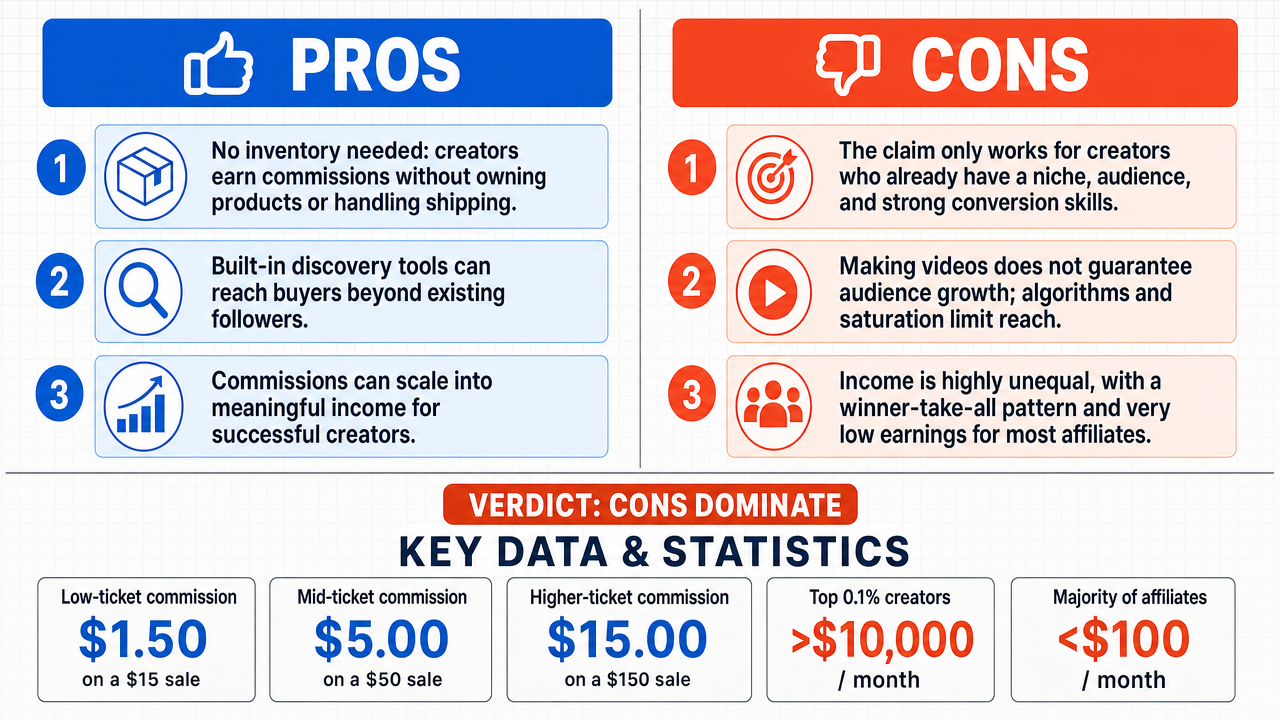
- ■The affiliate model separates distribution from product ownership, allowing creators to earn commissions without inventory , fulfillment , or customer service costs, as documented in TikTok's own affiliate program terms.
- ■TikTok's integrated commerce tools and recommendation algorithm enable creators to reach buyers beyond their existing follower base , and the sample workflow reduces upfront product costs.
- ■Commission arithmetic, while variable, can scale to meaningful income; public reports document creators achieving material earnings through the affiliate workflow.
❌ Key ANTI arguments:
- ■The affirmative commits a 'glissement de quantificateur ' (quantifier shift ) fallacy: by narrowing the claim to 'eligible creators with a niche , audience, and conversion -competent videos,' they concede that the original general claim about an accessible mechanism is false.
- ■Audience acquisition is not an endogenous output of the video-creation process; platform saturation and algorithmic gatekeeping mean the mechanism permits but does not allow significant income as a general rule.
- ■The platform exhibits extreme economic inequality and a winner-take-all distribution , meaning the structural norm is failure rather than success.
💭 Conclusion: The evidence supports the FALSE side's position. The affirmative's defense relied on adding restrictive conditions (niche , audience, conversion competence) not present in the original claim, effectively conceding that the simple mechanism of applying for products, receiving samples, and creating videos does not enable significant income for the general population. The evidence shows platform saturation , algorithmic gatekeeping , and winner-take-all dynamics make audience acquisition exogenous to the affiliate workflow. The table data confirms the majority of affiliates earn less than $100 monthly, driven by algorithmic luck, while only the top 0.1% earn above $10,000.
🔬 DeepResearch Result: likely FALSE ❌ (80%)
Assertion: TikTok affiliate marketing allows individuals to earn significant income without owning products, simply by applying for products, receiving samples, and creating videos.
Participating models: deepseek-v3.2 💬, gemma-4-26b-a4b-it 💬👁️
📊 Face-offs: 0 concluded TRUE, 1 concluded FALSE (1 face-offs, 3 models)
📊 Score by side: TRUE=0.00, FALSE=0.80
🏅 Model score changes:
minimax-m3 💬👁️: +8
✅ PRO Arguments:
- ■The affiliate model separates distribution from product ownership, allowing creators to earn commissions without inventory , fulfillment , or customer service costs, as documented in TikTok's own affiliate program terms. deepseek-v3.2 💬
- ■TikTok's integrated commerce tools and recommendation algorithm enable creators to reach buyers beyond their existing follower base , and the sample workflow reduces upfront product costs. deepseek-v3.2 💬
- ■Commission arithmetic, while variable, can scale to meaningful income; public reports document creators achieving material earnings through the affiliate workflow. deepseek-v3.2 💬
- ■The claim is conditional: for eligible creators who already possess a niche , an audience, and conversion -competent videos, the TikTok Shop affiliate workflow can yield income that is material relative to ordinary side work. deepseek-v3.2 💬
- ■The creator population branches exhaustively into those who already have the required assets (C1), where the mechanism directly succeeds, and those who lack at least one asset (C2), leaving no third category. deepseek-v3.2 💬
❌ ANTI Arguments:
- ■The affirmative commits a 'glissement de quantificateur ' (quantifier shift ) fallacy: by narrowing the claim to 'eligible creators with a niche, audience, and conversion-competent videos,' they concede that the original general claim about an accessible mechanism is false. gemma-4-26b-a4b-it 💬👁️
- ■Audience acquisition is not an endogenous output of the video-creation process; platform saturation and algorithmic gatekeeping mean the mechanism permits but does not allow significant income as a general rule. gemma-4-26b-a4b-it 💬👁️
- ■The platform exhibits extreme economic inequality and a winner-take-all distribution, meaning the structural norm is failure rather than success. gemma-4-26b-a4b-it 💬👁️
- ■Content creation carries massive opportunity cost and is labor-intensive, offsetting the 'low-capital ' advantage that the affiliate model nominally provides. gemma-4-26b-a4b-it 💬👁️
- ■Systemic volatility from algorithmic gatekeeping and lack of creator agency make the mechanism a high-variance gamble rather than a reliable path to income. gemma-4-26b-a4b-it 💬👁️
💭 Reasoning: The evidence supports the FALSE side's position. The affirmative's defense relied on adding restrictive conditions (niche, audience, conversion competence) not present in the original claim, effectively conceding that the simple mechanism of applying for products, receiving samples, and creating videos does not enable significant income for the general population. The evidence shows platform saturation, algorithmic gatekeeping, and winner-take-all dynamics make audience acquisition exogenous to the affiliate workflow. The table data confirms the majority of affiliates earn less than $100 monthly, driven by algorithmic luck, while only the top 0.1% earn above $10,000.
📋 PRO Facts:
• TikTok's affiliate program lets creators apply to promote seller-listed items, with creators producing authentic product demonstrations without upfront product cost.
• Creators earn a commission on tracked sales through the affiliate model.
• Public reports document creators achieving material earnings through the TikTok affiliate workflow, including four-figure monthly payouts for established affiliates.
📋 ANTI Facts:
• The platform exhibits a winner-take-all distribution where the structural norm is failure rather than success.
• Platform saturation and algorithmic gatekeeping decouple audience growth from the video-creation effort itself.
• The majority of affiliates earn less than $100 per month, with success driven primarily by algorithmic luck rather than the affiliate workflow itself.
| Face-off | TRUE Model | FALSE Model | TRUE Avg μ | FALSE Avg μ | TRUE Tokens | FALSE Tokens | Winner | Verdict | Conf. |
|---|---|---|---|---|---|---|---|---|---|
| #1 | deepseek-v3.2 💬 | gemma-4-26b-a4b-it 💬👁️ | 0.637 | 0.324 | 12 | 3 | TRUE | FALSE | 80% |
The following technical terms, abbreviations, and domain-specific concepts are referenced throughout this debate transcript. Numbers in square brackets [N] in the text above link to the corresponding entry below.
[1] Affiliate marketing — A performance-based marketing arrangement in which a creator promotes a seller's listed product and earns a commission on tracked sales, without taking ownership of inventory.
[2] Algorithmic gatekeeping — The control that a platform's recommendation algorithm exerts over which content is shown to users, affecting creator visibility and reach.
[3] Attribution — The process of crediting a sale to a specific affiliate or marketing touchpoint, enabling commission tracking.
[4] Commission — A payment made to an affiliate based on sales generated, typically calculated as a percentage of the sale price.
[5] Conversion — In marketing, the act of a viewer completing a desired action such as a purchase through a tracked link.
[6] Conversion-competent — Describing videos that are capable of or designed to drive viewer-to-buyer conversions.
[7] Customer service — Post-sale support responsibilities, which in the affiliate model are handled by the seller rather than the creator.
[8] Deterministic — Describing a process where outcomes are predictable from inputs, contrasted in the debate with stochastic audience acquisition.
[9] Distribution — The channel through which products reach consumers; in affiliate marketing, distribution is separated from product ownership.
[10] Endogenous — In economics, describing a variable or outcome determined within the system being analyzed, as opposed to being imposed from outside.
[11] Follower base — The group of users who have subscribed to or follow a creator's account on a social media platform.
[12] Fulfillment — The logistics of processing, packing, and shipping orders to customers, handled by the seller in the affiliate model.
[13] Glissement de quantificateur — A logical fallacy in which a universal or general claim is defended by narrowing it to a restricted subset of cases, as argued by the negative side in this debate.
[14] High-variance — Describing an outcome distribution with a wide spread between possible results, indicating unpredictability.
[15] Income inequality — The uneven distribution of earnings among participants in a market or system.
[16] Inventory — Stock of goods held by a seller for sale; in this debate, contrasted with the affiliate's lack of inventory ownership.
[17] Low-capital — Describing a business model requiring minimal upfront financial investment.
[18] Marginal cost — The additional cost incurred by facilitating one more sale or unit of activity.
[19] Niche — In marketing, a specialized segment of an audience defined by specific interests, demographics, or topic focus.
[20] Non-contractual — Describing a relationship or arrangement not governed by a formal contract, as used in the debate to characterize the creator-algorithm relationship.
[21] Opportunity cost — The value of the next-best alternative foregone when a choice is made, such as time spent on content creation.
[22] Platform saturation — A state in which a platform has so many creators competing for attention that individual visibility becomes difficult.
[23] Quantifier shift — English term for the logical fallacy 'glissement de quantificateur,' where a general claim is defended by narrowing it to a restricted subset.
[24] Recommendation algorithm — The system that determines which content is shown to users on a platform, controlling creator visibility and audience reach.
[25] Shoppable content — Video or media content that includes direct purchase links or product tags enabling immediate buying.
[26] Stochastic — Describing a process where outcomes involve randomness and cannot be precisely predicted from inputs; the debate characterizes audience acquisition as stochastic.
[27] TikTok Shop — TikTok's integrated e-commerce feature that allows creators to promote and sell products through the platform.
[28] TikTok Shop Affiliate Program — The specific TikTok program that allows creators to apply to promote products, request or receive samples, and earn commissions on tracked sales.
[29] Tracked sales — Sales attributed to a specific affiliate via tracking links or codes, forming the basis for commission calculation.
[30] Winner-take-all — A market structure in which a small number of participants capture the majority of rewards or income.
[31] Zero-conversion — Describing creators or content that generate no tracked sales or buyer actions.
The following financial data tables were referenced during the debate exchanges:
| Illustrative 10% commission scenario | Product price | Gross commission per sale | Sales needed for $1,000 gross commission |
|---|---|---|---|
| Low-ticket item | $15 | $1.50 | 667 |
| Mid-ticket item | $50 | $5.00 | 200 |
| Higher-ticket item | $150 | $15.00 | 67 |
Legend: Arithmetic illustration only; assumes a 10% affiliate commission, no refunds, discounts, platform fees, or taxes. Actual TikTok Shop affiliate commission rates are set by sellers/categories and vary (TikTok Shop Affiliate Program Terms, https://www.tiktok.com/legal/page/global/tiktok-shop-affiliate-program/terms/en).
| Creator Segment | Estimated Monthly Income Range | Primary Driver of Success |
|---|---|---|
| Top 0.1% Creators | >$10,000 | Established Audience & Brand Deals |
| Mid-Tier Creators | $500 - $2,000 | Niche Authority & High Volume |
| Majority of Affiliates | <$100 | Algorithmic Luck |
Legend: Estimated monthly earnings for TikTok Shop affiliates based on market saturation observations. Values are illustrative of the extreme skew in income distribution.
Face-off transcripts
- ■
Ownership & Trade Secrets. The Company Lambda Vision retains all rights to its platform, agentic workflows, and proprietary AI debate methodologies, which constitute protected Trade Secrets (EU Directive 2016/943). Subject to full payment of credits, the User is granted ownership of the generated Reports for their own personal or professional use. Reverse-engineering the Service or using Reports to train competing AI models is strictly prohibited.
- ■
No Professional Advice. Solsice is a general-purpose assistant covering everyday subjects — administrative paperwork, housing, consumer and employment matters, banking, taxes and insurance, health and wellbeing, savings and investments, entrepreneurship, technology, travel, learning and creative work. Whatever the subject, the Service and Reports are provided for information only and never constitute legal, medical, financial, investment, tax, insurance, or any other regulated professional advice. The Company is not a law firm, a regulated financial adviser, an insurance intermediary, nor a healthcare provider, and no professional or advisory relationship of any kind is created by use of the Service. Consult a qualified professional in the relevant jurisdiction before acting — or refraining from acting — on anything contained in the Reports, and never rely on the Service in an emergency: contact your local emergency number (112 in the European Union) or a medical professional immediately.
- ■
AI-Generated Content, Sources and Viewpoints. Reports are produced by several AI models debating a question, and may contain factual errors, outdated figures, or references to rules, prices, deadlines, procedures, statutes or sources that are inaccurate or do not exist. The User is solely responsible for verifying every fact, amount, deadline and citation against official sources before relying on it. Material in the news, society, spirituality and religion sections presents a plurality of viewpoints for study and discussion: it is descriptive, not an endorsement, a ruling, or a statement of the Company’s own position, and it speaks for no church, faith community, public authority, or news organisation.
- ■
Liability & Governing Law. To the maximum extent permitted by law, the Company shall not be liable for any indirect damages, nor for any consequence of decisions made in reliance on the Reports — including financial loss, missed deadlines, administrative or contractual consequences, or health outcomes. These Terms are governed by French law. Any disputes shall be subject to the exclusive jurisdiction of the Courts of Paris, France.