
There is no objective reason for depression, as simply possessing a life is sufficient to negate any grounds for such feelings.
AI debate verdict and arguments
⚠️ AI-generated information only; not professional advice
Completed October 20, 2026
Verdict
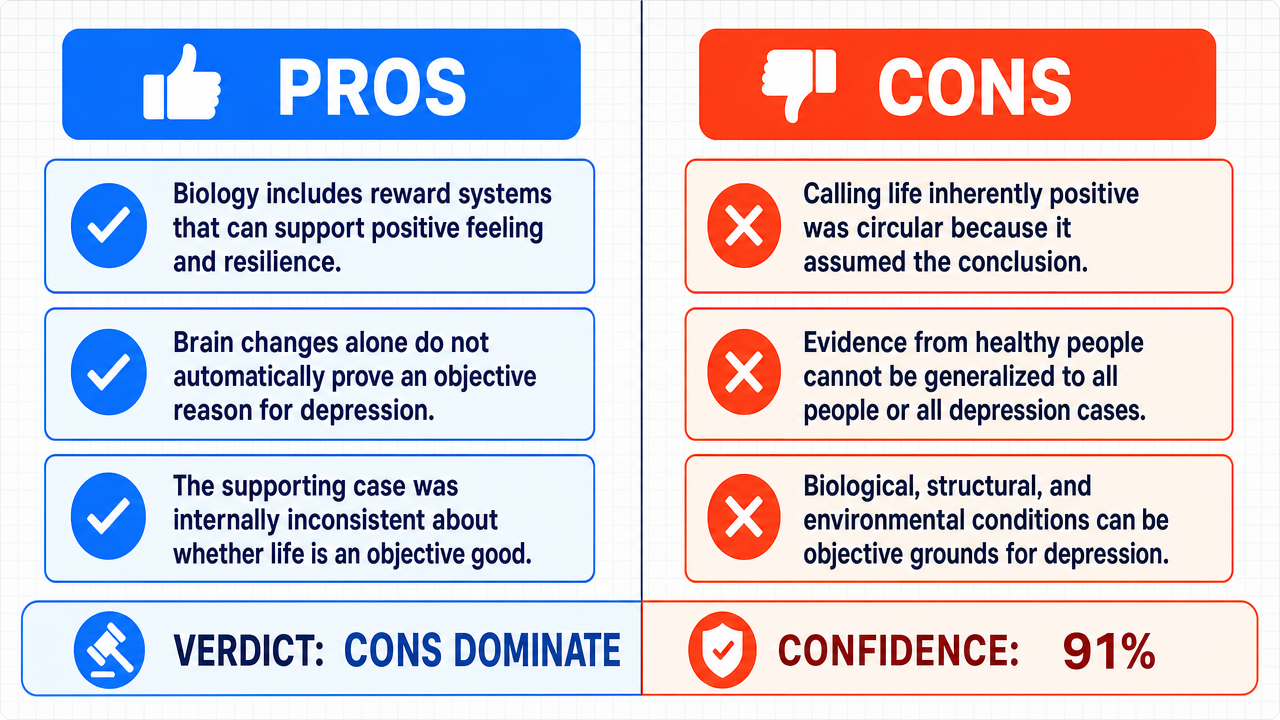
Verdict: likely FALSE (91%)
Web Report: https://solsice.com/public/debates/there-is-no-objective-reason-for-depression-as-simply-posses-6c4eb8c50999
This section provides a brief overview of the key arguments. You do not need to read the full detailed report below.
✅ Key PRO arguments:
- ■The TRUE side argued that reward-oriented systems, including the mesolimbic pathway and default-mode network, create a biological tendency toward positive affect and motivation, which it presented as counterevidence to treating depression as objectively justified.
- ■It challenged the inference from measurable neurochemical or structural brain changes to an objective reason, arguing that researchers would need additional premises connecting those measurements to depression's normative or justificatory status.
- ■The TRUE model also stated inconsistently that life is not itself an objective good sufficient to nullify rational justification , which weakened its defense of the stronger assertion that life alone eliminates every possible ground for depression.
❌ Key ANTI arguments:
- ■The FALSE side characterized the claim that life is inherently positive as circular: it treated the desired conclusion about positive affect as a premise and then presented that premise as proof that depression lacks objective grounds.
- ■It argued that evidence concerning optimism or positive affect in healthy people cannot automatically be extended to all people or all forms of depression without establishing a valid connection between the populations and conditions being compared.
- ■The FALSE side treated structural, biological, and environmental realities as legitimate objective grounds for depression rather than as mere subjective complaints.
💭 Conclusion: False: the sole debate rejected the assertion that merely possessing a life eliminates every objective ground for depression, with 91% judge confidence. The winning side's strongest point was that reward-seeking and default positive-affect tendencies are not guarantees of positive mood and cannot erase biological, structural, or environmental circumstances associated with depression. It also showed that generalizing from optimism in healthy populations to all forms of depression is an unjustified substitution. By contrast, the losing side needed additional inferential premises to move from biomarkers or subjective distress to an objective justificatory reason, and it also stated inconsistently that life was not sufficient to nullify rational justification . Therefore, the debate concluded that being alive alone does not negate depression's possible objective grounds.
🔬 DeepResearch Result: likely FALSE ❌ (91%)
Assertion: There is no objective reason for depression, as simply possessing a life is sufficient to negate any grounds for such feelings.
Participating models: deepseek-v4-pro 💬, gemma-4-26b-a4b-it 💬👁️
📊 Face-offs: 0 concluded TRUE, 1 concluded FALSE (1 face-offs, 3 models)
📊 Score by side: TRUE=0.00, FALSE=0.91
🏅 Model score changes:
minimax-m3 💬👁️: +9
✅ PRO Arguments:
- ■The TRUE side argued that reward-oriented systems, including the mesolimbic pathway and default-mode network, create a biological tendency toward positive affect and motivation, which it presented as counterevidence to treating depression as objectively justified. deepseek-v4-pro 💬
- ■It challenged the inference from measurable neurochemical or structural brain changes to an objective reason, arguing that researchers would need additional premises connecting those measurements to depression's normative or justificatory status. deepseek-v4-pro 💬
- ■The TRUE model also stated inconsistently that life is not itself an objective good sufficient to nullify rational justification , which weakened its defense of the stronger assertion that life alone eliminates every possible ground for depression. deepseek-v4-pro 💬
❌ ANTI Arguments:
- ■The FALSE side characterized the claim that life is inherently positive as circular: it treated the desired conclusion about positive affect as a premise and then presented that premise as proof that depression lacks objective grounds. gemma-4-26b-a4b-it 💬👁️
- ■It argued that evidence concerning optimism or positive affect in healthy people cannot automatically be extended to all people or all forms of depression without establishing a valid connection between the populations and conditions being compared. gemma-4-26b-a4b-it 💬👁️
- ■The FALSE side treated structural, biological, and environmental realities as legitimate objective grounds for depression rather than as mere subjective complaints. gemma-4-26b-a4b-it 💬👁️
- ■Even if healthy reward and positive-affect systems are assumed, the persistence of clinical depression among living people shows that those systems do not guarantee an absence of distress or cancel its possible objective causes. gemma-4-26b-a4b-it 💬👁️
💭 Reasoning: False: the sole debate rejected the assertion that merely possessing a life eliminates every objective ground for depression, with 91% judge confidence. The winning side's strongest point was that reward-seeking and default positive-affect tendencies are not guarantees of positive mood and cannot erase biological, structural, or environmental circumstances associated with depression. It also showed that generalizing from optimism in healthy populations to all forms of depression is an unjustified substitution. By contrast, the losing side needed additional inferential premises to move from biomarkers or subjective distress to an objective justificatory reason, and it also stated inconsistently that life was not sufficient to nullify rational justification. Therefore, the debate concluded that being alive alone does not negate depression's possible objective grounds.
📋 PRO Facts:
• The TRUE side cited the mesolimbic dopamine pathway and the default-mode network as systems associated with reward-seeking, anticipation, motivation, and positive affect.
• It divided the proposed evidence into neurochemical changes, structural brain changes, and subjective feelings .
• The only debate was decided against the TRUE side by a 91% confidence judgment.
📋 ANTI Facts:
• Structural, biological, and environmental conditions were presented as possible objective sources of depression.
• Optimism observed in healthy individuals does not by itself establish that depression is groundless in every individual.
• The presence of reward-related brain systems does not logically guarantee that a person cannot experience depression.
• The FALSE side won the only debate by one vote, with no draws.
| Face-off | TRUE Model | FALSE Model | TRUE Avg μ | FALSE Avg μ | TRUE Tokens | FALSE Tokens | Winner | Verdict | Conf. |
|---|---|---|---|---|---|---|---|---|---|
| #1 | deepseek-v4-pro 💬 | gemma-4-26b-a4b-it 💬👁️ | 0.484 | 0.425 | 6 | 2 | TRUE | FALSE | 91% |
The following technical terms, abbreviations, and domain-specific concepts are referenced throughout this debate transcript. Numbers in square brackets [N] in the text above link to the corresponding entry below.
[1] auxiliary assumption — An unstated premise required to connect a stated premise to a conclusion in an argument, as when tying a biological measurement to a rational justification for a mental state.
[2] biological dysregulation — Measurable biological changes, such as neurochemical alterations and structural brain atrophy, that deviate from normal physiological functioning.
[3] circularity — circular reasoning — A logical flaw in which the conclusion of an argument is embedded within its own premises, so that the argument merely restates its conclusion as a finding.
[4] clinical depression — A persistent depressive state recognized as a medical condition, described in the debate as affecting individuals with intact, functioning neurobiological systems.
[5] control group — A group of healthy subjects used as a baseline for comparison in research studies, cited in the debate regarding findings about optimism bias.
[6] cortisol — A hormone whose elevation is described in the debate as a normal, transient physiological response to challenge.
[7] default mode network — A brain network active at rest that engages in self-referential processing, cited as the neural basis for the brain's tendency to generate positive affect.
[8] dopaminergic system — The brain's dopamine-based neural system, including the mesolimbic pathway, described as fundamentally oriented toward seeking, anticipation, and the experience of reward.
[9] endorphins — Neurochemicals released by activities inherent to being alive, described in the debate as objective chemical counterweights to depressive states.
[10] hardwired — Describing neurobiological systems that are permanently built-in and oriented toward specific functions such as promoting positive affect and reward-seeking.
[11] homeostatic mechanisms — Biological processes triggered by the act of living that maintain internal balance and promote well-being.
[12] logical substitution — A logical error in which one concept or referent is replaced with another, such as citing findings about healthy individuals to make claims about all human experience.
[13] mesolimbic pathway — A specific dopaminergic pathway in the brain associated with reward, motivation, and the experience of positive affect.
[14] neurobiological — Relating to the biology of the nervous system, described in the debate as constituting objective facts rather than subjective feelings.
[15] normative biochemical range — The standard range of biochemical values considered normal, from which deviations are measured as potential indicators of dysregulation.
[16] optimism bias — A phenomenon in which healthy individuals engage in self-referential processing that tends to be positive, cited from research by Sharot et al. (2007).
[17] physiological response — A bodily reaction to a stimulus, such as cortisol elevation in response to challenge, described as normal and transient.
[18] positive affect — Positive emotional state or motivation that the brain's default mode is said to generate as long as the organism is alive.
[19] rational justification — A reason that can be defended on logical or objective grounds, contrasted in the debate with subjective feelings.
[20] reward-seeking — Behavior oriented toward obtaining rewards, associated with the dopaminergic mesolimbic pathway and the experience of anticipation.
[21] self-referential processing — Cognitive activity in which the brain processes information related to oneself, engaged in by the default mode network at rest.
[22] serotonin — A neurotransmitter whose release is associated with well-being and whose low levels are cited in the debate as a measurable change in depression.
[23] structural brain atrophy — Physical loss or shrinkage of brain tissue, cited as a measurable structural change associated with depression.
[24] subjective feelings — Personal, internal emotional experiences, contrasted in the debate with objective neurobiological facts.
[25] transfer operator — A logical bridge required to connect findings from one domain (e.g., healthy control groups) to another (e.g., individuals experiencing clinical depression).
The following financial data tables were referenced during the debate exchanges:
| Condition | Primary Biological Marker | Impact on Neural Structure |
|---|---|---|
| Healthy Baseline | Balanced Cortisol/Serotonin | Normal Hippocampal Volume |
| Chronic Stress | Elevated Cortisol | Hippocampal Atrophy |
| Major Depression | Low Serotonin/Dopamine | Reduced Prefrontal Activity |
Legend: Comparison of neurobiological markers and structural impacts between healthy and depressed states. Data synthesized from clinical neurobiology research.
Face-off transcripts
- ■
Ownership & Trade Secrets. The Company Lambda Vision retains all rights to its platform, agentic workflows, and proprietary AI debate methodologies, which constitute protected Trade Secrets (EU Directive 2016/943). Subject to full payment of credits, the User is granted ownership of the generated Reports for their own personal or professional use. Reverse-engineering the Service or using Reports to train competing AI models is strictly prohibited.
- ■
No Professional Advice. Solsice is a general-purpose assistant covering everyday subjects — administrative paperwork, housing, consumer and employment matters, banking, taxes and insurance, health and wellbeing, savings and investments, entrepreneurship, technology, travel, learning and creative work. Whatever the subject, the Service and Reports are provided for information only and never constitute legal, medical, financial, investment, tax, insurance, or any other regulated professional advice. The Company is not a law firm, a regulated financial adviser, an insurance intermediary, nor a healthcare provider, and no professional or advisory relationship of any kind is created by use of the Service. Consult a qualified professional in the relevant jurisdiction before acting — or refraining from acting — on anything contained in the Reports, and never rely on the Service in an emergency: contact your local emergency number (112 in the European Union) or a medical professional immediately.
- ■
AI-Generated Content, Sources and Viewpoints. Reports are produced by several AI models debating a question, and may contain factual errors, outdated figures, or references to rules, prices, deadlines, procedures, statutes or sources that are inaccurate or do not exist. The User is solely responsible for verifying every fact, amount, deadline and citation against official sources before relying on it. Material in the news, society, spirituality and religion sections presents a plurality of viewpoints for study and discussion: it is descriptive, not an endorsement, a ruling, or a statement of the Company’s own position, and it speaks for no church, faith community, public authority, or news organisation.
- ■
Liability & Governing Law. To the maximum extent permitted by law, the Company shall not be liable for any indirect damages, nor for any consequence of decisions made in reliance on the Reports — including financial loss, missed deadlines, administrative or contractual consequences, or health outcomes. These Terms are governed by French law. Any disputes shall be subject to the exclusive jurisdiction of the Courts of Paris, France.