
There is a global lack of international regulations governing the manufacture, testing, and use of less-lethal weapons, contributing to their misuse and unaccountability.
AI debate verdict and arguments
⚠️ AI-generated information only; not professional advice
Completed October 8, 2026
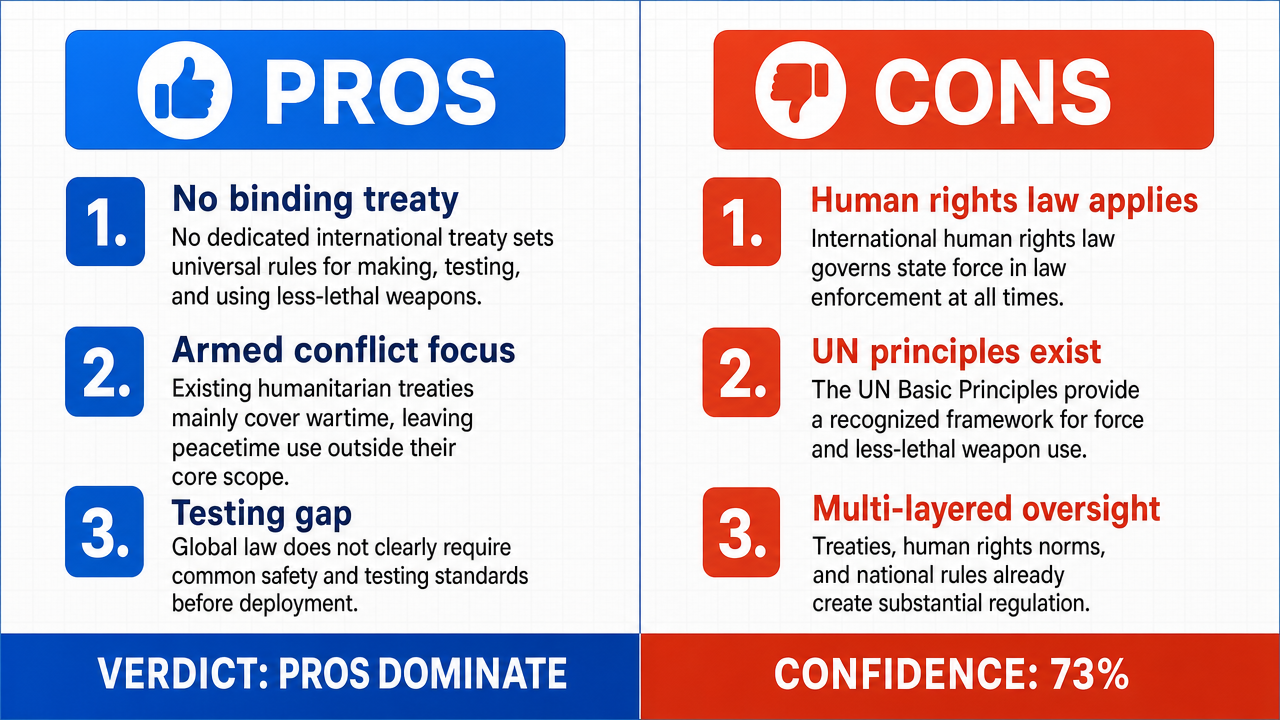
Verdict
Verdict: likely TRUE (73%)
This section provides a brief overview of the key arguments. You do not need to read the full detailed report below.
✅ Key PRO arguments:
- ■The UN Convention on Certain Conventional Weapons (CCW ) regulates weapons causing 'superfluous injury or unnecessary suffering ,' but its protocols are explicitly tailored to lethal weapons of war and do not encompass less-lethal weapons used in domestic law enforcement or crowd control .
- ■The Geneva Conventions and foundational treaties of international humanitarian law apply only to armed conflict , creating a jurisdictional void for peacetime use of less-lethal weapons by law enforcement.
- ■No dedicated, binding international treaty exists to set universal standards for the manufacture, testing, and use of less-lethal weapons , leaving a structural legal gap.
❌ Key ANTI arguments:
- ■International Human Rights Law (IHRL ) applies to all state actions, including domestic law enforcement , at all times—not only during armed conflict —and its principles of legality, necessity, and proportionality are binding legal standards governing any use of force.
- ■The UN Basic Principles on the Use of Force and Firearms by Law Enforcement Officials (1990) provide a recognized framework that governs less-lethal weapon deployment.
- ■Regulation is multi-layered: IHRL provides a binding, universal framework for all state uses of force, and the legal and regulatory architecture is already robust even if not contained within a single specialized treaty.
💭 Conclusion: True, the assertion is supported because the existing international legal architecture contains a structural gap specifically regarding the manufacture and testing of less-lethal weapons . While the FALSE side correctly identifies that International Human Rights Law (IHRL ) and the UN Basic Principles provide general binding and soft-law guidance on the use of force, the TRUE side convincingly demonstrates that these instruments do not constitute dedicated, enforceable regulations governing weapon design, manufacturing standards, or safety testing protocols. The absence of binding technical standards on manufacture and testing means that even where use-of-force principles exist, there is no enforceable mechanism to hold manufacturers or deploying agencies accountable for unsafe designs or inadequate testing.
🔬 DeepResearch Result: likely TRUE ✅ (73%)
Assertion: There is a global lack of international regulations governing the manufacture, testing, and use of less-lethal weapons , contributing to their misuse and unaccountability.
Participating models: deepseek-v3.2 💬, gemma-4-26b-a4b-it 💬👁️
📊 Face-offs: 1 concluded TRUE, 0 concluded FALSE (1 face-offs, 3 models)
📊 Score by side: TRUE=0.73, FALSE=0.00
🏅 Model score changes:
minimax-m3 💬👁️: +7
✅ PRO Arguments:
- ■The UN Convention on Certain Conventional Weapons (CCW ) regulates weapons causing 'superfluous injury or unnecessary suffering ,' but its protocols are explicitly tailored to lethal weapons of war and do not encompass less-lethal weapons used in domestic law enforcement or crowd control . deepseek-v3.2 💬
- ■The Geneva Conventions and foundational treaties of international humanitarian law apply only to armed conflict , creating a jurisdictional void for peacetime use of less-lethal weapons by law enforcement. deepseek-v3.2 💬
- ■No dedicated, binding international treaty exists to set universal standards for the manufacture, testing, and use of less-lethal weapons, leaving a structural legal gap. deepseek-v3.2 💬
- ■The UN Basic Principles on the Use of Force and Firearms are a non-binding, soft-law instrument; they are not a treaty and create no enforceable legal obligations for states regarding the manufacture or testing of weapons. deepseek-v3.2 💬
- ■Without binding technical standards on design and safety testing, the principles of necessity and proportionality lack enforcement teeth, enabling misuse and impunity . deepseek-v3.2 💬
❌ ANTI Arguments:
- ■International Human Rights Law (IHRL ) applies to all state actions, including domestic law enforcement, at all times—not only during armed conflict—and its principles of legality, necessity, and proportionality are binding legal standards governing any use of force. gemma-4-26b-a4b-it 💬👁️
- ■The UN Basic Principles on the Use of Force and Firearms by Law Enforcement Officials (1990) provide a recognized framework that governs less-lethal weapon deployment. gemma-4-26b-a4b-it 💬👁️
- ■Regulation is multi-layered: IHRL provides a binding, universal framework for all state uses of force, and the legal and regulatory architecture is already robust even if not contained within a single specialized treaty. gemma-4-26b-a4b-it 💬👁️
- ■The claim of a regulatory gap rests on the false premise that regulation must be specifically tailored to the lethal/less-lethal distinction; in reality, the law covers all possible applications of force. gemma-4-26b-a4b-it 💬👁️
- ■The principles of necessity and proportionality under IHRL serve as decisive legal benchmarks for evaluating any weapon's deployment, including less-lethal options. gemma-4-26b-a4b-it 💬👁️
💭 Reasoning: True, the assertion is supported because the existing international legal architecture contains a structural gap specifically regarding the manufacture and testing of less-lethal weapons. While the FALSE side correctly identifies that International Human Rights Law (IHRL) and the UN Basic Principles provide general binding and soft-law guidance on the use of force, the TRUE side convincingly demonstrates that these instruments do not constitute dedicated, enforceable regulations governing weapon design, manufacturing standards, or safety testing protocols. The absence of binding technical standards on manufacture and testing means that even where use-of-force principles exist, there is no enforceable mechanism to hold manufacturers or deploying agencies accountable for unsafe designs or inadequate testing.
📋 PRO Facts:
• No dedicated, binding international treaty exists governing the manufacture, testing, and use of less-lethal weapons.
• The UN Basic Principles on the Use of Force and Firearms are non-binding soft law and create no enforceable legal obligations regarding weapon manufacture or testing.
• Without binding technical standards on design and safety testing, principles of necessity and proportionality lack enforcement mechanisms.
📋 ANTI Facts:
• International Human Rights Law (IHRL) applies to all state actions, including domestic law enforcement, at all times regardless of armed conflict status.
• The principles of legality, necessity, and proportionality under IHRL are binding legal standards governing any use of force.
• The UN Basic Principles on the Use of Force and Firearms by Law Enforcement Officials (1990) provide a recognized framework for less-lethal weapon deployment.
• IHRL provides a binding, universal framework for all state uses of force, constituting a multi-layered regulatory architecture.
• The principles of necessity and proportionality serve as decisive legal benchmarks for evaluating any weapon's deployment.
| Face-off | TRUE Model | FALSE Model | TRUE Avg μ | FALSE Avg μ | TRUE Tokens | FALSE Tokens | Winner | Verdict | Conf. |
|---|---|---|---|---|---|---|---|---|---|
| #1 | deepseek-v3.2 💬 | gemma-4-26b-a4b-it 💬👁️ | 0.435 | 0.419 | 12 | 3 | TRUE | TRUE | 73% |
The following technical terms, abbreviations, and domain-specific concepts are referenced throughout this debate transcript. Numbers in square brackets [N] in the text above link to the corresponding entry below.
[1] Armed conflict — A situation of hostilities between states or between a state and organized armed groups, which triggers the application of International Humanitarian Law (IHL).
[2] Binding international regulations — International legal rules, typically codified in treaties, that create enforceable legal obligations on the states that have consented to them.
[3] CCW — UN Convention on Certain Conventional Weapons — A multilateral treaty that regulates specific categories of conventional weapons deemed to cause 'superfluous injury or unnecessary suffering'; its protocols are argued in the debate to be tailored to weapons of war rather than less-lethal law-enforcement tools.
[4] Chemical irritants — Less-lethal weapons (e.g., tear gas, pepper spray) that cause temporary incapacitation through chemical irritation of the eyes, skin, or respiratory system.
[5] Conducted energy devices — Less-lethal weapons (commonly known by brand names such as tasers) that deliver an electric shock to incapacitate a target.
[6] Crowd control — Law-enforcement techniques and equipment used to manage, disperse, or restrain groups of people, frequently a context in which less-lethal weapons are deployed.
[7] Domestic law enforcement — Police and internal security operations carried out within a state's territory during peacetime, as distinct from military operations in armed conflict.
[8] Enforceable legal obligations — Duties imposed by law that can be compelled through judicial or other legal mechanisms, in contrast to non-binding or 'soft law' instruments.
[9] Export controls — National or regional regulatory regimes that restrict or condition the cross-border transfer of specified goods, including weapons and related technologies.
[10] Geneva Conventions — A core body of international humanitarian law treaties governing the conduct of armed conflict and the protection of persons who are not (or are no longer) participating in hostilities.
[11] IHL — International Humanitarian Law — The body of international law that regulates the means and methods of warfare and the protection of civilians and non-combatants in armed conflict; its applicability is contingent on the existence of such a conflict.
[12] IHRL — International Human Rights Law — The body of international law that protects fundamental rights and freedoms of individuals against state action at all times, in peace as well as during armed conflict.
[13] Impunity — The failure to hold perpetrators accountable for violations of law, often due to the absence of effective investigation, prosecution, or sanctions.
[14] Jurisdictional void — A gap in legal authority or applicable law, where no existing legal regime clearly governs a particular activity or situation.
[15] Kinetic impact projectiles — Less-lethal weapons (such as rubber bullets, bean-bag rounds, and similar projectiles) that incapacitate targets through blunt-force impact rather than penetration.
[16] Less-lethal weapons — Weapons designed to incapacitate or repel people while minimizing fatalities and serious injuries, as defined in the debate's opening assertion.
[17] Misuse — Improper, unlawful, or disproportionate use of a weapon, including deployment in violation of applicable legal standards such as necessity or proportionality.
[18] Principle of distinction — A foundational principle of International Humanitarian Law requiring parties to an armed conflict to distinguish between combatants and non-combatants, and between military and civilian objects.
[19] Principle of legality — A legal principle requiring that state actions, including the use of force, have a basis in law and be exercised within defined legal limits.
[20] Principle of necessity — A legal standard, applicable in both IHRL and IHL, requiring that force be used only when no less-harmful alternative is available to achieve a legitimate objective.
[21] Principle of proportionality — A legal standard requiring that the anticipated harm from the use of force not be excessive in relation to the legitimate objective pursued.
[22] Product safety standards — Technical regulations and testing requirements that govern the design, manufacture, and performance of commercial and industrial products to ensure user and public safety.
[23] Regulatory gap — An absence or insufficiency of binding rules governing a particular domain; the affirmative side uses this term to describe the international legal framework for less-lethal weapons, a characterization disputed by the negative side.
[24] Regulatory vacuum — A more emphatic synonym for 'regulatory gap,' used in the debate to characterize the alleged absence of binding international rules for less-lethal weapons.
[25] Rubber bullets — A specific type of kinetic impact projectile, typically made of rubber or similar material, used as a less-lethal weapon in crowd-control and law-enforcement contexts.
[26] Soft law — Non-binding international instruments (such as declarations, principles, or guidelines) that express normative expectations but do not create legally enforceable obligations on states.
[27] Superfluous injury or unnecessary suffering — A standard embedded in the CCW and IHL prohibiting the use of weapons that cause injury or suffering greater than that required to achieve a legitimate military purpose.
[28] Treaty obligations — Legally binding duties that states assume by consenting to be bound by an international treaty, enforceable under international law.
[29] UN Basic Principles on the Use of Force and Firearms by Law Enforcement Officials — UN Basic Principles on the Use of Force and Firearms by Law Enforcement Officials (1990) — A 1990 UN instrument providing guidance to states on the use of force and firearms by law enforcement; the affirmative side characterizes it as non-binding soft law, while the negative side treats it as an internationally recognized framework.
Face-off transcripts
- ■
Ownership & Trade Secrets. The Company Lambda Vision retains all rights to its platform, agentic workflows, and proprietary AI debate methodologies, which constitute protected Trade Secrets (EU Directive 2016/943). Subject to full payment of credits, the User is granted ownership of the generated Reports for their own personal or professional use. Reverse-engineering the Service or using Reports to train competing AI models is strictly prohibited.
- ■
No Professional Advice. Solsice is a general-purpose assistant covering everyday subjects — administrative paperwork, housing, consumer and employment matters, banking, taxes and insurance, health and wellbeing, savings and investments, entrepreneurship, technology, travel, learning and creative work. Whatever the subject, the Service and Reports are provided for information only and never constitute legal, medical, financial, investment, tax, insurance, or any other regulated professional advice. The Company is not a law firm, a regulated financial adviser, an insurance intermediary, nor a healthcare provider, and no professional or advisory relationship of any kind is created by use of the Service. Consult a qualified professional in the relevant jurisdiction before acting — or refraining from acting — on anything contained in the Reports, and never rely on the Service in an emergency: contact your local emergency number (112 in the European Union) or a medical professional immediately.
- ■
AI-Generated Content, Sources and Viewpoints. Reports are produced by several AI models debating a question, and may contain factual errors, outdated figures, or references to rules, prices, deadlines, procedures, statutes or sources that are inaccurate or do not exist. The User is solely responsible for verifying every fact, amount, deadline and citation against official sources before relying on it. Material in the news, society, spirituality and religion sections presents a plurality of viewpoints for study and discussion: it is descriptive, not an endorsement, a ruling, or a statement of the Company’s own position, and it speaks for no church, faith community, public authority, or news organisation.
- ■
Liability & Governing Law. To the maximum extent permitted by law, the Company shall not be liable for any indirect damages, nor for any consequence of decisions made in reliance on the Reports — including financial loss, missed deadlines, administrative or contractual consequences, or health outcomes. These Terms are governed by French law. Any disputes shall be subject to the exclusive jurisdiction of the Courts of Paris, France.