
The Xiaomi 18 Pro's heat management issues, observed in the Chinese model, will be resolved before its French release.
AI debate verdict and arguments
⚠️ AI-generated information only; not professional advice
Completed October 11, 2026
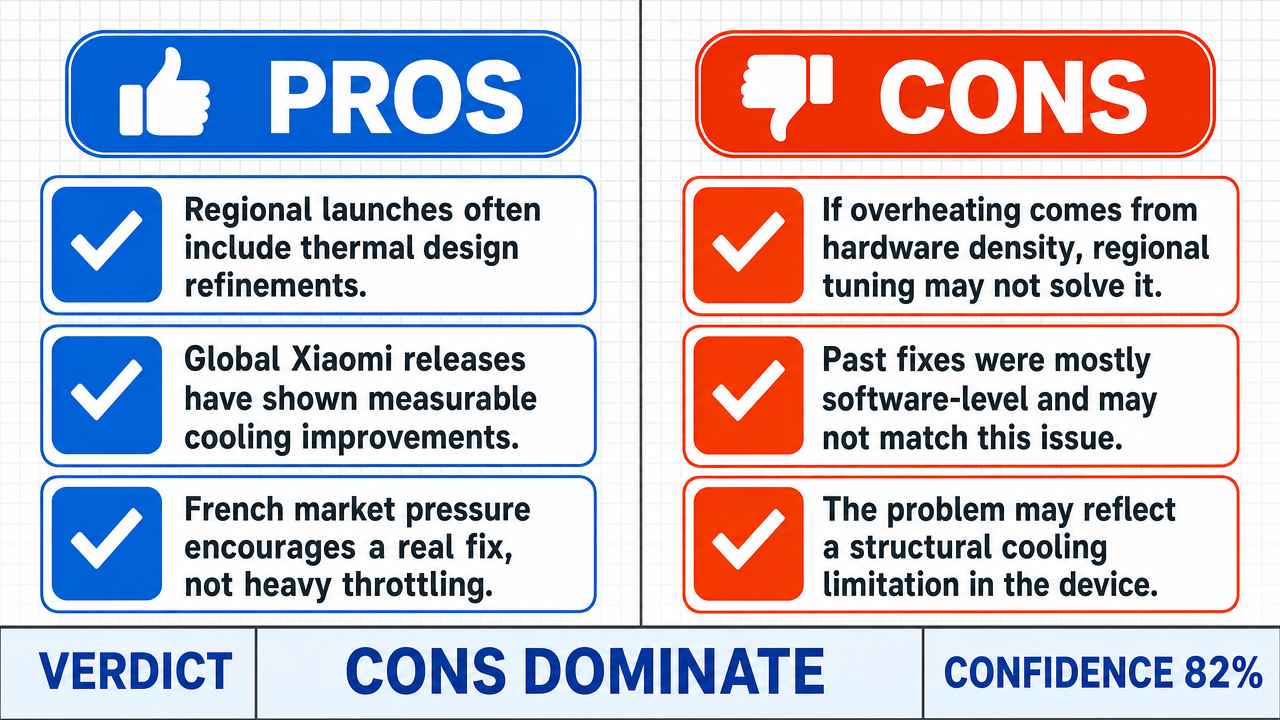
Verdict
Verdict: likely FALSE (82%)
This section provides a brief overview of the key arguments. You do not need to read the full detailed report below.
✅ Key PRO arguments:
- ■Xiaomi has a documented corporate practice of iterating on thermal design between regional launches, as seen with the Xiaomi 13 series where thermal complaints in China led to a revised vapor chamber and software tuning for European models, resulting in measurable improvements.
- ■The Xiaomi 14 Ultra's launch cycle demonstrates a pattern of measurable thermal improvements being implemented for the global model after issues were identified in the Chinese market, reflecting a standard corporate risk-mitigation strategy for global rollouts.
- ■French consumer protection regulations and commercial pressure make aggressive throttling an unviable commercial strategy, meaning Xiaomi must genuinely resolve thermal issues rather than mask them through performance crippling.
❌ Key ANTI arguments:
- ■The affirmative's reliance on historical iterations is a fundamental error of scale and scope; if the overheating is rooted in the physical density of the SoC or a fundamental inadequacy in the chassis's thermal dissipation capacity, no amount of software tuning or throttling algorithms can resolve the issue without a complete hardware redesign .
- ■The current thermal issue is not of the same genus as the previously 'resolved' iterations; the affirmative's cited examples of software tuning successes occurred in cases where the underlying hardware architecture was sufficient, whereas the Xiaomi 18 Pro's problem may represent a structural deficiency.
- ■The Xiaomi 18 Pro's specific heat management problem falls into a different category than previous models: a structural deficiency in thermal dissipation architecture that cannot be remedied through the iterative methods (software tuning , minor component adjustments ) that worked for prior devices.
💭 Conclusion: The Xiaomi model's heat management issues cannot be definitively resolved before any regional release based on available evidence. The negative side argued that thermal problems likely represent a structural hardware limitation rooted in the physical thermal dissipation capacity of the device's architecture, rather than a remediable software or minor component issue. The affirmative's reliance on historical precedents of software tuning and minor component adjustments fails because those successes occurred in cases where the underlying hardware architecture was sufficient, whereas the current problem may be a fundamental design deficiency. Without a complete hardware redesign —which may be logistically infeasible between regional launches—the thermal issues cannot be genuinely resolved. The negative's argument that no amount of software tuning can overcome a structural thermal dissipation inadequacy proved decisive.
🔬 DeepResearch Result: likely FALSE ❌ (82%)
Assertion: The Xiaomi 18 Pro's heat management issues, observed in the Chinese model, will be resolved before its French release.
Participating models: deepseek-v3.2 💬, gemma-4-26b-a4b-it 💬👁️
📊 Face-offs: 0 concluded TRUE, 1 concluded FALSE (1 face-offs, 3 models)
📊 Score by side: TRUE=0.00, FALSE=0.82
🏅 Model score changes:
minimax-m3 💬👁️: +8
✅ PRO Arguments:
- ■Xiaomi has a documented corporate practice of iterating on thermal design between regional launches, as seen with the Xiaomi 13 series where thermal complaints in China led to a revised vapor chamber and software tuning for European models, resulting in measurable improvements. deepseek-v3.2 💬
- ■The Xiaomi 14 Ultra's launch cycle demonstrates a pattern of measurable thermal improvements being implemented for the global model after issues were identified in the Chinese market, reflecting a standard corporate risk-mitigation strategy for global rollouts. deepseek-v3.2 💬
- ■French consumer protection regulations and commercial pressure make aggressive throttling an unviable commercial strategy, meaning Xiaomi must genuinely resolve thermal issues rather than mask them through performance crippling. deepseek-v3.2 💬
- ■In the smartphone market, a thermal management issue is considered resolved when the device operates within safe and acceptable performance parameters for its target audience without triggering widespread complaints or returns, which can be achieved through combined hardware and software refinements. deepseek-v3.2 💬
❌ ANTI Arguments:
- ■The affirmative's reliance on historical iterations is a fundamental error of scale and scope; if the overheating is rooted in the physical density of the SoC or a fundamental inadequacy in the chassis's thermal dissipation capacity, no amount of software tuning or throttling algorithms can resolve the issue without a complete hardware redesign . gemma-4-26b-a4b-it 💬👁️
- ■The current thermal issue is not of the same genus as the previously 'resolved' iterations; the affirmative's cited examples of software tuning successes occurred in cases where the underlying hardware architecture was sufficient, whereas the Xiaomi 18 Pro's problem may represent a structural deficiency. gemma-4-26b-a4b-it 💬👁️
- ■The Xiaomi 18 Pro's specific heat management problem falls into a different category than previous models: a structural deficiency in thermal dissipation architecture that cannot be remedied through the iterative methods (software tuning, minor component adjustments ) that worked for prior devices. gemma-4-26b-a4b-it 💬👁️
- ■The exhaustive set of possibilities regarding the nature of the thermal issue shows that if it is a fundamental hardware constraint, the iterative patterns cited by the affirmative are fundamentally inapplicable, and there is no evidence that Xiaomi has the time or willingness to undertake a complete hardware redesign between the Chinese and French releases. gemma-4-26b-a4b-it 💬👁️
💭 Reasoning: The Xiaomi model's heat management issues cannot be definitively resolved before any regional release based on available evidence. The negative side argued that thermal problems likely represent a structural hardware limitation rooted in the physical thermal dissipation capacity of the device's architecture, rather than a remediable software or minor component issue. The affirmative's reliance on historical precedents of software tuning and minor component adjustments fails because those successes occurred in cases where the underlying hardware architecture was sufficient, whereas the current problem may be a fundamental design deficiency. Without a complete hardware redesign—which may be logistically infeasible between regional launches—the thermal issues cannot be genuinely resolved. The negative's argument that no amount of software tuning can overcome a structural thermal dissipation inadequacy proved decisive.
📋 PRO Facts:
• Xiaomi has a documented history of iterating on thermal design between regional launches, including the Xiaomi 13 series and Xiaomi 14 Ultra.
• French consumer protection regulations impose requirements on device safety and performance parameters for consumer launches.
📋 ANTI Facts:
• If overheating is rooted in the physical density of the SoC or chassis thermal dissipation capacity, software tuning alone cannot resolve the issue.
| Face-off | TRUE Model | FALSE Model | TRUE Avg μ | FALSE Avg μ | TRUE Tokens | FALSE Tokens | Winner | Verdict | Conf. |
|---|---|---|---|---|---|---|---|---|---|
| #1 | deepseek-v3.2 💬 | gemma-4-26b-a4b-it 💬👁️ | 0.335 | 0.271 | 12 | 3 | TRUE | FALSE | 82% |
The following technical terms, abbreviations, and domain-specific concepts are referenced throughout this debate transcript. Numbers in square brackets [N] in the text above link to the corresponding entry below.
[1] Chipset — A set of integrated circuits designed to work together, typically referring to the main processor (SoC) in a smartphone. In the debate, the chipset's high power density is cited as a potential root cause of thermal issues.
[2] Component adjustments — Modifications to physical hardware parts made between regional product launches. Cited in the debate as part of Xiaomi's iterative approach to thermal improvements.
[3] Consumer protection laws — Regulations that protect buyers from unfair trade practices. In the debate, French consumer protection law is invoked regarding undisclosed performance degradation.
[4] DGCCRF — French Directorate General for Competition, Consumer Affairs and Fraud Control — A French regulatory body referenced in the debate as having previously sanctioned electronics firms for significant undisclosed performance degradation.
[5] Global rollout — The staged release of a product across multiple international markets. The debate discusses the gap between regional launches as a window for final validation and adjustments.
[6] Hardware architecture — The physical design and arrangement of a device's components. In the debate, the negative argues the 18 Pro's thermal issue may stem from fundamental limitations in this architecture.
[7] Hardware limitation — A constraint imposed by the physical design of a device that cannot be overcome through software changes alone. The negative's central argument is that the 18 Pro's overheating is such a limitation.
[8] Hardware redesign — A fundamental restructuring of a device's physical components. The negative argues this would be required if the thermal issue is structural, which is not feasible within the standard launch window.
[9] Hidden defect — A flaw not disclosed to consumers that affects product performance. The affirmative argues undisclosed throttling could constitute such a defect under French law.
[10] Misleading advertising — Marketing that misrepresents a product's actual capabilities. Cited in the debate as a legal risk if a device's performance is degraded without disclosure.
[11] Peak Surface Temp — Peak Surface Temperature — The highest temperature recorded on a device's exterior during stress testing. The debate cites a reduction from 47.2°C to 43.1°C between regional variants of the Xiaomi 14 Ultra.
[12] Performance degradation — A reduction in a device's operational speed or capability. The debate discusses whether throttling-induced degradation constitutes a hidden defect.
[13] Performance parameters — Measurable specifications defining a device's operational capabilities. The affirmative defines a thermal issue as 'resolved' when the device operates within safe and acceptable parameters.
[14] Power density — The amount of power dissipated per unit volume or area of a component. Cited in the debate as a factor contributing to the 18 Pro's thermal issues.
[15] Product fit for purpose — A consumer protection standard requiring products to perform as reasonably expected. Cited as a legal requirement that aggressive throttling could violate.
[16] Product lifecycle — The stages a product passes through from development to discontinuation. The debate references a global product lifecycle where regional launches inform subsequent iterations.
[17] Regulatory compliance — Adherence to laws, regulations, and guidelines governing a product's sale. The debate discusses whether throttling alone can satisfy compliance requirements.
[18] Risk-mitigation strategy — A corporate approach to reducing potential business risks. The affirmative characterizes Xiaomi's regional thermal iterations as a standard risk-mitigation strategy.
[19] Safety thresholds — Defined limits beyond which a device poses user risks. The debate notes that throttling may bring temperatures below these thresholds without resolving underlying issues.
[20] SoC — System on Chip — An integrated circuit that combines multiple computer components (CPU, GPU, memory controllers, etc.) onto a single chip. Cited in the debate as a potential source of thermal density issues.
[21] Software tuning — Adjustments to a device's software to optimize performance characteristics. Cited as a method Xiaomi has used historically to improve thermal profiles.
[22] Stress Test — A methodology that subjects a device to extreme workloads to evaluate performance limits. Used in the debate to measure peak surface temperatures.
[23] Structural deficit — A fundamental inadequacy in a device's physical design. The negative argues the 18 Pro's thermal issue is a structural deficit rather than a remediable software problem.
[24] Technical teardowns — Detailed physical disassemblies and analyses of devices to evaluate internal components and design. Cited as the source for comparative thermal data.
[25] Thermal design — The engineering of a device's heat management systems, including heat dissipation pathways. The debate discusses Xiaomi's iterative improvements to thermal design between regional launches.
[26] Thermal dissipation — The process by which heat is transferred away from internal components to the device's exterior or environment. The negative argues the chassis's dissipation capacity may be fundamentally inadequate.
[27] Thermal management — The overall systems and strategies used to control a device's operating temperature. The central subject of the debate regarding the Xiaomi 18 Pro.
[28] Thermal profile — The characteristic pattern of heat generation and distribution across a device under various conditions. Cited as something software tuning and vapor chamber revisions can correct.
[29] Throttling — The intentional reduction of a device's processor performance to limit heat generation. The debate disputes whether throttling 'resolves' thermal issues or merely masks them.
[30] Throttling algorithms — Software routines that dynamically reduce processor performance based on temperature readings. Cited as part of the Xiaomi 14 Ultra's thermal improvements.
[31] VC — vapor chamber — A sealed, flat heat-dissipation component containing fluid that vaporizes to transfer heat away from a chip. Cited as a hardware element Xiaomi revised between regional launches.
Face-off transcripts
- ■
Ownership & Trade Secrets. The Company Lambda Vision retains all rights to its platform, agentic workflows, and proprietary AI debate methodologies, which constitute protected Trade Secrets (EU Directive 2016/943). Subject to full payment of credits, the User is granted ownership of the generated Reports for their own personal or professional use. Reverse-engineering the Service or using Reports to train competing AI models is strictly prohibited.
- ■
No Professional Advice. Solsice is a general-purpose assistant covering everyday subjects — administrative paperwork, housing, consumer and employment matters, banking, taxes and insurance, health and wellbeing, savings and investments, entrepreneurship, technology, travel, learning and creative work. Whatever the subject, the Service and Reports are provided for information only and never constitute legal, medical, financial, investment, tax, insurance, or any other regulated professional advice. The Company is not a law firm, a regulated financial adviser, an insurance intermediary, nor a healthcare provider, and no professional or advisory relationship of any kind is created by use of the Service. Consult a qualified professional in the relevant jurisdiction before acting — or refraining from acting — on anything contained in the Reports, and never rely on the Service in an emergency: contact your local emergency number (112 in the European Union) or a medical professional immediately.
- ■
AI-Generated Content, Sources and Viewpoints. Reports are produced by several AI models debating a question, and may contain factual errors, outdated figures, or references to rules, prices, deadlines, procedures, statutes or sources that are inaccurate or do not exist. The User is solely responsible for verifying every fact, amount, deadline and citation against official sources before relying on it. Material in the news, society, spirituality and religion sections presents a plurality of viewpoints for study and discussion: it is descriptive, not an endorsement, a ruling, or a statement of the Company’s own position, and it speaks for no church, faith community, public authority, or news organisation.
- ■
Liability & Governing Law. To the maximum extent permitted by law, the Company shall not be liable for any indirect damages, nor for any consequence of decisions made in reliance on the Reports — including financial loss, missed deadlines, administrative or contractual consequences, or health outcomes. These Terms are governed by French law. Any disputes shall be subject to the exclusive jurisdiction of the Courts of Paris, France.