
The world of SpongeBob SquarePants reflects modern society's 'drive for achievement' as described by Byung-Chul Han.
AI debate verdict and arguments
⚠️ AI-generated information only; not professional advice
Completed October 11, 2026
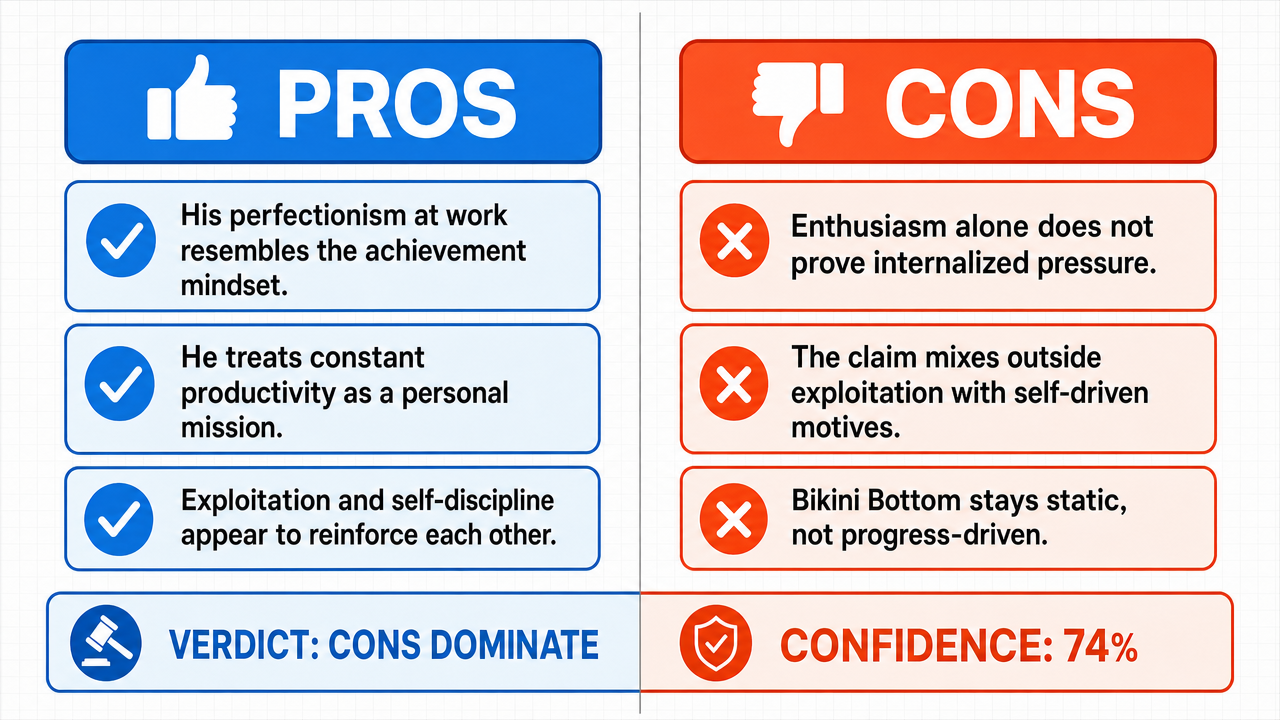
Verdict
Verdict: likely FALSE (74%)
This section provides a brief overview of the key arguments. You do not need to read the full detailed report below.
✅ Key PRO arguments:
- ■SpongeBob's relentless pursuit of perfection at the Krusty Krab, often to the detriment of his personal well-being, directly mirrors Han's 'achievement-subject ' — an individual driven by an internal compulsion to constantly optimize and perform.
- ■SpongeBob's boundless enthusiasm for his job, even when exploited by Mr. Krabs, exemplifies a self-driven imperative to maximize productivity, transforming work into a form of self-exploitation characteristic of neoliberal achievement societies.
- ■External exploitation and self-exploitation are precisely the two sides of the neoliberal achievement society ; Han's achievement-subject becomes both master and slave of the same imperative to optimize, so the presence of Mr. Krabs does not negate the internal compulsion .
❌ Key ANTI arguments:
- ■The affirmative commits a substitution of proxy: it observes SpongeBob's enthusiasm for a repetitive task and labels it 'internalized demand ' without providing the psychological or structural transfer operator that connects cartoon slapstick to Han's systemic neoliberal compulsion of self-exploitation .
- ■The TRUE argument is internally inconsistent — it simultaneously asserts that SpongeBob is exploited by Mr. Krabs (external driver) and that his behavior is driven by internal compulsion . If the driver is external exploitation, the behavior cannot be defined as purely internal self-optimization, and vice versa.
- ■The structural stasis and repetitive, circular nature of Bikini Bottom's economy directly contradicts the teleological progress required by a neoliberal achievement society ; in a world where characters perpetually reset to a status quo , the 'drive for achievement ' lacks the systemic consequence and cumulative optimization that define Han's critique.
💭 Conclusion: False. The world of SpongeBob SquarePants does not reflect Han's 'drive for achievement ' because Bikini Bottom's structural stasis and circular, repetitive narrative logic fundamentally contradict the teleological progress and cumulative optimization that Han's achievement society requires. The TRUE side's argument was undermined by an internal inconsistency: it claimed both that SpongeBob is externally exploited by Mr. Krabs and that his behavior is driven by purely internal compulsion , holding a proposition and its negation at once. The FALSE side correctly identified that the affirmative substituted proxy by mapping cartoon slapstick enthusiasm onto Han's sociological framework without a valid transfer operator . Furthermore, in a world where characters perpetually reset to a status quo , the systemic consequence and cumulative optimization central to Han's critique are absent. The verdict is drawn from the winning side's strongest arguments regarding structural mismatch and internal inconsistency in the opposing case.
🔬 DeepResearch Result: likely FALSE ❌ (74%)
Assertion: The world of SpongeBob SquarePants reflects modern society's 'drive for achievement ' as described by Byung-Chul Han.
Participating models: deepseek-v3.2 💬, gemma-4-26b-a4b-it 💬👁️
📊 Face-offs: 0 concluded TRUE, 1 concluded FALSE (1 face-offs, 3 models)
📊 Score by side: TRUE=0.00, FALSE=0.74
🏅 Model score changes:
minimax-m3 💬👁️: +7
✅ PRO Arguments:
- ■SpongeBob's relentless pursuit of perfection at the Krusty Krab, often to the detriment of his personal well-being, directly mirrors Han's 'achievement-subject ' — an individual driven by an internal compulsion to constantly optimize and perform. deepseek-v3.2 💬
- ■SpongeBob's boundless enthusiasm for his job, even when exploited by Mr. Krabs, exemplifies a self-driven imperative to maximize productivity, transforming work into a form of self-exploitation characteristic of neoliberal achievement societies. deepseek-v3.2 💬
- ■External exploitation and self-exploitation are precisely the two sides of the neoliberal achievement society ; Han's achievement-subject becomes both master and slave of the same imperative to optimize, so the presence of Mr. Krabs does not negate the internal compulsion. deepseek-v3.2 💬
- ■The recurring social world of Bikini Bottom mirrors Han's diagnosis that modern achievement societies replace external prohibition with internalized performance demands , making the show an interpretive reflection rather than a literal one. deepseek-v3.2 💬
❌ ANTI Arguments:
- ■The affirmative commits a substitution of proxy: it observes SpongeBob's enthusiasm for a repetitive task and labels it 'internalized demand ' without providing the psychological or structural transfer operator that connects cartoon slapstick to Han's systemic neoliberal compulsion of self-exploitation. gemma-4-26b-a4b-it 💬👁️
- ■The TRUE argument is internally inconsistent — it simultaneously asserts that SpongeBob is exploited by Mr. Krabs (external driver) and that his behavior is driven by internal compulsion. If the driver is external exploitation, the behavior cannot be defined as purely internal self-optimization, and vice versa. gemma-4-26b-a4b-it 💬👁️
- ■The structural stasis and repetitive, circular nature of Bikini Bottom's economy directly contradicts the teleological progress required by a neoliberal achievement society; in a world where characters perpetually reset to a status quo , the 'drive for achievement' lacks the systemic consequence and cumulative optimization that define Han's critique. gemma-4-26b-a4b-it 💬👁️
- ■Bikini Bottom's dominant mode is purposeless play and stasis rather than achievement-driven compulsion, so the show's central institutions and protagonist are not organized around the optimization imperative that Han describes. gemma-4-26b-a4b-it 💬👁️
💭 Reasoning: False. The world of SpongeBob SquarePants does not reflect Han's 'drive for achievement' because Bikini Bottom's structural stasis and circular, repetitive narrative logic fundamentally contradict the teleological progress and cumulative optimization that Han's achievement society requires. The TRUE side's argument was undermined by an internal inconsistency: it claimed both that SpongeBob is externally exploited by Mr. Krabs and that his behavior is driven by purely internal compulsion, holding a proposition and its negation at once. The FALSE side correctly identified that the affirmative substituted proxy by mapping cartoon slapstick enthusiasm onto Han's sociological framework without a valid transfer operator. Furthermore, in a world where characters perpetually reset to a status quo, the systemic consequence and cumulative optimization central to Han's critique are absent. The verdict is drawn from the winning side's strongest arguments regarding structural mismatch and internal inconsistency in the opposing case.
📋 PRO Facts:
• Byung-Chul Han describes a shift from a disciplinary society of prohibitions to an achievement society driven by internal compulsion to optimize.
• Han's 'achievement-subject' becomes both master and slave of the imperative to optimize, with external exploitation and self-exploitation as two sides of the same neoliberal dynamic.
📋 ANTI Facts:
• Bikini Bottom's economy exhibits structural stasis and a repetitive, circular nature where characters perpetually reset to a status quo.
• Han's achievement society requires teleological progress and cumulative optimization, which are absent in a world defined by purposeless play and stasis.
• An argument that simultaneously asserts external exploitation and purely internal compulsion as the driver of behavior is internally inconsistent.
| Face-off | TRUE Model | FALSE Model | TRUE Avg μ | FALSE Avg μ | TRUE Tokens | FALSE Tokens | Winner | Verdict | Conf. |
|---|---|---|---|---|---|---|---|---|---|
| #1 | deepseek-v3.2 💬 | gemma-4-26b-a4b-it 💬👁️ | 0.474 | 0.265 | 12 | 3 | TRUE | FALSE | 74% |
The following technical terms, abbreviations, and domain-specific concepts are referenced throughout this debate transcript. Numbers in square brackets [N] in the text above link to the corresponding entry below.
[1] absurdist logic — A narrative or comedic mode in which events follow non-rational, incongruous, or surreal rules rather than realistic causality. In the debate, the negative argues that SpongeBob's world operates under this logic, making its 'enthusiasm' a comedic trope rather than a sociological datum.
[2] achievement society — Byung-Chul Han's term for a modern social order in which individuals are driven by an internal compulsion to optimize and perform, replacing the earlier 'disciplinary society' of external prohibitions. The affirmative argues SpongeBob's world reflects this paradigm.
[3] achievement-subject — Han’s term for the modern subject who becomes both 'master and slave' of an internalized imperative to maximize performance. The affirmative claims SpongeBob embodies this figure through his self-imposed drive to be the 'best fry cook ever.'
[4] causal framework — The set of assumed cause-and-effect relations structuring an argument. The negative contends the affirmative's framework holds a proposition and its negation at once by pairing external exploitation with purely internal compulsion.
[5] change of subject — A logical error in which an argument shifts the property under discussion, substituting one concept for another without warrant. The negative accuses the affirmative of this when treating cartoon 'enthusiasm' as 'internalized demand.'
[6] comedic antithesis — A comedic device that opposes or inverts a serious concept for humorous effect. The negative argues SpongeBob's purposeless play functions as an antithesis to the performance imperative rather than a mask for it.
[7] comedic trope — A recurring convention or figure used for comic effect. The negative contends that SpongeBob's enthusiasm is a trope of surrealist comedy, not evidence of a sociological phenomenon.
[8] cumulative optimization — Progressive, compounding improvement toward an end. The negative argues Bikini Bottom's circular, status-quo reset lacks the cumulative trajectory Han's critique requires.
[9] disciplinary society — Han’s term for the prior social order organized around external prohibitions, negative sanctions, and obedience to authority. Han contrasts it with the achievement society, which operates through internalized performance demands.
[10] drive for achievement — Han’s phrase for the compulsive internal motivation to constantly optimize and produce. The affirmative treats SpongeBob's relentless work ethic as an instance of this drive.
[11] external prohibition — A rule enforced from outside the subject, characteristic of Han’s disciplinary society. Han argues the achievement society replaces such prohibitions with internalized performance demands.
[12] internal compulsion — A motivation arising from within the subject rather than imposed by external authority. The affirmative locates SpongeBob's work ethic in this kind of drive; the negative argues it is logically incompatible with simultaneous external exploitation.
[13] internalized demand — A requirement that the subject adopts as their own rather than experiencing as coercion. The affirmative argues SpongeBob's pursuit of being the 'best fry cook ever' exemplifies this.
[14] internalized performance demands — Han’s formulation of how the achievement society replaces external discipline with self-imposed standards of excellence and productivity. The affirmative cites this as the mechanism by which SpongeBob's world mirrors neoliberal labor.
[15] labor structures — The institutional and organizational arrangements governing work, wages, and exploitation. The negative argues the affirmative fails to correlate SpongeBob's absurdist setting with actual neoliberal labor structures.
[16] logical contradiction — A statement that asserts and denies the same property at the same time. The negative claims the affirmative's pairing of external exploitation with purely internal compulsion produces such a contradiction.
[17] master and slave — A Hegelian formulation Han adopts to describe the achievement-subject, who is simultaneously the commanding and the obeying party of the performance imperative. The affirmative invokes this to reconcile external exploitation with internal drive.
[18] narrative logic — The internal rules of consistency and causation governing a story world. The negative argues SpongeBob's narrative logic is incompatible with the systemic consequences Han's framework requires.
[19] neoliberal — A political-economic orientation emphasizing market deregulation, privatization, and the extension of competitive performance logic into all spheres of life. The debate treats neoliberalism as the broader frame for Han's achievement-subject.
[20] performance imperative — The internalized obligation to continuously perform and optimize. The negative argues SpongeBob's purposeless play is a comedic antithesis to this imperative rather than a mask for it.
[21] proposition and its negation — Two statements that cannot both be true at the same time. The negative accuses the affirmative of holding both at once by claiming SpongeBob is externally exploited yet driven by purely internal compulsion.
[22] self-exploitation — Han’s term for the process by which the achievement-subject exploits themselves in pursuit of optimization, treating themselves as a resource to be maximized. The affirmative argues SpongeBob transforms work into this form of self-exploitation.
[23] socioeconomic phenomenon — A pattern or process rooted in the relation between society and economic organization. The negative argues the affirmative treats a character's affect as a metric for such a phenomenon without establishing correlation.
[24] sociological datum — A piece of evidence usable for sociological inference. The negative contends that cartoon 'enthusiasm' is not such a datum and cannot ground claims about neoliberal labor.
[25] status quo — The existing state of affairs, used in the debate to describe Bikini Bottom's perpetual reset to baseline conditions. The negative argues this circularity contradicts the cumulative progress Han's framework requires.
[26] structural stasis — A condition in which the underlying social or narrative structure remains unchanged across episodes. The negative argues this stasis prevents SpongeBob's world from embodying the systemic consequences of an achievement society.
[27] surrealist comedy — A comedic mode employing incongruous, dreamlike, or absurd elements. The negative classifies SpongeBob within this mode, arguing its 'enthusiasm' is a comedic trope rather than sociological evidence.
[28] teleological progress — Goal-directed advancement toward an end or improvement. The negative argues a neoliberal achievement society requires such progress, which Bikini Bottom's circular reset denies.
[29] transfer operator — In the debate, the missing psychological or structural link that would connect a fictional representation to a real-world socioeconomic phenomenon. The negative argues the affirmative fails to supply this operator.
[30] ungrounded conjecture — A claim offered without sufficient supporting evidence or warrant. The negative labels the affirmative's mapping of SpongeBob onto Han's framework as such a conjecture.
Face-off transcripts
- ■
Ownership & Trade Secrets. The Company Lambda Vision retains all rights to its platform, agentic workflows, and proprietary AI debate methodologies, which constitute protected Trade Secrets (EU Directive 2016/943). Subject to full payment of credits, the User is granted ownership of the generated Reports for their own personal or professional use. Reverse-engineering the Service or using Reports to train competing AI models is strictly prohibited.
- ■
No Professional Advice. Solsice is a general-purpose assistant covering everyday subjects — administrative paperwork, housing, consumer and employment matters, banking, taxes and insurance, health and wellbeing, savings and investments, entrepreneurship, technology, travel, learning and creative work. Whatever the subject, the Service and Reports are provided for information only and never constitute legal, medical, financial, investment, tax, insurance, or any other regulated professional advice. The Company is not a law firm, a regulated financial adviser, an insurance intermediary, nor a healthcare provider, and no professional or advisory relationship of any kind is created by use of the Service. Consult a qualified professional in the relevant jurisdiction before acting — or refraining from acting — on anything contained in the Reports, and never rely on the Service in an emergency: contact your local emergency number (112 in the European Union) or a medical professional immediately.
- ■
AI-Generated Content, Sources and Viewpoints. Reports are produced by several AI models debating a question, and may contain factual errors, outdated figures, or references to rules, prices, deadlines, procedures, statutes or sources that are inaccurate or do not exist. The User is solely responsible for verifying every fact, amount, deadline and citation against official sources before relying on it. Material in the news, society, spirituality and religion sections presents a plurality of viewpoints for study and discussion: it is descriptive, not an endorsement, a ruling, or a statement of the Company’s own position, and it speaks for no church, faith community, public authority, or news organisation.
- ■
Liability & Governing Law. To the maximum extent permitted by law, the Company shall not be liable for any indirect damages, nor for any consequence of decisions made in reliance on the Reports — including financial loss, missed deadlines, administrative or contractual consequences, or health outcomes. These Terms are governed by French law. Any disputes shall be subject to the exclusive jurisdiction of the Courts of Paris, France.