
The world-building in *The Fires of December*, centered on a 'corpse of a demon' and its magical rivers, constitutes 'magic realism'.
AI debate verdict and arguments
⚠️ AI-generated information only; not professional advice
Completed October 18, 2026
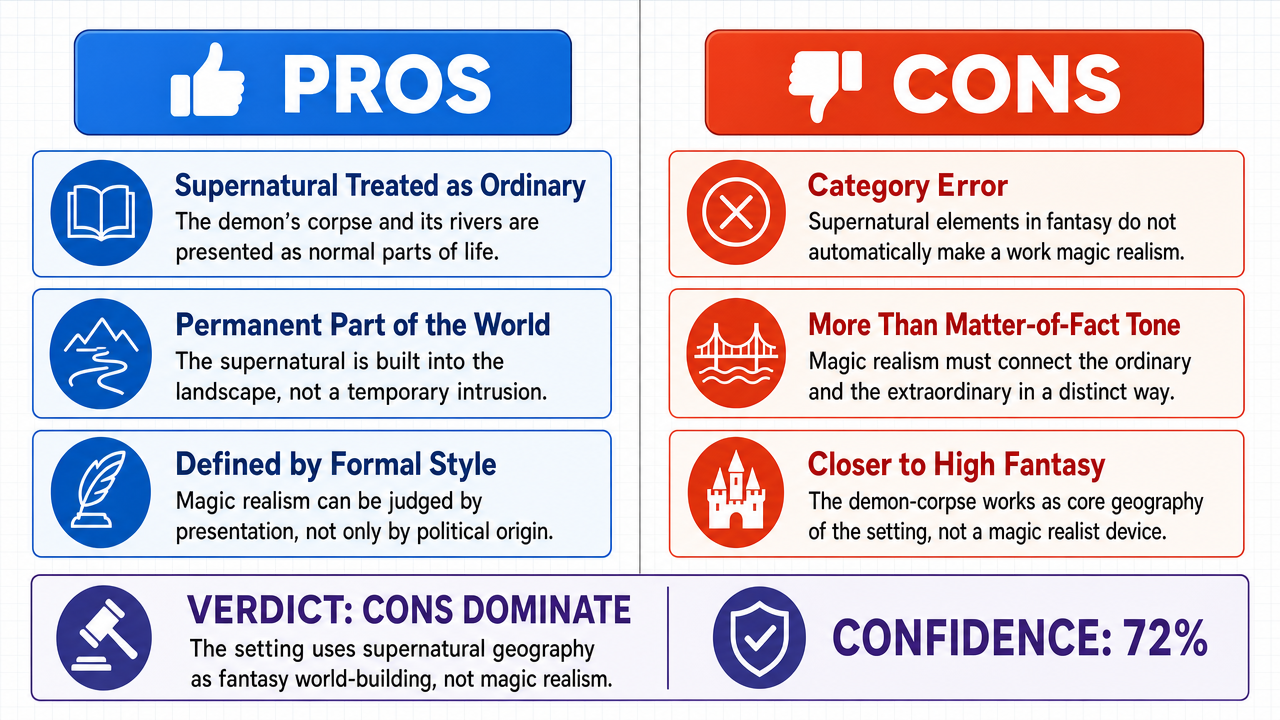
Verdict
Verdict: likely FALSE (72%)
Web Report: https://solsice.com/public/debates/the-world-building-in-the-fires-of-december-centered-on-a-co-b48227949621
This section provides a brief overview of the key arguments. You do not need to read the full detailed report below.
✅ Key PRO arguments:
- ■The demon-corpse world qualifies as magic realism because it presents the supernatural —a demon's corpse and the magical rivers flowing from it—as an ordinary, accepted component of the physical landscape, with the extraordinary woven into the fabric of the mundane and treated with the same matter-of-factness as a mountain or a river.
- ■The demon's corpse is not a summoned entity or temporary incursion but a permanent geographical feature, which naturalizes the supernatural within the world and aligns with the formal properties of magic realism as a narrative mode .
- ■Magic realism should be defined by its formal properties rather than exclusively by a post-colonial or socio-critical thematic origin, so the absence of explicit socio-historical commentary does not disqualify the work from the genre.
❌ Key ANTI arguments:
- ■The presence of supernatural elements in a fantasy setting does not constitute magic realism ; the affirmative commits a category error by treating mere supernatural presence as sufficient evidence for the genre.
- ■Magic realism is not merely 'fantasy with a matter-of-fact tone'; it is a mode where the supernatural must bridge the mundane and the extraordinary to reveal a deeper, often socio-historical , reality, which the demon-corpse fails to do.
- ■The demon-corpse functions as a foundational, geologic feature of the world-building rather than as a magical realist device, placing the work closer to High Fantasy than to magic realism .
💭 Conclusion: False. The world-building in The Fires of December does not constitute magic realism because the supernatural elements—the demon's corpse and its magical rivers—function as foundational, geographic features of a fantasy world rather than as devices that bridge the mundane and the extraordinary to reveal a deeper socio-historical reality. The affirmative's argument rests on a category error , conflating the mere presence of supernatural elements treated matter-of-factly with the formal and thematic requirements of magic realism. The negative correctly identifies that magic realism demands more than unremarkable acceptance of the supernatural; it requires the supernatural to interrogate or illuminate underlying realities, which a permanent corpse-as-landscape does not accomplish. Furthermore, the work's world-building aligns more closely with High Fantasy conventions than with the narrative mode of magic realism.
🔬 DeepResearch Result: likely FALSE ❌ (72%)
Assertion: The world-building in The Fires of December, centered on a 'corpse of a demon' and its magical rivers, constitutes 'magic realism '.
Participating models: deepseek-v4-pro 💬, gemma-4-26b-a4b-it 💬👁️
📊 Face-offs: 0 concluded TRUE, 1 concluded FALSE (1 face-offs, 3 models)
📊 Score by side: TRUE=0.00, FALSE=0.72
🏅 Model score changes:
minimax-m3 💬👁️: +7
✅ PRO Arguments:
- ■The demon-corpse world qualifies as magic realism because it presents the supernatural —a demon's corpse and the magical rivers flowing from it—as an ordinary, accepted component of the physical landscape, with the extraordinary woven into the fabric of the mundane and treated with the same matter-of-factness as a mountain or a river. deepseek-v4-pro 💬
- ■The demon's corpse is not a summoned entity or temporary incursion but a permanent geographical feature, which naturalizes the supernatural within the world and aligns with the formal properties of magic realism as a narrative mode . deepseek-v4-pro 💬
- ■Magic realism should be defined by its formal properties rather than exclusively by a post-colonial or socio-critical thematic origin, so the absence of explicit socio-historical commentary does not disqualify the work from the genre. deepseek-v4-pro 💬
❌ ANTI Arguments:
- ■The presence of supernatural elements in a fantasy setting does not constitute magic realism; the affirmative commits a category error by treating mere supernatural presence as sufficient evidence for the genre. gemma-4-26b-a4b-it 💬👁️
- ■Magic realism is not merely 'fantasy with a matter-of-fact tone'; it is a mode where the supernatural must bridge the mundane and the extraordinary to reveal a deeper, often socio-historical, reality, which the demon-corpse fails to do. gemma-4-26b-a4b-it 💬👁️
- ■The demon-corpse functions as a foundational, geologic feature of the world-building rather than as a magical realist device, placing the work closer to High Fantasy than to magic realism. gemma-4-26b-a4b-it 💬👁️
💭 Reasoning: False. The world-building in The Fires of December does not constitute magic realism because the supernatural elements—the demon's corpse and its magical rivers—function as foundational, geographic features of a fantasy world rather than as devices that bridge the mundane and the extraordinary to reveal a deeper socio-historical reality. The affirmative's argument rests on a category error, conflating the mere presence of supernatural elements treated matter-of-factly with the formal and thematic requirements of magic realism. The negative correctly identifies that magic realism demands more than unremarkable acceptance of the supernatural; it requires the supernatural to interrogate or illuminate underlying realities, which a permanent corpse-as-landscape does not accomplish. Furthermore, the work's world-building aligns more closely with High Fantasy conventions than with the narrative mode of magic realism.
📋 PRO Facts:
• The demon's corpse is described as a permanent geographical feature rather than a temporary or summoned entity.
• Magic realism has been theorized by some critics as a narrative mode defined by formal properties rather than exclusively by socio-historical themes.
📋 ANTI Facts:
• Magic realism typically requires the supernatural to bridge the mundane and the extraordinary to reveal a deeper, often socio-historical, reality.
• A supernatural element functioning as a foundational, geologic feature is characteristic of High Fantasy rather than magic realism.
• The affirmative failed to establish that the demon-corpse serves the bridging function central to magic realism.
| Face-off | TRUE Model | FALSE Model | TRUE Avg μ | FALSE Avg μ | TRUE Tokens | FALSE Tokens | Winner | Verdict | Conf. |
|---|---|---|---|---|---|---|---|---|---|
| #1 | deepseek-v4-pro 💬 | gemma-4-26b-a4b-it 💬👁️ | 0.430 | 0.385 | 6 | 2 | TRUE | FALSE | 72% |
The following technical terms, abbreviations, and domain-specific concepts are referenced throughout this debate transcript. Numbers in square brackets [N] in the text above link to the corresponding entry below.
[1] axiom — A foundational principle or assumption treated as self-evidently true. In the debate, the affirmative argues that the negative treats one theory of magic realism as the 'sole, immutable axiom of the genre.'
[2] category error — A philosophical or logical error of assigning something to a category to which it does not belong. The negative uses this term to argue that the affirmative commits a category error by treating the mere presence of the supernatural as sufficient evidence for magic realism.
[3] coloniality — A concept associated with post-colonial theory, referring to enduring patterns of colonial power, knowledge, and social structures. The affirmative argues that the negative's definition improperly requires magic realism to involve 'a critique of coloniality.'
[4] critical consensus — The general agreement among literary critics on a particular point. The affirmative argues that the negative's narrow definition of magic realism ignores 'the broader critical consensus.'
[5] frame (of the debate) — The established parameters, scope, or governing assumptions of a debate. The affirmative argues that the negative 'breaks the frame of the debate' by treating one theoretical position as the sole definition of the genre.
[6] genre convention — A standard or typical feature characteristic of a literary genre. The negative argues that the 'matter-of-fact' treatment of magic is a 'standard genre convention' in High Fantasy used to establish world-logic.
[7] hidden premise — An unstated assumption underlying an argument. Both sides accuse each other of relying on hidden premises presented as obvious.
[8] High Fantasy — A literary genre in which supernatural elements function as foundational rules of a secondary, fully imagined world. The negative argues that if the demon-corpse is 'a foundational rule of a secondary world,' the work is High Fantasy rather than magic realism.
[9] magic realism — A literary mode in which supernatural elements are presented as ordinary, accepted features of material reality. The debate disputes whether this mode requires specific socio-historical conditions (such as a post-colonial context) or is defined purely by its formal properties.
[10] narrative mode — A literary classification describing how a story is told rather than the specific content of its plot. The affirmative argues that magic realism is 'a narrative mode defined by its formal properties, not by a single thematic origin.'
[11] ontological subversion — The disruption of fundamental assumptions about the nature of being or reality. The negative argues that High Fantasy lacks 'the specific ontological subversion required by magic realism.'
[12] post-colonial — Relating to the theoretical framework addressing the cultural, political, and historical legacy of colonialism. The negative argues that magic realism requires the supernatural to emerge from 'the tension between conflicting cultural or historical realities' often associated with post-colonial contexts.
[13] remystification — A concept from literary criticism referring to the restoration of a sense of wonder or mystery to narrative. The term appears in Wendy B. Faris's book title 'Ordinary Enchantments: Magical Realism and the Remystification of Narrative.'
[14] secondary world — A fully imagined fictional setting distinct from the primary or real world, with its own internal rules. The negative argues that if the demon-corpse is 'a foundational, geological fact of a secondary world,' the work is High Fantasy.
[15] socio-historical — Relating to the interaction of social and historical factors. The negative argues that magic realism requires 'specific socio-historical conditions' beyond the mere presence of supernatural elements.
[16] stipulative definition — A definition that assigns a new or specific meaning to a term by stipulation rather than by reporting existing usage. The affirmative argues that the negative's narrow definition of magic realism is 'a stipulative definition that narrows the genre to a single thematic application.'
[17] supernatural — Beyond the natural; relating to magical, miraculous, or otherworldly phenomena. The debate centers on whether the presence of supernatural elements (a demon's corpse and magical rivers) constitutes magic realism.
[18] the marvelous — A term from literary criticism denoting the presence of supernatural or fantastical elements within a narrative. The negative argues that in magic realism, 'the marvelous' must function as 'an expression of a specific, often post-colonial, reality.'
[19] Western rationalism — The philosophical tradition emphasizing reason, logic, and empirical knowledge as primary sources of authority. The affirmative argues that the negative's definition improperly requires magic realism to involve 'a subversion of Western rationalism.'
[20] world-building — The construction of an imaginary world with its own geography, history, inhabitants, and rules. The debate concerns whether the world-building in The Fires of December constitutes magic realism.
[21] world-logic — The internal consistency and governing rules of a fictional world. The negative argues that the 'matter-of-fact' treatment of magic in High Fantasy establishes 'world-logic' rather than achieving the ontological subversion required by magic realism.
Face-off transcripts
- ■
Ownership & Trade Secrets. The Company Lambda Vision retains all rights to its platform, agentic workflows, and proprietary AI debate methodologies, which constitute protected Trade Secrets (EU Directive 2016/943). Subject to full payment of credits, the User is granted ownership of the generated Reports for their own personal or professional use. Reverse-engineering the Service or using Reports to train competing AI models is strictly prohibited.
- ■
No Professional Advice. Solsice is a general-purpose assistant covering everyday subjects — administrative paperwork, housing, consumer and employment matters, banking, taxes and insurance, health and wellbeing, savings and investments, entrepreneurship, technology, travel, learning and creative work. Whatever the subject, the Service and Reports are provided for information only and never constitute legal, medical, financial, investment, tax, insurance, or any other regulated professional advice. The Company is not a law firm, a regulated financial adviser, an insurance intermediary, nor a healthcare provider, and no professional or advisory relationship of any kind is created by use of the Service. Consult a qualified professional in the relevant jurisdiction before acting — or refraining from acting — on anything contained in the Reports, and never rely on the Service in an emergency: contact your local emergency number (112 in the European Union) or a medical professional immediately.
- ■
AI-Generated Content, Sources and Viewpoints. Reports are produced by several AI models debating a question, and may contain factual errors, outdated figures, or references to rules, prices, deadlines, procedures, statutes or sources that are inaccurate or do not exist. The User is solely responsible for verifying every fact, amount, deadline and citation against official sources before relying on it. Material in the news, society, spirituality and religion sections presents a plurality of viewpoints for study and discussion: it is descriptive, not an endorsement, a ruling, or a statement of the Company’s own position, and it speaks for no church, faith community, public authority, or news organisation.
- ■
Liability & Governing Law. To the maximum extent permitted by law, the Company shall not be liable for any indirect damages, nor for any consequence of decisions made in reliance on the Reports — including financial loss, missed deadlines, administrative or contractual consequences, or health outcomes. These Terms are governed by French law. Any disputes shall be subject to the exclusive jurisdiction of the Courts of Paris, France.