
The visualization technique described, involving imagining oneself as a rooted tree, offers comfort regardless of one's surrounding circumstances.
AI debate verdict and arguments
⚠️ AI-generated information only; not professional advice
Completed October 8, 2026
Verdict
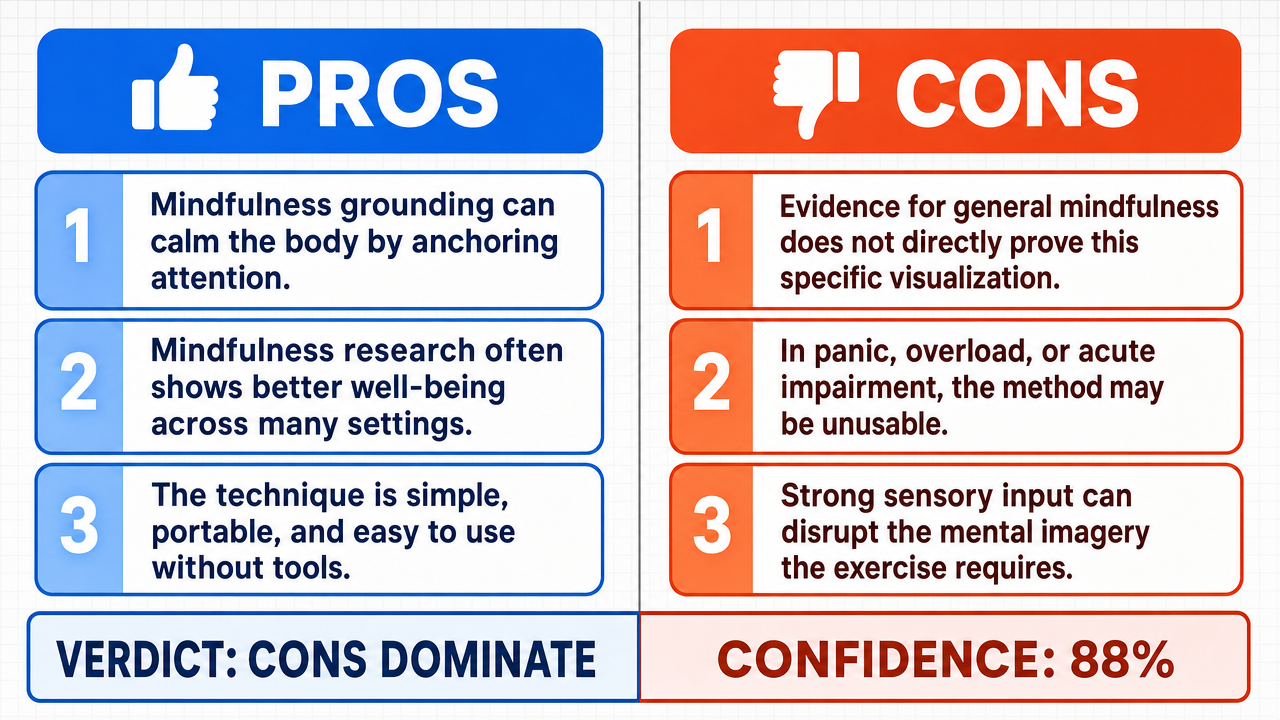
Verdict: likely FALSE (88%)
This section provides a brief overview of the key arguments. You do not need to read the full detailed report below.
✅ Key PRO arguments:
- ■The rooted-tree visualization is a recognized mindfulness exercise that anchors attention and engages the parasympathetic nervous system , reducing physiological stress markers like cortisol and subjective anxiety irrespective of external chaos.
- ■A meta-analysis of 47 mindfulness -based intervention studies found significant improvements in psychological well-being across diverse populations and settings, supporting the technique's inherent calming effect.
- ■The technique's structural simplicity—requiring only mental imagery —makes it cognitively accessible and portable, enabling use in diverse circumstances from acute medical settings to daily stress.
❌ Key ANTI arguments:
- ■Citing a meta-analysis of general mindfulness -based interventions is a substitution of proxy ; aggregate effects of diverse MBIs do not establish a direct causal link to the specific, idiosyncratic efficacy of the rooted-tree visualization technique.
- ■Cognitive and environmental barriers such as extreme sensory overload or acute cognitive incapacity during high-arousal states (e.g., panic attacks , acute psychosis ) can exceed executive capacity and prevent successful implementation of the visualization .
- ■From a neurobiological standpoint, intense external sensory input can overwhelm the cognitive resources needed to maintain complex mental imagery , rendering the technique ineffective or even counterproductive in chaotic circumstances.
💭 Conclusion: False. The debate verdict is FALSE because the affirmative side failed to establish that the rooted-tree visualization technique provides comfort universally across all circumstances. The negative side successfully argued that the affirmative's reliance on a meta-analysis of general mindfulness -based interventions constitutes a proxy substitution, as aggregate MBI effects do not demonstrate that this specific visualization technique works in every context. Furthermore, the negative side compellingly demonstrated that cognitive and environmental barriers—such as acute panic attacks , psychosis, or extreme sensory overload —can exceed an individual's executive capacity , preventing effective engagement with the visualization. The neurobiological argument that intense external stimuli can overwhelm the cognitive resources needed for mental imagery further undermined the universality claim. While the affirmative correctly noted the technique's simplicity and grounding in mindfulness research, the negative side showed that simplicity alone does not guarantee accessibility during high-arousal or cognitively compromised states.
🔬 DeepResearch Result: likely FALSE ❌ (88%)
Assertion: The visualization technique described, involving imagining oneself as a rooted tree, offers comfort regardless of one's surrounding circumstances.
Participating models: deepseek-v3.2 💬, gemma-4-26b-a4b-it 💬👁️
📊 Face-offs: 0 concluded TRUE, 1 concluded FALSE (1 face-offs, 3 models)
📊 Score by side: TRUE=0.00, FALSE=0.88
🏅 Model score changes:
minimax-m3 💬👁️: +9
✅ PRO Arguments:
- ■The rooted-tree visualization is a recognized mindfulness exercise that anchors attention and engages the parasympathetic nervous system , reducing physiological stress markers like cortisol and subjective anxiety irrespective of external chaos. deepseek-v3.2 💬
- ■A meta-analysis of 47 mindfulness-based intervention studies found significant improvements in psychological well-being across diverse populations and settings, supporting the technique's inherent calming effect. deepseek-v3.2 💬
- ■The technique's structural simplicity—requiring only mental imagery —makes it cognitively accessible and portable, enabling use in diverse circumstances from acute medical settings to daily stress. deepseek-v3.2 💬
- ■The TRUE side argued that the opponent's claim about cognitive load in high-arousal states rests on a hidden premise that such states universally preclude simple visualization, which is not supported by the clinical record. deepseek-v3.2 💬
❌ ANTI Arguments:
- ■Citing a meta-analysis of general mindfulness-based interventions is a substitution of proxy ; aggregate effects of diverse MBIs do not establish a direct causal link to the specific, idiosyncratic efficacy of the rooted-tree visualization technique. gemma-4-26b-a4b-it 💬👁️
- ■Cognitive and environmental barriers such as extreme sensory overload or acute cognitive incapacity during high-arousal states (e.g., panic attacks , acute psychosis ) can exceed executive capacity and prevent successful implementation of the visualization. gemma-4-26b-a4b-it 💬👁️
- ■From a neurobiological standpoint, intense external sensory input can overwhelm the cognitive resources needed to maintain complex mental imagery, rendering the technique ineffective or even counterproductive in chaotic circumstances. gemma-4-26b-a4b-it 💬👁️
- ■The claim of universal comfort fails to account for significant psychological barriers that can not only prevent effective engagement with the visualization but may actively induce distress in vulnerable individuals. gemma-4-26b-a4b-it 💬👁️
💭 Reasoning: False. The debate verdict is FALSE because the affirmative side failed to establish that the rooted-tree visualization technique provides comfort universally across all circumstances. The negative side successfully argued that the affirmative's reliance on a meta-analysis of general mindfulness-based interventions constitutes a proxy substitution, as aggregate MBI effects do not demonstrate that this specific visualization technique works in every context. Furthermore, the negative side compellingly demonstrated that cognitive and environmental barriers—such as acute panic attacks, psychosis, or extreme sensory overload—can exceed an individual's executive capacity, preventing effective engagement with the visualization. The neurobiological argument that intense external stimuli can overwhelm the cognitive resources needed for mental imagery further undermined the universality claim. While the affirmative correctly noted the technique's simplicity and grounding in mindfulness research, the negative side showed that simplicity alone does not guarantee accessibility during high-arousal or cognitively compromised states.
📋 PRO Facts:
• A meta-analysis of 47 studies found mindfulness-based interventions significantly improve psychological well-being across diverse populations and settings.
• Focused visualization techniques have been shown to reduce physiological stress markers such as cortisol and subjective anxiety.
• Mindfulness exercises engage the parasympathetic nervous system to produce calming effects.
📋 ANTI Facts:
• Aggregate effects of general mindfulness-based interventions do not establish efficacy for any specific visualization technique like the rooted-tree metaphor.
• During high-arousal states such as panic attacks or acute psychosis, cognitive load required for complex mental imagery can exceed executive capacity.
• Intense external sensory input can overwhelm the cognitive resources necessary to maintain mental imagery, rendering visualization techniques ineffective.
| Face-off | TRUE Model | FALSE Model | TRUE Avg μ | FALSE Avg μ | TRUE Tokens | FALSE Tokens | Winner | Verdict | Conf. |
|---|---|---|---|---|---|---|---|---|---|
| #1 | deepseek-v3.2 💬 | gemma-4-26b-a4b-it 💬👁️ | 0.501 | 0.444 | 12 | 3 | TRUE | FALSE | 88% |
The following technical terms, abbreviations, and domain-specific concepts are referenced throughout this debate transcript. Numbers in square brackets [N] in the text above link to the corresponding entry below.
[1] acute crises — Sudden, severe episodes of psychological or medical distress requiring immediate intervention, referenced in the debate as a context in which the visualization technique's efficacy is contested.
[2] acute psychosis — A severe mental health state characterized by a loss of contact with reality, cited by the negative side as a condition where complex visualization may exceed cognitive capacity.
[3] body scans — A mindfulness technique involving focused attention on sequential parts of the body, cited as an example of focused visualization that reduces stress.
[4] cognitive accessibility — The ease with which a mental task can be performed given an individual's cognitive resources; the affirmative argues the tree visualization is cognitively accessible because it requires only mental imagery.
[5] cognitive load — The amount of mental effort being used in working memory; the negative argues that maintaining complex imagery during high-arousal states can exceed this capacity.
[6] cognitive receptivity — An individual's capacity and openness to engage with a given mental technique, cited as a factor influencing mindfulness efficacy.
[7] conjecture — An assertion based on incomplete evidence; the negative's claim that the technique fails in acute crises is characterized by the affirmative as conjecture.
[8] cortisol — A steroid hormone released in response to stress, used as a physiological stress marker in mindfulness research.
[9] DBT — Dialectical Behavior Therapy — A clinical psychotherapy protocol that incorporates mindfulness skills; cited as evidence that the tree visualization is included in validated clinical practice.
[10] dosage — In the context of mindfulness interventions, the amount, frequency, or duration of practice; the negative argues efficacy depends on dosage rather than being universal.
[11] executive capacity — The cognitive resources governed by executive functions (e.g., attention control, working memory) needed to sustain goal-directed mental activity such as visualization.
[12] grounding — A set of psychological techniques used to anchor attention to the present moment, often via sensory or imagery cues; the negative notes that complex visualizations can become counterproductive under extreme sensory overload.
[13] high-arousal states — Conditions of heightened physiological and emotional activation, such as panic attacks, in which the negative argues visualization techniques may fail.
[14] iatrogenic distress — Distress inadvertently caused by a therapeutic intervention itself; the negative argues the 'rooted' metaphor can trigger feelings of paralysis or entrapment in certain trauma survivors.
[15] induced anxiety — Anxiety deliberately provoked in a research setting (e.g., experimentally) to test the effects of an intervention, as in the cited 2019 RCT.
[16] intervention group — In a randomized controlled trial, the group receiving the treatment being tested, as opposed to a control group.
[17] mental imagery — The cognitive process of generating perceptual representations in the absence of external sensory input; the core mechanism of the tree visualization technique.
[18] meta-analysis — A quantitative research method that statistically combines results from multiple studies to derive an overall effect estimate; cited by the affirmative to support mindfulness efficacy.
[19] mindfulness — A mental practice involving non-judgmental, present-moment attention, often used as a basis for stress-reduction interventions.
[20] mindfulness-based interventions — MBIs — Structured programs (e.g., MBSR, MBCT) that train mindfulness skills to improve psychological outcomes; the debate disputes whether aggregate MBI findings transfer to the specific tree visualization.
[21] nature imagery — Visualization of natural scenes (e.g., trees, landscapes) used in mindfulness practice to evoke calming responses.
[22] neurobiological — Pertaining to the biology of the nervous system; the negative argues intense external sensory input can neurobiologically override internal imagery.
[23] panic attacks — Sudden episodes of intense fear triggering severe physical symptoms, cited as a high-arousal state in which the visualization's efficacy is disputed.
[24] panic disorder — A clinical anxiety disorder characterized by recurrent panic attacks; the subject population in the cited 2019 RCT.
[25] parasympathetic nervous system — The branch of the autonomic nervous system that promotes 'rest-and-digest' responses, counteracting stress; the affirmative argues visualization engages this system.
[26] physiological stress markers — Measurable biological indicators of stress (e.g., cortisol levels, heart rate), used to assess the bodily impact of mindfulness interventions.
[27] psychological well-being — A multidimensional construct encompassing emotional, cognitive, and social functioning; cited as an outcome improved by mindfulness-based interventions.
[28] randomized controlled trial — RCT — An experimental study design in which participants are randomly assigned to intervention or control groups to test causal efficacy; cited as direct empirical evidence for the tree visualization.
[29] refutation condition — A specified circumstance under which a hypothesis would be falsified; the affirmative argues the negative failed to test its own refutation condition against clinical evidence.
[30] relaxation response — A physiological state of reduced arousal opposite to the stress response, often elicited by mindfulness and similar practices.
[31] sensory overload — A condition in which one or more of the senses are overstimulated, potentially impairing the ability to sustain internal mental imagery.
[32] somatic — Relating to the body; the affirmative argues the tree visualization creates a 'somatic sense of safety' through imagined bodily anchoring.
[33] subjective anxiety — Self-reported feelings of anxiety, as opposed to objective physiological measures; cited as an outcome reduced by mindfulness.
[34] substitution of proxy — A logical error in which evidence about a general category is used to support a claim about a specific instance; the negative accuses the affirmative of this with respect to MBIs and the tree technique.
[35] transfer operator — In the debate's logical framing, a direct correlation or causal link that would justify extending general MBI findings to the specific tree visualization; the negative argues this link is missing.
[36] trauma histories — An individual's record of past traumatic experiences; the negative argues such histories can cause the 'rooted' metaphor to trigger entrapment responses.
[37] visualization — A mental technique involving the deliberate creation of sensory images in the mind, used here as a form of focused attention practice.
Face-off transcripts
- ■
Ownership & Trade Secrets. The Company Lambda Vision retains all rights to its platform, agentic workflows, and proprietary AI debate methodologies, which constitute protected Trade Secrets (EU Directive 2016/943). Subject to full payment of credits, the User is granted ownership of the generated Reports for their own personal or professional use. Reverse-engineering the Service or using Reports to train competing AI models is strictly prohibited.
- ■
No Professional Advice. Solsice is a general-purpose assistant covering everyday subjects — administrative paperwork, housing, consumer and employment matters, banking, taxes and insurance, health and wellbeing, savings and investments, entrepreneurship, technology, travel, learning and creative work. Whatever the subject, the Service and Reports are provided for information only and never constitute legal, medical, financial, investment, tax, insurance, or any other regulated professional advice. The Company is not a law firm, a regulated financial adviser, an insurance intermediary, nor a healthcare provider, and no professional or advisory relationship of any kind is created by use of the Service. Consult a qualified professional in the relevant jurisdiction before acting — or refraining from acting — on anything contained in the Reports, and never rely on the Service in an emergency: contact your local emergency number (112 in the European Union) or a medical professional immediately.
- ■
AI-Generated Content, Sources and Viewpoints. Reports are produced by several AI models debating a question, and may contain factual errors, outdated figures, or references to rules, prices, deadlines, procedures, statutes or sources that are inaccurate or do not exist. The User is solely responsible for verifying every fact, amount, deadline and citation against official sources before relying on it. Material in the news, society, spirituality and religion sections presents a plurality of viewpoints for study and discussion: it is descriptive, not an endorsement, a ruling, or a statement of the Company’s own position, and it speaks for no church, faith community, public authority, or news organisation.
- ■
Liability & Governing Law. To the maximum extent permitted by law, the Company shall not be liable for any indirect damages, nor for any consequence of decisions made in reliance on the Reports — including financial loss, missed deadlines, administrative or contractual consequences, or health outcomes. These Terms are governed by French law. Any disputes shall be subject to the exclusive jurisdiction of the Courts of Paris, France.