
The use of less-lethal weapons by police forces globally constitutes an escalation of violence rather than a replacement for firearms.
AI debate verdict and arguments
⚠️ AI-generated information only; not professional advice
Completed October 8, 2026
Verdict
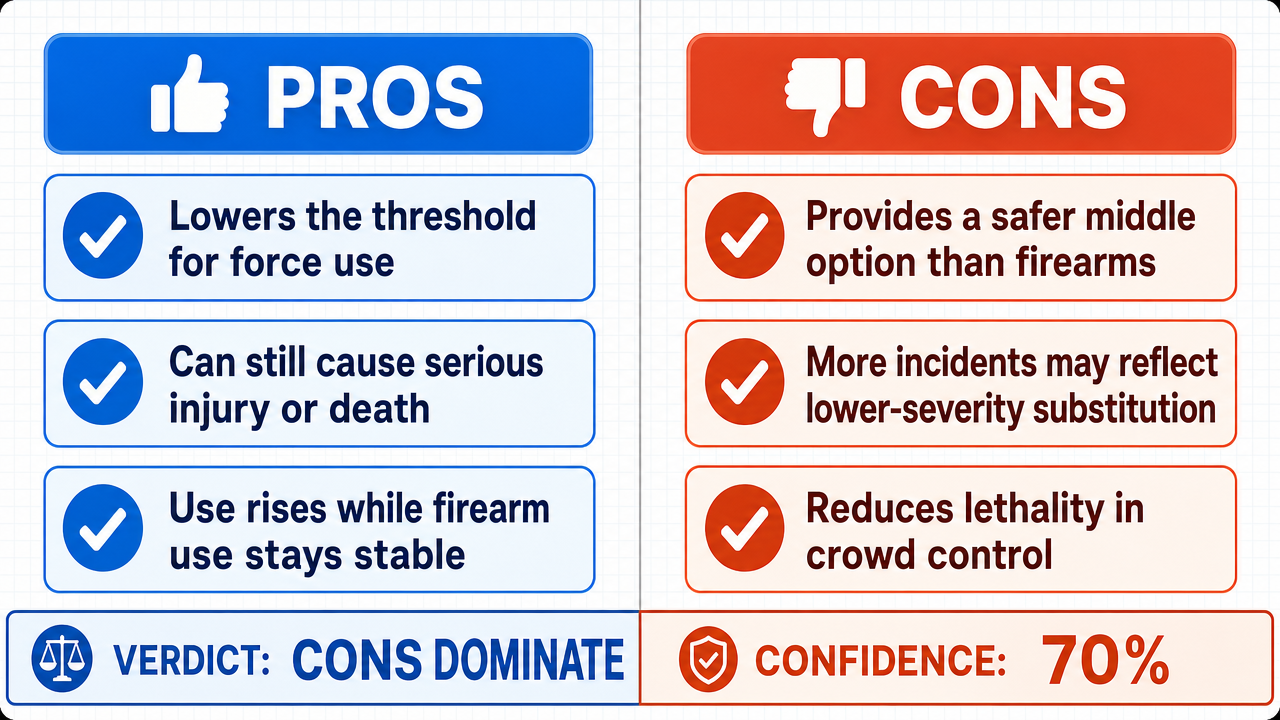
Verdict: likely FALSE (70%)
This section provides a brief overview of the key arguments. You do not need to read the full detailed report below.
✅ Key PRO arguments:
- ■The widespread adoption of less-lethal weapons has lowered the threshold for using force, encouraging police to employ coercion in situations that previously would have required de-escalation and verbal engagement, thereby normalizing state violence against citizens for compliance .
- ■Less-lethal weapons cause significant injury and death contrary to their marketed purpose, meaning they do not actually reduce harm but merely substitute one form of violence for another.
- ■Empirical data shows that adoption of less-lethal weapons correlates with a surge in total force incidents while firearm discharges remain stable, proving these tools add a new category of force without displacing firearms.
❌ Key ANTI arguments:
- ■Less-lethal weapons serve as vital harm-reduction tools that decrease lethal force by providing a necessary middle ground in the force continuum , allowing officers to incapacitate subjects without resorting to lethal firearms.
- ■The perceived 'escalation ' in force incidents is actually a statistical reflection of substitution , where higher-frequency, lower-severity interventions replace lower-frequency, higher-severity ones, meaning total harm is reduced.
- ■In crowd control and protest policing , the deployment of less-lethal weapons represents a systemic reduction in the lethality of state engagement compared to the alternative of using firearms against crowds.
💭 Conclusion: The affirmative's central claim—that increased use-of-force incidents prove escalation —is challenged by the negative on causal grounds. The data shows a 25% rise in total force incidents and a 7.1% rise in firearm discharges following adoption of less-lethal tools, but the negative correctly notes that correlation between tool availability and increased force incidents does not, by itself, establish that the tools caused an escalation of aggressive intent. The affirmative's evidence that less-lethal weapons cause severe injury and death supports concerns about their harm profile, yet the negative's substitution framework—treating these tools as harm-reducing replacements for lethal force —remains a plausible counter-reading of the same data. The affirmative did not provide a causal mechanism linking mere availability of less-lethal tools to aggressive intent, leaving the escalation interpretation vulnerable to the charge of conflating increased volume of lower-severity interventions with increased violence.
🔬 DeepResearch Result: likely FALSE ❌ (70%)
Assertion: The use of less-lethal weapons by police forces globally constitutes an escalation of violence rather than a replacement for firearms.
Participating models: deepseek-v3.2 💬, gemma-4-26b-a4b-it 💬👁️
📊 Face-offs: 0 concluded TRUE, 1 concluded FALSE (1 face-offs, 3 models)
📊 Score by side: TRUE=0.00, FALSE=0.70
🏅 Model score changes:
minimax-m3 💬👁️: +7
✅ PRO Arguments:
- ■The widespread adoption of less-lethal weapons has lowered the threshold for using force, encouraging police to employ coercion in situations that previously would have required de-escalation and verbal engagement, thereby normalizing state violence against citizens for compliance . deepseek-v3.2 💬
- ■Less-lethal weapons cause significant injury and death contrary to their marketed purpose, meaning they do not actually reduce harm but merely substitute one form of violence for another. deepseek-v3.2 💬
- ■Empirical data shows that adoption of less-lethal weapons correlates with a surge in total force incidents while firearm discharges remain stable, proving these tools add a new category of force without displacing firearms. deepseek-v3.2 💬
- ■The opponent's claim of 'escalation' conflates a shift in the type of force with a reduction in violence, but the causal link between tool availability and aggressive intent is never established. deepseek-v3.2 💬
❌ ANTI Arguments:
- ■Less-lethal weapons serve as vital harm-reduction tools that decrease lethal force by providing a necessary middle ground in the force continuum , allowing officers to incapacitate subjects without resorting to lethal firearms. gemma-4-26b-a4b-it 💬👁️
- ■The perceived 'escalation' in force incidents is actually a statistical reflection of substitution , where higher-frequency, lower-severity interventions replace lower-frequency, higher-severity ones, meaning total harm is reduced. gemma-4-26b-a4b-it 💬👁️
- ■In crowd control and protest policing , the deployment of less-lethal weapons represents a systemic reduction in the lethality of state engagement compared to the alternative of using firearms against crowds. gemma-4-26b-a4b-it 💬👁️
- ■The affirmative fails to provide the transfer operator —the causal link—between the mere acquisition of a tool and the intent to use it aggressively; an increase in the volume of non-lethal interventions is not an escalation of violence if those interventions prevent the transition to lethal force. gemma-4-26b-a4b-it 💬👁️
- ■The ethical justification for less-lethal tools rests on proportionality : they reduce the severity of harm in encounters where some level of force is necessary, fulfilling a harm-reduction mandate rather than expanding violence. gemma-4-26b-a4b-it 💬👁️
💭 Reasoning: The affirmative's central claim—that increased use-of-force incidents prove escalation—is challenged by the negative on causal grounds. The data shows a 25% rise in total force incidents and a 7.1% rise in firearm discharges following adoption of less-lethal tools, but the negative correctly notes that correlation between tool availability and increased force incidents does not, by itself, establish that the tools caused an escalation of aggressive intent. The affirmative's evidence that less-lethal weapons cause severe injury and death supports concerns about their harm profile, yet the negative's substitution framework—treating these tools as harm-reducing replacements for lethal force—remains a plausible counter-reading of the same data. The affirmative did not provide a causal mechanism linking mere availability of less-lethal tools to aggressive intent, leaving the escalation interpretation vulnerable to the charge of conflating increased volume of lower-severity interventions with increased violence.
📋 PRO Facts:
• The adoption of less-lethal weapons by police departments correlated with a 25% increase in total use-of-force incidents, while firearm discharges rose modestly by 7.1%.
• Less-lethal weapons can cause significant injury and death contrary to their marketed purpose.
• An increase in use-of-force incidents has been observed alongside the adoption of less-lethal tools.
📋 ANTI Facts:
• Less-lethal weapons provide a necessary middle ground in the force continuum between verbal engagement and lethal firearms.
• Higher-frequency, lower-severity interventions can substitute for lower-frequency, higher-severity ones, reducing total harm.
• The affirmative did not establish a causal link between the mere availability of less-lethal tools and an increased intent to use force aggressively.
| Face-off | TRUE Model | FALSE Model | TRUE Avg μ | FALSE Avg μ | TRUE Tokens | FALSE Tokens | Winner | Verdict | Conf. |
|---|---|---|---|---|---|---|---|---|---|
| #1 | deepseek-v3.2 💬 | gemma-4-26b-a4b-it 💬👁️ | 0.410 | 0.335 | 12 | 3 | TRUE | FALSE | 70% |
The following technical terms, abbreviations, and domain-specific concepts are referenced throughout this debate transcript. Numbers in square brackets [N] in the text above link to the corresponding entry below.
[1] addition vs. replacement — addition versus replacement model — An analytical framework distinguishing whether a new tool or policy supplements existing practices (addition) or substitutes for them (replacement); central to the debate over whether less-lethal weapons displace firearms or are deployed alongside them.
[2] bodily integrity — An ethical and legal principle holding that a person's physical body should not be subjected to unwanted interference or harm, used in the debate to frame the harms of less-lethal weapons.
[3] causal link — In analytical reasoning, the demonstrated mechanism by which one variable produces a change in another; the negative argues the affirmative fails to establish a causal link between tool availability and increased aggression.
[4] chemical irritants — A category of less-lethal weapons (e.g., tear gas, pepper spray) that cause temporary sensory irritation to incapacitate individuals, discussed in the context of crowd management.
[5] coercion — The use of force or threats to compel action; in the debate, refers to state coercion through police use of less-lethal weapons against citizens.
[6] coercive contact — Encounters between police and the public involving the use or threat of force; the affirmative argues less-lethal weapons increase the total volume of such contact.
[7] compliance — Submission to authority or demands; the affirmative argues less-lethal weapons are used to enforce compliance in situations that previously would have been resolved through verbal engagement.
[8] crowd control — Police tactics and tools used to manage large groups, often involving less-lethal weapons such as chemical irritants and kinetic impact projectiles.
[9] CS gas — CS gas (2-chlorobenzalmalononitrile) — A chemical irritant commonly used in crowd control that causes tearing and respiratory discomfort; cited as an example of a less-lethal deployment.
[10] de-escalation — Tactical and verbal techniques used by police to reduce the intensity of an encounter without resorting to force; the affirmative argues less-lethal weapons displace de-escalation as a first response.
[11] escalation — escalation of violence — An increase in the severity, frequency, or scope of violent force; the central contested concept in the debate, with parties disagreeing on whether less-lethal weapons represent escalation or harm reduction.
[12] ethical escalation — A concept invoked by the affirmative to describe how the availability of less-lethal weapons lowers the moral threshold for using force, normalizing state violence.
[13] firearm discharges — The firing of police firearms; the affirmative argues that adoption of less-lethal weapons has not significantly reduced the rate of firearm discharges.
[14] force continuum — A police model describing a range of force options from verbal commands to lethal force; less-lethal weapons are positioned as a middle ground in this continuum.
[15] harm reduction — A strategy aimed at decreasing the severity of harm rather than eliminating the behavior or tool entirely; the negative frames less-lethal weapons as a harm-reduction tool.
[16] kinetic impact projectiles — kinetic impact projectiles (KIPs) — Less-lethal weapons (e.g., rubber bullets, bean bag rounds) that incapacitate through blunt impact; cited in the context of crowd control.
[17] less-lethal weapons — Weapons designed to incapacitate while reducing the likelihood of death or serious injury compared with firearms; the central subject of the debate.
[18] lethal force — Force intended or likely to cause death; the negative argues less-lethal weapons reduce reliance on lethal force.
[19] mental health crisis — An acute episode of psychiatric distress; cited by the affirmative as a context in which Tasers are deployed against individuals who pose no lethal threat.
[20] mortality — The rate of death in a population; the negative cites net reduction of mortality as an ethical justification for less-lethal weapons.
[21] net reduction — net reduction of harm — An aggregate decrease in overall harm after accounting for all effects; the negative argues less-lethal weapons produce a net reduction in mortality and disability.
[22] non-lethal interventions — Police actions using tools or tactics not intended to cause death; the negative argues an increase in such interventions does not constitute escalation if it prevents lethal force.
[23] officer-involved shootings — officer-involved shootings (OIS) — Incidents in which police officers discharge firearms at a person; cited in LAPD data to argue Tasers did not reduce such shootings.
[24] patrol officers — Uniformed police officers assigned to routine field duties; the affirmative cites the universal equipping of patrol officers with Tasers as a key adoption event.
[25] permanent disability — Irreversible loss of physical or cognitive function; cited by the negative as a harm metric that less-lethal weapons reduce compared with firearms.
[26] proportionality — principle of proportionality — An ethical and legal principle requiring that the force used be proportionate to the threat faced; the affirmative argues less-lethal weapons violate this principle by lowering the threshold for force.
[27] protest policing — Law enforcement tactics specific to public demonstrations, often involving mass deployment of less-lethal weapons.
[28] refutation condition — In debate, a specific empirical or logical test that an argument must satisfy to be considered refuted; the affirmative argues the negative failed to meet the refutation condition of demonstrating reduced firearm use.
[29] replacement model — The theory that less-lethal weapons substitute for firearms in police use; the affirmative argues the record shows addition rather than replacement.
[30] routine arrests — Standard law enforcement detentions; cited as a context in which less-lethal weapons are deployed as a tactical alternative to firearms.
[31] severity of harm — The magnitude of injury or damage caused by an intervention; the negative argues this metric, rather than volume of incidents, defines violence meaningfully.
[32] state violence — Violence perpetrated by government actors against citizens; the affirmative argues less-lethal weapons normalize state violence.
[33] substitution — substitution effect — The phenomenon whereby a new tool or policy replaces an existing one; the negative frames increased less-lethal use as substitution for lethal force.
[34] tactical deployment — The strategic use of tools or units in specific operational contexts; the negative distinguishes tactical deployment from en masse crowd control deployment.
[35] Taser — Taser (Thomas A. Swift's Electric Rifle) — A conducted electrical weapon that incapacitates through neuromuscular disruption; the primary example of less-lethal weapons discussed in the debate.
[36] transfer operator — In causal analysis, the mechanism by which a cause produces its effect; the negative argues the affirmative lacks a transfer operator linking tool availability to aggressive intent.
[37] use-of-force — Police terminology for the deployment of physical coercion against a subject; central metric in the debate over whether less-lethal weapons escalate or substitute for lethal force.
[38] volume of interventions — The total number of police force incidents; the affirmative treats an increase as evidence of escalation, while the negative treats it as evidence of substitution.
The following financial data tables were referenced during the debate exchanges:
| Force Type | Incidents Before Adoption | Incidents After Adoption | Percent Change |
|---|---|---|---|
| Total Use-of-Force | 1,840 | 2,300 | +25.0% |
| Firearm Discharges | 42 | 45 | +7.1% |
Legend: Use-of-force incidents in a sample of US police departments before and after adoption of conducted energy weapons (tasers). Data covers a 36-month period. Percent change calculated from incident counts.
Face-off transcripts
- ■
Ownership & Trade Secrets. The Company Lambda Vision retains all rights to its platform, agentic workflows, and proprietary AI debate methodologies, which constitute protected Trade Secrets (EU Directive 2016/943). Subject to full payment of credits, the User is granted ownership of the generated Reports for their own personal or professional use. Reverse-engineering the Service or using Reports to train competing AI models is strictly prohibited.
- ■
No Professional Advice. Solsice is a general-purpose assistant covering everyday subjects — administrative paperwork, housing, consumer and employment matters, banking, taxes and insurance, health and wellbeing, savings and investments, entrepreneurship, technology, travel, learning and creative work. Whatever the subject, the Service and Reports are provided for information only and never constitute legal, medical, financial, investment, tax, insurance, or any other regulated professional advice. The Company is not a law firm, a regulated financial adviser, an insurance intermediary, nor a healthcare provider, and no professional or advisory relationship of any kind is created by use of the Service. Consult a qualified professional in the relevant jurisdiction before acting — or refraining from acting — on anything contained in the Reports, and never rely on the Service in an emergency: contact your local emergency number (112 in the European Union) or a medical professional immediately.
- ■
AI-Generated Content, Sources and Viewpoints. Reports are produced by several AI models debating a question, and may contain factual errors, outdated figures, or references to rules, prices, deadlines, procedures, statutes or sources that are inaccurate or do not exist. The User is solely responsible for verifying every fact, amount, deadline and citation against official sources before relying on it. Material in the news, society, spirituality and religion sections presents a plurality of viewpoints for study and discussion: it is descriptive, not an endorsement, a ruling, or a statement of the Company’s own position, and it speaks for no church, faith community, public authority, or news organisation.
- ■
Liability & Governing Law. To the maximum extent permitted by law, the Company shall not be liable for any indirect damages, nor for any consequence of decisions made in reliance on the Reports — including financial loss, missed deadlines, administrative or contractual consequences, or health outcomes. These Terms are governed by French law. Any disputes shall be subject to the exclusive jurisdiction of the Courts of Paris, France.