
The use of artificial sweeteners within FDA-acceptable limits in early life does not lead to persistent neurocognitive or metabolic impairments in adulthood.
AI debate verdict and arguments
⚠️ AI-generated information only; not professional advice
Completed October 14, 2026
Verdict
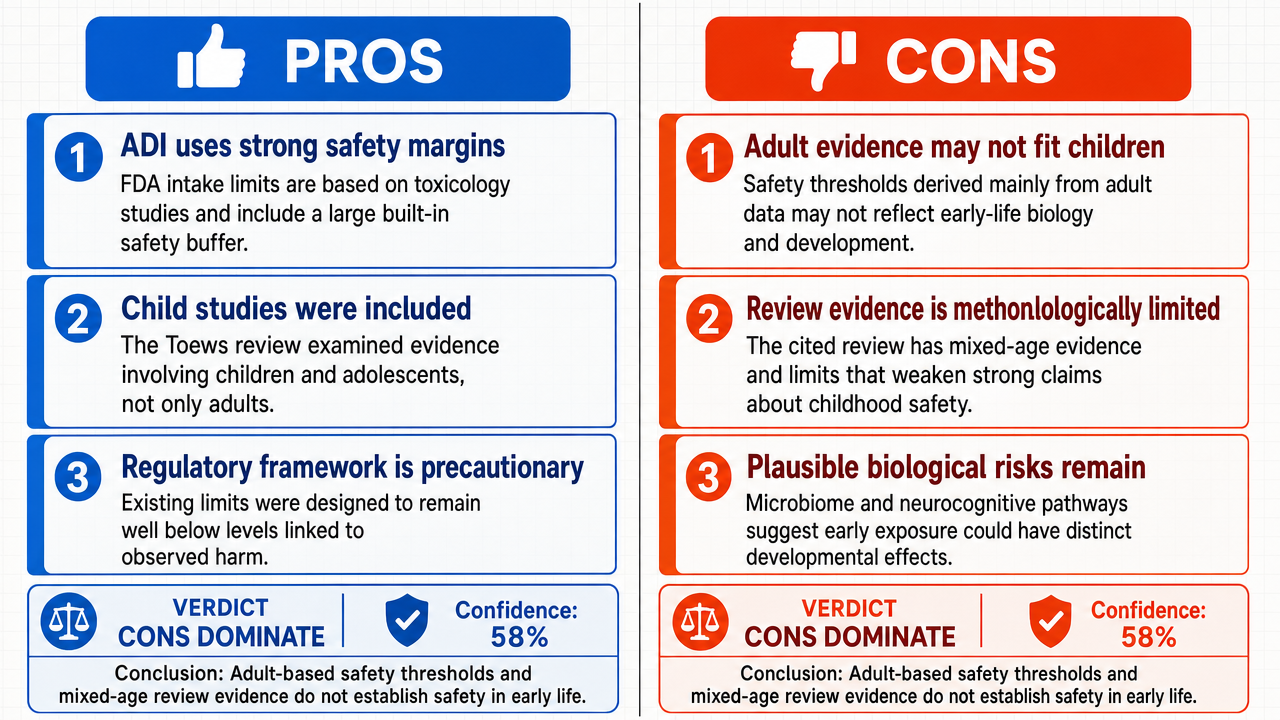
Verdict: likely FALSE (58%)
Web Report: https://solsice.com/public/debates/the-use-of-artificial-sweeteners-within-fda-acceptable-limit-8120f43a74a9
This section provides a brief overview of the key arguments. You do not need to read the full detailed report below.
✅ Key PRO arguments:
- ■The FDA's Acceptable Daily Intake (ADI ) is derived from extensive toxicological studies applying a 100-fold safety factor to the No-Observed-Adverse-Effect Level (NOAEL ), establishing a safety margin designed to be protective across all life stages including early development. For example, the ADI for aspartame is 50 mg/kg body weight per day, far exceeding typical consumption even among high consumers.
- ■The Toews et al. (2019) systematic review explicitly included and analyzed studies on children and adolescents , directly addressing the developmental window in question, and found 'no evidence of any effect of non-sugar sweeteners ' on a range of health outcomes across randomized controlled trials and prospective cohort studies .
❌ Key ANTI arguments:
- ■The affirmative commits a logical error by substituting adult toxicological proxies for childhood safety; the safety of a substance in an adult physiological context does not translate to safety during critical developmental windows , and the affirmative fails to provide a transfer operator —a mechanistic link or longitudinal beta coefficient —demonstrating how adult findings apply to early life.
- ■The methodological critique of the Toews (2019) review functions as a structural refutation of the affirmative's evidentiary foundation, because the review's conclusion of 'no evidence' is non-invariant when applied to children specifically—the affirmative's scale of application is misaligned with the claim being defended.
- ■Independent biological pillars—microbiota disruption and neurocognitive pathway effects—provide substantive mechanisms for why early-life exposure could produce persistent adult impairments, even where aggregate adult-level evidence appears reassuring.
💭 Conclusion: False. The winning side demonstrated that the affirmative's reliance on adult-derived toxicological safety thresholds and a mixed-age systematic review constitutes a category error: regulatory safety margins established for adult metabolism and aggregate-population systematic reviews do not invariantly transfer to the unique vulnerabilities of early developmental windows . The negative's structural critique of the Toews (2019) review—arguing its conclusion cannot be cleanly applied to children specifically—undermined the affirmative's primary evidentiary foundation. Independent biological mechanisms concerning microbiota development supplied substantive alternative pathways for harm, meaning the compound claim's burden of demonstrating safety across both metabolic and microbiota domains was not met. The confidence reflects that this is a compound claim, and while the metabolic and microbiota sub-claims are interconnected, neither was conclusively disproven beyond the moderate certainty the judge assigned. The verdict rests on the absence of a validated mechanistic transfer from adult safety data to early-life exposure, combined with unresolved developmental-specific evidence gaps.
🔬 DeepResearch Result: likely FALSE ❌ (58%)
Assertion: The use of artificial sweeteners within FDA-acceptable limits in early life does not lead to persistent neurocognitive or metabolic impairments in adulthood.
Participating models: deepseek-v3.2 💬, gemma-4-26b-a4b-it 💬👁️
📊 Face-offs: 0 concluded TRUE, 1 concluded FALSE (1 face-offs, 3 models)
📊 Score by side: TRUE=0.00, FALSE=0.58
🏅 Model score changes:
minimax-m3 💬👁️: +6
✅ PRO Arguments:
- ■The FDA's Acceptable Daily Intake (ADI ) is derived from extensive toxicological studies applying a 100-fold safety factor to the No-Observed-Adverse-Effect Level (NOAEL ), establishing a safety margin designed to be protective across all life stages including early development. For example, the ADI for aspartame is 50 mg/kg body weight per day, far exceeding typical consumption even among high consumers. deepseek-v3.2 💬
- ■The Toews et al. (2019) systematic review explicitly included and analyzed studies on children and adolescents , directly addressing the developmental window in question, and found 'no evidence of any effect of non-sugar sweeteners ' on a range of health outcomes across randomized controlled trials and prospective cohort studies . deepseek-v3.2 💬
❌ ANTI Arguments:
- ■The affirmative commits a logical error by substituting adult toxicological proxies for childhood safety; the safety of a substance in an adult physiological context does not translate to safety during critical developmental windows , and the affirmative fails to provide a transfer operator —a mechanistic link or longitudinal beta coefficient —demonstrating how adult findings apply to early life. gemma-4-26b-a4b-it 💬👁️
- ■The methodological critique of the Toews (2019) review functions as a structural refutation of the affirmative's evidentiary foundation, because the review's conclusion of 'no evidence' is non-invariant when applied to children specifically—the affirmative's scale of application is misaligned with the claim being defended. gemma-4-26b-a4b-it 💬👁️
- ■Independent biological pillars—microbiota disruption and neurocognitive pathway effects—provide substantive mechanisms for why early-life exposure could produce persistent adult impairments, even where aggregate adult-level evidence appears reassuring. gemma-4-26b-a4b-it 💬👁️
💭 Reasoning: False. The winning side demonstrated that the affirmative's reliance on adult-derived toxicological safety thresholds and a mixed-age systematic review constitutes a category error: regulatory safety margins established for adult metabolism and aggregate-population systematic reviews do not invariantly transfer to the unique vulnerabilities of early developmental windows. The negative's structural critique of the Toews (2019) review—arguing its conclusion cannot be cleanly applied to children specifically—undermined the affirmative's primary evidentiary foundation. Independent biological mechanisms concerning microbiota development supplied substantive alternative pathways for harm, meaning the compound claim's burden of demonstrating safety across both metabolic and microbiota domains was not met. The confidence reflects that this is a compound claim, and while the metabolic and microbiota sub-claims are interconnected, neither was conclusively disproven beyond the moderate certainty the judge assigned. The verdict rests on the absence of a validated mechanistic transfer from adult safety data to early-life exposure, combined with unresolved developmental-specific evidence gaps.
📋 PRO Facts:
• Regulatory bodies apply a safety factor to the No-Observed-Adverse-Effect Level (NOAEL) when setting Acceptable Daily Intake values.
• The ADI for aspartame is established as a body-weight-adjusted daily threshold.
• Toews et al. (2019) systematic review included studies on children and adults and reported no evidence of effect of non-sugar sweeteners on measured health outcomes.
📋 ANTI Facts:
• Safety established in adult physiological contexts does not automatically transfer to critical developmental windows without a mechanistic bridging argument.
• The Toews (2019) review's aggregate-population conclusion was contested as non-invariant when restricted to pediatric subgroups.
• Microbiota developmental pathways were cited as plausible mechanistic vectors for persistent adult effects from early-life exposure.
| Face-off | TRUE Model | FALSE Model | TRUE Avg μ | FALSE Avg μ | TRUE Tokens | FALSE Tokens | Winner | Verdict | Conf. |
|---|---|---|---|---|---|---|---|---|---|
| #1 | deepseek-v3.2 💬 | gemma-4-26b-a4b-it 💬👁️ | 0.551 | 0.300 | 8 | 2 | TRUE | FALSE | 58% |
The following technical terms, abbreviations, and domain-specific concepts are referenced throughout this debate transcript. Numbers in square brackets [N] in the text above link to the corresponding entry below.
[1] ADI — Acceptable Daily Intake — A regulatory threshold, expressed in mg/kg body weight per day, representing the maximum amount of a substance (such as a food additive or sweetener) considered safe for lifetime daily consumption, typically derived by applying a safety factor to the NOAEL.
[2] adolescents — The developmental life stage between childhood and adulthood, typically corresponding to teenage years during which significant physiological and neurocognitive maturation occurs.
[3] beta coefficient — A standardized regression coefficient (β) that quantifies the strength and direction of the association between an exposure and an outcome, used here as a quantitative measure for longitudinal claims.
[4] cohort studies — A type of observational study in which a group of people sharing a common characteristic is followed over time to assess how certain exposures relate to outcomes. Large cohort studies are often used in nutrition and epidemiology to track long-term health effects.
[5] developmental windows — Critical periods during early life (including infancy, childhood, and adolescence) when biological systems are especially sensitive to environmental exposures, which may produce lasting effects on metabolism or neurocognition.
[6] FDA-acceptable limits — Maximum intake levels set by the U.S. Food and Drug Administration for regulated substances such as artificial sweeteners, typically anchored to the Acceptable Daily Intake.
[7] infancy — The earliest stage of life, generally referring to the period from birth through approximately 12 months, characterized by rapid growth and neurodevelopment.
[8] inter-species variation — Differences in physiological response between species (e.g., between laboratory animals and humans) that toxicological safety factors are designed to account for when extrapolating safety thresholds.
[9] longitudinal — Referring to study designs or analyses that follow the same subjects over an extended period of time to observe changes and outcomes, as opposed to cross-sectional snapshots.
[10] meta-analysis — A statistical technique that combines the results of multiple independent studies addressing the same question to derive a more precise overall estimate of effect.
[11] metabolic — Relating to metabolism—the biochemical processes by which the body converts food into energy and maintains cellular function; in the debate, referring to metabolic health outcomes such as glucose regulation, insulin response, or weight.
[12] microbiota — The community of microorganisms (bacteria, fungi, viruses) living in a particular environment in the body—most commonly the gut—which plays a role in digestion, immunity, and metabolic regulation.
[13] neurocognition — Brain-based functions including memory, attention, reasoning, and processing speed; used in the debate to describe potential adverse effects on these functions.
[14] neurocognitive — Relating to the ability to think, reason, learn, remember, and use judgment—functions governed by the brain and nervous system; in the debate, referring to brain-related performance outcomes.
[15] NOAEL — No-Observed-Adverse-Effect Level — The highest dose of a substance at which no statistically or biologically significant adverse effect is observed in experimental animals; used as the basis for deriving the ADI.
[16] non-invariant — non-invariant of scale — A methodological objection meaning that a result, theory, or conclusion derived at one scale (e.g., adult populations) does not automatically remain valid when applied at a different scale (e.g., childhood populations).
[17] non-sugar sweeteners — Sweetening agents that provide sweetness without the calories of sugar, including artificial sweeteners (e.g., aspartame, sucralose) and other sugar substitutes; the term used in the Toews et al. (2019) BMJ review.
[18] phenylalanine — An amino acid found in dietary protein; relevant in the debate because it is a metabolite produced when aspartame is broken down and is implicated in the condition phenylketonuria (PKU).
[19] prospective cohort studies — Cohort studies that begin by identifying a group of participants free of the outcome, then follow them forward in time to record exposures and subsequent health outcomes.
[20] randomized controlled trials — randomized controlled trials (RCTs) — Experimental study designs in which participants are randomly assigned to intervention or control groups; considered the gold standard for evaluating causal effects of an exposure or treatment.
[21] safety factor — 100-fold safety factor — A regulatory multiplier applied to the NOAEL to derive the Acceptable Daily Intake, intended to account for inter-species differences in toxicity and inter-individual human variability.
[22] subgroup analyses — Statistical analyses conducted within defined subsets of a study population (e.g., children vs. adults) to determine whether an overall effect varies across groups.
[23] systematic review — A structured, comprehensive review of all relevant studies on a given question that uses explicit methods to identify, appraise, and synthesize the evidence—often including a meta-analysis.
[24] Toews et al. (2019) — Toews et al. (2019) systematic review — A systematic review published in The BMJ in 2019 by Toews and colleagues analyzing randomized controlled trials and observational studies on non-sugar sweeteners and health outcomes, which concluded there was no consistent evidence of long-term adverse effects.
[25] toxicological — Relating to toxicology—the study of the adverse effects of chemicals and substances on living organisms, including the determination of safe exposure thresholds.
[26] transfer operator — In the debate's framing, a mechanistic explanation or quantitative bridge that justifies translating a finding from one population or context (e.g., adults) to another (e.g., infants or adolescents).
The following financial data tables were referenced during the debate exchanges:
| Sweetener Type | Primary Microbiota Impact | Metabolic Risk Factor | Glucose Tolerance Shift |
|---|---|---|---|
| Saccharin | Decreased Bacteroides | High | Significant |
| Sucralose | Altered Lactobacillus | Moderate | Observed |
| Aspartame | Minimal direct shift | Low (Direct) | Indirect |
Legend: Summary of metabolic and microbial impacts based on longitudinal gut microbiome studies. "Shift" refers to the observed change in glucose response relative to control groups.
Face-off transcripts
- ■
Ownership & Trade Secrets. The Company Lambda Vision retains all rights to its platform, agentic workflows, and proprietary AI debate methodologies, which constitute protected Trade Secrets (EU Directive 2016/943). Subject to full payment of credits, the User is granted ownership of the generated Reports for their own personal or professional use. Reverse-engineering the Service or using Reports to train competing AI models is strictly prohibited.
- ■
No Professional Advice. Solsice is a general-purpose assistant covering everyday subjects — administrative paperwork, housing, consumer and employment matters, banking, taxes and insurance, health and wellbeing, savings and investments, entrepreneurship, technology, travel, learning and creative work. Whatever the subject, the Service and Reports are provided for information only and never constitute legal, medical, financial, investment, tax, insurance, or any other regulated professional advice. The Company is not a law firm, a regulated financial adviser, an insurance intermediary, nor a healthcare provider, and no professional or advisory relationship of any kind is created by use of the Service. Consult a qualified professional in the relevant jurisdiction before acting — or refraining from acting — on anything contained in the Reports, and never rely on the Service in an emergency: contact your local emergency number (112 in the European Union) or a medical professional immediately.
- ■
AI-Generated Content, Sources and Viewpoints. Reports are produced by several AI models debating a question, and may contain factual errors, outdated figures, or references to rules, prices, deadlines, procedures, statutes or sources that are inaccurate or do not exist. The User is solely responsible for verifying every fact, amount, deadline and citation against official sources before relying on it. Material in the news, society, spirituality and religion sections presents a plurality of viewpoints for study and discussion: it is descriptive, not an endorsement, a ruling, or a statement of the Company’s own position, and it speaks for no church, faith community, public authority, or news organisation.
- ■
Liability & Governing Law. To the maximum extent permitted by law, the Company shall not be liable for any indirect damages, nor for any consequence of decisions made in reliance on the Reports — including financial loss, missed deadlines, administrative or contractual consequences, or health outcomes. These Terms are governed by French law. Any disputes shall be subject to the exclusive jurisdiction of the Courts of Paris, France.