
The use of AI agents for lead qualification and event preparation will consistently generate over $6 million in new business pipeline for organizations employing this strategy.
AI debate verdict and arguments
⚠️ AI-generated information only; not professional advice
Completed October 11, 2026
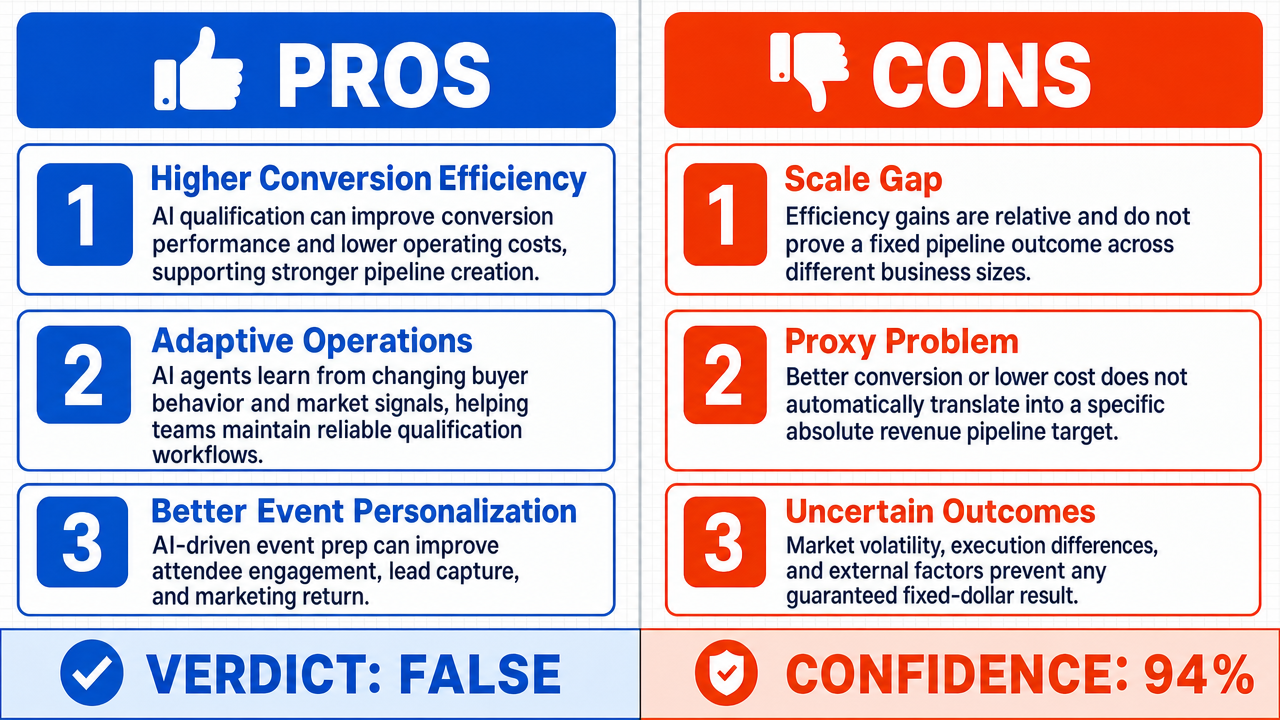
Verdict
Verdict: likely FALSE (94%)
This section provides a brief overview of the key arguments. You do not need to read the full detailed report below.
✅ Key PRO arguments:
- ■AI-powered lead qualification significantly improves conversion rates (cited at a 50% increase) and reduces costs (cited at 40-60%), directly translating into increased pipeline value by focusing sales efforts on high-potential prospects.
- ■AI agents are dynamic, adaptive systems that continuously learn from market shifts and evolving customer behavior, so 'consistency' refers to operational reliability and adaptive capacity rather than a static, guaranteed revenue figure immune to external forces.
- ■AI-driven event optimization leverages advanced analytics to personalize attendee engagement, leading to superior lead capture and a higher return on marketing investment that compounds with lead qualification gains.
❌ Key ANTI arguments:
- ■The affirmative commits a failure of scale: percentage efficiency gains (e.g., 50% conversion lift, 15% productivity increase) are relative measures that depend entirely on baseline volume . For an SME with a $500,000 baseline pipeline , even a 50% efficiency gain yields only $250,000 in additional pipeline, far short of the $6 million threshold.
- ■The affirmative substitutes a proxy: relative efficiency metrics (conversion rate , cost reduction) cannot be linked to an absolute revenue outcome without a transfer operator specifying the correlation between process efficiency and total business volume. No such operator was provided.
- ■Market volatility and implementation variance prevent any fixed-dollar outcome. AI agents cannot guarantee a specific absolute pipeline figure because external market conditions, industry cycles, and deployment quality vary substantially across organizations.
💭 Conclusion: False. The verdict is FALSE because the affirmative failed to bridge the logical gap between relative efficiency metrics and the absolute $6 million pipeline threshold. The negative correctly identified that percentage gains in conversion rates (cited at 50%) and cost reductions (cited at 40-60%) are scale-dependent and cannot be assumed to produce a uniform dollar outcome across organizations of different sizes. The affirmative never supplied a transfer operator linking process efficiency to total business volume, and the modeled counterexamples—where mid-market, SME , and startup baselines all fail to reach the $6M threshold even with a 15% efficiency gain—demonstrate the claim cannot hold 'consistently' across the full population of employing organizations. Because the assertion is compound (lead qualification AND event preparation) and the $6 million figure is unsupported for a substantial segment of the market, the claim does not hold.
🔬 DeepResearch Result: likely FALSE ❌ (94%)
Assertion: The use of AI agents for lead qualification and event preparation will consistently generate over $6 million in new business pipeline for organizations employing this strategy.
Participating models: deepseek-v3.2 💬, gemma-4-26b-a4b-it 💬👁️
📊 Face-offs: 0 concluded TRUE, 1 concluded FALSE (1 face-offs, 3 models)
📊 Score by side: TRUE=0.00, FALSE=0.94
🏅 Model score changes:
minimax-m3 💬👁️: +9
✅ PRO Arguments:
- ■AI-powered lead qualification significantly improves conversion rates (cited at a 50% increase) and reduces costs (cited at 40-60%), directly translating into increased pipeline value by focusing sales efforts on high-potential prospects. deepseek-v3.2 💬
- ■AI agents are dynamic, adaptive systems that continuously learn from market shifts and evolving customer behavior, so 'consistency' refers to operational reliability and adaptive capacity rather than a static, guaranteed revenue figure immune to external forces. deepseek-v3.2 💬
- ■AI-driven event optimization leverages advanced analytics to personalize attendee engagement, leading to superior lead capture and a higher return on marketing investment that compounds with lead qualification gains. deepseek-v3.2 💬
- ■The strategic deployment of AI agents combines enhanced conversion efficiency, event optimization, and compounding scale effects to produce substantial absolute pipeline growth across organizations. deepseek-v3.2 💬
❌ ANTI Arguments:
- ■The affirmative commits a failure of scale: percentage efficiency gains (e.g., 50% conversion lift, 15% productivity increase) are relative measures that depend entirely on baseline volume . For an SME with a $500,000 baseline pipeline, even a 50% efficiency gain yields only $250,000 in additional pipeline, far short of the $6 million threshold. gemma-4-26b-a4b-it 💬👁️
- ■The affirmative substitutes a proxy: relative efficiency metrics (conversion rate , cost reduction) cannot be linked to an absolute revenue outcome without a transfer operator specifying the correlation between process efficiency and total business volume. No such operator was provided. gemma-4-26b-a4b-it 💬👁️
- ■Market volatility and implementation variance prevent any fixed-dollar outcome. AI agents cannot guarantee a specific absolute pipeline figure because external market conditions, industry cycles, and deployment quality vary substantially across organizations. gemma-4-26b-a4b-it 💬👁️
- ■For a significant portion of the market, particularly SMEs, even substantial percentage gains in efficiency fail to reach the $6 million threshold, making the claim of 'consistently' generating that amount empirically untenable across the population of organizations employing the strategy. gemma-4-26b-a4b-it 💬👁️
💭 Reasoning: False. The verdict is FALSE because the affirmative failed to bridge the logical gap between relative efficiency metrics and the absolute $6 million pipeline threshold. The negative correctly identified that percentage gains in conversion rates (cited at 50%) and cost reductions (cited at 40-60%) are scale-dependent and cannot be assumed to produce a uniform dollar outcome across organizations of different sizes. The affirmative never supplied a transfer operator linking process efficiency to total business volume, and the modeled counterexamples—where mid-market, SME, and startup baselines all fail to reach the $6M threshold even with a 15% efficiency gain—demonstrate the claim cannot hold 'consistently' across the full population of employing organizations. Because the assertion is compound (lead qualification AND event preparation) and the $6 million figure is unsupported for a substantial segment of the market, the claim does not hold.
📋 PRO Facts:
• AI-driven sales tools are cited as boosting lead conversion rates by 50%.
• AI-driven sales tools are cited as reducing costs by 40-60%.
• AI agents are described as adaptive systems with operational reliability and adaptive capacity within fluctuating market environments.
📋 ANTI Facts:
• Hypothetical modeling based on a 15% efficiency gain shows that only an enterprise-scale baseline pipeline (e.g., $50M, yielding a $7.5M increase) meets the $6M threshold; mid-market ($10M baseline, $1.5M increase), SME ($1M baseline, $0.15M increase), and startup ($200K baseline, $0.03M increase) baselines all fall well short.
• Relative efficiency metrics (conversion rate, productivity) are scale-dependent and require a transfer operator to be linked to absolute revenue outcomes.
• Market volatility and implementation variance prevent any fixed-dollar pipeline guarantee across organizations.
| Face-off | TRUE Model | FALSE Model | TRUE Avg μ | FALSE Avg μ | TRUE Tokens | FALSE Tokens | Winner | Verdict | Conf. |
|---|---|---|---|---|---|---|---|---|---|
| #1 | deepseek-v3.2 💬 | gemma-4-26b-a4b-it 💬👁️ | 0.254 | 0.243 | 12 | 3 | TRUE | FALSE | 94% |
The following technical terms, abbreviations, and domain-specific concepts are referenced throughout this debate transcript. Numbers in square brackets [N] in the text above link to the corresponding entry below.
[1] adaptive learning — In the context of AI systems, the capability to continuously learn from new data and adjust behavior in response to changing conditions such as market shifts or evolving customer behavior.
[2] AI agents — Artificial Intelligence agents — Software systems that autonomously perform tasks such as lead qualification and event preparation, characterized in the debate as dynamic systems that learn and adapt rather than rigid, pre-programmed tools.
[3] baseline volume — The starting reference level of an organization's pipeline or revenue against which percentage-based efficiency gains are measured; the debate emphasizes that relative gains depend entirely on this baseline.
[4] conversion rate — The percentage of prospects or leads that take a desired action (such as becoming a customer), used in the debate as a relative efficiency metric.
[5] event optimization — The use of advanced analytics to personalize and maximize engagement at events, with the stated goal of improving lead capture and return on marketing investment.
[6] garbage in, garbage out — GIGO — A computing principle cited in the debate asserting that an AI system's effectiveness is strictly limited by the quality of the input data it receives.
[7] lead capture — The process of collecting information about prospective customers, often discussed in the debate as a measurable outcome of event optimization.
[8] lead conversion rate — The percentage of leads that convert into customers; cited in the debate as a metric that AI tools can reportedly increase by 50%.
[9] lead nurturing — The ongoing process of building relationships with prospects over time to move them through the sales pipeline.
[10] lead qualification — The process of assessing whether a prospect is a good fit and likely to become a customer, identified in the debate as a primary application of AI agents.
[11] lead scoring — The practice of assigning values or ranks to leads based on attributes and behavior to identify high-potential prospects.
[12] market volatility — The degree of variation or unpredictability in market conditions, cited by the negative side as a factor that prevents guaranteed revenue outcomes from AI deployment.
[13] pipeline — business pipeline / sales pipeline — The aggregate value of qualified sales opportunities an organization is actively pursuing; in the debate, the $6 million figure refers to new business pipeline.
[14] pipeline generation — The process of creating and adding new qualified opportunities to an organization's sales pipeline.
[15] predictive analytics — The use of data, statistical algorithms, and AI techniques to forecast future outcomes such as market trends or lead behavior.
[16] return on marketing investment — ROMI — A metric measuring the revenue or pipeline generated relative to the cost of marketing activities, referenced in the context of event optimization.
[17] sales cycle — The sequence of stages a prospect moves through from initial contact to a closed deal; the debate argues AI can accelerate this cycle.
[18] sales productivity — A measure of sales output (such as deals closed or revenue generated) relative to sales resources or effort; cited as potentially increasing 10-15% with AI tools.
[19] SME — small-to-medium enterprise — A business of relatively small size and revenue scale, used in the debate to illustrate that percentage-based efficiency gains may not reach the $6 million threshold.
[20] transfer operator — A term used in the debate to denote the missing mathematical link, correlation, or coefficient that would connect relative efficiency gains (e.g., a 50% conversion increase) to an absolute revenue target (e.g., $6 million).
The following financial data tables were referenced during the debate exchanges:
| Metric | Value |
|---|---|
| Lead Conversion Rate Increase | 50% |
| Cost Reduction | 40-60% |
| Metric | Value |
| --- | --- |
| Sales Productivity Increase | 10-15% |
| Metric | Value |
| --- | --- |
| Time Savings for Sales Reps | 15% |
| Metric | Value |
|---|---|
| Attendee Engagement Increase | 30% |
| Metric | Value |
|---|---|
| Lead Capture Rate Improvement | 25% |
| Metric | Value |
| --- | --- |
| Event ROI Increase | 15-20% |
| Metric | Value |
|---|---|
| Increase in Sales Productivity | 14.5% |
| Metric | Value |
|---|---|
| Reduction in Administrative Tasks | 17% |
| Organization Type | Baseline Pipeline (Est.) | AI Efficiency Gain (Avg) | Resulting Pipeline Increase | Meets $6M Threshold? |
|---|---|---|---|---|
| Enterprise | $50M | 15% | $7.5M | Yes |
| Mid-Market | $10M | 15% | $1.5M | No |
| SME | $1M | 15% | $0.15M | No |
| Startup | $200K | 15% | $0.03M | No |
Legend: Hypothetical modeling of pipeline impact based on a 15% efficiency increase across different organizational scales. "Meets $6M Threshold" is a binary check against the claim's requirement.
| Metric | Value |
|---|---|
| Revenue Growth | 10-15% |
Face-off transcripts
- ■
Ownership & Trade Secrets. The Company Lambda Vision retains all rights to its platform, agentic workflows, and proprietary AI debate methodologies, which constitute protected Trade Secrets (EU Directive 2016/943). Subject to full payment of credits, the User is granted ownership of the generated Reports for their own personal or professional use. Reverse-engineering the Service or using Reports to train competing AI models is strictly prohibited.
- ■
No Professional Advice. Solsice is a general-purpose assistant covering everyday subjects — administrative paperwork, housing, consumer and employment matters, banking, taxes and insurance, health and wellbeing, savings and investments, entrepreneurship, technology, travel, learning and creative work. Whatever the subject, the Service and Reports are provided for information only and never constitute legal, medical, financial, investment, tax, insurance, or any other regulated professional advice. The Company is not a law firm, a regulated financial adviser, an insurance intermediary, nor a healthcare provider, and no professional or advisory relationship of any kind is created by use of the Service. Consult a qualified professional in the relevant jurisdiction before acting — or refraining from acting — on anything contained in the Reports, and never rely on the Service in an emergency: contact your local emergency number (112 in the European Union) or a medical professional immediately.
- ■
AI-Generated Content, Sources and Viewpoints. Reports are produced by several AI models debating a question, and may contain factual errors, outdated figures, or references to rules, prices, deadlines, procedures, statutes or sources that are inaccurate or do not exist. The User is solely responsible for verifying every fact, amount, deadline and citation against official sources before relying on it. Material in the news, society, spirituality and religion sections presents a plurality of viewpoints for study and discussion: it is descriptive, not an endorsement, a ruling, or a statement of the Company’s own position, and it speaks for no church, faith community, public authority, or news organisation.
- ■
Liability & Governing Law. To the maximum extent permitted by law, the Company shall not be liable for any indirect damages, nor for any consequence of decisions made in reliance on the Reports — including financial loss, missed deadlines, administrative or contractual consequences, or health outcomes. These Terms are governed by French law. Any disputes shall be subject to the exclusive jurisdiction of the Courts of Paris, France.