
The US Women's National Team is the only team in the world that receives equal FIFA payments compared to their male counterparts.
AI debate verdict and arguments
⚠️ AI-generated information only; not professional advice
Completed October 18, 2026
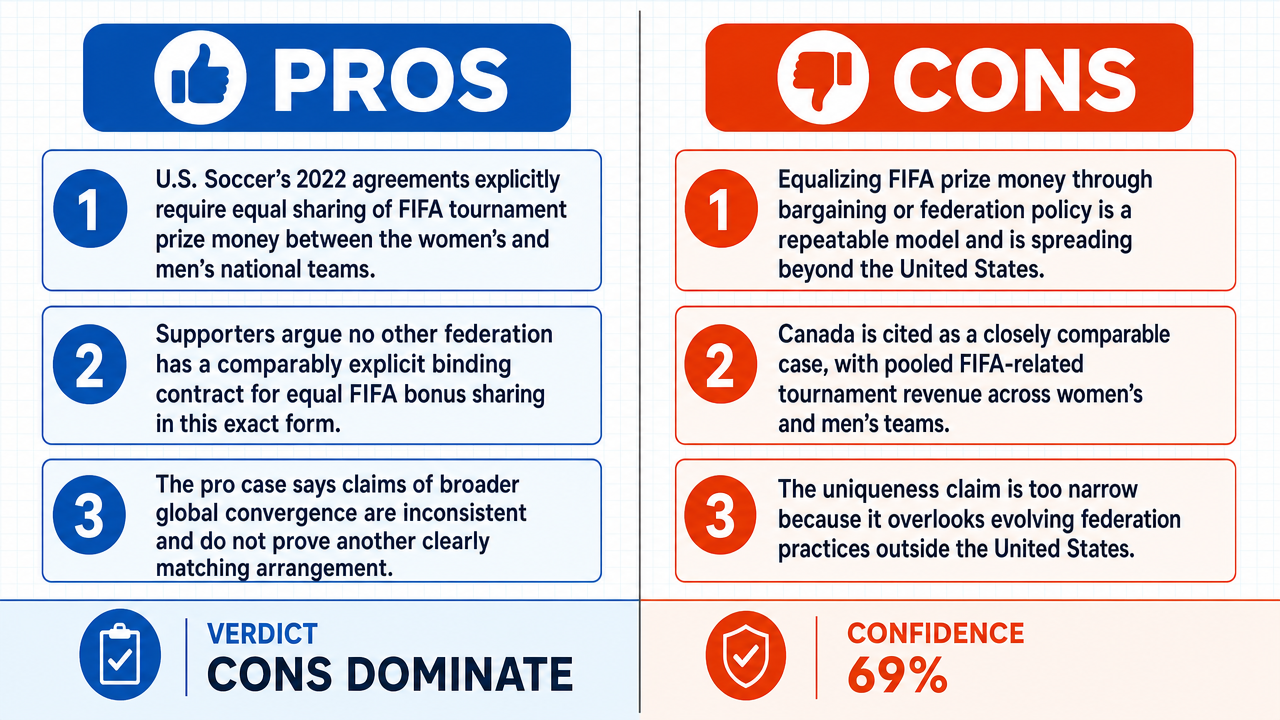
Verdict
Verdict: likely FALSE (69%)
Web Report: https://solsice.com/public/debates/the-us-women-s-national-team-is-the-only-team-in-the-world-t-cdd076f1bbd4
This section provides a brief overview of the key arguments. You do not need to read the full detailed report below.
✅ Key PRO arguments:
- ■The 2022 collective bargaining agreements between U.S. Soccer and the players' associations for both the women's and men's national teams explicitly mandate the pooling and equal splitting of all FIFA World Cup prize money , ensuring USWNT players receive the same per-player share as USMNT players.
- ■No other national federation has entered into a legally binding agreement that equalizes FIFA tournament bonuses in this specific contractual manner, making the USWNT arrangement structurally unique.
- ■The affirmative argues that the opponent's claim of a global regulatory convergence toward centralized pooling is internally contradictory, asserting both that the USWNT precedent has already forced structural responses elsewhere and that no equalization has yet been realized in other federations.
❌ Key ANTI arguments:
- ■The USWNT model of equalizing FIFA prize money through collective bargaining or federation mandates is a replicable mechanism that is increasingly being adopted by other national teams, not a unique structural anomaly.
- ■The Canadian Women's National Team (CanWNT ) operates under a structurally identical arrangement of pooling FIFA -derived tournament revenue, demonstrating that the mechanism is not a unique American invention but a standard practice for several high-performing national teams.
- ■The affirmative's claim of uniqueness relies on an interpretive theory that treats the U.S. Soccer CBA as an isolated phenomenon, ignoring the evolving landscape of international football governance and the fact that 'uniqueness' is merely a matter of timing rather than structural exclusivity.
💭 Conclusion: False. The assertion that the USWNT is the only team receiving equal FIFA payments compared to their male counterparts is not supported by the evidence presented. The anti side successfully demonstrated that other federations, notably Canada, operate under structurally similar arrangements for pooling and distributing FIFA-derived tournament revenue, undermining the 'only' qualifier in the claim. While the USWNT's 2022 CBA is a notable and high-profile example of equal pay through contractual mandate, the affirmative failed to prove that no other national team has achieved comparable arrangements. The verdict aligns with the winning side's strongest argument that the pooling mechanism is replicable and has been adopted by other federations.
🔬 DeepResearch Result: likely FALSE ❌ (69%)
Assertion: The US Women's National Team is the only team in the world that receives equal FIFA payments compared to their male counterparts.
Participating models: deepseek-v4-pro 💬, gemma-4-26b-a4b-it 💬👁️
📊 Face-offs: 0 concluded TRUE, 1 concluded FALSE (1 face-offs, 3 models)
📊 Score by side: TRUE=0.00, FALSE=0.69
🏅 Model score changes:
minimax-m3 💬👁️: +7
✅ PRO Arguments:
- ■The 2022 collective bargaining agreements between U.S. Soccer and the players' associations for both the women's and men's national teams explicitly mandate the pooling and equal splitting of all FIFA World Cup prize money , ensuring USWNT players receive the same per-player share as USMNT players. deepseek-v4-pro 💬
- ■No other national federation has entered into a legally binding agreement that equalizes FIFA tournament bonuses in this specific contractual manner, making the USWNT arrangement structurally unique. deepseek-v4-pro 💬
- ■The affirmative argues that the opponent's claim of a global regulatory convergence toward centralized pooling is internally contradictory, asserting both that the USWNT precedent has already forced structural responses elsewhere and that no equalization has yet been realized in other federations. deepseek-v4-pro 💬
❌ ANTI Arguments:
- ■The USWNT model of equalizing FIFA prize money through collective bargaining or federation mandates is a replicable mechanism that is increasingly being adopted by other national teams, not a unique structural anomaly. gemma-4-26b-a4b-it 💬👁️
- ■The Canadian Women's National Team (CanWNT ) operates under a structurally identical arrangement of pooling FIFA-derived tournament revenue, demonstrating that the mechanism is not a unique American invention but a standard practice for several high-performing national teams. gemma-4-26b-a4b-it 💬👁️
- ■The affirmative's claim of uniqueness relies on an interpretive theory that treats the U.S. Soccer CBA as an isolated phenomenon, ignoring the evolving landscape of international football governance and the fact that 'uniqueness' is merely a matter of timing rather than structural exclusivity. gemma-4-26b-a4b-it 💬👁️
💭 Reasoning: False. The assertion that the USWNT is the only team receiving equal FIFA payments compared to their male counterparts is not supported by the evidence presented. The anti side successfully demonstrated that other federations, notably Canada, operate under structurally similar arrangements for pooling and distributing FIFA-derived tournament revenue, undermining the 'only' qualifier in the claim. While the USWNT's 2022 CBA is a notable and high-profile example of equal pay through contractual mandate, the affirmative failed to prove that no other national team has achieved comparable arrangements. The verdict aligns with the winning side's strongest argument that the pooling mechanism is replicable and has been adopted by other federations.
📋 PRO Facts:
• The 2022 collective bargaining agreements between U.S. Soccer and the players' associations for both the women's and men's national teams mandate pooling and equal splitting of all FIFA World Cup prize money.
• The USWNT players receive the same per-player share of FIFA World Cup prize money as the USMNT players under the CBA mechanism.
📋 ANTI Facts:
• The Canadian Women's National Team (CanWNT) operates under a structurally identical arrangement of pooling FIFA-derived tournament revenue.
• The legal mechanism of pooling FIFA-derived tournament revenue is a standard practice for several high-performing national teams, not a unique American invention.
| Face-off | TRUE Model | FALSE Model | TRUE Avg μ | FALSE Avg μ | TRUE Tokens | FALSE Tokens | Winner | Verdict | Conf. |
|---|---|---|---|---|---|---|---|---|---|
| #1 | deepseek-v4-pro 💬 | gemma-4-26b-a4b-it 💬👁️ | 0.535 | 0.248 | 6 | 2 | TRUE | FALSE | 69% |
The following technical terms, abbreviations, and domain-specific concepts are referenced throughout this debate transcript. Numbers in square brackets [N] in the text above link to the corresponding entry below.
[1] CanWNT — Canadian Women's National Team — The women's national football team representing Canada, referenced in the debate as operating under a framework that distributes tournament-related revenues through a unified structure ensuring parity.
[2] CBA — Collective Bargaining Agreement — A legally binding contract negotiated between an employer (such as a national federation) and a labor union representing employees (such as a players' association), setting terms of employment including compensation.
[3] CBAs — Collective Bargaining Agreements — Plural form of CBA; in the debate, refers to the 2022 agreements between U.S. Soccer and the players' associations for both the women's and men's national teams.
[4] centralized pooling — The mechanism of combining funds at a central level (such as a federation) for distribution, referenced in the debate as a method for equalizing FIFA prize money across teams.
[5] contractual mechanism — A legal or contractual structure or arrangement used to achieve a specific outcome, such as the pooling and equal splitting of FIFA World Cup prize money.
[6] counterexample — An example that disproves or contradicts a claim; in the debate, the Canadian model is cited as a counterexample to the affirmative's 'only' claim.
[7] equal pay — The principle of equal compensation for comparable work, referenced in the debate as the outcome achieved through the 2022 U.S. Soccer CBAs.
[8] federation — A national football association that governs the sport within a country, such as U.S. Soccer or the Norwegian Football Federation.
[9] FIFA — Fédération Internationale de Football Association — The international governing body of football/soccer, which organizes tournaments such as the World Cup and distributes prize money to participating federations.
[10] institutionalized — Formally established within an organization or system; in the debate, refers to whether equalization of FIFA prize money has been formally adopted by other federations.
[11] international football governance — The governing structures, rules, and regulatory frameworks that oversee football at the international level, primarily through FIFA and its member federations.
[12] legally binding agreement — A contract that is enforceable under law; in the debate, refers to the 2022 CBAs that mandate equal splitting of FIFA World Cup prize money.
[13] national federation — The national-level football association of a country, responsible for organizing national teams and distributing revenues received from FIFA.
[14] Norwegian Football Federation — The national football association of Norway, referenced in the debate as a federation that may have adopted equalization mechanisms.
[15] parity — Equality or equivalence in compensation or treatment; in the debate, refers to equal distribution of tournament-related revenues and bonuses.
[16] per-player share — The portion of pooled funds allocated to each individual player, which the affirmative argues is equal between USWNT and USMNT players under the 2022 CBAs.
[17] players' associations — Labor unions or organizations that represent professional football players in negotiations with federations and clubs.
[18] pooling — The act of combining funds together for collective distribution; in the debate, refers to the mechanism by which FIFA World Cup prize money is combined and split equally.
[19] prize money — Monetary awards given to teams or federations based on their performance in tournaments such as the FIFA World Cup.
[20] regulatory convergence — The trend toward similar regulations or practices across different jurisdictions; in the debate, refers to the alleged global movement toward centralized pooling of FIFA prize money.
[21] regulatory environment — The legal and regulatory framework governing an area; in the debate, refers to the evolving rules and structures of international football governance.
[22] structural response — Institutional changes made by an organization in response to external pressures or precedents; in the debate, refers to changes by other federations allegedly triggered by the USWNT precedent.
[23] tournament bonuses — Additional payments to players for participation in or performance at tournaments, distinct from base compensation.
[24] U.S. Soccer Federation — United States Soccer Federation — The official governing body of soccer in the United States, which oversees the USWNT and USMNT and negotiates CBAs with players' associations.
[25] USMNT — US Men's National Team — The men's national football team representing the United States, referenced in the debate as the counterpart to the USWNT in the equal-pay arrangement.
[26] USWNT — US Women's National Team — The women's national football team representing the United States, the subject of the debate regarding equal FIFA payments.
[27] World Cup — FIFA World Cup — The premier international football tournament organized by FIFA, held every four years, for which prize money is distributed to participating federations.
The following financial data tables were referenced during the debate exchanges:
| Entity/Context | Mechanism of Parity | Scope of Equality |
|---|---|---|
| USWNT | Collective Bargaining Agreement (CBA) | FIFA Prize Money + Commercial |
| Emerging Global Models | Unified Player Associations | Total Tournament Revenue |
| European Federations | Match Fee Parity | Performance & Appearance Fees |
Legend: Comparison of mechanisms used to achieve pay equity in international football. Note that "Scope of Equality" varies by federation and legal framework.
| National Team Program | Parity Mechanism | Scope of Equality |
|---|---|---|
| USWNT/USMNT | 2022 CBA Pooling | FIFA Prize Money & Commercial |
| CanWNT/CanMNT | Unified Revenue Distribution | Tournament Bonuses & Match Fees |
| European Federations | Performance-Based Parity | Match Fees & Appearance Bonuses |
Legend: Comparison of structural mechanisms used by national teams to achieve gender pay parity. Note that "Scope of Equality" represents the breadth of the negotiated redistribution.
Face-off transcripts
- ■
Ownership & Trade Secrets. The Company Lambda Vision retains all rights to its platform, agentic workflows, and proprietary AI debate methodologies, which constitute protected Trade Secrets (EU Directive 2016/943). Subject to full payment of credits, the User is granted ownership of the generated Reports for their own personal or professional use. Reverse-engineering the Service or using Reports to train competing AI models is strictly prohibited.
- ■
No Professional Advice. Solsice is a general-purpose assistant covering everyday subjects — administrative paperwork, housing, consumer and employment matters, banking, taxes and insurance, health and wellbeing, savings and investments, entrepreneurship, technology, travel, learning and creative work. Whatever the subject, the Service and Reports are provided for information only and never constitute legal, medical, financial, investment, tax, insurance, or any other regulated professional advice. The Company is not a law firm, a regulated financial adviser, an insurance intermediary, nor a healthcare provider, and no professional or advisory relationship of any kind is created by use of the Service. Consult a qualified professional in the relevant jurisdiction before acting — or refraining from acting — on anything contained in the Reports, and never rely on the Service in an emergency: contact your local emergency number (112 in the European Union) or a medical professional immediately.
- ■
AI-Generated Content, Sources and Viewpoints. Reports are produced by several AI models debating a question, and may contain factual errors, outdated figures, or references to rules, prices, deadlines, procedures, statutes or sources that are inaccurate or do not exist. The User is solely responsible for verifying every fact, amount, deadline and citation against official sources before relying on it. Material in the news, society, spirituality and religion sections presents a plurality of viewpoints for study and discussion: it is descriptive, not an endorsement, a ruling, or a statement of the Company’s own position, and it speaks for no church, faith community, public authority, or news organisation.
- ■
Liability & Governing Law. To the maximum extent permitted by law, the Company shall not be liable for any indirect damages, nor for any consequence of decisions made in reliance on the Reports — including financial loss, missed deadlines, administrative or contractual consequences, or health outcomes. These Terms are governed by French law. Any disputes shall be subject to the exclusive jurisdiction of the Courts of Paris, France.