
The US housing market will experience a significant downturn, with average home prices decreasing by more than 5% by the end of 2026.
AI debate verdict and arguments
⚠️ AI-generated information only; not professional advice
Completed October 11, 2026
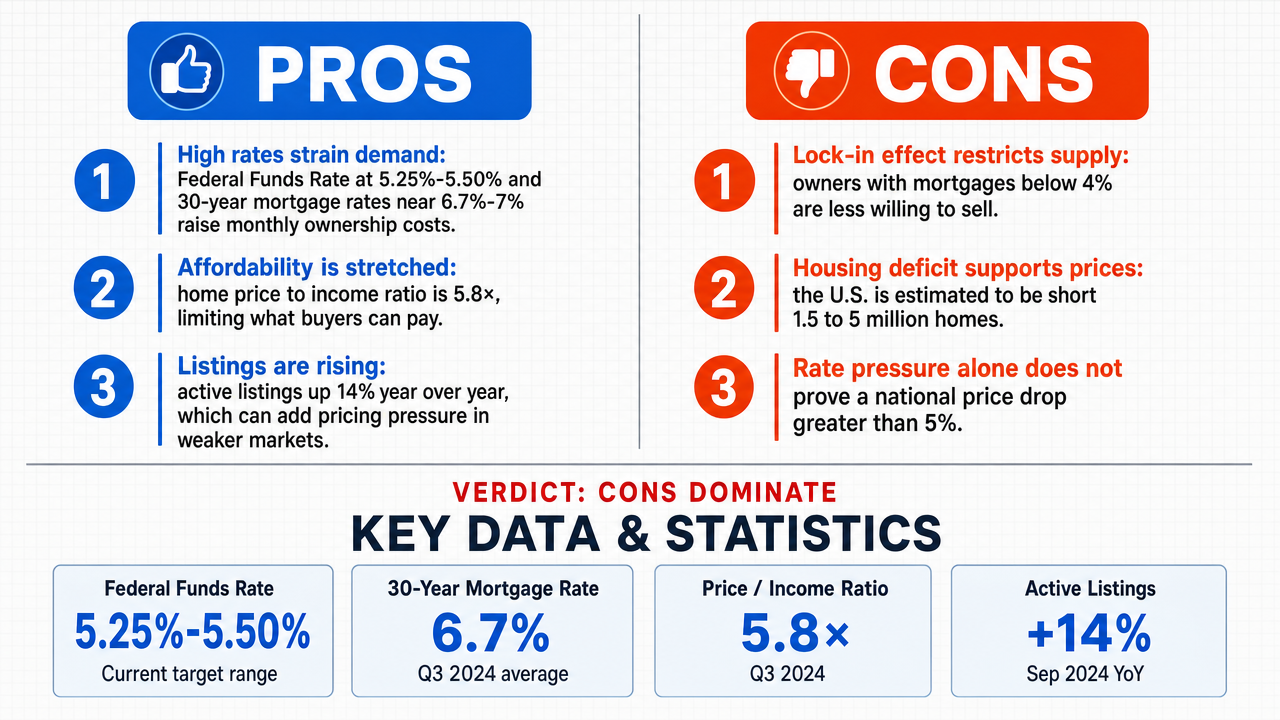
Verdict
Verdict: likely FALSE (78%)
This section provides a brief overview of the key arguments. You do not need to read the full detailed report below.
✅ Key PRO arguments:
- ■Elevated interest rates (Federal Funds Rate at 5.25%-5.50%) and high mortgage rates significantly increase the monthly cost of homeownership, pricing many buyers out of the market and creating sustained downward pressure on prices.
- ■Affordability has become a binding structural constraint, with a price-to-income ratio of 5.8× and mortgage rates near 7% pushing the monthly mortgage payment on a median-priced home to a record share of median income, requiring price adjustment.
- ■Rising inventory is consistent with a structural supply deficit : the US carries an estimated 1.5 to 5 million housing unit deficit, and active listings can rise 10–20% year-over-year from a pandemic-depressed floor while still remaining below the pre-2020 norm of roughly 1.1–1.3 million active listings, shifting bargaining leverage toward buyers.
❌ Key ANTI arguments:
- ■The 'lock-in effect ' structurally limits supply: existing homeowners holding mortgages at historically low rates (often below 4%) are disincentivized from selling, preventing the inventory increase required to facilitate a price drop and creating a decoupling between high borrowing costs and nominal prices .
- ■The structural housing deficit—the gap between total existing units and long-term demand—acts as a permanent price floor that prevents significant nominal price declines even amid affordability stress.
- ■The affirmative's argument suffers from a substitution error: citing the Federal Funds Rate and mortgage rates as drivers of price corrections fails to provide the specific correlation or sensitivity coefficient linking these macro rates to a national average price decline of over 5%, making the >5% threshold unsupported.
💭 Conclusion: False. The FALSE side prevailed because the affirmative failed to establish a quantitative link between elevated interest rates and a national average price decline exceeding 5%, leaving the specific threshold unsupported. The lock-in effect , whereby homeowners holding sub-4% mortgages refuse to sell, structurally constrains supply and prevents the inventory surge needed to drive a significant nominal price collapse. The structural housing deficit of 1.5 to 5 million units constrains supply and limits downside risk even as affordability deteriorates. While affordability metrics (price-to-income ratio of 5.8×, mortgage rates near 7%) are genuinely stressed, the FALSE side more convincingly argued that these conditions produce stagnation or modest correction rather than a >5% decline by end-2026.
🔬 DeepResearch Result: likely FALSE ❌ (78%)
Assertion: The US housing market will experience a significant downturn, with average home prices decreasing by more than 5% by the end of 2026.
Participating models: deepseek-v3.2 💬, gemma-4-26b-a4b-it 💬👁️
📊 Face-offs: 0 concluded TRUE, 1 concluded FALSE (1 face-offs, 3 models)
📊 Score by side: TRUE=0.00, FALSE=0.78
🏅 Model score changes:
minimax-m3 💬👁️: +8
✅ PRO Arguments:
- ■Elevated interest rates (Federal Funds Rate at 5.25%-5.50%) and high mortgage rates significantly increase the monthly cost of homeownership, pricing many buyers out of the market and creating sustained downward pressure on prices. deepseek-v3.2 💬
- ■Affordability has become a binding structural constraint, with a price-to-income ratio of 5.8× and mortgage rates near 7% pushing the monthly mortgage payment on a median-priced home to a record share of median income, requiring price adjustment. deepseek-v3.2 💬
- ■Rising inventory is consistent with a structural supply deficit : the US carries an estimated 1.5 to 5 million housing unit deficit, and active listings can rise 10–20% year-over-year from a pandemic-depressed floor while still remaining below the pre-2020 norm of roughly 1.1–1.3 million active listings, shifting bargaining leverage toward buyers. deepseek-v3.2 💬
❌ ANTI Arguments:
- ■The 'lock-in effect ' structurally limits supply: existing homeowners holding mortgages at historically low rates (often below 4%) are disincentivized from selling, preventing the inventory increase required to facilitate a price drop and creating a decoupling between high borrowing costs and nominal prices . gemma-4-26b-a4b-it 💬👁️
- ■The structural housing deficit—the gap between total existing units and long-term demand—acts as a permanent price floor that prevents significant nominal price declines even amid affordability stress. gemma-4-26b-a4b-it 💬👁️
- ■The affirmative's argument suffers from a substitution error: citing the Federal Funds Rate and mortgage rates as drivers of price corrections fails to provide the specific correlation or sensitivity coefficient linking these macro rates to a national average price decline of over 5%, making the >5% threshold unsupported. gemma-4-26b-a4b-it 💬👁️
💭 Reasoning: False. The FALSE side prevailed because the affirmative failed to establish a quantitative link between elevated interest rates and a national average price decline exceeding 5%, leaving the specific threshold unsupported. The lock-in effect, whereby homeowners holding sub-4% mortgages refuse to sell, structurally constrains supply and prevents the inventory surge needed to drive a significant nominal price collapse. The structural housing deficit of 1.5 to 5 million units constrains supply and limits downside risk even as affordability deteriorates. While affordability metrics (price-to-income ratio of 5.8×, mortgage rates near 7%) are genuinely stressed, the FALSE side more convincingly argued that these conditions produce stagnation or modest correction rather than a >5% decline by end-2026.
📋 PRO Facts:
• Federal Funds Rate target range is 5.25%-5.50% (Federal Reserve ).
• US housing unit deficit estimated at 1.5 to 5 million units relative to long-term demand (Freddie Mac 2021; NAR 2022).
• Active listings can rise 10–20% year-over-year from a pandemic-depressed floor while remaining below the pre-2020 norm of roughly 1.1–1.3 million active listings.
• Price-to-income ratio of 5.8× with mortgage rates near 7% pushes monthly mortgage payment on a median-priced home to a record share of median income.
📋 ANTI Facts:
• Existing homeowners hold mortgages at historically low rates, often below 4%, creating a lock-in effect that suppresses transaction velocity.
• The structural housing deficit of 1.5–5 million units relative to long-term demand constrains supply and limits the magnitude of any price decline.
• High borrowing costs reduce affordability for buyers while the lock-in effect simultaneously restricts the supply of existing homes for sale.
| Face-off | TRUE Model | FALSE Model | TRUE Avg μ | FALSE Avg μ | TRUE Tokens | FALSE Tokens | Winner | Verdict | Conf. |
|---|---|---|---|---|---|---|---|---|---|
| #1 | deepseek-v3.2 💬 | gemma-4-26b-a4b-it 💬👁️ | 0.459 | 0.341 | 12 | 3 | TRUE | FALSE | 78% |
The following technical terms, abbreviations, and domain-specific concepts are referenced throughout this debate transcript. Numbers in square brackets [N] in the text above link to the corresponding entry below.
[1] active listing velocity — The rate at which homes currently listed for sale are sold or removed from the market.
[2] active listings — Homes currently available for sale on the market.
[3] affordability constraints — Limitations on a household's ability to purchase housing, typically driven by the ratio of housing costs to income.
[4] bargaining leverage — The relative power of buyers and sellers in price negotiations, influenced by market conditions such as inventory levels.
[5] borrowing costs — The interest and fees paid on loans, such as mortgages.
[6] buyer confidence — The willingness of prospective purchasers to commit to home purchases, influenced by economic conditions and outlook.
[7] buyer's market — A market condition in which supply exceeds demand, giving purchasers an advantage in negotiations.
[8] correlation — A statistical measure of the relationship between two variables.
[9] demand destruction — A significant and sustained reduction in buyer demand, often caused by affordability constraints or economic shocks.
[10] downward pressure — Economic forces that tend to push prices lower.
[11] Federal Funds Rate — The target interest rate range set by the Federal Reserve for overnight lending between banks, which influences broader interest rates including mortgage rates.
[12] Federal Reserve — The central bank of the United States, responsible for monetary policy including setting the Federal Funds Rate.
[13] Freddie Mac — A U.S. government-sponsored enterprise that purchases and securitizes mortgages, referenced in the debate for housing supply estimates.
[14] housing affordability — The degree to which households can financially access homeownership, given their income and prevailing mortgage rates and home prices.
[15] inflation — A general increase in prices across the economy, which the Federal Reserve attempts to control through interest rate policy.
[16] interest rate environment — The prevailing level and structure of interest rates in an economy.
[17] labor market — The market in which workers and employers interact to determine wages and employment levels.
[18] lock-in effect — The phenomenon in which existing homeowners with low mortgage rates are reluctant to sell because moving would require taking on a higher-rate mortgage.
[19] macroeconomic headwinds — Broad economic conditions that negatively affect markets or sectors.
[20] months of supply — A real estate metric indicating how many months it would take to sell all current inventory at the present sales pace.
[21] mortgage rates — The interest rates charged on home loans.
[22] NAR — National Association of Realtors — A U.S. trade association for real estate professionals, referenced in the debate for housing market data and analysis.
[23] nominal prices — Prices expressed in current dollars, not adjusted for inflation.
[24] price corrections — Declines in market prices following a period of elevation, often in response to changing supply-demand conditions.
[25] price depreciation — A decline in the value or price of an asset.
[26] price discovery — The process by which market participants determine the prevailing price of an asset through transactions.
[27] price floor — A minimum price level below which prices are not expected to fall due to structural market factors.
[28] price-to-income ratio — The ratio of home prices to household income, used as a measure of housing affordability.
[29] recession risk — The probability of a significant decline in economic activity.
[30] seller's market — A market condition in which demand exceeds supply, giving sellers an advantage in negotiations.
[31] sensitivity coefficient — A statistical measure indicating how much one variable changes in response to a change in another.
[32] structural supply deficit — A long-term shortage of housing units relative to demand, often cited as a baseline condition in housing markets.
[33] supply-demand balance — The equilibrium between the quantity of goods available and the quantity desired by purchasers.
[34] supply-side constraints — Limitations on the availability of goods or housing, such as a shortage of units for sale.
[35] transfer operator — In economic arguments, the specific mechanism or coefficient linking a macroeconomic variable (such as interest rates) to an outcome (such as home prices).
[36] velocity of transactions — The speed or frequency at which sales occur in a market.
[37] year-over-year — YoY — A comparison of a metric in one period to the same period one year earlier.
The following financial data tables were referenced during the debate exchanges:
| Rate |
|---|
| 5.25%-5.50% |
Legend: Current target range for the Federal Funds Rate. Source: Federal Reserve.
| Metric | 2023 Average | 2024 Projection | Trend |
|---|---|---|---|
| Total Housing Inventory (Units) | ~14.5M | ~15.1M | Increasing |
| Housing Under Construction (Units) | ~1.5M | ~1.6M | Stable |
| Annual Housing Starts (Units) | ~1.4M | ~1.5M | Increasing |
Legend: Estimated US housing stock and construction activity. Inventory and starts are expressed in millions of units.
| Indicator | Value | Period |
|---|---|---|
| Median Home Price / Median Household Income | 5.8× | Q3 2024 |
| Mortgage Rate (30-yr fixed) | 6.7% avg | Q3 2024 |
| Months of Supply | 4.1 | Sep 2024 |
| Active Listings YoY Change | +14% | Sep 2024 |
Legend: Affordability and supply metrics. Price-to-income ratio from NAR Housing Affordability Index. Mortgage rate from Freddie Mac Primary Mortgage Market Survey. Months of supply and active listings from Realtor.com Monthly Housing Market Report.
Face-off transcripts
- ■
Ownership & Trade Secrets. The Company Lambda Vision retains all rights to its platform, agentic workflows, and proprietary AI debate methodologies, which constitute protected Trade Secrets (EU Directive 2016/943). Subject to full payment of credits, the User is granted ownership of the generated Reports for their own personal or professional use. Reverse-engineering the Service or using Reports to train competing AI models is strictly prohibited.
- ■
No Professional Advice. Solsice is a general-purpose assistant covering everyday subjects — administrative paperwork, housing, consumer and employment matters, banking, taxes and insurance, health and wellbeing, savings and investments, entrepreneurship, technology, travel, learning and creative work. Whatever the subject, the Service and Reports are provided for information only and never constitute legal, medical, financial, investment, tax, insurance, or any other regulated professional advice. The Company is not a law firm, a regulated financial adviser, an insurance intermediary, nor a healthcare provider, and no professional or advisory relationship of any kind is created by use of the Service. Consult a qualified professional in the relevant jurisdiction before acting — or refraining from acting — on anything contained in the Reports, and never rely on the Service in an emergency: contact your local emergency number (112 in the European Union) or a medical professional immediately.
- ■
AI-Generated Content, Sources and Viewpoints. Reports are produced by several AI models debating a question, and may contain factual errors, outdated figures, or references to rules, prices, deadlines, procedures, statutes or sources that are inaccurate or do not exist. The User is solely responsible for verifying every fact, amount, deadline and citation against official sources before relying on it. Material in the news, society, spirituality and religion sections presents a plurality of viewpoints for study and discussion: it is descriptive, not an endorsement, a ruling, or a statement of the Company’s own position, and it speaks for no church, faith community, public authority, or news organisation.
- ■
Liability & Governing Law. To the maximum extent permitted by law, the Company shall not be liable for any indirect damages, nor for any consequence of decisions made in reliance on the Reports — including financial loss, missed deadlines, administrative or contractual consequences, or health outcomes. These Terms are governed by French law. Any disputes shall be subject to the exclusive jurisdiction of the Courts of Paris, France.