
The US housing market will experience a significant correction, with prices potentially falling by 10-30%, due to economic conditions and interest rates.
AI debate verdict and arguments
⚠️ AI-generated information only; not professional advice
Completed October 19, 2026
Verdict
Verdict: likely FALSE (58%)
Web Report: https://solsice.com/public/debates/the-us-housing-market-will-experience-a-significant-correcti-00a0e1ad4ea5
This section provides a brief overview of the key arguments. You do not need to read the full detailed report below.
✅ Key PRO arguments:
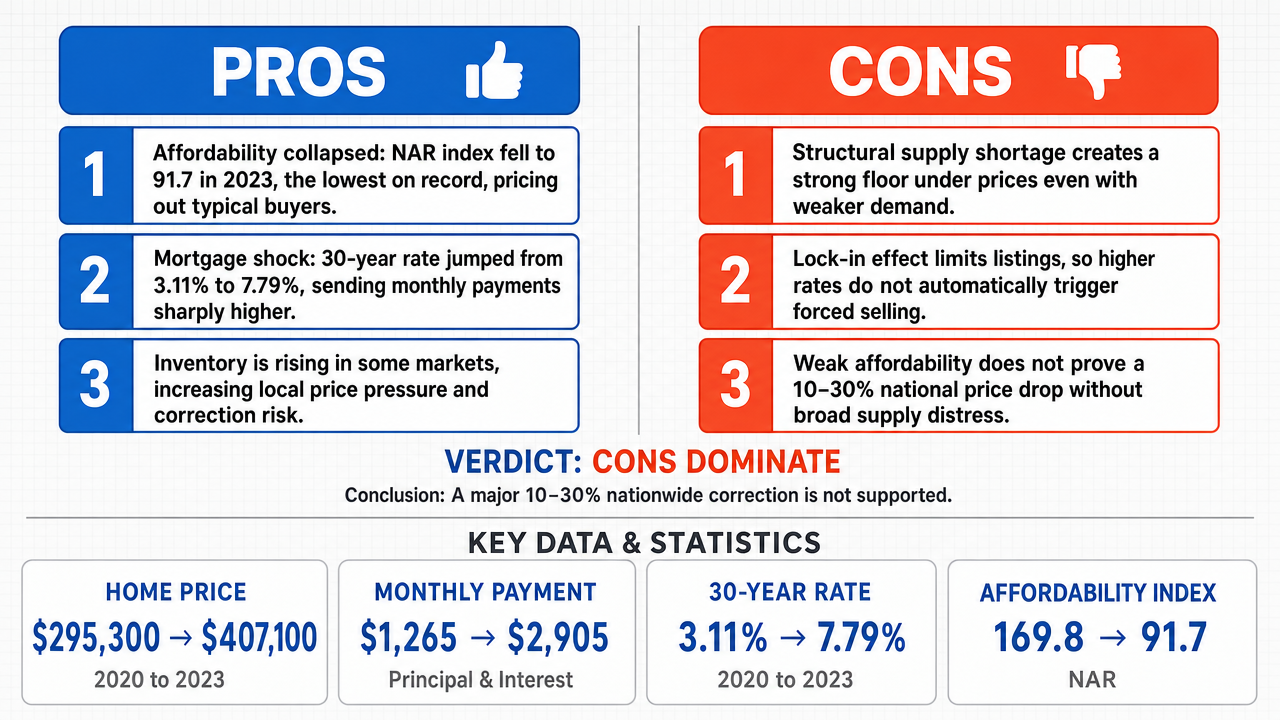
- ■The NAR Housing Affordability Index plummeted to 91.7 in September 2023, the lowest reading since the series began in 1989, meaning the typical family can no longer qualify for a mortgage on the median-priced home , signaling a historic collapse in affordability that will force price corrections.
- ■The average 30-year fixed mortgage rate rose from 3.11% at end-2020 to 7.79% in October 2023, pushing the monthly principal-and-interest payment on a median-priced existing home from $1,265 to $2,905, an increase of 129.7%, which will inevitably compress demand and drive prices down.
- ■Inventory dynamics are highly regional and already shifting decisively, with active listings nationally rising 2.0% year-over-year in September 2023, and dramatic divergence in markets where prices rose most, undermining the claim that a structural supply deficit acts as a universal price floor .
❌ Key ANTI arguments:
- ■The current housing market is defined by a structural supply deficit that acts as a hard floor for prices; even as demand softens due to higher rates, the chronic undersupply of new construction and the reluctance of current owners to liquidate low-rate mortgages create persistent upward pressure on prices.
- ■The affirmative treats the 'lock-in effect ' as a temporary friction that will eventually yield to 'forced sales ,' but fails to establish the necessary causal transfer between rising unemployment and a surge in distressed inventory , making the 10-30% correction scenario implausible.
- ■The affirmative's argument is built upon a fundamental logical inconsistency regarding the very metrics used to define 'affordability' and 'demand,' undermining the causal link between the cited 129.7% increase in monthly payments and an actual price decline of 10-30%.
💭 Conclusion: False. The debate verdict rejects the assertion that US housing prices will fall 10-30% due to economic conditions and interest rates. The winning side successfully argued that a structural supply deficit acts as a hard price floor , preventing the kind of significant correction the affirmative predicted. The affirmative's case relied heavily on affordability metrics and mortgage rate increases, but the negative demonstrated internal inconsistencies in the causal logic connecting these factors to a 10-30% price decline. The lock-in effect and chronic undersupply of new construction were identified as persistent forces that prevent forced sales from cascading into a major correction. The confidence is moderate at 58% because while the structural supply argument is compelling, the debate only ran once and the compound nature of the claim (combining price magnitude, timing, and causation) means each sub-claim must be independently supported. The weakest sub-claim—the specific 10-30% magnitude—is not strongly supported by either side's evidence, which limits overall confidence in the verdict.
🔬 DeepResearch Result: likely FALSE ❌ (58%)
Assertion: The US housing market will experience a significant correction, with prices potentially falling by 10-30%, due to economic conditions and interest rates.
Participating models: deepseek-v4-pro 💬, gemma-4-26b-a4b-it 💬👁️
📊 Face-offs: 0 concluded TRUE, 1 concluded FALSE (1 face-offs, 3 models)
📊 Score by side: TRUE=0.00, FALSE=0.58
🏅 Model score changes:
minimax-m3 💬👁️: +6
✅ PRO Arguments:
- ■The NAR Housing Affordability Index plummeted to 91.7 in September 2023, the lowest reading since the series began in 1989, meaning the typical family can no longer qualify for a mortgage on the median-priced home , signaling a historic collapse in affordability that will force price corrections. deepseek-v4-pro 💬
- ■The average 30-year fixed mortgage rate rose from 3.11% at end-2020 to 7.79% in October 2023, pushing the monthly principal-and-interest payment on a median-priced existing home from $1,265 to $2,905, an increase of 129.7%, which will inevitably compress demand and drive prices down. deepseek-v4-pro 💬
- ■Inventory dynamics are highly regional and already shifting decisively, with active listings nationally rising 2.0% year-over-year in September 2023, and dramatic divergence in markets where prices rose most, undermining the claim that a structural supply deficit acts as a universal price floor . deepseek-v4-pro 💬
- ■The labor market is already softening in ways that will unlock inventory through forced sales , contradicting the opposing argument that treats low inventory as a hard price floor and dismisses the potential for distressed selling. deepseek-v4-pro 💬
❌ ANTI Arguments:
- ■The current housing market is defined by a structural supply deficit that acts as a hard floor for prices; even as demand softens due to higher rates, the chronic undersupply of new construction and the reluctance of current owners to liquidate low-rate mortgages create persistent upward pressure on prices. gemma-4-26b-a4b-it 💬👁️
- ■The affirmative treats the 'lock-in effect ' as a temporary friction that will eventually yield to 'forced sales,' but fails to establish the necessary causal transfer between rising unemployment and a surge in distressed inventory , making the 10-30% correction scenario implausible. gemma-4-26b-a4b-it 💬👁️
- ■The affirmative's argument is built upon a fundamental logical inconsistency regarding the very metrics used to define 'affordability' and 'demand,' undermining the causal link between the cited 129.7% increase in monthly payments and an actual price decline of 10-30%. gemma-4-26b-a4b-it 💬👁️
- ■The structural supply shortage, combined with robust labor markets and demographic demand drivers, prevents the kind of significant correction the affirmative predicts, as the mechanisms required to produce a 10-30% price decline are not present in current conditions. gemma-4-26b-a4b-it 💬👁️
💭 Reasoning: False. The debate verdict rejects the assertion that US housing prices will fall 10-30% due to economic conditions and interest rates. The winning side successfully argued that a structural supply deficit acts as a hard price floor, preventing the kind of significant correction the affirmative predicted. The affirmative's case relied heavily on affordability metrics and mortgage rate increases, but the negative demonstrated internal inconsistencies in the causal logic connecting these factors to a 10-30% price decline. The lock-in effect and chronic undersupply of new construction were identified as persistent forces that prevent forced sales from cascading into a major correction. The confidence is moderate at 58% because while the structural supply argument is compelling, the debate only ran once and the compound nature of the claim (combining price magnitude, timing, and causation) means each sub-claim must be independently supported. The weakest sub-claim—the specific 10-30% magnitude—is not strongly supported by either side's evidence, which limits overall confidence in the verdict.
📋 PRO Facts:
• NAR Housing Affordability Index fell to 91.7 in September 2023, the lowest reading since the series began in 1989
• Average 30-year fixed mortgage rate rose from 3.11% at end-2020 to 7.79% in October 2023
• Monthly principal-and-interest payment on a median-priced existing home rose from $1,265 to $2,905, an increase of 129.7%
• Active listings nationally rose 2.0% year-over-year in September 2023
📋 ANTI Facts:
• The US housing market has a structural supply deficit that acts as a hard floor for prices
• Current owners are reluctant to liquidate low-rate mortgages, creating a persistent lock-in effect
• There is a chronic undersupply of new construction in the US housing market
• The affirmative's affordability metrics contain internal inconsistencies that undermine the causal link to a 10-30% price decline
| Face-off | TRUE Model | FALSE Model | TRUE Avg μ | FALSE Avg μ | TRUE Tokens | FALSE Tokens | Winner | Verdict | Conf. |
|---|---|---|---|---|---|---|---|---|---|
| #1 | deepseek-v4-pro 💬 | gemma-4-26b-a4b-it 💬👁️ | 0.706 | 0.368 | 6 | 2 | TRUE | FALSE | 58% |
The following technical terms, abbreviations, and domain-specific concepts are referenced throughout this debate transcript. Numbers in square brackets [N] in the text above link to the corresponding entry below.
[1] 30-year fixed rate — 30-year fixed mortgage rate — A mortgage product with a constant interest rate and a repayment term of 30 years, commonly used as a benchmark for U.S. home loan costs.
[2] Active listings — Active real estate listings — The count of homes currently for sale on the market, used as a real-time indicator of housing supply and inventory levels.
[3] Capitulate — Capitulation (in market context) — In a market context, the act of sellers giving in and lowering asking prices in order to complete transactions when demand has weakened.
[4] Distressed inventory — Distressed property inventory — Real estate listings involving properties under financial duress, such as foreclosures or short sales, which can pressure market prices downward.
[5] Existing homes — Existing home sales/inventory — Homes that have been previously owned and sold, as opposed to newly built properties; a major segment tracked in U.S. housing statistics.
[6] Forced sales — Forced property sales — Sales of real estate compelled by financial circumstances (e.g., job loss, mortgage default), which can add supply to the market and depress prices.
[7] Housing Affordability Index — NAR Housing Affordability Index — An index published by the National Association of Realtors measuring whether a typical family earns enough income to qualify for a mortgage on a median-priced home; a value of 100 indicates the median family earns exactly the income needed.
[8] Labor market — The market in which workers and employers interact to determine wages, employment levels, and workforce participation; a key driver of housing demand.
[9] Lock-in effect — Mortgage rate lock-in effect — The phenomenon in which homeowners with low existing mortgage rates are reluctant to sell and re-finance at higher rates, reducing the supply of homes on the market.
[10] Median-priced home — A home priced at the median (middle value) of all homes in a given market, used as a standard benchmark for tracking housing price trends.
[11] Mortgage rates — Mortgage interest rates — The interest rates charged on home loans, which directly influence monthly housing payments and overall housing affordability.
[12] NAR — National Association of Realtors — A U.S. trade association representing real estate professionals that publishes widely cited housing market statistics, including the Housing Affordability Index.
[13] New construction — New residential construction — Newly built homes that add to the housing supply, distinguished from existing home inventory in real estate market analysis.
[14] Price correction — Housing price correction — A significant downward adjustment in market prices following a period of overvaluation or unsustainable price growth.
[15] Price floor — A minimum price level supported by market conditions (such as supply scarcity) below which prices are argued not to fall.
[16] Principal-and-interest payment — Principal and interest (P&I) payment — The portion of a monthly mortgage payment that goes toward repaying the loan principal plus interest, excluding taxes and insurance.
[17] Structural supply deficit — Structural housing supply deficit — A chronic, long-term shortage of housing supply relative to demand, often attributed to underbuilding and regulatory constraints, rather than short-term cyclical factors.
[18] Subprime — Subprime mortgage — A mortgage extended to borrowers with weaker credit profiles, historically associated with higher default risk and used to characterize the 2006–2012 housing bust.
[19] Subprime-backed inventory — Subprime-backed housing inventory — Housing supply associated with subprime mortgage originations, cited in the debate as a distinguishing feature of the 2006–2012 bust versus the current market.
[20] Supply-side constraint — A factor limiting the quantity of goods (here, housing) supplied to the market, such as limited new construction or reluctance of owners to sell.
[21] Undersupply — Housing undersupply — A condition in which the available quantity of housing falls short of demand, typically supporting higher prices.
[22] Year-over-year (YoY) — Year-over-year — A comparison metric measuring the change in a value relative to the same period one year earlier, commonly used to track housing inventory and price trends.
The following financial data tables were referenced during the debate exchanges:
| Metric | 2020 (Pre‑pandemic) | 2023 (Current) | Change |
|---|---|---|---|
| 30-Year Fixed Mortgage Rate | 3.11% | 7.79% | +4.68 pp |
| Median Existing Home Price | $295,300 | $407,100 | +37.9% |
| Monthly Payment (P&I) | $1,265 | $2,905 | +129.7% |
| NAR Affordability Index | 169.8 | 91.7 | -46.0% |
Legend: Key housing affordability metrics, 2020 vs. 2023. Mortgage rate source: Freddie Mac. Price: NAR. Monthly payment assumes 20% down. Affordability index: NAR (100 = median family exactly qualifies). Data as of October 2023.
| Metric | 2021 | 2023 | Change |
|---|---|---|---|
| Housing Starts (Annualized Rate) | ~1.7M | ~1.4M | -17.6% |
| Existing Home Inventory (Months' Supply) | ~2.5 | ~3.4 | +36.0% |
| Homeownership Rate | 65.8% | 65.6% | -0.2 pp |
Legend: Comparative housing metrics for 2021 and 2023. Housing starts and inventory data reflect structural supply trends. Homeownership rate is based on US Census Bureau data.
| Economic Indicator | Current Status | Impact on Housing |
|---|---|---|
| Unemployment Rate | Historically Low | Supports demand/stability |
| Mortgage Delinquency Rate | Near Record Lows | Prevents supply surge |
| Real Wage Growth | Stabilizing | Maintains purchasing power |
Legend: Qualitative assessment of macroeconomic drivers affecting housing stability.
| Metro Area | Active Listings YoY Change (Sep 2023) | Median List Price YoY Change (Sep 2023) |
|---|---|---|
| Austin, TX | +104.6% | -5.2% |
| Phoenix, AZ | +69.7% | -2.8% |
| Las Vegas, NV | +52.3% | -4.1% |
| San Antonio, TX | +48.1% | -3.5% |
| Nashville, TN | +43.9% | -1.9% |
Legend: Year-over-year change in active listings and median list price for selected US metros, September 2023. Source: Realtor.com Housing Trends Report. Price declines are already occurring alongside inventory surges.
Face-off transcripts
- ■
Ownership & Trade Secrets. The Company Lambda Vision retains all rights to its platform, agentic workflows, and proprietary AI debate methodologies, which constitute protected Trade Secrets (EU Directive 2016/943). Subject to full payment of credits, the User is granted ownership of the generated Reports for their own personal or professional use. Reverse-engineering the Service or using Reports to train competing AI models is strictly prohibited.
- ■
No Professional Advice. Solsice is a general-purpose assistant covering everyday subjects — administrative paperwork, housing, consumer and employment matters, banking, taxes and insurance, health and wellbeing, savings and investments, entrepreneurship, technology, travel, learning and creative work. Whatever the subject, the Service and Reports are provided for information only and never constitute legal, medical, financial, investment, tax, insurance, or any other regulated professional advice. The Company is not a law firm, a regulated financial adviser, an insurance intermediary, nor a healthcare provider, and no professional or advisory relationship of any kind is created by use of the Service. Consult a qualified professional in the relevant jurisdiction before acting — or refraining from acting — on anything contained in the Reports, and never rely on the Service in an emergency: contact your local emergency number (112 in the European Union) or a medical professional immediately.
- ■
AI-Generated Content, Sources and Viewpoints. Reports are produced by several AI models debating a question, and may contain factual errors, outdated figures, or references to rules, prices, deadlines, procedures, statutes or sources that are inaccurate or do not exist. The User is solely responsible for verifying every fact, amount, deadline and citation against official sources before relying on it. Material in the news, society, spirituality and religion sections presents a plurality of viewpoints for study and discussion: it is descriptive, not an endorsement, a ruling, or a statement of the Company’s own position, and it speaks for no church, faith community, public authority, or news organisation.
- ■
Liability & Governing Law. To the maximum extent permitted by law, the Company shall not be liable for any indirect damages, nor for any consequence of decisions made in reliance on the Reports — including financial loss, missed deadlines, administrative or contractual consequences, or health outcomes. These Terms are governed by French law. Any disputes shall be subject to the exclusive jurisdiction of the Courts of Paris, France.