
The United States national debt will lead to a significant financial event, characterized by high inflation and currency devaluation, by the end of 2028.
AI debate verdict and arguments
⚠️ AI-generated information only; not professional advice
Completed October 8, 2026
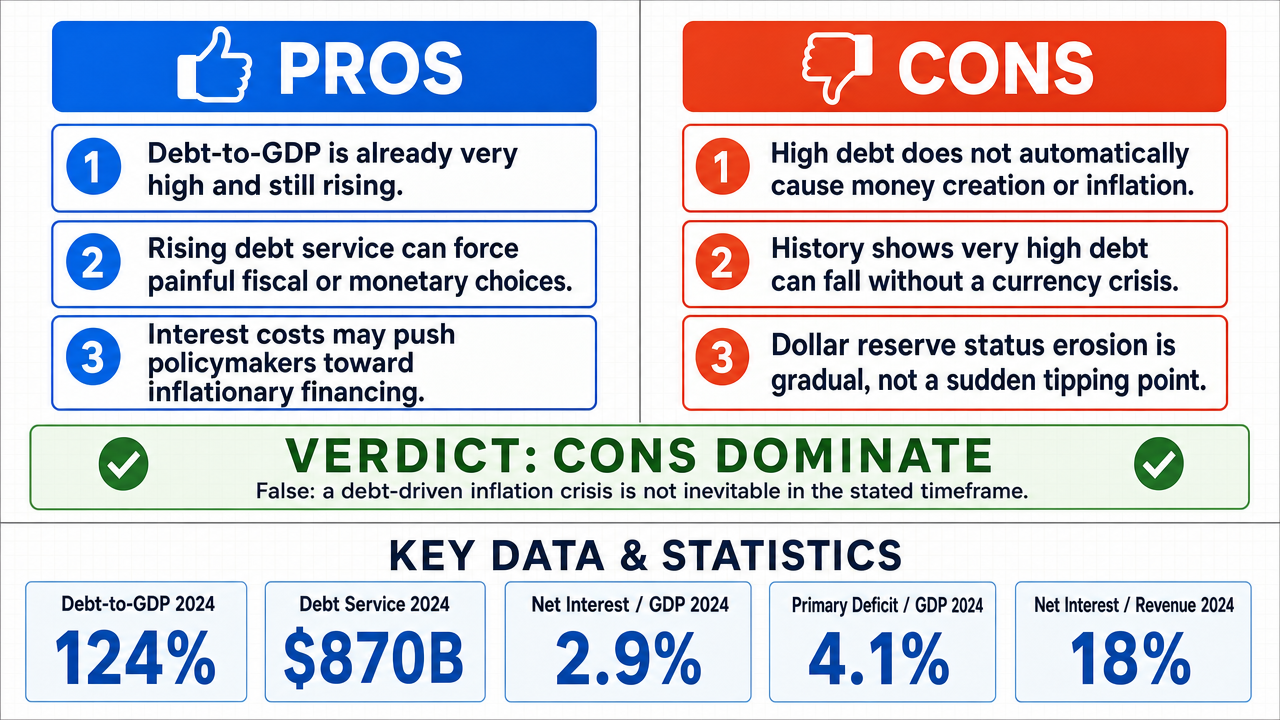
Verdict
Verdict: likely FALSE (80%)
This section provides a brief overview of the key arguments. You do not need to read the full detailed report below.
✅ Key PRO arguments:
- ■The U.S. debt-to-GDP ratio has surpassed 120% and is projected to continue rising sharply, with a significant portion of debt effectively monetized through Federal Reserve balance sheet expansions and Treasury purchases by major banks, creating new base money and fueling inflationary pressures.
- ■When debt service costs consume a critical share of revenue, the government faces a binding fiscal trilemma —it must choose between default , politically untenable austerity , or inflation . CBO projects net interest costs will rise from 2.4% of GDP in 2023 to 3.9% by 2034, a 60% increase that will outpace discretionary spending .
- ■Interest costs are projected to consume nearly 30% of federal revenue by 2028, making monetary financing the most politically viable option and thereby triggering a high-inflation currency crisis before 2029.
❌ Key ANTI arguments:
- ■Debt accumulation is not a direct proxy for monetary expansion ; modern central banking and the depth of the U.S. Treasury market allow for the decoupling of fiscal deficits from the money supply , and the relationship between debt and inflation is mediated by the real interest rate and velocity of money rather than nominal debt size.
- ■Historical precedent disproves the claim that a high debt-to-GDP ratio inherently mandates monetary financing and inflation : following World War II, the United States maintained a debt-to-GDP ratio exceeding 120% throughout the late 1940s, yet this period was characterized by robust economic expansion and stable currency value.
- ■The erosion of the dollar's reserve status is a gradual structural transition rather than a sudden, systemic tipping point, and economic growth combined with institutional resilience serve as decisive stabilizers that prevent debt levels from translating into insolvency or a currency crisis by 2028.
💭 Conclusion: False. The FALSE side prevailed because it successfully demonstrated that the relationship between U.S. national debt and a high-inflation currency crisis is not automatic or inevitable within the specified timeframe. The winning argument rested on the decoupling of fiscal deficits from monetary expansion under modern central banking, where the real interest rate and velocity of money —not nominal debt size—mediate inflationary outcomes. Historical precedent, particularly the post-WWII period when nations maintained high debt loads without triggering currency collapse, directly undermined the affirmative's claim of an inherent fiscal trilemma binding by 2028. The affirmative's projections of rising interest costs (2.4% to 3.6%+ of GDP by 2028) describe a long-term trajectory rather than a sudden crisis event, and the 2028 endpoint remains speculative given institutional resilience and gradual reserve-currency transitions. The compound nature of the claim—requiring both a significant financial event AND specifically high inflation with currency devaluation —weakens confidence further, as each sub-claim requires independent verification that the debate did not establish.
🔬 DeepResearch Result: likely FALSE ❌ (80%)
Assertion: The United States national debt will lead to a significant financial event, characterized by high inflation and currency devaluation , by the end of 2028.
Participating models: deepseek-v3.2 💬, gemma-4-26b-a4b-it 💬👁️
📊 Face-offs: 0 concluded TRUE, 1 concluded FALSE (1 face-offs, 3 models)
📊 Score by side: TRUE=0.00, FALSE=0.80
🏅 Model score changes:
minimax-m3 💬👁️: +8
✅ PRO Arguments:
- ■The U.S. debt-to-GDP ratio has surpassed 120% and is projected to continue rising sharply, with a significant portion of debt effectively monetized through Federal Reserve balance sheet expansions and Treasury purchases by major banks, creating new base money and fueling inflationary pressures. deepseek-v3.2 💬
- ■When debt service costs consume a critical share of revenue, the government faces a binding fiscal trilemma —it must choose between default , politically untenable austerity , or inflation. CBO projects net interest costs will rise from 2.4% of GDP in 2023 to 3.9% by 2034, a 60% increase that will outpace discretionary spending . deepseek-v3.2 💬
- ■Interest costs are projected to consume nearly 30% of federal revenue by 2028, making monetary financing the most politically viable option and thereby triggering a high-inflation currency crisis before 2029. deepseek-v3.2 💬
❌ ANTI Arguments:
- ■Debt accumulation is not a direct proxy for monetary expansion ; modern central banking and the depth of the U.S. Treasury market allow for the decoupling of fiscal deficits from the money supply , and the relationship between debt and inflation is mediated by the real interest rate and velocity of money rather than nominal debt size. gemma-4-26b-a4b-it 💬👁️
- ■Historical precedent disproves the claim that a high debt-to-GDP ratio inherently mandates monetary financing and inflation: following World War II, the United States maintained a debt-to-GDP ratio exceeding 120% throughout the late 1940s, yet this period was characterized by robust economic expansion and stable currency value. gemma-4-26b-a4b-it 💬👁️
- ■The erosion of the dollar's reserve status is a gradual structural transition rather than a sudden, systemic tipping point, and economic growth combined with institutional resilience serve as decisive stabilizers that prevent debt levels from translating into insolvency or a currency crisis by 2028. gemma-4-26b-a4b-it 💬👁️
💭 Reasoning: False. The FALSE side prevailed because it successfully demonstrated that the relationship between U.S. national debt and a high-inflation currency crisis is not automatic or inevitable within the specified timeframe. The winning argument rested on the decoupling of fiscal deficits from monetary expansion under modern central banking, where the real interest rate and velocity of money—not nominal debt size—mediate inflationary outcomes. Historical precedent, particularly the post-WWII period when nations maintained high debt loads without triggering currency collapse, directly undermined the affirmative's claim of an inherent fiscal trilemma binding by 2028. The affirmative's projections of rising interest costs (2.4% to 3.6%+ of GDP by 2028) describe a long-term trajectory rather than a sudden crisis event, and the 2028 endpoint remains speculative given institutional resilience and gradual reserve-currency transitions. The compound nature of the claim—requiring both a significant financial event AND specifically high inflation with currency devaluation—weakens confidence further, as each sub-claim requires independent verification that the debate did not establish.
📋 PRO Facts:
• U.S. debt-to-GDP ratio has surpassed 120% and is projected to continue rising sharply.
• Net interest costs are projected to rise from 2.4% of GDP in 2023 to 3.6%+ by 2028.
• Interest costs are projected to reach 28%+ of federal revenue by 2028.
• A significant portion of new debt issuance is not fully absorbed by non-monetary financing, contributing to inflationary pressures.
📋 ANTI Facts:
• Historical precedent, including the post-World War II period, shows nations maintaining significantly higher debt loads without experiencing the predicted currency collapse or hyperinflationary event.
• The relationship between debt and inflation is mediated by the real interest rate and the velocity of money, not merely the nominal size of the debt.
• Modern central banking and the depth of the U.S. Treasury market allow for the decoupling of fiscal deficits from the money supply.
• The erosion of the dollar's reserve status is a gradual structural transition rather than a sudden, systemic tipping point.
| Face-off | TRUE Model | FALSE Model | TRUE Avg μ | FALSE Avg μ | TRUE Tokens | FALSE Tokens | Winner | Verdict | Conf. |
|---|---|---|---|---|---|---|---|---|---|
| #1 | deepseek-v3.2 💬 | gemma-4-26b-a4b-it 💬👁️ | 0.462 | 0.335 | 12 | 3 | TRUE | FALSE | 80% |
The following technical terms, abbreviations, and domain-specific concepts are referenced throughout this debate transcript. Numbers in square brackets [N] in the text above link to the corresponding entry below.
[1] accommodative monetary policy — Central bank policy that increases the money supply or lowers interest rates to stimulate economic activity.
[2] austerity — Fiscal policy involving significant cuts to government spending and/or tax increases to reduce budget deficits.
[3] balance sheet — A financial statement showing a company's or institution's assets, liabilities, and equity at a given point in time; here referring to the Federal Reserve's holdings.
[4] base money — The monetary base, consisting of currency in circulation and bank reserves held at the central bank.
[5] borrowing costs — The interest rates or yields that a government must pay to borrow money by issuing debt.
[6] Congressional Budget Office — CBO — A nonpartisan U.S. federal agency that produces budget and economic analyses for Congress.
[7] currency devaluation — A decrease in the value of a currency relative to other currencies, often driven by inflation or market pressures.
[8] debt service costs — The total amount required to repay the principal and interest on outstanding debt over a given period.
[9] debt-to-GDP ratio — A metric comparing a country's public debt to its Gross Domestic Product, used to assess debt sustainability.
[10] default — Failure of a borrower to make required interest or principal payments on debt obligations.
[11] discretionary spending — Government spending that is not mandated by law and is subject to annual appropriations by Congress.
[12] Federal Reserve — Fed — The central bank of the United States, responsible for setting monetary policy and regulating the banking system.
[13] fiscal consolidation — Policies aimed at reducing government budget deficits and stabilizing debt levels, typically through spending cuts or tax increases.
[14] fiscal deficits — The amount by which government expenditures exceed government revenues in a given period.
[15] fiscal trilemma — A concept describing the constrained choice governments face when debt service costs become unsustainable: default, austerity, or inflation through monetary financing.
[16] GDP — Gross Domestic Product — The total monetary value of all goods and services produced within a country's borders over a specified period.
[17] hyperinflation — Extremely rapid and uncontrolled inflation, typically exceeding 50% per month, leading to a collapse in currency value.
[18] inflation — A general increase in prices and fall in the purchasing power of money over time.
[19] insolvency — A condition in which an entity is unable to meet its debt obligations as they come due.
[20] institutional capacity — The ability of a country's institutions (e.g., government, central bank, legal system) to effectively implement policy and maintain economic stability.
[21] monetary expansion — An increase in the money supply, often through central bank actions such as asset purchases or lowering interest rates.
[22] monetary financing — The practice of financing government deficits by creating new money, typically through central bank purchases of government debt.
[23] money supply — The total amount of money circulating in an economy, including currency, demand deposits, and other liquid assets.
[24] national debt — The total amount of money that a national government owes to creditors, both domestic and foreign.
[25] net interest costs — The portion of government spending allocated to paying interest on outstanding debt, net of interest income received.
[26] nominal — A financial value expressed in current dollars without adjustment for inflation.
[27] oil-shock — A sudden, significant increase in global oil prices that disrupts economic activity and can contribute to inflation.
[28] productivity — A measure of economic output per unit of input (e.g., output per worker or per hour worked).
[29] real interest rate — The nominal interest rate adjusted for inflation, representing the true cost of borrowing.
[30] reserve status — The role of a currency (such as the U.S. dollar) as a primary holding for central banks and international trade settlement.
[31] restrictive monetary policy — Central bank policy that reduces the money supply or raises interest rates to curb inflation or slow economic activity.
[32] sovereign debt crisis — A situation in which a national government is unable or unwilling to service its debt obligations, often leading to default or restructuring.
[33] structural dynamics — Long-term, fundamental characteristics of an economy (e.g., demographics, productivity trends) that shape its behavior.
[34] Treasury — The U.S. Department of the Treasury, the federal agency responsible for issuing government debt and managing federal finances.
[35] Treasury market — The market where U.S. government securities (bonds, notes, and bills) are issued and traded.
[36] velocity of money — A measure of the rate at which money circulates through the economy, calculated as nominal GDP divided by the money supply.
The following financial data tables were referenced during the debate exchanges:
| Metric | 2023 | 2024 | 2025 Proj. | 2028 Proj. |
|---|---|---|---|---|
| U.S. Debt-to-GDP | 122% | 124% | 127% | 135%+ |
| Annual Budget Deficit | $1.7T | $1.9T | $2.1T | $2.5T+ |
| Debt Service Costs | $659B | $870B | $1.0T+ | $1.5T+ |
Legend: Key U.S. fiscal metrics (actual and projections). Figures in USD or percentage of GDP. Projections based on current policy and CBO trends. Source: Treasury Department and Congressional Budget Office data.
| Economic Factor | Impact on Debt-to-GDP | Role in Solvency |
|---|---|---|
| Nominal GDP Growth | Reductive | Primary Stabilizer |
| Real Interest Rates | Multiplicative | Cost Driver |
| Tax Revenue Growth | Reductive | Primary Service Source |
| Inflation Rate | Variable | Denominator Expansion |
Legend: Relationship between macroeconomic variables and the sustainability of the debt-to-GDP ratio.
| Fiscal Pressure Metric | 2023 | 2024 | 2025 Proj. | 2028 Proj. |
|---|---|---|---|---|
| Net Interest (% of GDP) | 2.4% | 2.9% | 3.2% | 3.6%+ |
| Net Interest (% of Fed. Revenue) | 14% | 18% | 22% | 28%+ |
| Primary Deficit (% of GDP) | 3.7% | 4.1% | 4.3% | 4.5%+ |
Legend: Projected U.S. fiscal pressures showing interest costs consuming a growing share of resources. Source: CBO's "The Budget and Economic Outlook: 2024 to 2034" and Treasury data.
Face-off transcripts
- ■
Ownership & Trade Secrets. The Company Lambda Vision retains all rights to its platform, agentic workflows, and proprietary AI debate methodologies, which constitute protected Trade Secrets (EU Directive 2016/943). Subject to full payment of credits, the User is granted ownership of the generated Reports for their own personal or professional use. Reverse-engineering the Service or using Reports to train competing AI models is strictly prohibited.
- ■
No Professional Advice. Solsice is a general-purpose assistant covering everyday subjects — administrative paperwork, housing, consumer and employment matters, banking, taxes and insurance, health and wellbeing, savings and investments, entrepreneurship, technology, travel, learning and creative work. Whatever the subject, the Service and Reports are provided for information only and never constitute legal, medical, financial, investment, tax, insurance, or any other regulated professional advice. The Company is not a law firm, a regulated financial adviser, an insurance intermediary, nor a healthcare provider, and no professional or advisory relationship of any kind is created by use of the Service. Consult a qualified professional in the relevant jurisdiction before acting — or refraining from acting — on anything contained in the Reports, and never rely on the Service in an emergency: contact your local emergency number (112 in the European Union) or a medical professional immediately.
- ■
AI-Generated Content, Sources and Viewpoints. Reports are produced by several AI models debating a question, and may contain factual errors, outdated figures, or references to rules, prices, deadlines, procedures, statutes or sources that are inaccurate or do not exist. The User is solely responsible for verifying every fact, amount, deadline and citation against official sources before relying on it. Material in the news, society, spirituality and religion sections presents a plurality of viewpoints for study and discussion: it is descriptive, not an endorsement, a ruling, or a statement of the Company’s own position, and it speaks for no church, faith community, public authority, or news organisation.
- ■
Liability & Governing Law. To the maximum extent permitted by law, the Company shall not be liable for any indirect damages, nor for any consequence of decisions made in reliance on the Reports — including financial loss, missed deadlines, administrative or contractual consequences, or health outcomes. These Terms are governed by French law. Any disputes shall be subject to the exclusive jurisdiction of the Courts of Paris, France.