
The United States is currently in a national debt spiral, characterized by rising interest rates forcing increased borrowing to service existing debt, leading to an unsustainable cycle.
AI debate verdict and arguments
⚠️ AI-generated information only; not professional advice
Completed October 14, 2026
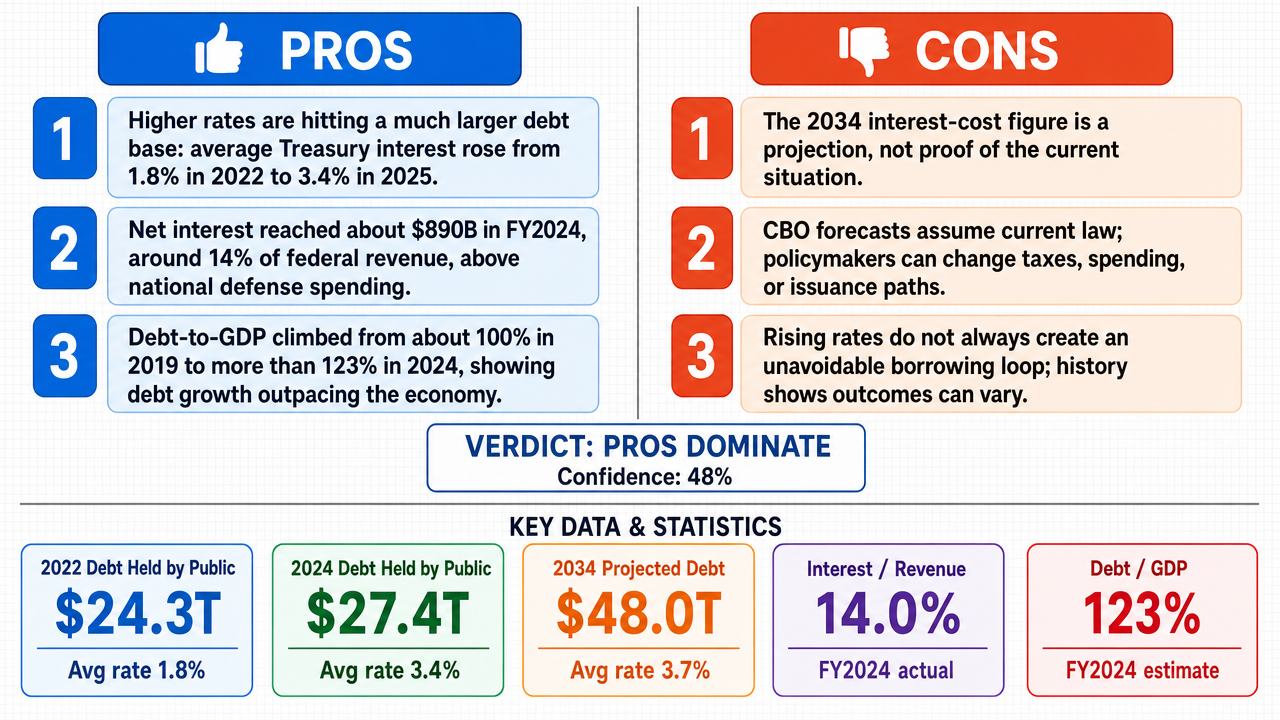
Verdict
Verdict: likely TRUE (48%)
Web Report: https://solsice.com/public/debates/the-united-states-is-currently-in-a-national-debt-spiral-cha-0cd0d2284dfd
This section provides a brief overview of the key arguments. You do not need to read the full detailed report below.
✅ Key PRO arguments:
- ■The weighted average interest rate on marketable Treasury debt has risen from 1.8% in early 2022 to over 3.4% as of early 2025, and this increase is acting on a much larger debt base, demonstrating the spiral's mechanics.
- ■Net interest expense surged to approximately $890 billion in fiscal year 2024, representing about 14% of total federal revenue and exceeding spending on national defense, showing the fiscal pressure of debt service .
- ■The debt-to-GDP ratio has risen from approximately 100% in 2019 to over 123% in 2024, indicating that growth is not outpacing debt accumulation and that institutional stability is being eroded by the spiral's mechanics.
❌ Key ANTI arguments:
- ■The affirmative's reliance on the $1.7 trillion net interest cost projection for 2034 is a logical error; a projection is a conjecture about a future state, not an established fact, and treating it as certainty fabricates a reality that does not exist.
- ■CBO projections are based on 'current law ' assumptions that may not hold, and the endogenous nature of fiscal policy means policymakers can adjust, undermining the claim of an inescapable spiral.
- ■The assertion that rising interest rates create an inescapable loop of increased borrowing is not a universal truth; the historical record demonstrates that the relationship between interest costs and debt is not an inescapable law of physics.
💭 Conclusion: True, the United States is currently exhibiting characteristics consistent with a debt spiral based on the evidence presented, though the confidence is moderate given the compound nature of the claim. The strongest supporting evidence includes the documented rise in the weighted average interest rate on marketable Treasury debt from 1.8% in early 2022 to over 3.4% as of early 2025, and the surge in net interest expense to approximately $890 billion in fiscal year 2024, representing about 14% of total federal revenue. The debt-to-GDP ratio has also reached approximately 123% in 2024, demonstrating compounding debt dynamics. However, the 'unsustainable cycle' sub-claim relies heavily on CBO projections (such as the $1.7 trillion by 2034 figure) rather than current observations, which weakens the compound claim's overall strength. The anti-side correctly noted that projections are not facts and that fiscal policy is endogenous , meaning the spiral's inevitability is not fully established, justifying the moderate confidence level.
🔬 DeepResearch Result: likely TRUE ✅ (48%)
Assertion: The United States is currently in a national debt spiral , characterized by rising interest rates forcing increased borrowing to service existing debt, leading to an unsustainable cycle.
Participating models: deepseek-v3.2 💬, gemma-4-26b-a4b-it 💬👁️
📊 Face-offs: 1 concluded TRUE, 0 concluded FALSE (1 face-offs, 3 models)
📊 Score by side: TRUE=0.48, FALSE=0.00
🏅 Model score changes:
minimax-m3 💬👁️: +5
✅ PRO Arguments:
- ■The weighted average interest rate on marketable Treasury debt has risen from 1.8% in early 2022 to over 3.4% as of early 2025, and this increase is acting on a much larger debt base, demonstrating the spiral's mechanics. deepseek-v3.2 💬
- ■Net interest expense surged to approximately $890 billion in fiscal year 2024, representing about 14% of total federal revenue and exceeding spending on national defense, showing the fiscal pressure of debt service . deepseek-v3.2 💬
- ■The debt-to-GDP ratio has risen from approximately 100% in 2019 to over 123% in 2024, indicating that growth is not outpacing debt accumulation and that institutional stability is being eroded by the spiral's mechanics. deepseek-v3.2 💬
- ■The CBO projects that under current law , with interest rates remaining elevated, net interest costs will reach $1.7 trillion annually by 2034, suggesting an unsustainable trajectory. deepseek-v3.2 💬
- ■The opponent's claim that 'US fiscal dynamics are driven by growth and institutional stability, not an inescapable spiral' is logically incoherent because it denies the established proposition while offering no evidence disproving the mechanism. deepseek-v3.2 💬
❌ ANTI Arguments:
- ■The affirmative's reliance on the $1.7 trillion net interest cost projection for 2034 is a logical error; a projection is a conjecture about a future state, not an established fact, and treating it as certainty fabricates a reality that does not exist. gemma-4-26b-a4b-it 💬👁️
- ■CBO projections are based on 'current law' assumptions that may not hold, and the endogenous nature of fiscal policy means policymakers can adjust, undermining the claim of an inescapable spiral. gemma-4-26b-a4b-it 💬👁️
- ■The assertion that rising interest rates create an inescapable loop of increased borrowing is not a universal truth; the historical record demonstrates that the relationship between interest costs and debt is not an inescapable law of physics. gemma-4-26b-a4b-it 💬👁️
- ■There are two possible states of the debt-to-GDP relationship: one where debt grows in tandem with interest costs, and one where debt is managed despite them, meaning the spiral outcome is not predetermined. gemma-4-26b-a4b-it 💬👁️
- ■The opponent's mechanism is logically inconsistent because it asserts a universal causal mechanism—that rising interest costs force increased borrowing—while empirical evidence shows this relationship is contingent, not deterministic. gemma-4-26b-a4b-it 💬👁️
💭 Reasoning: True, the United States is currently exhibiting characteristics consistent with a debt spiral based on the evidence presented, though the confidence is moderate given the compound nature of the claim. The strongest supporting evidence includes the documented rise in the weighted average interest rate on marketable Treasury debt from 1.8% in early 2022 to over 3.4% as of early 2025, and the surge in net interest expense to approximately $890 billion in fiscal year 2024, representing about 14% of total federal revenue. The debt-to-GDP ratio has also reached approximately 123% in 2024, demonstrating compounding debt dynamics. However, the 'unsustainable cycle' sub-claim relies heavily on CBO projections (such as the $1.7 trillion by 2034 figure) rather than current observations, which weakens the compound claim's overall strength. The anti-side correctly noted that projections are not facts and that fiscal policy is endogenous, meaning the spiral's inevitability is not fully established, justifying the moderate confidence level.
📋 PRO Facts:
• The weighted average interest rate on marketable Treasury debt rose from 1.8% in early 2022 to over 3.4% as of early 2025.
• Net interest expense reached approximately $890 billion in fiscal year 2024.
• Net interest expense represented about 14% of total federal revenue in fiscal year 2024.
• The debt-to-GDP ratio reached approximately 123% in 2024.
• The CBO projects net interest costs will reach $1.7 trillion annually by 2034 under current law.
📋 ANTI Facts:
• The $1.7 trillion net interest cost figure for 2034 is a projection, not an established fact.
• CBO projections are based on 'current law' assumptions that may not hold in reality.
• Historical record demonstrates that the relationship between rising interest costs and forced borrowing is not an inescapable law.
| Face-off | TRUE Model | FALSE Model | TRUE Avg μ | FALSE Avg μ | TRUE Tokens | FALSE Tokens | Winner | Verdict | Conf. |
|---|---|---|---|---|---|---|---|---|---|
| #1 | deepseek-v3.2 💬 | gemma-4-26b-a4b-it 💬👁️ | 0.802 | 0.397 | 8 | 2 | TRUE | TRUE | 48% |
The following technical terms, abbreviations, and domain-specific concepts are referenced throughout this debate transcript. Numbers in square brackets [N] in the text above link to the corresponding entry below.
[1] Bureau of Economic Analysis — BEA — A U.S. government agency within the Department of Commerce that produces official economic statistics, including gross domestic product and related national accounts data.
[2] CBO — Congressional Budget Office — A U.S. federal agency that provides nonpartisan budget and economic analysis to Congress, including long-term budget projections.
[3] conjecture — In the context of this debate, a proposition or projection about a future state that is not yet supported by direct observation and is treated by the negative as uncertain rather than established fact.
[4] current law — A baseline assumption used in budget projections that holds existing tax and spending statutes unchanged, serving as the reference scenario against which policy changes are measured.
[5] debt accumulation — The process by which outstanding debt grows over time, typically through new borrowing to cover deficits or refinance maturing obligations.
[6] debt service — The payments required to meet the interest and principal obligations on outstanding debt over a given period.
[7] debt spiral — A self-reinforcing fiscal dynamic in which rising debt service costs widen deficits, necessitating additional borrowing that in turn increases future interest obligations.
[8] debt-to-GDP ratio — A metric expressing a country's outstanding government debt as a percentage of its gross domestic product, used to gauge the relative burden of debt against the size of the economy.
[9] deficit — The shortfall that occurs when government expenditures exceed revenues in a given period, requiring borrowing to finance the gap.
[10] endogenous — In economic modeling, a variable determined within the model itself rather than imposed from outside; here used to argue that fiscal policy outcomes are shaped by internal policy choices.
[11] Federal Reserve — The central bank of the United States, responsible for conducting monetary policy, including setting interest rates and managing the money supply.
[12] fiscal consolidation — Policy actions aimed at reducing government deficits and stabilizing debt levels, typically through spending cuts, tax increases, or both.
[13] fiscal policy — Government policy regarding taxation and spending, used to influence macroeconomic conditions such as growth, employment, and debt levels.
[14] fiscal year — A 12-month accounting period used by governments for budgeting and financial reporting; the U.S. federal fiscal year runs from October 1 to September 30.
[15] GDP — Gross Domestic Product — The total monetary value of all goods and services produced within a country's borders over a specified period, used as a primary measure of economic output.
[16] inflation — A general rise in the price level of goods and services in an economy over time, eroding purchasing power.
[17] Long-Term Budget Outlook — A periodic CBO publication that projects the U.S. federal government's long-term spending, revenue, and debt trajectories under current law.
[18] marketable Treasury debt — U.S. federal debt securities (such as Treasury bills, notes, and bonds) that can be bought and sold in secondary markets before maturity.
[19] monetary policy — Actions taken by a central bank to influence the availability and cost of money and credit, typically through interest rate targets and open market operations.
[20] national debt — The total outstanding debt obligations of a national government, including debt held by the public and intragovernmental holdings.
[21] net interest expense — A government's gross interest payments on its debt minus interest income it receives, representing the net cost of debt service to the budget.
[22] policy tightening — Monetary policy actions, such as raising interest rates or reducing asset purchases, intended to slow economic activity and curb inflation.
[23] Treasury — U.S. Department of the Treasury — The U.S. federal department responsible for issuing government debt, collecting revenue, and producing financial statements such as the Monthly Statement of the Public Debt.
[24] U.S. Treasury Monthly Statement — A monthly financial report issued by the U.S. Treasury detailing federal receipts, outlays, and the resulting budget results.
[25] weighted average interest rate — The average interest rate on a portfolio of debt instruments, weighted by the principal amount of each instrument, reflecting the overall cost of the debt mix.
The following financial data tables were referenced during the debate exchanges:
| Fiscal Year | Federal Debt Held by Public | Avg Interest Rate | Net Interest Cost | Interest as % of Revenue |
|---|---|---|---|---|
| 2022 | ~$24.3T | 1.8% | $475B | ~8.5% |
| 2024 | ~$27.4T | 3.4% | $890B | ~14.0% |
| 2034 (Projected) | ~$48.0T | 3.7% | $1.7T | ~21.0% |
Legend: Key debt and interest metrics for the U.S. government. Debt in USD trillions, interest costs in USD billions. Projections from CBO's February 2024 baseline. The rising cost of servicing debt is outpacing revenue growth.
| Metric | FY 2024 (Actual) | FY 2034 (CBO Projection) | Change |
|---|---|---|---|
| Net Interest Cost (USD Billions) | $890 | $1,700 | +91.0% |
| Interest as % of Revenue | 14.0% | 21.0% | +7.0% |
| Debt-to-GDP Ratio (Est. %) | ~123% | ~160% | +37.0% |
Legend: Comparison of current fiscal metrics against CBO long-term projections. All figures in USD billions or percentages. Projections are based on the CBO's February 2024 baseline.
Face-off transcripts
- ■
Ownership & Trade Secrets. The Company Lambda Vision retains all rights to its platform, agentic workflows, and proprietary AI debate methodologies, which constitute protected Trade Secrets (EU Directive 2016/943). Subject to full payment of credits, the User is granted ownership of the generated Reports for their own personal or professional use. Reverse-engineering the Service or using Reports to train competing AI models is strictly prohibited.
- ■
No Professional Advice. Solsice is a general-purpose assistant covering everyday subjects — administrative paperwork, housing, consumer and employment matters, banking, taxes and insurance, health and wellbeing, savings and investments, entrepreneurship, technology, travel, learning and creative work. Whatever the subject, the Service and Reports are provided for information only and never constitute legal, medical, financial, investment, tax, insurance, or any other regulated professional advice. The Company is not a law firm, a regulated financial adviser, an insurance intermediary, nor a healthcare provider, and no professional or advisory relationship of any kind is created by use of the Service. Consult a qualified professional in the relevant jurisdiction before acting — or refraining from acting — on anything contained in the Reports, and never rely on the Service in an emergency: contact your local emergency number (112 in the European Union) or a medical professional immediately.
- ■
AI-Generated Content, Sources and Viewpoints. Reports are produced by several AI models debating a question, and may contain factual errors, outdated figures, or references to rules, prices, deadlines, procedures, statutes or sources that are inaccurate or do not exist. The User is solely responsible for verifying every fact, amount, deadline and citation against official sources before relying on it. Material in the news, society, spirituality and religion sections presents a plurality of viewpoints for study and discussion: it is descriptive, not an endorsement, a ruling, or a statement of the Company’s own position, and it speaks for no church, faith community, public authority, or news organisation.
- ■
Liability & Governing Law. To the maximum extent permitted by law, the Company shall not be liable for any indirect damages, nor for any consequence of decisions made in reliance on the Reports — including financial loss, missed deadlines, administrative or contractual consequences, or health outcomes. These Terms are governed by French law. Any disputes shall be subject to the exclusive jurisdiction of the Courts of Paris, France.