
The title 'Scribbler' for a book sounds too similar to the 'Alcatraz' series
AI debate verdict and arguments
⚠️ AI-generated information only; not professional advice
Completed October 8, 2026
Verdict
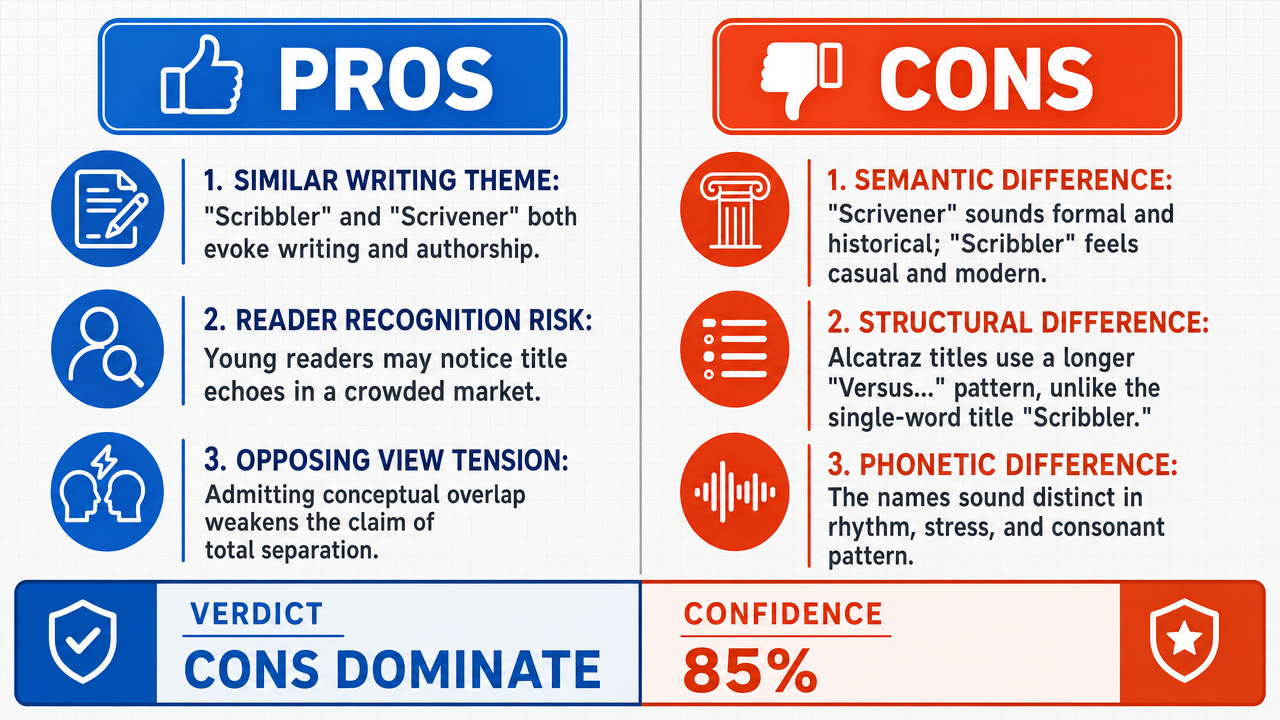
Verdict: likely FALSE (85%)
This section provides a brief overview of the key arguments. You do not need to read the full detailed report below.
✅ Key PRO arguments:
- ■Phonetic and stylistic mirroring: 'Scribbler' shares semantic overlap with the 'Alcatraz' series title 'Alcatraz Versus the Scrivener's Bones,' since 'Scrivener' and 'Scribbler' are direct synonyms denoting a writer or copyist, creating immediate semantic overlap for the middle-grade target audience.
- ■Middle-grade readers are highly sensitive to title recognition and branding, and thematic similarity in the crowded middle-grade market is a primary vector for consumer association , making the shared writing-related semantic space a foundation for potential confusion.
- ■The opponent's position is logically inconsistent: it concedes that 'scrivener' and 'scribbler' share a 'broad conceptual field related to writing' yet asserts this shared field is insufficient to cause confusion without defining any threshold for sufficiency.
❌ Key ANTI arguments:
- ■Semantic distinction: 'Scrivener' denotes a professional clerk or scribe with formal or historical connotations, whereas 'Scribbler' is a colloquial, often self-deprecating term for an amateur writer; they are not synonymous in a way that triggers consumer confusion .
- ■Structural distinction: The 'Alcatraz' series is defined by a complex, multi-part 'Versus [Descriptor] [Noun]' titling convention (e.g., 'Alcatraz Versus the Evil Librarians'), a rhythmic signature that a single-word title like 'Scribbler' cannot replicate.
- ■Phonetic distinction: 'Alcatraz' and 'Scribbler' are phonetically distinct, with different syllable counts, stress patterns, and consonant clusters, making auditory confusion unlikely.
💭 Conclusion: False. The title 'Scribbler' is not too similar to the 'Alcatraz' series because the two differ fundamentally across semantic, structural, and phonetic dimensions. Semantically, 'scrivener' implies a formal, professional role while 'scribbler' is a colloquial term for an amateur writer, so they are not true synonyms. Structurally, the 'Alcatraz' series relies on a distinctive multi-word 'Versus [Descriptor] [Noun]' formula that a single-word title cannot replicate. Phonetically, 'Alcatraz' and 'Scribbler' have different syllable counts, stress patterns, and sounds, making auditory confusion unlikely. From a trademark perspective, the series' brand strength derives from its specific titling convention rather than any individual word, so 'Scribbler' does not create a likelihood of confusion . The affirmative's argument rested primarily on a loose thematic association that the judge found insufficient to establish meaningful similarity.
🔬 DeepResearch Result: likely FALSE ❌ (85%)
Assertion: The title 'Scribbler' for a book sounds too similar to the 'Alcatraz' series
Participating models: deepseek-v3.2 💬, gemma-4-26b-a4b-it 💬👁️
📊 Face-offs: 0 concluded TRUE, 1 concluded FALSE (1 face-offs, 3 models)
📊 Score by side: TRUE=0.00, FALSE=0.85
🏅 Model score changes:
minimax-m3 💬👁️: +8
✅ PRO Arguments:
- ■Phonetic and stylistic mirroring: 'Scribbler' shares semantic overlap with the 'Alcatraz' series title 'Alcatraz Versus the Scrivener's Bones,' since 'Scrivener' and 'Scribbler' are direct synonyms denoting a writer or copyist, creating immediate semantic overlap for the middle-grade target audience. deepseek-v3.2 💬
- ■Middle-grade readers are highly sensitive to title recognition and branding, and thematic similarity in the crowded middle-grade market is a primary vector for consumer association , making the shared writing-related semantic space a foundation for potential confusion. deepseek-v3.2 💬
- ■The opponent's position is logically inconsistent: it concedes that 'scrivener' and 'scribbler' share a 'broad conceptual field related to writing' yet asserts this shared field is insufficient to cause confusion without defining any threshold for sufficiency. deepseek-v3.2 💬
❌ ANTI Arguments:
- ■Semantic distinction: 'Scrivener' denotes a professional clerk or scribe with formal or historical connotations, whereas 'Scribbler' is a colloquial, often self-deprecating term for an amateur writer; they are not synonymous in a way that triggers consumer confusion . gemma-4-26b-a4b-it 💬👁️
- ■Structural distinction: The 'Alcatraz' series is defined by a complex, multi-part 'Versus [Descriptor] [Noun]' titling convention (e.g., 'Alcatraz Versus the Evil Librarians'), a rhythmic signature that a single-word title like 'Scribbler' cannot replicate. gemma-4-26b-a4b-it 💬👁️
- ■Phonetic distinction: 'Alcatraz' and 'Scribbler' are phonetically distinct, with different syllable counts, stress patterns, and consonant clusters, making auditory confusion unlikely. gemma-4-26b-a4b-it 💬👁️
- ■Trademark law analysis: Under the standard USPTO 'likelihood of confusion ' test, the 'Alcatraz' series' strength derives from its highly specific multi-word titling convention, not from the word 'Alcatraz' alone; a single-word title like 'Scribbler' does not infringe on this distinctive format. gemma-4-26b-a4b-it 💬👁️
💭 Reasoning: False. The title 'Scribbler' is not too similar to the 'Alcatraz' series because the two differ fundamentally across semantic, structural, and phonetic dimensions. Semantically, 'scrivener' implies a formal, professional role while 'scribbler' is a colloquial term for an amateur writer, so they are not true synonyms. Structurally, the 'Alcatraz' series relies on a distinctive multi-word 'Versus [Descriptor] [Noun]' formula that a single-word title cannot replicate. Phonetically, 'Alcatraz' and 'Scribbler' have different syllable counts, stress patterns, and sounds, making auditory confusion unlikely. From a trademark perspective, the series' brand strength derives from its specific titling convention rather than any individual word, so 'Scribbler' does not create a likelihood of confusion. The affirmative's argument rested primarily on a loose thematic association that the judge found insufficient to establish meaningful similarity.
📋 PRO Facts:
• The 'Alcatraz' series by Brandon Sanderson includes the title 'Alcatraz Versus the Scrivener's Bones.'
• 'Scrivener' and 'Scribbler' both broadly relate to writing or copying text.
• The middle-grade reading demographic is sensitive to title recognition and branding.
📋 ANTI Facts:
• 'Scrivener' historically denotes a professional clerk or scribe, while 'scribbler' is a colloquial term for an amateur writer.
• The 'Alcatraz' series uses a consistent multi-word titling convention: 'Alcatraz Versus the [Descriptor] [Noun].'
• 'Alcatraz' and 'Scribbler' are phonetically distinct in syllable count, stress, and consonant composition.
• Under USPTO trademark analysis, brand strength derives from distinctive titling patterns, not individual words.
| Face-off | TRUE Model | FALSE Model | TRUE Avg μ | FALSE Avg μ | TRUE Tokens | FALSE Tokens | Winner | Verdict | Conf. |
|---|---|---|---|---|---|---|---|---|---|
| #1 | deepseek-v3.2 💬 | gemma-4-26b-a4b-it 💬👁️ | 0.477 | 0.383 | 12 | 3 | TRUE | FALSE | 85% |
The following technical terms, abbreviations, and domain-specific concepts are referenced throughout this debate transcript. Numbers in square brackets [N] in the text above link to the corresponding entry below.
[1] auditory brand — The sonic or phonetic identity of a brand, including sounds, rhythms, and cadence that consumers associate with a product or series.
[2] brand dilution — The weakening of a brand's identity or distinctiveness, often caused by similar competing products or titles entering the market.
[3] brand identity — The set of distinctive features—including naming conventions, structural patterns, and stylistic markers—that define and distinguish a brand or series.
[4] brand recognition — The ability of consumers to identify a brand or series based on its characteristic features, such as title structure or naming patterns.
[5] consumer association — The mental linkage a consumer makes between products or titles based on shared thematic, semantic, or phonetic features.
[6] consumer confusion — A state in which a consumer mistakenly attributes one product or title to another, often due to perceived similarity.
[7] dactylic — In prosody, a metrical foot consisting of one stressed syllable followed by two unstressed syllables; the debate describes 'Alcatraz' as a three-syllable dactylic proper noun.
[8] likelihood of confusion — A legal standard used by the USPTO and courts in trademark analysis to determine whether consumers are likely to confuse one mark with another.
[9] middle-grade — A publishing industry category referring to books targeted at readers roughly ages 8–12, identified in the debate as the primary audience for both titles.
[10] phonetic — Relating to the sounds of speech; in the debate, used to compare the auditory qualities of 'Scribbler' and 'Alcatraz' series titles.
[11] prepositional phrase — A grammatical structure consisting of a preposition and its object; the debate notes the 'Alcatraz' titles are characterized by multi-word prepositional phrases.
[12] rhythmic cadence — The patterned rise and fall of stress or sound in speech or titles; cited in the debate as a defining feature of the 'Alcatraz' series' brand.
[13] semantic field — A set of words or concepts grouped by shared meaning; the debate notes 'scrivener' and 'scribbler' share a broad conceptual field related to writing.
[14] semantic overlap — The degree to which two terms share meaning or conceptual territory; cited by the affirmative as evidence of potential confusion.
[15] semantic space — The conceptual territory occupied by a word's meaning; the affirmative argues that two words occupying the same semantic space form the basis for potential confusion.
[16] similarity of the marks — A factor in the trademark likelihood-of-confusion analysis assessing how alike two marks are in appearance, sound, or meaning.
[17] strength of the mark — A factor in trademark law measuring how distinctive or recognizable a mark is; the debate argues the 'Alcatraz' series' strength derives from its multi-word titling convention.
[18] stylistic — Relating to the distinctive manner or style of expression; used in the debate to compare the stylistic features of competing book titles.
[19] syntactic complexity — The degree to which a phrase or title involves elaborate grammatical structure; the debate contrasts the multi-part 'Alcatraz' titles with the single-word 'Scribbler.'
[20] titular formula — A recurring structural pattern used in a series of titles; the debate identifies the 'Alcatraz Versus the [Descriptor] [Noun]' pattern as the series' titular formula.
[21] trademark — A legally protected symbol, word, or phrase that identifies and distinguishes the source of goods; the debate discusses whether the 'Alcatraz' titles qualify for trademark-level protection.
[22] trochee — In prosody, a metrical foot consisting of one stressed syllable followed by one unstressed syllable; the debate describes 'Scribbler' as a two-syllable trochee.
[23] USPTO — United States Patent and Trademark Office — The U.S. federal agency responsible for granting patents and registering trademarks; cited in the debate as the body whose likelihood-of-confusion standard applies.
Face-off transcripts
- ■
Ownership & Trade Secrets. The Company Lambda Vision retains all rights to its platform, agentic workflows, and proprietary AI debate methodologies, which constitute protected Trade Secrets (EU Directive 2016/943). Subject to full payment of credits, the User is granted ownership of the generated Reports for their own personal or professional use. Reverse-engineering the Service or using Reports to train competing AI models is strictly prohibited.
- ■
No Professional Advice. Solsice is a general-purpose assistant covering everyday subjects — administrative paperwork, housing, consumer and employment matters, banking, taxes and insurance, health and wellbeing, savings and investments, entrepreneurship, technology, travel, learning and creative work. Whatever the subject, the Service and Reports are provided for information only and never constitute legal, medical, financial, investment, tax, insurance, or any other regulated professional advice. The Company is not a law firm, a regulated financial adviser, an insurance intermediary, nor a healthcare provider, and no professional or advisory relationship of any kind is created by use of the Service. Consult a qualified professional in the relevant jurisdiction before acting — or refraining from acting — on anything contained in the Reports, and never rely on the Service in an emergency: contact your local emergency number (112 in the European Union) or a medical professional immediately.
- ■
AI-Generated Content, Sources and Viewpoints. Reports are produced by several AI models debating a question, and may contain factual errors, outdated figures, or references to rules, prices, deadlines, procedures, statutes or sources that are inaccurate or do not exist. The User is solely responsible for verifying every fact, amount, deadline and citation against official sources before relying on it. Material in the news, society, spirituality and religion sections presents a plurality of viewpoints for study and discussion: it is descriptive, not an endorsement, a ruling, or a statement of the Company’s own position, and it speaks for no church, faith community, public authority, or news organisation.
- ■
Liability & Governing Law. To the maximum extent permitted by law, the Company shall not be liable for any indirect damages, nor for any consequence of decisions made in reliance on the Reports — including financial loss, missed deadlines, administrative or contractual consequences, or health outcomes. These Terms are governed by French law. Any disputes shall be subject to the exclusive jurisdiction of the Courts of Paris, France.