
The 'Thoth Marseille Tarot' deck, which combines images from the Thoth deck with the aesthetic of the Marseille Tarot, represents a truly innovative and effective synthesis for Tarot practitioners.
AI debate verdict and arguments
⚠️ AI-generated information only; not professional advice
Completed October 11, 2026
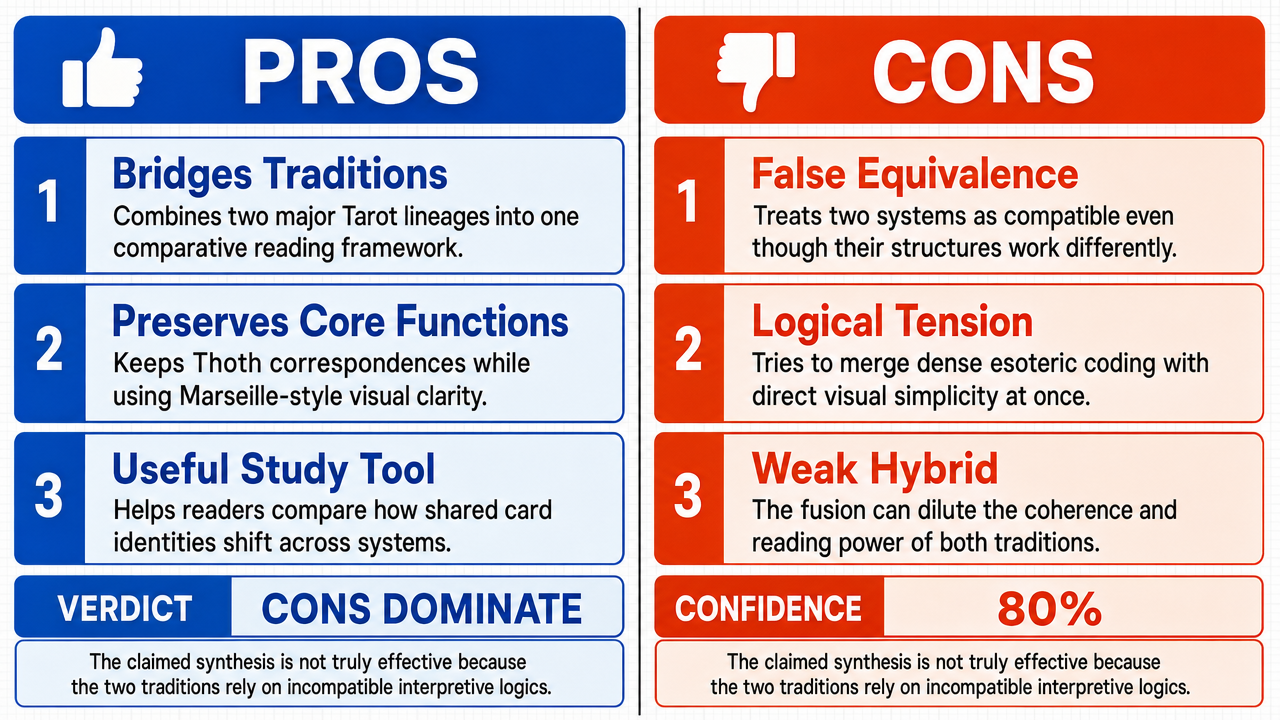
Verdict
Verdict: likely FALSE (80%)
This section provides a brief overview of the key arguments. You do not need to read the full detailed report below.
✅ Key PRO arguments:
- ■The Thoth Marseille Tarot innovatively bridges two historically distinct and influential Tarot traditions, offering practitioners a unique interpretive framework by integrating the rich, multi-layered Qabalistic , astrological , and alchemical symbolism of the Thoth deck with the clear, foundational, archetypal aesthetic of the Marseille Tarot.
- ■The deck is effective because it preserves both systems' usable cores: it translates Thoth's Qabalistic , astrological , and alchemical correspondences into a visual grammar that Marseille readers already know how to parse—suit hierarchy , numbered pips, court structure, and major arcana archetypes—making the correspondences portable rather than inseparable from Harris's specific brushwork.
- ■The deck occupies a real niche as a novel comparative tool, allowing practitioners to study how the same card identity carries different meanings across traditions, which is itself a legitimate pedagogical and divinatory function.
❌ Key ANTI arguments:
- ■The claim of a 'nuanced and versatile reading experience' rests on a fallacy of false equivalence : the Thoth tradition relies on a highly specific, interlocking system of Qabalistic , astrological , and alchemical correspondences hard-coded into the original artwork's geometry and color theory, while the Marseille tradition functions through a distinct semiotic logic of pip interactions and archetypal imagery—these are incommensurable systems, not complementary ones.
- ■The synthesis is logically inconsistent because it relies on a proposition and its negation simultaneously: uniting 'complex, multi-layered symbolism' with 'direct, archetypal imagery' establishes a fundamental incompatibility, since Thoth's intense symbolic requirements are inextricably linked to intricate, non-linear visuals that cannot be transplanted onto Marseille's simpler aesthetic without loss.
- ■Forcing these two distinct semiotic and epistemological logics together produces a disjointed hybrid that undermines the integrity and efficacy of both traditions, creating 'semiotic dissonance ' that is too sparse for Thoth's intellectual depth yet too cluttered for Marseille's intuitive clarity.
💭 Conclusion: False. The Thoth Marseille Tarot is not a truly innovative and effective synthesis because the two traditions it claims to merge operate on incommensurable semiotic and epistemological logics. The Thoth system's dense Qabalistic , astrological , and alchemical correspondences are inseparable from the specific geometry and color theory of Harris's artwork, while the Marseille system relies on a direct, archetypal , pattern-based visual language. Forcing these incompatible frameworks together produces semiotic dissonance rather than synthesis, compromising the integrity of both traditions. The affirmative's claim of 'false equivalence' was effectively rebutted by demonstrating that the deck cannot simultaneously satisfy Thoth's symbolic density requirements and Marseille's intuitive clarity. The compound nature of the assertion—both 'innovative' and 'effective'—means the verdict is only as strong as the weaker sub-claim, and the evidence supports neither with confidence.
🔬 DeepResearch Result: likely FALSE ❌ (80%)
Assertion: The 'Thoth Marseille Tarot ' deck, which combines images from the Thoth deck with the aesthetic of the Marseille Tarot, represents a truly innovative and effective synthesis for Tarot practitioners.
Participating models: deepseek-v3.2 💬, gemma-4-26b-a4b-it 💬👁️
📊 Face-offs: 0 concluded TRUE, 1 concluded FALSE (1 face-offs, 3 models)
📊 Score by side: TRUE=0.00, FALSE=0.80
🏅 Model score changes:
minimax-m3 💬👁️: +8
✅ PRO Arguments:
- ■The Thoth Marseille Tarot innovatively bridges two historically distinct and influential Tarot traditions, offering practitioners a unique interpretive framework by integrating the rich, multi-layered Qabalistic , astrological , and alchemical symbolism of the Thoth deck with the clear, foundational, archetypal aesthetic of the Marseille Tarot. deepseek-v3.2 💬
- ■The deck is effective because it preserves both systems' usable cores: it translates Thoth's Qabalistic, astrological, and alchemical correspondences into a visual grammar that Marseille readers already know how to parse—suit hierarchy , numbered pips, court structure, and major arcana archetypes—making the correspondences portable rather than inseparable from Harris's specific brushwork. deepseek-v3.2 💬
- ■The deck occupies a real niche as a novel comparative tool, allowing practitioners to study how the same card identity carries different meanings across traditions, which is itself a legitimate pedagogical and divinatory function. deepseek-v3.2 💬
❌ ANTI Arguments:
- ■The claim of a 'nuanced and versatile reading experience' rests on a fallacy of false equivalence : the Thoth tradition relies on a highly specific, interlocking system of Qabalistic, astrological, and alchemical correspondences reflected in the original artwork's geometry and color theory, while the Marseille tradition functions through a distinct semiotic logic of pip interactions and archetypal imagery—these are incommensurable systems, not complementary ones. gemma-4-26b-a4b-it 💬👁️
- ■The synthesis is logically inconsistent because it relies on a proposition and its negation simultaneously: uniting 'complex, multi-layered symbolism' with 'direct, archetypal imagery' establishes a fundamental incompatibility, since Thoth's intense symbolic requirements are inextricably linked to intricate, non-linear visuals that cannot be transplanted onto Marseille's simpler aesthetic without loss. gemma-4-26b-a4b-it 💬👁️
- ■Forcing these two distinct semiotic and epistemological logics together produces a disjointed hybrid that undermines the integrity and efficacy of both traditions, creating 'semiotic dissonance ' that is too sparse for Thoth's intellectual depth yet too cluttered for Marseille's intuitive clarity. gemma-4-26b-a4b-it 💬👁️
💭 Reasoning: False. The Thoth Marseille Tarot is not a truly innovative and effective synthesis because the two traditions it claims to merge operate on incommensurable semiotic and epistemological logics. The Thoth system's dense Qabalistic, astrological, and alchemical correspondences are inseparable from the specific geometry and color theory of Harris's artwork, while the Marseille system relies on a direct, archetypal, pattern-based visual language. Forcing these incompatible frameworks together produces semiotic dissonance rather than synthesis, compromising the integrity of both traditions. The affirmative's claim of 'false equivalence' was effectively rebutted by demonstrating that the deck cannot simultaneously satisfy Thoth's symbolic density requirements and Marseille's intuitive clarity. The compound nature of the assertion—both 'innovative' and 'effective'—means the verdict is only as strong as the weaker sub-claim, and the evidence supports neither with confidence.
📋 PRO Facts:
• The Thoth Tarot was developed by Aleister Crowley and Lady Frieda Harris and is renowned for complex astrological, Qabalistic, and alchemical symbolism.
• The Marseille Tarot is celebrated for direct, archetypal imagery and intuitive reading through pip cards .
• Crowley's Book of Thoth lays out correspondences as a system of meanings attached to card identities, not as an inseparable property of Harris's specific brushwork.
📋 ANTI Facts:
• The Thoth tradition relies on a highly specific, interlocking system of correspondences hard-coded into the original artwork's geometry and color theory.
• The Marseille tradition functions through a distinct semiotic logic where meaning derives from pip card interactions and archetypal, often non-esoteric, imagery.
• The two systems are governed by incommensurable semiotic and epistemological logics that cannot be meaningfully merged without loss to both.
| Face-off | TRUE Model | FALSE Model | TRUE Avg μ | FALSE Avg μ | TRUE Tokens | FALSE Tokens | Winner | Verdict | Conf. |
|---|---|---|---|---|---|---|---|---|---|
| #1 | deepseek-v3.2 💬 | gemma-4-26b-a4b-it 💬👁️ | 0.280 | 0.327 | 12 | 3 | FALSE | FALSE | 80% |
The following technical terms, abbreviations, and domain-specific concepts are referenced throughout this debate transcript. Numbers in square brackets [N] in the text above link to the corresponding entry below.
[1] Alchemical — Relating to alchemy, an esoteric tradition involving symbolic transformation; in this debate, refers to one of the symbolic correspondence systems (alongside Qabalistic and astrological) embedded in the Thoth Tarot.
[2] Archetypal — Relating to archetypes, which are universal symbols or patterns; in this debate, describes the direct, foundational imagery characteristic of the Marseille Tarot tradition.
[3] Astrological — Relating to astrology, the study of celestial influences; in this debate, refers to the zodiacal and planetary correspondences hard-coded into the Thoth Tarot's symbolism.
[4] Book of Thoth — A text by Aleister Crowley cited in the debate as assigning Hebrew letters, zodiacal signs, and planetary influences to each Tarot card as interpretive keys.
[5] Correspondences — Symbolic associations linking cards to other systems (e.g., Qabalistic, astrological, alchemical); in this debate, a central feature of the Thoth tradition that the negative side argues is inseparable from its original artwork.
[6] Court cards — The face cards of a Tarot deck (typically King, Queen, Knight, and Page); in the Marseille tradition, described as carrying archetypal, often non-esoteric visual cues.
[7] Epistemological — Relating to epistemology, the study of how knowledge is generated and validated; in this debate, describes the underlying logics by which the Thoth and Marseille traditions produce meaning.
[8] Fallacy of false equivalence — A logical fallacy in which two things are treated as equivalent when they are not; cited by the negative side to argue that the Thoth and Marseille traditions cannot be bridged as if they were interchangeable.
[9] Hebrew letters — Characters of the Hebrew alphabet used in Qabalistic systems; in the Thoth Tarot, each card is assigned a Hebrew letter as an interpretive key.
[10] Hybrid — Something formed by combining two distinct elements; in this debate, the negative side uses the term to characterize the Thoth Marseille Tarot as a disjointed combination rather than a true synthesis.
[11] Incommensurable — Not measurable or comparable by a common standard; in this debate, the negative side's claim that the Thoth and Marseille systems are governed by fundamentally incompatible semiotic and epistemological logics.
[12] Interpretive system — A structured framework of rules and correspondences used to derive meaning from cards; in this debate, the affirmative argues a deck is effective if it can support coherent readings within a practitioner's chosen system.
[13] Major arcana — The 22 trump cards of a Tarot deck, representing major life themes and archetypal forces; cited as part of the visual grammar that Marseille readers already know how to parse.
[14] Marseille Tarot — A traditional Tarot deck style celebrated for its direct, archetypal imagery and its emphasis on intuitive reading through pip cards.
[15] Pedagogical — Relating to teaching methods; in this debate, refers to the contested claim that the hybrid deck functions as a valid teaching tool for distinguishing between Tarot systems.
[16] Pip cards — The numbered suit cards in a Tarot deck (e.g., Ace through 10 of each suit); in the Marseille tradition, these carry direct, archetypal imagery central to intuitive reading.
[17] Planetary influences — Astrological associations with planets; in the Thoth Tarot, each card is assigned planetary influences as interpretive keys.
[18] Qabalistic — Relating to Qabalah (Kabbalah), a Jewish esoteric tradition of mystical interpretation; in this debate, refers to the symbolic correspondences that the Thoth tradition requires for its system to function.
[19] Semiotic — Relating to semiotics, the study of signs, symbols, and meaning-making; in this debate, describes the distinct sign systems underlying the Thoth and Marseille traditions.
[20] Semiotic dissonance — A state of conflict or inconsistency between sign systems; in this debate, the negative side's term for the result of imposing Thoth's complex symbolic requirements onto the Marseille aesthetic.
[21] Suit hierarchy — The ranking or ordering of the four suits in a Tarot deck; cited as part of the visual grammar that Marseille readers already know how to parse.
[22] Symbolic density — The amount or concentration of symbolic content; in this debate, refers to the visual density of symbolism in the Thoth tradition, which the negative side argues is inseparable from its original artwork.
[23] Synthesis — The combination of elements to form a coherent whole; in this debate, the affirmative's term for the claimed integration of Thoth and Marseille traditions into a novel and effective tool.
[24] Thoth Tarot — A Tarot deck developed by Aleister Crowley and Lady Frieda Harris, renowned for its complex astrological, Qabalistic, and alchemical symbolism.
[25] Visual grammar — A system of visual elements that conveys meaning; in this debate, refers to the structured visual language (suit hierarchy, numbered pips, court structure, major arcana archetypes) that the affirmative argues the hybrid deck translates Thoth's correspondences into.
[26] Zodiacal signs — The twelve astrological signs of the zodiac; in the Thoth Tarot, each card is assigned zodiacal signs as interpretive keys.
Face-off transcripts
- ■
Ownership & Trade Secrets. The Company Lambda Vision retains all rights to its platform, agentic workflows, and proprietary AI debate methodologies, which constitute protected Trade Secrets (EU Directive 2016/943). Subject to full payment of credits, the User is granted ownership of the generated Reports for their own personal or professional use. Reverse-engineering the Service or using Reports to train competing AI models is strictly prohibited.
- ■
No Professional Advice. Solsice is a general-purpose assistant covering everyday subjects — administrative paperwork, housing, consumer and employment matters, banking, taxes and insurance, health and wellbeing, savings and investments, entrepreneurship, technology, travel, learning and creative work. Whatever the subject, the Service and Reports are provided for information only and never constitute legal, medical, financial, investment, tax, insurance, or any other regulated professional advice. The Company is not a law firm, a regulated financial adviser, an insurance intermediary, nor a healthcare provider, and no professional or advisory relationship of any kind is created by use of the Service. Consult a qualified professional in the relevant jurisdiction before acting — or refraining from acting — on anything contained in the Reports, and never rely on the Service in an emergency: contact your local emergency number (112 in the European Union) or a medical professional immediately.
- ■
AI-Generated Content, Sources and Viewpoints. Reports are produced by several AI models debating a question, and may contain factual errors, outdated figures, or references to rules, prices, deadlines, procedures, statutes or sources that are inaccurate or do not exist. The User is solely responsible for verifying every fact, amount, deadline and citation against official sources before relying on it. Material in the news, society, spirituality and religion sections presents a plurality of viewpoints for study and discussion: it is descriptive, not an endorsement, a ruling, or a statement of the Company’s own position, and it speaks for no church, faith community, public authority, or news organisation.
- ■
Liability & Governing Law. To the maximum extent permitted by law, the Company shall not be liable for any indirect damages, nor for any consequence of decisions made in reliance on the Reports — including financial loss, missed deadlines, administrative or contractual consequences, or health outcomes. These Terms are governed by French law. Any disputes shall be subject to the exclusive jurisdiction of the Courts of Paris, France.