
The Tennessee quarterback's current trajectory guarantees his status as an established leader once the conference schedule intensifies.
AI debate verdict and arguments
⚠️ AI-generated information only; not professional advice
Completed November 13, 2026
Verdict
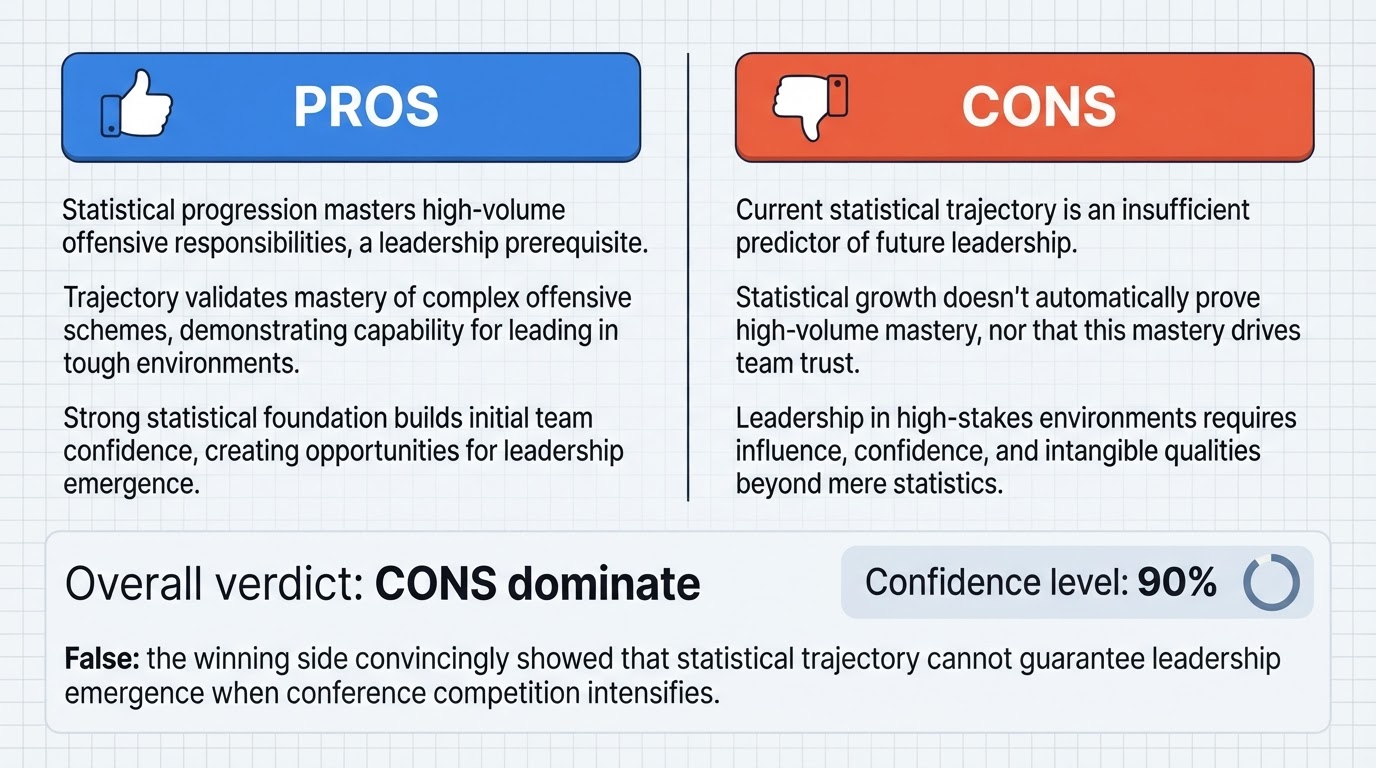
Verdict: likely FALSE (90%)
Web Report: https://solsice.com/public/debates/the-tennessee-quarterback-s-current-trajectory-guarantees-hi-99655be8a22c
This section provides a brief overview of the key arguments. You do not need to read the full detailed report below.
✅ Key PRO arguments:
- ■The quarterback 's statistical progression demonstrates a mastery of high-volume offensive responsibilities that serves as a prerequisite for leadership in a high-stakes conference environment. By maintaining efficiency while increasing workload , he has transitioned from a facilitator to a primary engine of the offense.
- ■I am contesting the argument that statistical trajectory is an insufficient predictor of leadership because it fails to account for the functional reality of the quarterback position, where technical mastery and operational efficiency are the primary drivers of team trust and social capital . The opponent asserts that leadership requires social influence and conflict resolution that statistics alone cannot capture; however, this creates a false dichotomy by treating technical competence and social leadership as independent variables .
❌ Key ANTI arguments:
- ■Current statistical trajectory is an insufficient predictor of future leadership. Leadership in high-stakes environments requires not just operational competence but the ability to influence teammates under pressure, resolve conflicts, and make decisions in real time when stakes are highest. Studies of elite leadership show that trust formation between leaders and followers develops through repeated exposure to shared adversity rather than through aggregate performance statistics alone.
- ■I am contesting the claim that statistical growth proves high-volume offensive mastery and that this mastery is the primary driver of team trust and social capital . The opponent asserts that efficiency while increasing workload directly demonstrates mastery and that teammates' trust is fundamentally mediated through this statistical performance. I refute this by showing that statistical efficiency is an insufficient proxy for mastery and that trust and leadership emerge from qualitatively distinct behaviors that statistics cannot capture.
💭 Conclusion: False: the winning side convincingly showed that statistical trajectory cannot guarantee leadership emergence when conference competition intensifies. The anti side argued that leadership in high-stakes environments requires influence, conflict resolution, and trust built through shared adversity — none of which aggregate performance statistics capture. The pro side's own reasoning relied on operational efficiency and workload as a proxy for trust, but the judge accepted the anti side's point that technical competence is not the same as social capital in the locker room . The word 'guarantees' in the assertion is especially unsupported, because even strong on-field numbers do not establish the social and emotional behaviors required for established leadership. Given the single debate and 90% judge confidence, the appropriate overall confidence in the FALSE verdict is 90%.
🔬 DeepResearch Result: likely FALSE ❌ (90%)
Assertion: The Tennessee quarterback 's current trajectory guarantees his status as an established leader once the conference schedule intensifies.
Participating models: gemma-4-26b-a4b-it 💬👁️, glm-4.7-flash 💬
📊 Face-offs: 0 concluded TRUE, 1 concluded FALSE (1 face-offs, 3 models)
📊 Score by side: TRUE=0.00, FALSE=0.90
🏅 Model score changes:
deepseek-v4-flash-0731 💬: +9
✅ PRO Arguments:
- ■The quarterback's statistical progression demonstrates a mastery of high-volume offensive responsibilities that serves as a prerequisite for leadership in a high-stakes conference environment. By maintaining efficiency while increasing workload , he has transitioned from a facilitator to a primary engine of the offense. gemma-4-26b-a4b-it 💬👁️
- ■I am contesting the argument that statistical trajectory is an insufficient predictor of leadership because it fails to account for the functional reality of the quarterback position, where technical mastery and operational efficiency are the primary drivers of team trust and social capital . The opponent asserts that leadership requires social influence and conflict resolution that statistics alone cannot capture; however, this creates a false dichotomy by treating technical competence and social leadership as independent variables . gemma-4-26b-a4b-it 💬👁️
❌ ANTI Arguments:
- ■Current statistical trajectory is an insufficient predictor of future leadership. Leadership in high-stakes environments requires not just operational competence but the ability to influence teammates under pressure, resolve conflicts, and make decisions in real time when stakes are highest. Studies of elite leadership show that trust formation between leaders and followers develops through repeated exposure to shared adversity rather than through aggregate performance statistics alone. glm-4.7-flash 💬
- ■I am contesting the claim that statistical growth proves high-volume offensive mastery and that this mastery is the primary driver of team trust and social capital. The opponent asserts that efficiency while increasing workload directly demonstrates mastery and that teammates' trust is fundamentally mediated through this statistical performance. I refute this by showing that statistical efficiency is an insufficient proxy for mastery and that trust and leadership emerge from qualitatively distinct behaviors that statistics cannot capture. glm-4.7-flash 💬
💭 Reasoning: False: the winning side convincingly showed that statistical trajectory cannot guarantee leadership emergence when conference competition intensifies. The anti side argued that leadership in high-stakes environments requires influence, conflict resolution, and trust built through shared adversity — none of which aggregate performance statistics capture. The pro side's own reasoning relied on operational efficiency and workload as a proxy for trust, but the judge accepted the anti side's point that technical competence is not the same as social capital in the locker room . The word 'guarantees' in the assertion is especially unsupported, because even strong on-field numbers do not establish the social and emotional behaviors required for established leadership. Given the single debate and 90% judge confidence, the appropriate overall confidence in the FALSE verdict is 90%.
📋 PRO Facts:
• Gemma argued that the quarterback maintained efficiency while increasing workload and became the primary engine of the offense.
• Gemma's round-2 argument treated technical mastery and operational efficiency as the primary drivers of team trust and social capital.
📋 ANTI Facts:
• GLM argued that trust formation develops through repeated exposure to shared adversity, not aggregate performance statistics.
• GLM argued that leadership requires influence, conflict resolution, and real-time decision-making under pressure, which statistics cannot capture.
• The judge sided with the anti argument at 90% confidence.
| Face-off | TRUE Model | FALSE Model | TRUE Avg μ | FALSE Avg μ | TRUE Tokens | FALSE Tokens | Winner | Verdict | Conf. |
|---|---|---|---|---|---|---|---|---|---|
| #1 | gemma-4-26b-a4b-it 💬👁️ | glm-4.7-flash 💬 | 0.177 | 0.444 | 2 | 4 | FALSE | FALSE | 90% |
The following technical terms, abbreviations, and domain-specific concepts are referenced throughout this debate transcript. Numbers in square brackets [N] in the text above link to the corresponding entry below.
[1] aggregate performance statistics — Overall numerical measures of a player's performance compiled across plays or games, used in the debate as an indicator of individual capability.
[2] collective cohesion — The degree to which teammates work together effectively as a unified group, particularly during a demanding schedule.
[3] conference play — Games against teams within the same athletic conference, typically considered more competitive and scrutinized than non-conference games.
[4] conference schedule — The portion of a team's season devoted to matchups against conference opponents, often regarded as more intense and consequential.
[5] decision-making efficiency — The quarterback's ability to make sound choices quickly and reliably during offensive plays, minimizing errors.
[6] defensive schemes — The strategic formations and coverages used by a defense to stop an offense.
[7] defensive scrutiny — The increased attention and pressure applied by opposing defenses seeking to exploit weaknesses or force mistakes.
[8] emotional intelligence — The capacity to recognize, understand, and manage one's own emotions and those of others, cited as important for leadership.
[9] explosive plays — High-gain offensive plays that produce substantial yardage, often in critical moments.
[10] false dichotomy — An argument that wrongly presents two factors as mutually exclusive when they can coexist, here technical skill and social leadership.
[11] high-pressure collegiate football — College-level football played in situations of intense competitive stress and heightened stakes.
[12] high-stakes drive — A possession or series of plays occurring in a situation of great importance, used as a context for building trust in the quarterback.
[13] high-stakes environment — A competitive setting where outcomes have significant consequences, such as important conference games.
[14] high-volume offensive responsibilities — A heavy workload of passing and play-direction duties assigned to a quarterback within the offensive system.
[15] independent variables — Factors treated as separate and unrelated; the debate disputes whether technical competence and social leadership can be so separated.
[16] leadership emergence — The process by which an individual comes to be recognized as a leader by teammates, disputed in the debate as guaranteed by statistical trajectory.
[17] locker room — The team's private space, used idiomatically to refer to team culture, relationships, and internal influence.
[18] longitudinal evidence — Data collected over an extended period showing changes or consistency in behavior, cited as needed to demonstrate social influence.
[19] offensive statistics — Numerical measures of offensive performance such as passing yards, touchdowns, and completion rates.
[20] performance metrics — Quantitative indicators used to evaluate an athlete's on-field effectiveness.
[21] play-calling — The selection and coordination of offensive plays, reflecting a quarterback's command of the offense.
[22] quarterback — The offensive player who receives the snap and directs the team's plays; in the debate, the Tennessee quarterback under evaluation.
[23] shared adversity — Difficult experiences faced jointly by teammates, cited as a basis for trust formation.
[24] situational football — Play in specific high-leverage scenarios such as third downs, red zone, and late-game moments, where decision-making is critical.
[25] social capital — The relational value and influence a person holds within a group, derived here from trust and interpersonal connections.
[26] statistical progression — The trend of improving performance numbers over time, used by the affirmative as evidence of leadership readiness.
[27] team anchor — A player who serves as a stabilizing central figure for the team; the debate questions whether statistics alone establish that role.
[28] technical competence — Proficiency in the mechanical and tactical aspects of playing quarterback, as opposed to interpersonal leadership skills.
[29] trust formation — The development of confidence among teammates in a leader's reliability and judgment, disputed in origin by the debaters.
[30] turnover risks — The likelihood of losing possession of the ball through interceptions, fumbles, or other mistakes.
[31] workload — The volume of offensive tasks assigned to the quarterback, with increased workload cited as evidence of growing responsibility.
Face-off transcripts
- ■
Ownership & Trade Secrets. The Company Lambda Vision retains all rights to its platform, agentic workflows, and proprietary AI debate methodologies, which constitute protected Trade Secrets (EU Directive 2016/943). Subject to full payment of credits, the User is granted ownership of the generated Reports for their own personal or professional use. Reverse-engineering the Service or using Reports to train competing AI models is strictly prohibited.
- ■
No Professional Advice. Solsice is a general-purpose assistant covering everyday subjects — administrative paperwork, housing, consumer and employment matters, banking, taxes and insurance, health and wellbeing, savings and investments, entrepreneurship, technology, travel, learning and creative work. Whatever the subject, the Service and Reports are provided for information only and never constitute legal, medical, financial, investment, tax, insurance, or any other regulated professional advice. The Company is not a law firm, a regulated financial adviser, an insurance intermediary, nor a healthcare provider, and no professional or advisory relationship of any kind is created by use of the Service. Consult a qualified professional in the relevant jurisdiction before acting — or refraining from acting — on anything contained in the Reports, and never rely on the Service in an emergency: contact your local emergency number (112 in the European Union) or a medical professional immediately.
- ■
AI-Generated Content, Sources and Viewpoints. Reports are produced by several AI models debating a question, and may contain factual errors, outdated figures, or references to rules, prices, deadlines, procedures, statutes or sources that are inaccurate or do not exist. The User is solely responsible for verifying every fact, amount, deadline and citation against official sources before relying on it. Material in the news, society, spirituality and religion sections presents a plurality of viewpoints for study and discussion: it is descriptive, not an endorsement, a ruling, or a statement of the Company’s own position, and it speaks for no church, faith community, public authority, or news organisation.
- ■
Liability & Governing Law. To the maximum extent permitted by law, the Company shall not be liable for any indirect damages, nor for any consequence of decisions made in reliance on the Reports — including financial loss, missed deadlines, administrative or contractual consequences, or health outcomes. These Terms are governed by French law. Any disputes shall be subject to the exclusive jurisdiction of the Courts of Paris, France.