
The synchronized global monetary tightening observed by 2026-10-11, including actions by the European Central Bank and Bank of England, will inevitably lead to a worldwide economic slowdown.
AI debate verdict and arguments
⚠️ AI-generated information only; not professional advice
Completed October 11, 2026
Verdict
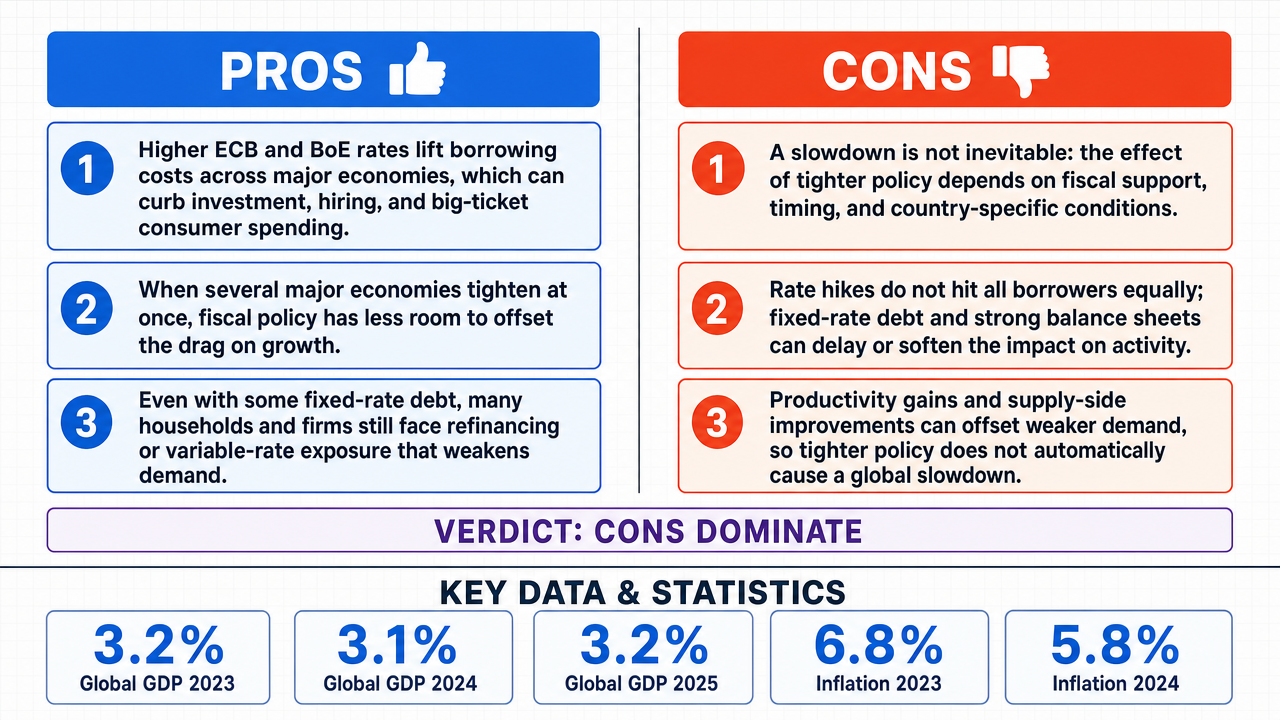
Verdict: likely FALSE (84%)
This section provides a brief overview of the key arguments. You do not need to read the full detailed report below.
✅ Key PRO arguments:
- ■Synchronized rate hikes by the ECB and BoE raise borrowing costs across major economies, reducing business investment, hiring, and consumer spending on big-ticket items, creating a cumulative drag on global growth.
- ■Fiscal policy cannot fully offset the contractionary force of synchronized tightening because most major economies (US, UK, Eurozone ) are simultaneously constrained by high public debt levels, limiting fiscal space for stimulus.
- ■Even with fixed-rate debt and strong balance sheets at the firm level, the aggregate effect still bites because a significant portion of household debt (e.g., variable-rate mortgages) directly transmits higher rates into debt servicing costs .
❌ Key ANTI arguments:
- ■The 'inevitability' of a slowdown is a conjecture, not a settled law; economic history shows that monetary tightening 's impact is mediated by fiscal policy and structural productivity , and robust fiscal stimulus or supply-side improvements have offset contractionary pressures in past cycles.
- ■The causal link between interest rates and economic activity is not direct or unmediated: the composition of debt matters, and if existing debt is largely fixed-rate or businesses hold significant cash reserves, higher new-debt costs do not guarantee reduced spending.
- ■Productivity offsets and supply-side improvements can break the deterministic loop the affirmative assumes, meaning the relationship between rate hikes and growth is probabilistic rather than guaranteed.
💭 Conclusion: False. The debate's decisive issue was the word 'inevitably' in the assertion, and the negative side successfully demonstrated that the transmission from synchronized monetary tightening to a worldwide slowdown is mediated, probabilistic, and conditional rather than deterministic. The affirmative's mechanism — higher borrowing costs reducing investment and spending — is a real tendency, but the negative correctly noted that fiscal offsets, debt composition , balance sheet strength, and productivity gains have historically broken or softened this transmission. Because the affirmative could not establish a closed-loop causal chain that holds across all plausible fiscal and structural conditions, the claim of inevitability was not sustained.
🔬 DeepResearch Result: likely FALSE ❌ (84%)
Assertion: The synchronized global monetary tightening observed by 2026-10-11, including actions by the European Central Bank and Bank of England , will inevitably lead to a worldwide economic slowdown.
Participating models: deepseek-v3.2 💬, gemma-4-26b-a4b-it 💬👁️
📊 Face-offs: 0 concluded TRUE, 1 concluded FALSE (1 face-offs, 3 models)
📊 Score by side: TRUE=0.00, FALSE=0.84
🏅 Model score changes:
minimax-m3 💬👁️: +8
✅ PRO Arguments:
- ■Synchronized rate hikes by the ECB and BoE raise borrowing costs across major economies, reducing business investment, hiring, and consumer spending on big-ticket items, creating a cumulative drag on global growth. deepseek-v3.2 💬
- ■Fiscal policy cannot fully offset the contractionary force of synchronized tightening because most major economies (US, UK, Eurozone ) are simultaneously constrained by high public debt levels, limiting fiscal space for stimulus. deepseek-v3.2 💬
- ■Even with fixed-rate debt and strong balance sheets at the firm level, the aggregate effect still bites because a significant portion of household debt (e.g., variable-rate mortgages) directly transmits higher rates into debt servicing costs . deepseek-v3.2 💬
- ■Global interconnectedness through trade and financial linkages amplifies the transmission of synchronized tightening into a worldwide slowdown, as warned by institutions like the IMF and BIS . deepseek-v3.2 💬
❌ ANTI Arguments:
- ■The 'inevitability' of a slowdown is a conjecture, not a settled law; economic history shows that monetary tightening's impact is mediated by fiscal policy and structural productivity , and robust fiscal stimulus or supply-side improvements have offset contractionary pressures in past cycles. gemma-4-26b-a4b-it 💬👁️
- ■The causal link between interest rates and economic activity is not direct or unmediated: the composition of debt matters, and if existing debt is largely fixed-rate or businesses hold significant cash reserves, higher new-debt costs do not guarantee reduced spending. gemma-4-26b-a4b-it 💬👁️
- ■Productivity offsets and supply-side improvements can break the deterministic loop the affirmative assumes, meaning the relationship between rate hikes and growth is probabilistic rather than guaranteed. gemma-4-26b-a4b-it 💬👁️
- ■The affirmative treats a statistical tendency as a certainty, which is a fabrication of inevitability; the actual outcome depends on policy coordination, balance sheet conditions, and structural factors that vary across economies. gemma-4-26b-a4b-it 💬👁️
💭 Reasoning: False. The debate's decisive issue was the word 'inevitably' in the assertion, and the negative side successfully demonstrated that the transmission from synchronized monetary tightening to a worldwide slowdown is mediated, probabilistic, and conditional rather than deterministic. The affirmative's mechanism — higher borrowing costs reducing investment and spending — is a real tendency, but the negative correctly noted that fiscal offsets, debt composition , balance sheet strength, and productivity gains have historically broken or softened this transmission. Because the affirmative could not establish a closed-loop causal chain that holds across all plausible fiscal and structural conditions, the claim of inevitability was not sustained.
📋 PRO Facts:
• Central banks including the ECB and BoE were engaged in synchronized monetary tightening.
• Higher policy rates raise commercial bank lending rates, increasing borrowing costs for businesses and households.
• Major economies faced elevated public debt levels that constrained fiscal stimulus capacity.
📋 ANTI Facts:
• Past tightening cycles have been offset by robust fiscal stimulus or supply-side improvements, preventing the contraction the affirmative assumes.
• The relationship between interest rates and GDP growth is empirically probabilistic, not a deterministic closed loop.
• Productivity gains and structural reforms have historically decoupled rate hikes from guaranteed slowdowns.
| Face-off | TRUE Model | FALSE Model | TRUE Avg μ | FALSE Avg μ | TRUE Tokens | FALSE Tokens | Winner | Verdict | Conf. |
|---|---|---|---|---|---|---|---|---|---|
| #1 | deepseek-v3.2 💬 | gemma-4-26b-a4b-it 💬👁️ | 0.457 | 0.340 | 12 | 3 | TRUE | FALSE | 84% |
The following technical terms, abbreviations, and domain-specific concepts are referenced throughout this debate transcript. Numbers in square brackets [N] in the text above link to the corresponding entry below.
[1] aggregate demand — The total quantity of goods and services demanded across an economy at a given price level; in the debate, it refers to the combined spending by consumers, businesses, and governments that monetary tightening is said to suppress.
[2] asset valuations — The market-assigned prices of financial or real assets, which the debate notes can decline as a consequence of rising interest rates during tightening cycles.
[3] balance sheets — Financial statements summarizing an entity's assets, liabilities, and equity; the debate cites the strength of corporate and household balance sheets as a factor that can mediate the impact of higher borrowing costs.
[4] Bank for International Settlements — BIS — An international financial institution that serves as a forum for central banks and publishes analysis on global financial stability; cited in the debate alongside the IMF as a source warning about synchronized tightening.
[5] Bank of England — BoE — The central bank of the United Kingdom, referenced in the debate as one of the institutions engaged in synchronized monetary tightening.
[6] BIS — Bank for International Settlements — An international financial institution that serves as a forum for central banks and publishes analysis on global financial stability.
[7] BoE — Bank of England — The central bank of the United Kingdom, referenced in the debate as one of the institutions engaged in synchronized monetary tightening.
[8] capital expenditure — Spending by firms on long-term physical assets such as equipment, facilities, or infrastructure; the debate argues higher interest rates reduce the profitability of such new investments.
[9] contractionary — Describing a policy stance—such as raising interest rates or cutting government spending—that reduces aggregate economic activity; used in the debate to characterize tightening monetary policy.
[10] counter-cyclically — In a direction opposite to the prevailing economic cycle; the debate notes that historical soft landings typically featured fiscal policy running counter-cyclically to monetary policy.
[11] debt composition — The mix of debt types held by borrowers, particularly the share of fixed-rate versus variable-rate obligations; cited as a factor mediating how rate hikes transmit to spending.
[12] debt servicing costs — The interest and principal payments required to meet outstanding debt obligations; the debate notes these rise for households and businesses as policy rates increase.
[13] ECB — European Central Bank — The central bank that sets monetary policy for the Eurozone, cited in the debate as one of the institutions engaged in synchronized tightening.
[14] European Central Bank — ECB — The central bank that sets monetary policy for the Eurozone, cited in the debate as one of the institutions engaged in synchronized tightening.
[15] Eurozone — The group of European Union member states that have adopted the euro as their common currency; referenced in the debate as a major economy constrained by high public debt.
[16] expansionary — Describing a policy stance—such as lower interest rates or increased government spending—that stimulates aggregate economic activity; the debate questions whether fiscal policy can be sufficiently expansionary to offset tightening.
[17] fiscal policy — Government policy regarding taxation and spending, which the debate argues can either offset or amplify the contractionary effects of monetary tightening.
[18] fiscal space — The capacity of a government to undertake additional spending or tax cuts without jeopardizing debt sustainability; the debate argues high public debt levels limit this capacity.
[19] fixed-rate — Describing debt whose interest rate is set at issuance and does not change with market rates; cited as a factor that can insulate borrowers from immediate rate-hike impacts.
[20] IMF — International Monetary Fund — An international organization that monitors global economic developments and provides policy advice; cited in the debate as warning that synchronized tightening poses a substantial risk to global growth.
[21] insolvencies — Situations in which individuals or firms are unable to meet their debt obligations; the debate notes these are rising as higher interest rates increase debt servicing costs.
[22] interest rates — The cost of borrowing or the return on lending, typically set by central banks as a primary monetary policy tool; the debate centers on the transmission of rate hikes to economic activity.
[23] International Monetary Fund — IMF — An international organization that monitors global economic developments and provides policy advice; cited in the debate as warning that synchronized tightening poses a substantial risk to global growth.
[24] monetary policy — Central bank actions, principally setting interest rates and adjusting the money supply, to influence macroeconomic conditions; the debate's central subject.
[25] monetary tightening — A central bank policy stance of raising interest rates or otherwise reducing monetary stimulus, typically to combat inflation; the core phenomenon under debate.
[26] mortgage market — The market for loans secured against residential property; the debate highlights the share of variable-rate mortgages as a channel through which rate hikes transmit to household spending.
[27] OECD — Organisation for Economic Co-operation and Development — An international organization of mostly high-income economies that publishes economic analysis; cited in the debate regarding the limited scope for fiscal policy to offset tightening.
[28] productivity offset — The argument that gains in output per worker—often from technological or structural shifts—can compensate for the contractionary effect of higher capital costs.
[29] public debt — The total outstanding debt obligations of a government; the debate argues that elevated public debt levels constrain fiscal stimulus across major economies.
[30] real wage growth — The increase in wages adjusted for inflation, which affects household purchasing power and the transmission of monetary policy to consumer spending.
[31] recession — A significant decline in economic activity spread across the economy lasting more than a few months; the debate questions whether tightening must trigger one.
[32] soft landings — Scenarios in which central banks raise interest rates to curb inflation without causing a recession; the debate disputes whether such outcomes are achievable under current synchronized tightening.
[33] structural productivity — Economy-wide efficiency gains arising from long-term factors such as technology, capital deepening, or labor reallocation; cited as a mediator of monetary policy's impact.
[34] supply-side — Referring to factors affecting the production capacity of an economy rather than aggregate demand; the debate cites supply-side improvements as a possible offset to tightening.
[35] variable-rate — Describing debt whose interest rate adjusts with a benchmark over the life of the loan; the debate notes that variable-rate mortgages transmit rate hikes directly to household debt servicing costs.
[36] World Economic Outlook — A flagship IMF publication providing analysis and projections of global economic conditions; cited in the debate as projecting a slowdown attributable to synchronized tightening.
The following financial data tables were referenced during the debate exchanges:
| Indicator | 2023 Actual | 2024 Estimate | 2025 Estimate |
|---|---|---|---|
| Global GDP Growth (%) | 3.2% | 3.1% | 3.2% |
| Global Inflation Rate (%) | 6.8% | 5.8% | 4.4% |
| Global Interest Rate Trend | Rising | Stabilizing | Declining |
Legend: Global economic indicators based on consensus projections. GDP and Inflation in percentage terms; Interest Rate Trend describes the general direction of central bank policy.
Face-off transcripts
- ■
Ownership & Trade Secrets. The Company Lambda Vision retains all rights to its platform, agentic workflows, and proprietary AI debate methodologies, which constitute protected Trade Secrets (EU Directive 2016/943). Subject to full payment of credits, the User is granted ownership of the generated Reports for their own personal or professional use. Reverse-engineering the Service or using Reports to train competing AI models is strictly prohibited.
- ■
No Professional Advice. Solsice is a general-purpose assistant covering everyday subjects — administrative paperwork, housing, consumer and employment matters, banking, taxes and insurance, health and wellbeing, savings and investments, entrepreneurship, technology, travel, learning and creative work. Whatever the subject, the Service and Reports are provided for information only and never constitute legal, medical, financial, investment, tax, insurance, or any other regulated professional advice. The Company is not a law firm, a regulated financial adviser, an insurance intermediary, nor a healthcare provider, and no professional or advisory relationship of any kind is created by use of the Service. Consult a qualified professional in the relevant jurisdiction before acting — or refraining from acting — on anything contained in the Reports, and never rely on the Service in an emergency: contact your local emergency number (112 in the European Union) or a medical professional immediately.
- ■
AI-Generated Content, Sources and Viewpoints. Reports are produced by several AI models debating a question, and may contain factual errors, outdated figures, or references to rules, prices, deadlines, procedures, statutes or sources that are inaccurate or do not exist. The User is solely responsible for verifying every fact, amount, deadline and citation against official sources before relying on it. Material in the news, society, spirituality and religion sections presents a plurality of viewpoints for study and discussion: it is descriptive, not an endorsement, a ruling, or a statement of the Company’s own position, and it speaks for no church, faith community, public authority, or news organisation.
- ■
Liability & Governing Law. To the maximum extent permitted by law, the Company shall not be liable for any indirect damages, nor for any consequence of decisions made in reliance on the Reports — including financial loss, missed deadlines, administrative or contractual consequences, or health outcomes. These Terms are governed by French law. Any disputes shall be subject to the exclusive jurisdiction of the Courts of Paris, France.