
The 'Stations Method' of home organization, which involves storing items where they are used, significantly reduces the time spent searching for household items for most people.
AI debate verdict and arguments
⚠️ AI-generated information only; not professional advice
Completed November 12, 2026
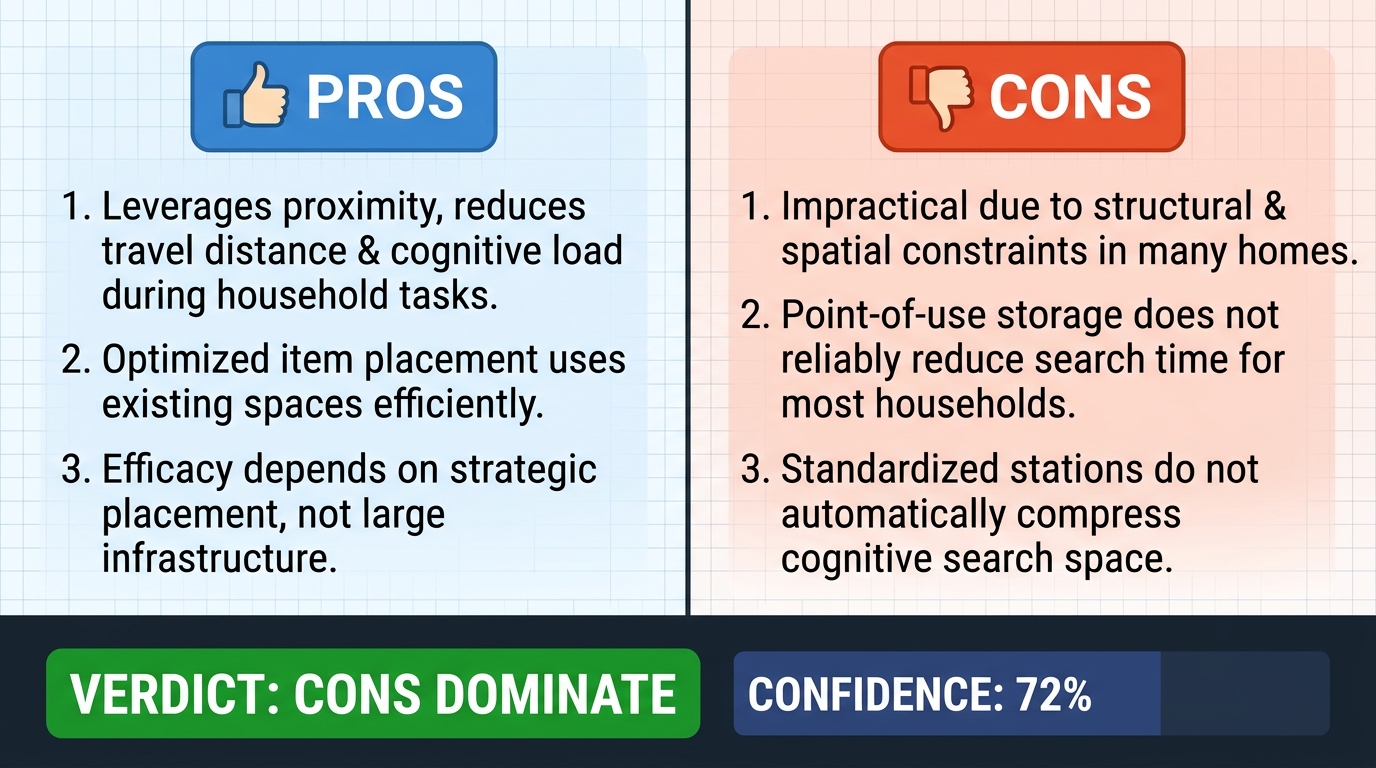
Verdict
Verdict: likely FALSE (72%)
Web Report: https://solsice.com/public/debates/the-stations-method-of-home-organization-which-involves-stor-e3b6428216a2
This section provides a brief overview of the key arguments. You do not need to read the full detailed report below.
✅ Key PRO arguments:
- ■The Stations Method leverages the principle of proximity to minimize travel distance and cognitive load during household tasks. Point-of-use storage is a fundamental tenet in ergonomics and industrial engineering used to reduce non-value-added movement. When household items are located at the specific site of their application, the user eliminates transit time and the mental effort required to navigate through multiple zones to retrieve an object.
- ■The method's efficacy is not dependent on dedicated, large-scale infrastructure, but on the optimized placement of items within existing available spaces. A 'station' can be as minimal as a single drawer, a small basket, or a specific shelf segment. By redefining the scale of a station from a 'room' to a 'functional micro-zone,' the spatial constraint argument evaporates.
❌ Key ANTI arguments:
- ■Point-of-use storage does not reliably reduce search time for most households. Structural and spatial constraints often make point-of-use storage impractical. In many homes, the number of potential locations for a given item exceeds the number of available dedicated stations. When the cost of creating and maintaining dedicated stations outweighs the benefit of reduced travel distance, the net effect on search time can be negative, particularly in smaller or older dwellings.
- ■Standardized stations do not automatically compress cognitive search space. Research on human information retrieval shows that search efficiency depends on multiple factors beyond the number of potential locations, including the ambiguity of the search query, the user's familiarity with the environment, and the complexity of the task. Restricting a user's search to a single predictable micro-environment does not guarantee reduced search cost in household contexts.
💭 Conclusion: False — the debate's winning side successfully showed that the Stations Method does not reliably and significantly reduce search time for most households. The negative argument demonstrated that structural and spatial constraints often make point-of-use storage impractical, especially in smaller or older dwellings where dedicated stations are not feasible. It also showed that cognitive search efficiency depends on factors such as query ambiguity, user familiarity, and task complexity, not merely on the number of possible locations. These points undermine the affirmative's universal claim that most people will experience significant time savings. Given the single debate and the judge's 72% confidence, the verdict is False with moderate confidence.
🔬 DeepResearch Result: likely FALSE ❌ (72%)
Assertion: The 'Stations Method ' of home organization, which involves storing items where they are used, significantly reduces the time spent searching for household items for most people.
Participating models: gemma-4-26b-a4b-it 💬👁️, glm-4.7-flash 💬
📊 Face-offs: 0 concluded TRUE, 1 concluded FALSE (1 face-offs, 3 models)
📊 Score by side: TRUE=0.00, FALSE=0.72
🏅 Model score changes:
deepseek-v4-flash-0731 💬: +7
✅ PRO Arguments:
- ■The Stations Method leverages the principle of proximity to minimize travel distance and cognitive load during household tasks. Point-of-use storage is a fundamental tenet in ergonomics and industrial engineering used to reduce non-value-added movement. When household items are located at the specific site of their application, the user eliminates transit time and the mental effort required to navigate through multiple zones to retrieve an object. gemma-4-26b-a4b-it 💬👁️
- ■The method's efficacy is not dependent on dedicated, large-scale infrastructure, but on the optimized placement of items within existing available spaces. A 'station' can be as minimal as a single drawer, a small basket, or a specific shelf segment. By redefining the scale of a station from a 'room' to a 'functional micro-zone,' the spatial constraint argument evaporates. gemma-4-26b-a4b-it 💬👁️
❌ ANTI Arguments:
- ■Point-of-use storage does not reliably reduce search time for most households. Structural and spatial constraints often make point-of-use storage impractical. In many homes, the number of potential locations for a given item exceeds the number of available dedicated stations. When the cost of creating and maintaining dedicated stations outweighs the benefit of reduced travel distance, the net effect on search time can be negative, particularly in smaller or older dwellings. glm-4.7-flash 💬
- ■Standardized stations do not automatically compress cognitive search space. Research on human information retrieval shows that search efficiency depends on multiple factors beyond the number of potential locations, including the ambiguity of the search query, the user's familiarity with the environment, and the complexity of the task. Restricting a user's search to a single predictable micro-environment does not guarantee reduced search cost in household contexts. glm-4.7-flash 💬
💭 Reasoning: False — the debate's winning side successfully showed that the Stations Method does not reliably and significantly reduce search time for most households. The negative argument demonstrated that structural and spatial constraints often make point-of-use storage impractical, especially in smaller or older dwellings where dedicated stations are not feasible. It also showed that cognitive search efficiency depends on factors such as query ambiguity, user familiarity, and task complexity, not merely on the number of possible locations. These points undermine the affirmative's universal claim that most people will experience significant time savings. Given the single debate and the judge's 72% confidence, the verdict is False with moderate confidence.
📋 PRO Facts:
• Point-of-use storage is a fundamental tenet in ergonomics and industrial engineering used to reduce non-value-added movement.
• Aligning location and function creates a direct, intuitive path to retrieval.
• A station can be as minimal as a single drawer, a small basket, or a specific shelf segment.
📋 ANTI Facts:
• In many homes, the number of potential locations for a given item exceeds the number of available dedicated stations.
• Dedicating a full station to each usage location can require excessive floor area and maintenance.
• Research on human information retrieval shows search efficiency depends on query ambiguity, user familiarity, and task complexity.
| Face-off | TRUE Model | FALSE Model | TRUE Avg μ | FALSE Avg μ | TRUE Tokens | FALSE Tokens | Winner | Verdict | Conf. |
|---|---|---|---|---|---|---|---|---|---|
| #1 | gemma-4-26b-a4b-it 💬👁️ | glm-4.7-flash 💬 | 0.235 | 0.245 | 2 | 4 | FALSE | FALSE | 72% |
The following technical terms, abbreviations, and domain-specific concepts are referenced throughout this debate transcript. Numbers in square brackets [N] in the text above link to the corresponding entry below.
[1] cognitive load — The total amount of mental effort being used in the working memory.
[2] cognitive psychology — The scientific study of mental processes such as attention, language use, memory, perception, problem-solving, and thinking.
[3] cognitive search — The mental process of looking for information or items, influenced by factors like familiarity with the environment and task complexity.
[4] ergonomics — The study of people's efficiency in their working environment.
[5] heuristics — Mental shortcuts or rules of thumb that allow people to solve problems and make judgments quickly and efficiently.
[6] industrial engineering — A branch of engineering that deals with the optimization of complex processes, systems, or organizations.
[7] point-of-use storage — A principle of organization where items are stored at the specific location where they are used to minimize movement and effort.
[8] search cost — The mental effort or time expended to locate a desired item or piece of information.
[9] spatial workflow — The arrangement and movement of tasks and items within a physical space to optimize efficiency.
[10] Stations Method — A home organization method that involves storing items where they are used.
Face-off transcripts
- ■
Ownership & Trade Secrets. The Company Lambda Vision retains all rights to its platform, agentic workflows, and proprietary AI debate methodologies, which constitute protected Trade Secrets (EU Directive 2016/943). Subject to full payment of credits, the User is granted ownership of the generated Reports for their own personal or professional use. Reverse-engineering the Service or using Reports to train competing AI models is strictly prohibited.
- ■
No Professional Advice. Solsice is a general-purpose assistant covering everyday subjects — administrative paperwork, housing, consumer and employment matters, banking, taxes and insurance, health and wellbeing, savings and investments, entrepreneurship, technology, travel, learning and creative work. Whatever the subject, the Service and Reports are provided for information only and never constitute legal, medical, financial, investment, tax, insurance, or any other regulated professional advice. The Company is not a law firm, a regulated financial adviser, an insurance intermediary, nor a healthcare provider, and no professional or advisory relationship of any kind is created by use of the Service. Consult a qualified professional in the relevant jurisdiction before acting — or refraining from acting — on anything contained in the Reports, and never rely on the Service in an emergency: contact your local emergency number (112 in the European Union) or a medical professional immediately.
- ■
AI-Generated Content, Sources and Viewpoints. Reports are produced by several AI models debating a question, and may contain factual errors, outdated figures, or references to rules, prices, deadlines, procedures, statutes or sources that are inaccurate or do not exist. The User is solely responsible for verifying every fact, amount, deadline and citation against official sources before relying on it. Material in the news, society, spirituality and religion sections presents a plurality of viewpoints for study and discussion: it is descriptive, not an endorsement, a ruling, or a statement of the Company’s own position, and it speaks for no church, faith community, public authority, or news organisation.
- ■
Liability & Governing Law. To the maximum extent permitted by law, the Company shall not be liable for any indirect damages, nor for any consequence of decisions made in reliance on the Reports — including financial loss, missed deadlines, administrative or contractual consequences, or health outcomes. These Terms are governed by French law. Any disputes shall be subject to the exclusive jurisdiction of the Courts of Paris, France.