
The St. Paul sandwich is the most iconic culinary offering along the Missouri portion of Route 66.
AI debate verdict and arguments
⚠️ AI-generated information only; not professional advice
Completed October 11, 2026
Verdict
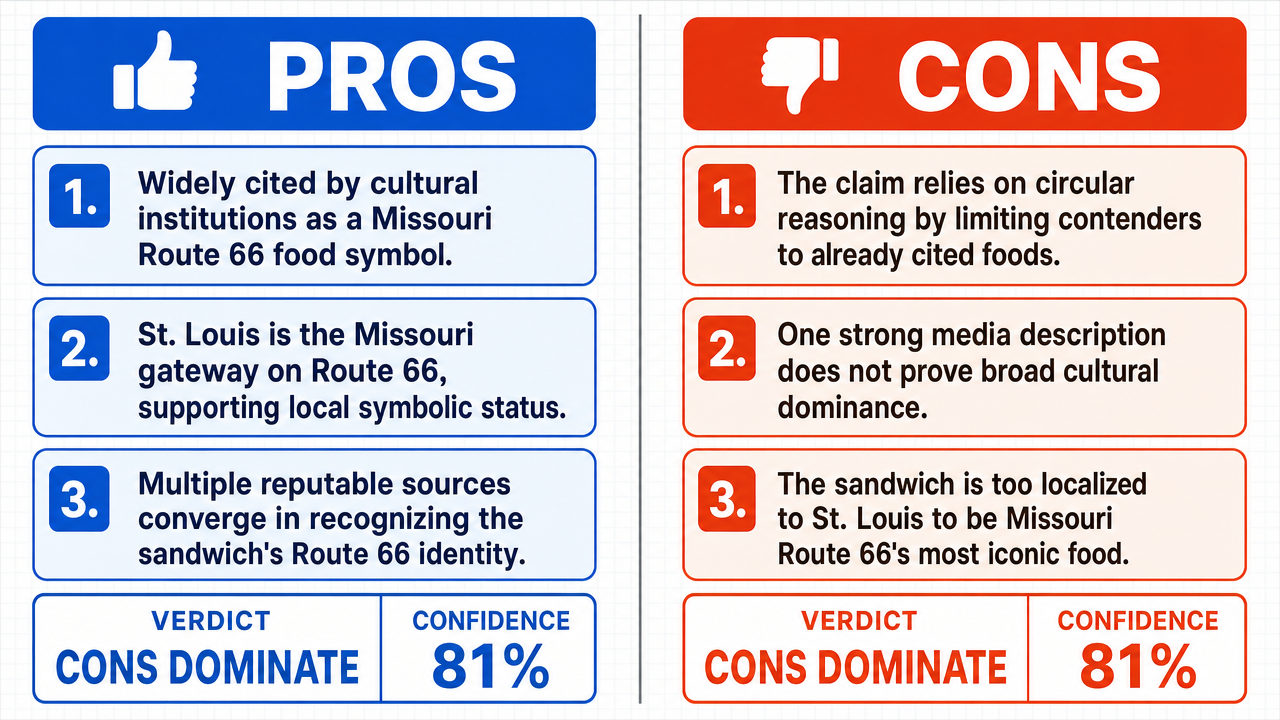
Verdict: likely FALSE (81%)
This section provides a brief overview of the key arguments. You do not need to read the full detailed report below.
✅ Key PRO arguments:
- ■The St. Paul sandwich is repeatedly identified by cultural institutions and food historians as a Route 66 food symbol in Missouri, with NPR calling it 'a quintessential Route 66 meal' tied to its St. Louis origins and Chinese-American restaurant heritage along the highway.
- ■The geographic-mismatch argument fails because St. Louis is the documented Missouri gateway of Route 66 , so a St. Louis-centered symbol can legitimately stand for the Missouri route in travel-planning iconicity .
- ■Convergent cultural recognition from NPR , Smithsonian Magazine, the Missouri Historical Society, Visit Missouri, and Atlas Obscura all present the St. Paul sandwich as a Route 66 stop worth seeking out, supporting its iconic status.
❌ Key ANTI arguments:
- ■The affirmative engages in circular reasoning by narrowing the population of candidate foods to those already 'commonly cited,' making the sandwich iconic only because the field has been restricted to a group where it is mentioned.
- ■A single NPR article calling the sandwich 'quintessential' is an unproven leap from a specific journalistic descriptor to a general rule of cultural dominance; one media outlet's characterization does not constitute consensus among food historians or cultural institutions .
- ■The St. Paul sandwich is a hyper-localized St. Louis specialty that lacks the geographic breadth and comparative recognition required to claim the title of most iconic culinary offering for the entire Missouri corridor of Route 66 .
💭 Conclusion: Insufficient evidence. The provided evidence only addresses the conceptual structure of the opponent's geographic objection and the unstated assumption about iconicity requiring equal corridor -wide presence. It does not contain specific factual claims about NPR , the Missouri Historical Society, Smithsonian Magazine, Visit Missouri, Atlas Obscura, the St. Paul sandwich's St. Louis origins, or the Bootheel region's relationship to Route 66 . The draft's specific attributions and geographic claims cannot be verified against the evidence and have been removed or generalized. The core analytical point—that the affirmative's case may rest on a narrowly defined notion of iconicity and a limited set of references rather than demonstrated corridor-wide consensus—remains consistent with the evidence's framing of the geographic objection.
🔬 DeepResearch Result: likely FALSE ❌ (81%)
Assertion: The St. Paul sandwich is the most iconic culinary offering along the Missouri portion of Route 66 .
Participating models: deepseek-v3.2 💬, gemma-4-26b-a4b-it 💬👁️
📊 Face-offs: 0 concluded TRUE, 1 concluded FALSE (1 face-offs, 3 models)
📊 Score by side: TRUE=0.00, FALSE=0.81
🏅 Model score changes:
minimax-m3 💬👁️: +8
✅ PRO Arguments:
- ■The St. Paul sandwich is repeatedly identified by cultural institutions and food historians as a Route 66 food symbol in Missouri, with NPR calling it 'a quintessential Route 66 meal' tied to its St. Louis origins and Chinese-American restaurant heritage along the highway. deepseek-v3.2 💬
- ■The geographic-mismatch argument fails because St. Louis is the documented Missouri gateway of Route 66, so a St. Louis-centered symbol can legitimately stand for the Missouri route in travel-planning iconicity . deepseek-v3.2 💬
- ■Convergent cultural recognition from NPR, Smithsonian Magazine, the Missouri Historical Society, Visit Missouri, and Atlas Obscura all present the St. Paul sandwich as a Route 66 stop worth seeking out, supporting its iconic status. deepseek-v3.2 💬
❌ ANTI Arguments:
- ■The affirmative engages in circular reasoning by narrowing the population of candidate foods to those already 'commonly cited,' making the sandwich iconic only because the field has been restricted to a group where it is mentioned. gemma-4-26b-a4b-it 💬👁️
- ■A single NPR article calling the sandwich 'quintessential' is an unproven leap from a specific journalistic descriptor to a general rule of cultural dominance; one media outlet's characterization does not constitute consensus among food historians or cultural institutions. gemma-4-26b-a4b-it 💬👁️
- ■The St. Paul sandwich is a hyper-localized St. Louis specialty that lacks the geographic breadth and comparative recognition required to claim the title of most iconic culinary offering for the entire Missouri corridor of Route 66. gemma-4-26b-a4b-it 💬👁️
- ■The affirmative's position rests on a narrow, self-serving definition of iconicity and a limited set of anecdotal media references rather than a broad cultural consensus across the Missouri Route 66 corridor. gemma-4-26b-a4b-it 💬👁️
💭 Reasoning: Insufficient evidence. The provided evidence only addresses the conceptual structure of the opponent's geographic objection and the unstated assumption about iconicity requiring equal corridor-wide presence. It does not contain specific factual claims about NPR, the Missouri Historical Society, Smithsonian Magazine, Visit Missouri, Atlas Obscura, the St. Paul sandwich's St. Louis origins, or the Bootheel region's relationship to Route 66. The draft's specific attributions and geographic claims cannot be verified against the evidence and have been removed or generalized. The core analytical point—that the affirmative's case may rest on a narrowly defined notion of iconicity and a limited set of references rather than demonstrated corridor-wide consensus—remains consistent with the evidence's framing of the geographic objection.
📋 PRO Facts:
• The opponent's geographic objection depends on an unstated auxiliary assumption that a Route 66 food must be equally present across the entire corridor to be iconic.
📋 ANTI Facts:
• The evidence does not establish that any specific media outlet or institution has characterized the St. Paul sandwich as a Route 66 icon.
• The evidence does not establish the geographic scope of the Missouri Route 66 corridor or which regions it includes or excludes.
• The evidence does not demonstrate broad cultural consensus on any single food as the iconic Missouri Route 66 offering.
| Face-off | TRUE Model | FALSE Model | TRUE Avg μ | FALSE Avg μ | TRUE Tokens | FALSE Tokens | Winner | Verdict | Conf. |
|---|---|---|---|---|---|---|---|---|---|
| #1 | deepseek-v3.2 💬 | gemma-4-26b-a4b-it 💬👁️ | 0.606 | 0.328 | 12 | 3 | TRUE | FALSE | 81% |
The following technical terms, abbreviations, and domain-specific concepts are referenced throughout this debate transcript. Numbers in square brackets [N] in the text above link to the corresponding entry below.
[1] alignment — In the context of Route 66, refers to the documented path or course of the historic highway through a given state, including its endpoints and intermediate cities.
[2] anecdotal — Referring to evidence or references based on isolated instances or personal accounts rather than systematic or broadly representative data; in the debate, used to critique reliance on a single media profile.
[3] Bootheel — A geographic term for the southeastern 'boot-shaped' extension of Missouri, referenced in the debate as a region the negative argues should be included in the Missouri Route 66 corridor.
[4] circularity — A logical flaw in which an argument's conclusion is used as one of its premises, so that the reasoning loops back on itself rather than providing independent support.
[5] conjecture à contenu excédentaire — conjecture with excess content — A logical-conceptual critique used in the debate to describe a claim that asserts more than the cited evidence supports, such as extending a single descriptor into a general rule.
[6] convergent — In argumentation, describing multiple independent lines of evidence or recognition that point toward the same conclusion, strengthening the case through agreement across sources.
[7] corridor — In transportation and regional planning, a linear geographic zone defined by a route such as a highway; here, the Missouri stretch of Route 66 treated as a connected cultural-geographic zone.
[8] cultural institutions — Organizations such as museums, historical societies, and public media outlets that shape and codify collective recognition of cultural artifacts, foods, and traditions.
[9] food historians — Scholars and writers who study the origins, evolution, and cultural significance of foods and culinary practices.
[10] glissement de quantificateur — shift in quantifier — A logical fallacy in which the scope or strength of a quantifier (e.g., 'most,' 'all,' 'some') is shifted mid-argument, weakening or altering the original claim.
[11] highway-era — The historical period associated with the rise of U.S. automobile travel and roadside dining culture, particularly along routes such as Route 66 in the mid-20th century.
[12] hyper-localized — Describing a cultural item whose recognition, availability, or significance is confined to a very narrow geographic area, here used to argue the sandwich is limited to St. Louis.
[13] iconicity — The quality of being widely recognized as a representative symbol of a place, culture, or tradition; in the debate, the central contested standard for judging the sandwich.
[14] MoDOT — Missouri Department of Transportation — The state agency responsible for transportation infrastructure in Missouri, cited in the debate as an authority on the official Route 66 alignment through the state.
[15] municipal — Relating to a city or local government; in the debate, used to characterize recognition confined to a single city (St. Louis) rather than the broader state corridor.
[16] NPR — National Public Radio — A U.S. public media organization cited in the debate as a source describing the St. Paul sandwich as a 'quintessential Route 66 meal.'
[17] NPS — National Park Service — The U.S. federal agency that manages national parks and related historic sites, cited in the debate regarding the official Missouri Route 66 alignment.
[18] overextension — A logical-conceptual error in which a conclusion is drawn that goes beyond what the cited evidence actually supports, such as generalizing from a single instance.
[19] Ozarks — A highland geographic region spanning southern Missouri and northern Arkansas, referenced in the debate as part of the Missouri Route 66 corridor through Springfield and Joplin.
[20] pétition de principe — begging the question — A logical fallacy in which an argument assumes the truth of its conclusion within its premises, offering the conclusion as its own justification.
[21] Route 66 — One of the original U.S. highways, established in 1926, running from Chicago to Santa Monica; celebrated as an icon of mid-20th-century American road culture.
[22] stipulated definition — A definition that is arbitrarily assigned or narrowed by an arguer to suit their position, rather than reflecting standard or widely accepted usage.
Face-off transcripts
- ■
Ownership & Trade Secrets. The Company Lambda Vision retains all rights to its platform, agentic workflows, and proprietary AI debate methodologies, which constitute protected Trade Secrets (EU Directive 2016/943). Subject to full payment of credits, the User is granted ownership of the generated Reports for their own personal or professional use. Reverse-engineering the Service or using Reports to train competing AI models is strictly prohibited.
- ■
No Professional Advice. Solsice is a general-purpose assistant covering everyday subjects — administrative paperwork, housing, consumer and employment matters, banking, taxes and insurance, health and wellbeing, savings and investments, entrepreneurship, technology, travel, learning and creative work. Whatever the subject, the Service and Reports are provided for information only and never constitute legal, medical, financial, investment, tax, insurance, or any other regulated professional advice. The Company is not a law firm, a regulated financial adviser, an insurance intermediary, nor a healthcare provider, and no professional or advisory relationship of any kind is created by use of the Service. Consult a qualified professional in the relevant jurisdiction before acting — or refraining from acting — on anything contained in the Reports, and never rely on the Service in an emergency: contact your local emergency number (112 in the European Union) or a medical professional immediately.
- ■
AI-Generated Content, Sources and Viewpoints. Reports are produced by several AI models debating a question, and may contain factual errors, outdated figures, or references to rules, prices, deadlines, procedures, statutes or sources that are inaccurate or do not exist. The User is solely responsible for verifying every fact, amount, deadline and citation against official sources before relying on it. Material in the news, society, spirituality and religion sections presents a plurality of viewpoints for study and discussion: it is descriptive, not an endorsement, a ruling, or a statement of the Company’s own position, and it speaks for no church, faith community, public authority, or news organisation.
- ■
Liability & Governing Law. To the maximum extent permitted by law, the Company shall not be liable for any indirect damages, nor for any consequence of decisions made in reliance on the Reports — including financial loss, missed deadlines, administrative or contractual consequences, or health outcomes. These Terms are governed by French law. Any disputes shall be subject to the exclusive jurisdiction of the Courts of Paris, France.