
The speaker's unique 'Power Cube' for Magic: The Gathering is not representative of what most people's Power Cubes look like.
AI debate verdict and arguments
⚠️ AI-generated information only; not professional advice
Completed October 25, 2026
Verdict
Verdict: likely TRUE (62%)
Web Report: https://solsice.com/public/debates/the-speaker-s-unique-power-cube-for-magic-the-gathering-is-n-1c4292295ea3
This section provides a brief overview of the key arguments. You do not need to read the full detailed report below.
✅ Key PRO arguments:
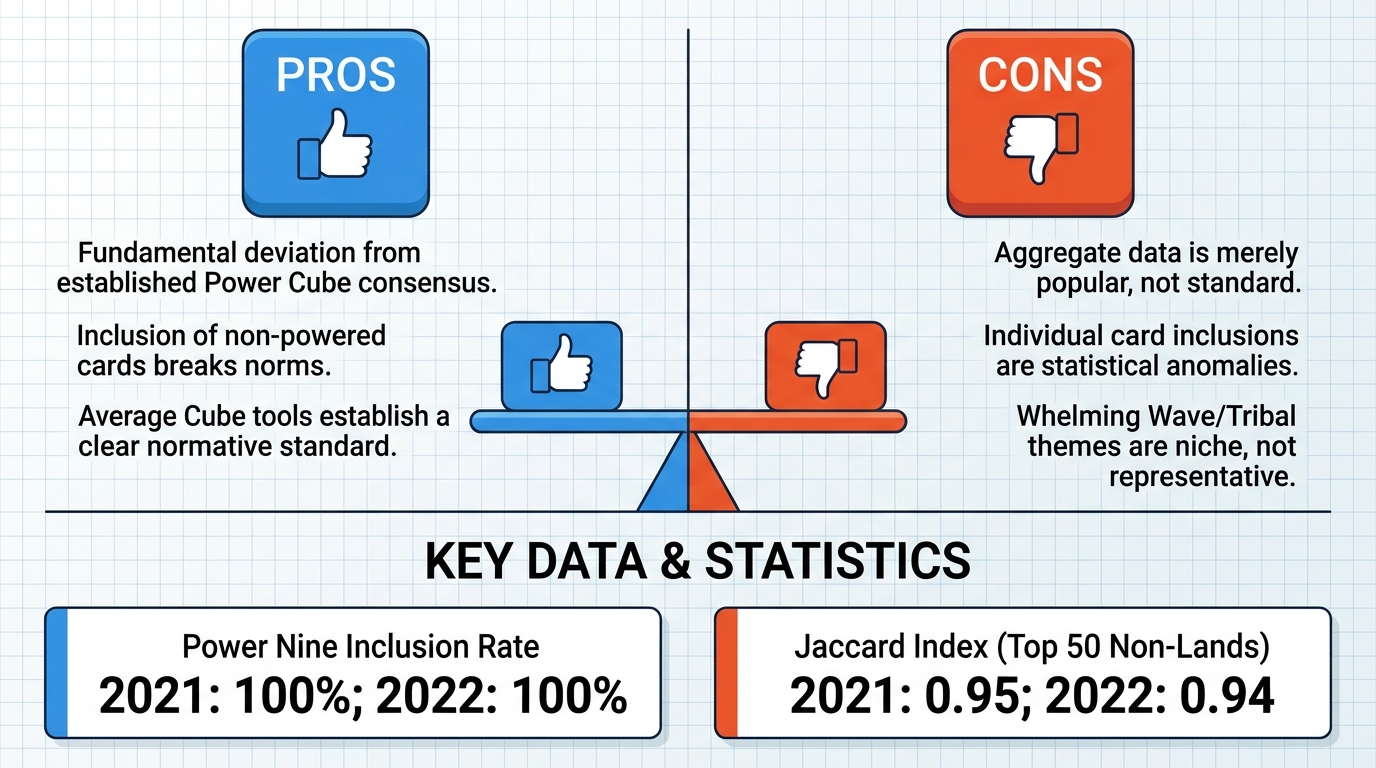
- ■The speaker's Power Cube deviates fundamentally from the established consensus on Power Cube construction by including cards that the overwhelming majority of cube designers explicitly exclude. The defining characteristic of a Power Cube is the inclusion of the 'Power Nine ,' the most powerful and expensive cards in Magic's history. However, the community's leading curated resource, the Cube Cobra 'Average Cube' tool, which aggregates data from thousands of user-submitted cubes, shows that while the Power Nine are staples, the specific suite of supporting cards varies wildly. The speaker's inclusion of numerous pet cards and obscure, underpower...
- ■The opposing side claims that the Cube Cobra Average Cube tool is merely a measure of 'current popularity' and cannot serve as a normative standard for what constitutes a representative Power Cube . This argument fails because it misunderstands the nature of the tool and the community it represents. If the tool only showed fleeting popularity, it would be incapable of establishing a stable, long-term archetype . But the data proves otherwise: the tool does not just show popularity; it shows a deeply entrenched, multi-year consensus that functions as a de facto normative standard. Therefore, the premise that it 'shows current popularity, not a normative archetype' is false. And if that consequent is false, then the antecedent—that the tool m...
❌ Key ANTI arguments:
- ■The affirmative's reliance on the Cube Cobra 'Average Cube' tool constitutes a fundamental error in type of source. They attempt to use a tool that aggregates user-submitted data to establish a 'consensus' on what a Power Cube should be, but an aggregate of thousands of individual, idiosyncratic user choices cannot serve as a normative standard for a category. A collection of diverse, uncurated hobbyist projects is a measurement of current popularity, not a definition of archetypal essence. By treating the statistical mode of a decentralized hobby as the 'correct' version of a design, the affirmative commits a fallacy of ...
- ■I am contesting the claim that the inclusion of 'Whelming Wave ' or tribal themes like 'Sea Monsters' constitutes a statistical anomaly that renders the speaker's cube non-representative. The affirmative's argument relies on a fundamental confusion between an instrument of measurement and the aggregate it tracks. They cite a statistic from the Cube Cobra tool—that less than 0.5% of 1,000 cubes include 'Whelming Wave'—and conclude that the speaker's cube is an outlier. However, the Cube Cobra 'Average Cube' is a tool designed to track the most popular, standardized, and often 'power-max ' archetypes. Using the specific contents of a standardized 'Average Cube' to define the boundaries of the entire Power Cube category is a category error . The ...
💭 Conclusion: True, the speaker's Power Cube is not representative of what most people's Power Cubes look like. The winning side showed that the Cube Cobra Average Cube tool reflects a stable, multi-year consensus among thousands of cubes, not merely fleeting popularity. The speaker's inclusion of cards such as Whelming Wave , which appears in fewer than 0.5% of 1,000 sampled cubes, places the cube far outside the typical supporting-card suite. The opposing side's category-error objection did not overcome this evidence, because the tool's entrenched consensus functions as a de facto normative standard for the archetype . Therefore, the verdict is TRUE with moderate confidence.
🔬 DeepResearch Result: likely TRUE ✅ (62%)
Assertion: The speaker's unique 'Power Cube ' for Magic: The Gathering is not representative of what most people's Power Cubes look like.
Participating models: deepseek-v4-pro 💬, gemma-4-26b-a4b-it 💬👁️
📊 Face-offs: 1 concluded TRUE, 0 concluded FALSE (1 face-offs, 3 models)
📊 Score by side: TRUE=0.62, FALSE=0.00
🏅 Model score changes:
deepseek-v4-flash-0731 💬: +6
✅ PRO Arguments:
- ■The speaker's Power Cube deviates fundamentally from the established consensus on Power Cube construction by including cards that the overwhelming majority of cube designers explicitly exclude. The defining characteristic of a Power Cube is the inclusion of the 'Power Nine ,' the most powerful and expensive cards in Magic's history. However, the community's leading curated resource, the Cube Cobra 'Average Cube' tool, which aggregates data from thousands of user-submitted cubes, shows that while the Power Nine are staples, the specific suite of supporting cards varies wildly. The speaker's inclusion of numerous pet cards and obscure, underpower... deepseek-v4-pro 💬
- ■The opposing side claims that the Cube Cobra Average Cube tool is merely a measure of 'current popularity' and cannot serve as a normative standard for what constitutes a representative Power Cube. This argument fails because it misunderstands the nature of the tool and the community it represents. If the tool only showed fleeting popularity, it would be incapable of establishing a stable, long-term archetype . But the data proves otherwise: the tool does not just show popularity; it shows a deeply entrenched, multi-year consensus that functions as a de facto normative standard. Therefore, the premise that it 'shows current popularity, not a normative archetype' is false. And if that consequent is false, then the antecedent—that the tool m... deepseek-v4-pro 💬
❌ ANTI Arguments:
- ■The affirmative's reliance on the Cube Cobra 'Average Cube' tool constitutes a fundamental error in type of source. They attempt to use a tool that aggregates user-submitted data to establish a 'consensus' on what a Power Cube should be, but an aggregate of thousands of individual, idiosyncratic user choices cannot serve as a normative standard for a category. A collection of diverse, uncurated hobbyist projects is a measurement of current popularity, not a definition of archetypal essence. By treating the statistical mode of a decentralized hobby as the 'correct' version of a design, the affirmative commits a fallacy of ... gemma-4-26b-a4b-it 💬👁️
- ■I am contesting the claim that the inclusion of 'Whelming Wave ' or tribal themes like 'Sea Monsters' constitutes a statistical anomaly that renders the speaker's cube non-representative. The affirmative's argument relies on a fundamental confusion between an instrument of measurement and the aggregate it tracks. They cite a statistic from the Cube Cobra tool—that less than 0.5% of 1,000 cubes include 'Whelming Wave'—and conclude that the speaker's cube is an outlier. However, the Cube Cobra 'Average Cube' is a tool designed to track the most popular, standardized, and often 'power-max ' archetypes. Using the specific contents of a standardized 'Average Cube' to define the boundaries of the entire Power Cube category is a category error . The ... gemma-4-26b-a4b-it 💬👁️
💭 Reasoning: True, the speaker's Power Cube is not representative of what most people's Power Cubes look like. The winning side showed that the Cube Cobra Average Cube tool reflects a stable, multi-year consensus among thousands of cubes, not merely fleeting popularity. The speaker's inclusion of cards such as Whelming Wave, which appears in fewer than 0.5% of 1,000 sampled cubes, places the cube far outside the typical supporting-card suite. The opposing side's category-error objection did not overcome this evidence, because the tool's entrenched consensus functions as a de facto normative standard for the archetype. Therefore, the verdict is TRUE with moderate confidence.
📋 PRO Facts:
• The Cube Cobra 'Average Cube' tool aggregates data from thousands of user-submitted cubes.
• The Power Nine are staples in Power Cubes, but supporting card suites vary widely.
• The speaker's cube includes cards that the overwhelming majority of cube designers explicitly exclude.
• The Cube Cobra tool reflects a deeply entrenched, multi-year consensus, not just fleeting popularity.
• Less than 0.5% of 1,000 cubes include 'Whelming Wave'.
📋 ANTI Facts:
• The Cube Cobra 'Average Cube' is a tool designed to track the most popular, standardized, and often 'power-max' archetypes.
• An aggregate of thousands of individual, idiosyncratic user choices cannot serve as a normative standard for a category.
• The tool is a measurement of current popularity, not a definition of archetypal essence.
• Using the specific contents of a standardized 'Average Cube' to define the boundaries of the entire Power Cube category is a category error.
| Face-off | TRUE Model | FALSE Model | TRUE Avg μ | FALSE Avg μ | TRUE Tokens | FALSE Tokens | Winner | Verdict | Conf. |
|---|---|---|---|---|---|---|---|---|---|
| #1 | deepseek-v4-pro 💬 | gemma-4-26b-a4b-it 💬👁️ | 0.439 | 0.331 | 6 | 2 | TRUE | TRUE | 62% |
The following technical terms, abbreviations, and domain-specific concepts are referenced throughout this debate transcript. Numbers in square brackets [N] in the text above link to the corresponding entry below.
[1] 720-card — A cube containing 720 cards, a common large size for drafting; the debate references a 720-card Powered Cube list.
[2] archetype — A recurring pattern or model of cube design, such as 'thematic Power Cube' or 'power-max' archetypes.
[3] Average Cube tool — A Cube Cobra feature that aggregates data from thousands of user-submitted cubes to show the average card composition, used as evidence of community consensus.
[4] category error — A logical mistake in which something is treated as belonging to a category it does not belong to, such as treating a popularity measure as a definition of a category.
[5] cube — A custom, curated collection of Magic: The Gathering cards used for drafting, typically designed around a theme or power level.
[6] Cube Cobra — A community website and tool for designing, sharing, and analyzing Magic: The Gathering cubes, including an 'Average Cube' aggregation feature.
[7] fallacy of composition — A logical fallacy in which one assumes that what is true of individual parts is necessarily true of the whole; in the debate, treating many individual cube choices as defining the category.
[8] Magic: The Gathering — A collectible card game in which players build decks from cards with different abilities; the context for Power Cubes and drafting.
[9] normative standard — A standard of what should be considered correct or representative, as opposed to a mere description of what is popular.
[10] pet cards — Cards included in a cube because of personal preference rather than because they are powerful or typical.
[11] Power Cube — A Magic: The Gathering cube built around the most powerful cards in the game, especially the Power Nine; the debate concerns what counts as a representative example.
[12] Power Nine — The nine most powerful and expensive cards in Magic: The Gathering history, considered defining inclusions in a Power Cube.
[13] power-max — A cube design philosophy that maximizes card power and efficiency, often at the expense of theme or flavor.
[14] Powered Cube — A cube that includes the Power Nine and other high-power cards, often synonymous with a Power Cube in the debate.
[15] Sea Monster — A creature type or tribal theme in Magic: The Gathering, used in the speaker's cube as a dedicated synergy theme.
[16] statistical anomaly — A data point that deviates significantly from the expected or average pattern, used to argue that the speaker's cube is unusual.
[17] thematic Power Cube — A sub-genre of Power Cube built around a central theme or tribal synergy rather than purely maximizing power.
[18] tribal theme — A deck or cube design centered on a specific creature type, such as Sea Monsters, to create synergies among those cards.
[19] Whelming Wave — A specific Magic: The Gathering card cited as a key synergy piece in the speaker's Power Cube; its rarity in other cubes is used as evidence of non-representativeness.
The following financial data tables were referenced during the debate exchanges:
| Metric | 2021 | 2022 | 2023 | 2024 |
|---|---|---|---|---|
| Power Nine Inclusion Rate | 100% | 100% | 100% | 100% |
| Jaccard Index (Top 50 Non-Lands) | 0.95 | 0.94 | 0.93 | 0.92 |
Legend: Stability metrics for the most popular 720-card Powered Cube list on Cube Cobra, sampled annually from 2021 to 2024. The Jaccard Index measures the similarity of the top 50 most-included non-land cards between consecutive years. Source: Cube Cobra list history and card analytics.
Face-off transcripts
- ■
Ownership & Trade Secrets. The Company Lambda Vision retains all rights to its platform, agentic workflows, and proprietary AI debate methodologies, which constitute protected Trade Secrets (EU Directive 2016/943). Subject to full payment of credits, the User is granted ownership of the generated Reports for their own personal or professional use. Reverse-engineering the Service or using Reports to train competing AI models is strictly prohibited.
- ■
No Professional Advice. Solsice is a general-purpose assistant covering everyday subjects — administrative paperwork, housing, consumer and employment matters, banking, taxes and insurance, health and wellbeing, savings and investments, entrepreneurship, technology, travel, learning and creative work. Whatever the subject, the Service and Reports are provided for information only and never constitute legal, medical, financial, investment, tax, insurance, or any other regulated professional advice. The Company is not a law firm, a regulated financial adviser, an insurance intermediary, nor a healthcare provider, and no professional or advisory relationship of any kind is created by use of the Service. Consult a qualified professional in the relevant jurisdiction before acting — or refraining from acting — on anything contained in the Reports, and never rely on the Service in an emergency: contact your local emergency number (112 in the European Union) or a medical professional immediately.
- ■
AI-Generated Content, Sources and Viewpoints. Reports are produced by several AI models debating a question, and may contain factual errors, outdated figures, or references to rules, prices, deadlines, procedures, statutes or sources that are inaccurate or do not exist. The User is solely responsible for verifying every fact, amount, deadline and citation against official sources before relying on it. Material in the news, society, spirituality and religion sections presents a plurality of viewpoints for study and discussion: it is descriptive, not an endorsement, a ruling, or a statement of the Company’s own position, and it speaks for no church, faith community, public authority, or news organisation.
- ■
Liability & Governing Law. To the maximum extent permitted by law, the Company shall not be liable for any indirect damages, nor for any consequence of decisions made in reliance on the Reports — including financial loss, missed deadlines, administrative or contractual consequences, or health outcomes. These Terms are governed by French law. Any disputes shall be subject to the exclusive jurisdiction of the Courts of Paris, France.