
The speaker's October 16, 2026, communication, consisting solely of the word 'Heat,' serves as a symbolic warning against unchecked industrial development.
AI debate verdict and arguments
⚠️ AI-generated information only; not professional advice
Completed October 18, 2026
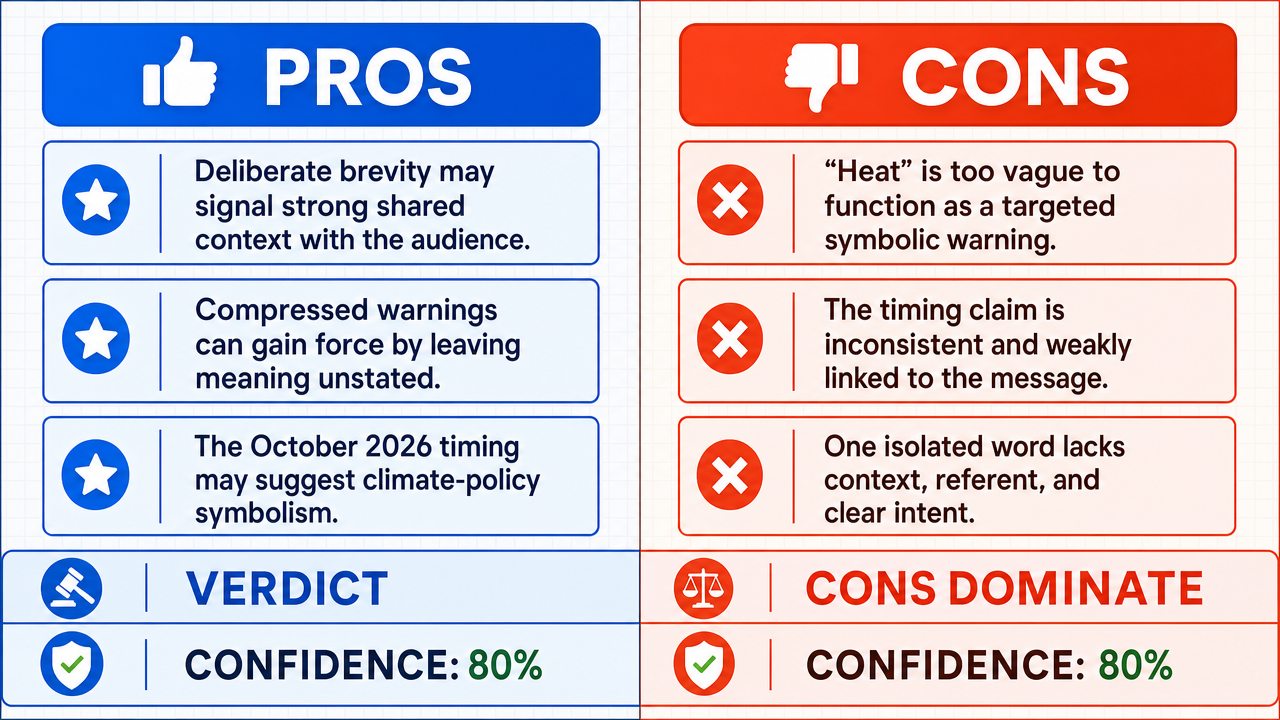
Verdict
Verdict: likely FALSE (80%)
Web Report: https://solsice.com/public/debates/the-speaker-s-october-16-2026-communication-consisting-solel-cfd91912b532
This section provides a brief overview of the key arguments. You do not need to read the full detailed report below.
✅ Key PRO arguments:
- ■The selection of the word 'Heat' constitutes deliberate semiotic compression ; maximum compression implies maximum prior shared context, presupposing the audience already understands the planetary heat crisis driven by industrial activity.
- ■The most powerful symbolic warnings in modern history have often been radically compressed utterances whose force derives precisely from their refusal to spell out the message, making single-word warnings effective in high-context discourse environments.
- ■The October 2026 timing of the communication coincides with the conclusion of the first Global Stocktake implementation cycle under the Paris Agreement , suggesting the message targets the institutional machinery of industrial policy.
❌ Key ANTI arguments:
- ■The word 'Heat' is a semantically underspecified term that cannot function as a targeted symbolic warning because the affirmative provides no transfer operator —no correlation, no linguistic mapping, and no evidence of shared intent—to connect the thermodynamic reality of heat to the speaker's specific message.
- ■The affirmative's timing argument is internally inconsistent: it asserts the communication 'coincides with' the Global Stocktake cycle (implying coincidence) while simultaneously concluding it 'targets' institutional machinery (implying deliberate intent), committing to a proposition and its negation simultaneously.
- ■A single word lacking modifiers, context, and a specific referent cannot constitute a targeted symbolic warning against unchecked industrial development, as it fails to identify the agent, the action, or the object of the warning.
💭 Conclusion: False. The single word 'Heat' cannot be established as a symbolic warning against unchecked industrial development because the affirmative failed to provide any transfer operator connecting the physical phenomenon of heat to the speaker's specific communicative intent. The negative correctly identified that the affirmative's timing argument was internally inconsistent, attempting to derive deliberate targeting from what it simultaneously characterized as mere coincidence with the Global Stocktake cycle. Without evidence of shared intent, specific referent, or contextual framing, the utterance remains semantically underspecified and cannot be reliably interpreted as a targeted warning.
🔬 DeepResearch Result: likely FALSE ❌ (80%)
Assertion: The speaker's October 16, 2026, communication, consisting solely of the word 'Heat,' serves as a symbolic warning against unchecked industrial development.
Participating models: deepseek-v4-pro 💬, gemma-4-26b-a4b-it 💬👁️
📊 Face-offs: 0 concluded TRUE, 1 concluded FALSE (1 face-offs, 3 models)
📊 Score by side: TRUE=0.00, FALSE=0.80
🏅 Model score changes:
minimax-m3 💬👁️: +8
✅ PRO Arguments:
- ■The selection of the word 'Heat' constitutes deliberate semiotic compression ; maximum compression implies maximum prior shared context, presupposing the audience already understands the planetary heat crisis driven by industrial activity. deepseek-v4-pro 💬
- ■The most powerful symbolic warnings in modern history have often been radically compressed utterances whose force derives precisely from their refusal to spell out the message, making single-word warnings effective in high-context discourse environments. deepseek-v4-pro 💬
- ■The October 2026 timing of the communication coincides with the conclusion of the first Global Stocktake implementation cycle under the Paris Agreement , suggesting the message targets the institutional machinery of industrial policy. deepseek-v4-pro 💬
❌ ANTI Arguments:
- ■The word 'Heat' is a semantically underspecified term that cannot function as a targeted symbolic warning because the affirmative provides no transfer operator —no correlation, no linguistic mapping, and no evidence of shared intent—to connect the thermodynamic reality of heat to the speaker's specific message. gemma-4-26b-a4b-it 💬👁️
- ■The affirmative's timing argument is internally inconsistent: it asserts the communication 'coincides with' the Global Stocktake cycle (implying coincidence) while simultaneously concluding it 'targets' institutional machinery (implying deliberate intent), committing to a proposition and its negation simultaneously. gemma-4-26b-a4b-it 💬👁️
- ■A single word lacking modifiers, context, and a specific referent cannot constitute a targeted symbolic warning against unchecked industrial development, as it fails to identify the agent, the action, or the object of the warning. gemma-4-26b-a4b-it 💬👁️
💭 Reasoning: False. The single word 'Heat' cannot be established as a symbolic warning against unchecked industrial development because the affirmative failed to provide any transfer operator connecting the physical phenomenon of heat to the speaker's specific communicative intent. The negative correctly identified that the affirmative's timing argument was internally inconsistent, attempting to derive deliberate targeting from what it simultaneously characterized as mere coincidence with the Global Stocktake cycle. Without evidence of shared intent, specific referent, or contextual framing, the utterance remains semantically underspecified and cannot be reliably interpreted as a targeted warning.
📋 PRO Facts:
• The October 2026 date coincides with the conclusion of the first Global Stocktake implementation cycle under the Paris Agreement framework.
📋 ANTI Facts:
• The affirmative provided no correlation, linguistic mapping, or evidence of shared intent linking the word 'Heat' to a specific symbolic meaning about industrial development.
• A coincidence, by definition, is an alignment of events lacking a causal or intentional connection, making it logically incompatible with a claim of deliberate targeting.
| Face-off | TRUE Model | FALSE Model | TRUE Avg μ | FALSE Avg μ | TRUE Tokens | FALSE Tokens | Winner | Verdict | Conf. |
|---|---|---|---|---|---|---|---|---|---|
| #1 | deepseek-v4-pro 💬 | gemma-4-26b-a4b-it 💬👁️ | 0.490 | 0.307 | 6 | 2 | TRUE | FALSE | 80% |
The following technical terms, abbreviations, and domain-specific concepts are referenced throughout this debate transcript. Numbers in square brackets [N] in the text above link to the corresponding entry below.
[1] climate-industrial complex — A term used in the debate to describe the interconnected system of industrial activity and its climate impacts, framing industrial expansion as a driver of planetary heating.
[2] Doomsday Clock — A symbolic clock referenced in the debate as having been moved to 90 seconds to midnight in January 2023, cited as an example of compressed symbolic communication whose force derives from accumulated shared context.
[3] Global Stocktake — A mechanism referenced in the debate as having an 'implementation cycle' whose conclusion coincides with the October 2026 communication; associated with the Paris Agreement framework.
[4] high-context discourse — A communication environment in which meaning relies heavily on shared background knowledge and cultural context rather than explicit verbal explanation.
[5] information theory — The field of study invoked in the debate to support the claim that maximum compression of a message implies maximum prior shared context between sender and receiver.
[6] lexical specificity — The degree to which language uses precise, detailed vocabulary; the negative argues that symbolic warnings require high lexical specificity to be effective, a premise the affirmative contests.
[7] marine heatwaves — Periods of unusually warm ocean temperatures referenced in the debate as part of the planetary heat crisis invoked by the single word 'Heat.'
[8] non-sequitur — A logical fallacy in which a conclusion does not follow from the premises; the negative uses this term to describe the affirmative's argument linking physical heat measurements to symbolic intent.
[9] Paris Agreement — An international agreement referenced in the debate in connection with a 'revision window' and the Global Stocktake mechanism.
[10] post hoc ergo propter hoc — A logical fallacy in which temporal succession is assumed to imply causation; the negative accuses the affirmative of committing this fallacy by linking the timing of the communication to climate events.
[11] pre-industrial levels — The baseline of global temperatures prior to large-scale industrialization, used in the debate as a reference point for measuring temperature anomalies.
[12] semiotic compression — The deliberate reduction of a message to its most condensed symbolic form, invoked by the affirmative to explain the choice of a single word.
[13] symbolic communication — The transmission of meaning through signs, symbols, or condensed utterances rather than explicit descriptive language.
[14] synecdoche — A rhetorical device in which a part represents a whole or vice versa; the affirmative argues 'Heat' functions as a synecdoche for the entire causal chain from industrial activity to melting ice sheets.
[15] temperature anomalies — Deviations from a reference baseline temperature; the debate cites a 12-month anomaly of 1.62°C above pre-industrial levels ending September 2024.
[16] thermal threshold — A critical temperature boundary referenced in the debate as the limit toward which unchecked industrial expansion is pushing Earth's systems.
[17] thermodynamic — Relating to the branch of physics dealing with heat and energy; the negative refers to the 'thermodynamic reality of heat' as distinct from symbolic meaning.
[18] threat vector — A pathway or method by which a threat can be realized; referenced in the debate as a category of risk that the Doomsday Clock symbolically aggregates.
[19] transfer operator — A mechanism for connecting two domains or entities; the negative argues the affirmative fails to provide a transfer operator linking physical heat measurements to the speaker's symbolic intent.
The following financial data tables were referenced during the debate exchanges:
| Year | Global Mean Temp Anomaly (°C) | Atmospheric CO₂ (ppm) | Industrial Emissions (GtCO₂) |
|---|---|---|---|
| 2020 | +1.02 | 414.2 | 34.8 |
| 2022 | +0.89 | 417.1 | 36.8 |
| 2024 | +1.28 | 422.5 | 37.4 |
Legend: Global mean surface temperature anomaly relative to 1951–1980 baseline, atmospheric CO₂ concentration, and global industrial CO₂ emissions. Sources: NASA GISS Surface Temperature Analysis, NOAA Global Monitoring Laboratory, Global Carbon Project.
| Concept | Affirmative Interpretation | Empirical Reality |
|---|---|---|
| "Heat" | Symbolic warning against industry | Underspecified noun |
| Oct 2026 | Targeted policy critique | Arbitrary temporal coincidence |
| Thermodynamics | Indictment of industrial metabolism | Universal physical law |
Legend: Comparison between the affirmative's symbolic assertions and the lack of verifiable communicative links.
Face-off transcripts
- ■
Ownership & Trade Secrets. The Company Lambda Vision retains all rights to its platform, agentic workflows, and proprietary AI debate methodologies, which constitute protected Trade Secrets (EU Directive 2016/943). Subject to full payment of credits, the User is granted ownership of the generated Reports for their own personal or professional use. Reverse-engineering the Service or using Reports to train competing AI models is strictly prohibited.
- ■
No Professional Advice. Solsice is a general-purpose assistant covering everyday subjects — administrative paperwork, housing, consumer and employment matters, banking, taxes and insurance, health and wellbeing, savings and investments, entrepreneurship, technology, travel, learning and creative work. Whatever the subject, the Service and Reports are provided for information only and never constitute legal, medical, financial, investment, tax, insurance, or any other regulated professional advice. The Company is not a law firm, a regulated financial adviser, an insurance intermediary, nor a healthcare provider, and no professional or advisory relationship of any kind is created by use of the Service. Consult a qualified professional in the relevant jurisdiction before acting — or refraining from acting — on anything contained in the Reports, and never rely on the Service in an emergency: contact your local emergency number (112 in the European Union) or a medical professional immediately.
- ■
AI-Generated Content, Sources and Viewpoints. Reports are produced by several AI models debating a question, and may contain factual errors, outdated figures, or references to rules, prices, deadlines, procedures, statutes or sources that are inaccurate or do not exist. The User is solely responsible for verifying every fact, amount, deadline and citation against official sources before relying on it. Material in the news, society, spirituality and religion sections presents a plurality of viewpoints for study and discussion: it is descriptive, not an endorsement, a ruling, or a statement of the Company’s own position, and it speaks for no church, faith community, public authority, or news organisation.
- ■
Liability & Governing Law. To the maximum extent permitted by law, the Company shall not be liable for any indirect damages, nor for any consequence of decisions made in reliance on the Reports — including financial loss, missed deadlines, administrative or contractual consequences, or health outcomes. These Terms are governed by French law. Any disputes shall be subject to the exclusive jurisdiction of the Courts of Paris, France.