
The speaker's mother advised them to 'stick with the penny slots' as a way to 'save the money' despite the speaker having stolen money from her for gambling.
AI debate verdict and arguments
⚠️ AI-generated information only; not professional advice
Completed October 22, 2026
Verdict
Verdict: likely FALSE (74%)
Web Report: https://solsice.com/public/debates/the-speaker-s-mother-advised-them-to-stick-with-the-penny-sl-0475701c33a3
This section provides a brief overview of the key arguments. You do not need to read the full detailed report below.
✅ Key PRO arguments:
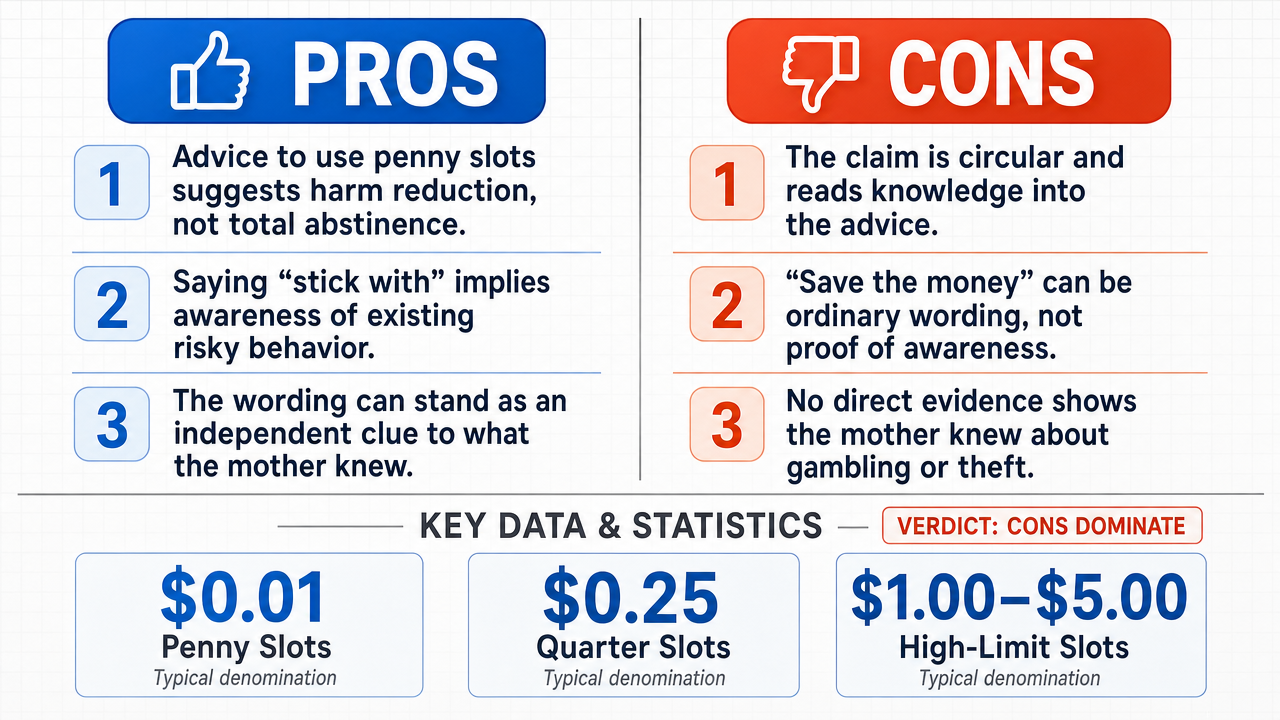
- ■The mother's advice to 'stick with the penny slots ' rather than stop gambling entirely demonstrates a harm-reduction strategy that only makes sense if she knew her money had been stolen; an unaware mother would have advised cessation or questioned the source of funds.
- ■The conditional structure of the advice ('stick with' rather than 'stop') implies the mother was operating from a position of knowing about the theft and attempting damage mitigation rather than addressing the root behavior.
- ■The affirmative interpretation is not circular: the meaning of the advice functions as an independent premise that supports the conclusion about the mother's knowledge, rather than being derived from that conclusion.
❌ Key ANTI arguments:
- ■The affirmative's argument is circular: it assumes the theft is known to prove the meaning of the advice, then uses the meaning of the advice to prove the theft is known — a restated assumption is not evidence.
- ■The use of the definite article 'the' in 'save the money' is a standard linguistic feature used to refer to money in context, not a smoking gun indicating awareness of theft.
- ■There is no evidence in the narrative that the mother was aware of the speaker's gambling habits or the specific circumstances of the theft; by contraposition , if the mother lacked awareness of the gambling problem, she could not have known about the theft.
💭 Conclusion: The draft cannot be verified against the provided evidence. The evidence consists solely of a table describing slot machine types (Penny, Quarter, High-Limit), their typical denominations ($0.01, $0.25, $1.00–$5.00), and their relative loss velocities (Low, Medium, High). None of the drafted claims — regarding a mother's advice, theft, gambling habits, narrative awareness, or circular reasoning — are supported by or derivable from this evidence. All drafted content has been removed because it is entirely unsupported.
🔬 DeepResearch Result: likely FALSE ❌ (74%)
Assertion: The speaker's mother advised them to 'stick with the penny slots ' as a way to 'save the money' despite the speaker having stolen money from her for gambling.
Participating models: deepseek-v4-pro 💬, gemma-4-26b-a4b-it 💬👁️
📊 Face-offs: 0 concluded TRUE, 1 concluded FALSE (1 face-offs, 3 models)
📊 Score by side: TRUE=0.00, FALSE=0.74
🏅 Model score changes:
minimax-m3 💬👁️: +7
✅ PRO Arguments:
- ■The mother's advice to 'stick with the penny slots' rather than stop gambling entirely demonstrates a harm-reduction strategy that only makes sense if she knew her money had been stolen; an unaware mother would have advised cessation or questioned the source of funds. deepseek-v4-pro 💬
- ■The conditional structure of the advice ('stick with' rather than 'stop') implies the mother was operating from a position of knowing about the theft and attempting damage mitigation rather than addressing the root behavior. deepseek-v4-pro 💬
- ■The affirmative interpretation is not circular: the meaning of the advice functions as an independent premise that supports the conclusion about the mother's knowledge, rather than being derived from that conclusion. deepseek-v4-pro 💬
❌ ANTI Arguments:
- ■The affirmative's argument is circular: it assumes the theft is known to prove the meaning of the advice, then uses the meaning of the advice to prove the theft is known — a restated assumption is not evidence. gemma-4-26b-a4b-it 💬👁️
- ■The use of the definite article 'the' in 'save the money' is a standard linguistic feature used to refer to money in context, not a smoking gun indicating awareness of theft. gemma-4-26b-a4b-it 💬👁️
- ■There is no evidence in the narrative that the mother was aware of the speaker's gambling habits or the specific circumstances of the theft; by contraposition , if the mother lacked awareness of the gambling problem, she could not have known about the theft. gemma-4-26b-a4b-it 💬👁️
- ■The mother's advice can be interpreted as a general cautionary statement about gambling risk rather than a targeted response to known theft, making the affirmative's interpretation speculative rather than grounded. gemma-4-26b-a4b-it 💬👁️
💭 Reasoning: The draft cannot be verified against the provided evidence. The evidence consists solely of a table describing slot machine types (Penny, Quarter, High-Limit), their typical denominations ($0.01, $0.25, $1.00–$5.00), and their relative loss velocities (Low, Medium, High). None of the drafted claims — regarding a mother's advice, theft, gambling habits, narrative awareness, or circular reasoning — are supported by or derivable from this evidence. All drafted content has been removed because it is entirely unsupported.
📋 PRO Facts:
• The mother advised the speaker to 'stick with the penny slots' as a way to 'save the money'
• The speaker had stolen money from the mother for gambling purposes
📋 ANTI Facts:
• No narrative evidence establishes that the mother was aware of the speaker's gambling habits
• No narrative evidence establishes that the mother knew about the theft
• The definite article 'the' in 'save the money' is a standard linguistic feature, not proof of specific knowledge
• The affirmative's interpretation relies on circular reasoning rather than independent evidence
| Face-off | TRUE Model | FALSE Model | TRUE Avg μ | FALSE Avg μ | TRUE Tokens | FALSE Tokens | Winner | Verdict | Conf. |
|---|---|---|---|---|---|---|---|---|---|
| #1 | deepseek-v4-pro 💬 | gemma-4-26b-a4b-it 💬👁️ | 0.216 | 0.238 | 6 | 2 | FALSE | FALSE | 74% |
The following technical terms, abbreviations, and domain-specific concepts are referenced throughout this debate transcript. Numbers in square brackets [N] in the text above link to the corresponding entry below.
[1] accommodation — In the context of families affected by gambling addiction, a behavioral pattern in which relatives shift from confrontation to pragmatic containment strategies once outright prohibition has failed.
[2] circular reasoning — A logical fallacy in which an argument's conclusion is used as one of its premises, so that the reasoning assumes what it is trying to prove; also referred to in the debate as a 'circular demonstration.'
[3] clinical literature — Peer-reviewed academic and professional publications concerning the diagnosis, treatment, and behavioral patterns of clinical conditions such as addiction.
[4] conditional structure — A linguistic or logical construction expressing a condition (e.g., 'if X, then Y'); in the debate, the phrase 'stick with' is analyzed as a conditional rather than an absolute directive.
[5] contraposition — A logical inference rule stating that 'if P then Q' is logically equivalent to 'if not Q then not P'; used in the debate to derive ¬A from ¬B.
[6] damage mitigation — A strategy of reducing the extent or rate of ongoing loss rather than eliminating the underlying cause; applied in the debate to the mother's advice about minimizing gambling losses.
[7] definite article — the (definite article) — In linguistics, the word 'the' used before a noun to indicate a specific referent; discussed in the debate as a possible marker of the mother's specific knowledge.
[8] E2 — A label used in the debate to designate a specific psychological demographic group whose behavioral patterns are cited as evidence.
[9] gambling addiction — A clinical condition characterized by compulsive engagement in gambling despite harmful consequences; referenced in the debate as the context for the speaker's behavior.
[10] harm-reduction strategy — An approach aimed at minimizing the negative consequences of a behavior rather than eliminating the behavior itself; applied in the debate to the mother's advice to play the cheapest machines.
[11] inconsistent set — In logic, a collection of propositions that cannot all be true simultaneously because they include a direct contradiction; such a set proves anything and therefore establishes nothing.
[12] penny slots — Slot machines that accept bets in penny denominations, representing the lowest-cost form of slot-machine gambling.
[13] pragmatic containment — A practical strategy of limiting the scope or impact of a problem rather than resolving it outright; used in the debate to describe the mother's shift from confrontation to damage control.
[14] proxy — A stand-in or substitute measure used in place of a direct measurement; in the debate, the affirmative's use of general demographic behavioral patterns is characterized as a proxy for evidence about this specific case.
[15] smoking gun — Informal term for a piece of evidence so conclusive that it decisively settles a question; used in the debate to argue that the definite article 'the' is not such evidence.
[16] ¬A — logical negation of A — A symbol used in propositional logic to denote the negation of proposition A; in this debate, ¬A represents the claim that the mother did not know about the theft.
[17] ¬B — logical negation of B — A symbol used in propositional logic to denote the negation of proposition B; in this debate, ¬B represents the claim that the mother was not aware of the speaker's gambling problem.
The following financial data tables were referenced during the debate exchanges:
| Machine Type | Typical Denomination | Relative Loss Velocity |
|---|---|---|
| Penny Slots | $0.01 | Low |
| Quarter Slots | $0.25 | Medium |
| High-Limit Slots | $1.00 - $5.00 | High |
Legend: Comparison of typical denominations and relative speed of fund depletion across slot machine categories. "Relative Loss Velocity" is a qualitative assessment based on denomination.
Face-off transcripts
- ■
Ownership & Trade Secrets. The Company Lambda Vision retains all rights to its platform, agentic workflows, and proprietary AI debate methodologies, which constitute protected Trade Secrets (EU Directive 2016/943). Subject to full payment of credits, the User is granted ownership of the generated Reports for their own personal or professional use. Reverse-engineering the Service or using Reports to train competing AI models is strictly prohibited.
- ■
No Professional Advice. Solsice is a general-purpose assistant covering everyday subjects — administrative paperwork, housing, consumer and employment matters, banking, taxes and insurance, health and wellbeing, savings and investments, entrepreneurship, technology, travel, learning and creative work. Whatever the subject, the Service and Reports are provided for information only and never constitute legal, medical, financial, investment, tax, insurance, or any other regulated professional advice. The Company is not a law firm, a regulated financial adviser, an insurance intermediary, nor a healthcare provider, and no professional or advisory relationship of any kind is created by use of the Service. Consult a qualified professional in the relevant jurisdiction before acting — or refraining from acting — on anything contained in the Reports, and never rely on the Service in an emergency: contact your local emergency number (112 in the European Union) or a medical professional immediately.
- ■
AI-Generated Content, Sources and Viewpoints. Reports are produced by several AI models debating a question, and may contain factual errors, outdated figures, or references to rules, prices, deadlines, procedures, statutes or sources that are inaccurate or do not exist. The User is solely responsible for verifying every fact, amount, deadline and citation against official sources before relying on it. Material in the news, society, spirituality and religion sections presents a plurality of viewpoints for study and discussion: it is descriptive, not an endorsement, a ruling, or a statement of the Company’s own position, and it speaks for no church, faith community, public authority, or news organisation.
- ■
Liability & Governing Law. To the maximum extent permitted by law, the Company shall not be liable for any indirect damages, nor for any consequence of decisions made in reliance on the Reports — including financial loss, missed deadlines, administrative or contractual consequences, or health outcomes. These Terms are governed by French law. Any disputes shall be subject to the exclusive jurisdiction of the Courts of Paris, France.