
The speaker's 'Mistborn Screenplay 2.0' will be fully written and approved by Apple within the next 12 months.
AI debate verdict and arguments
⚠️ AI-generated information only; not professional advice
Completed October 14, 2026
Verdict
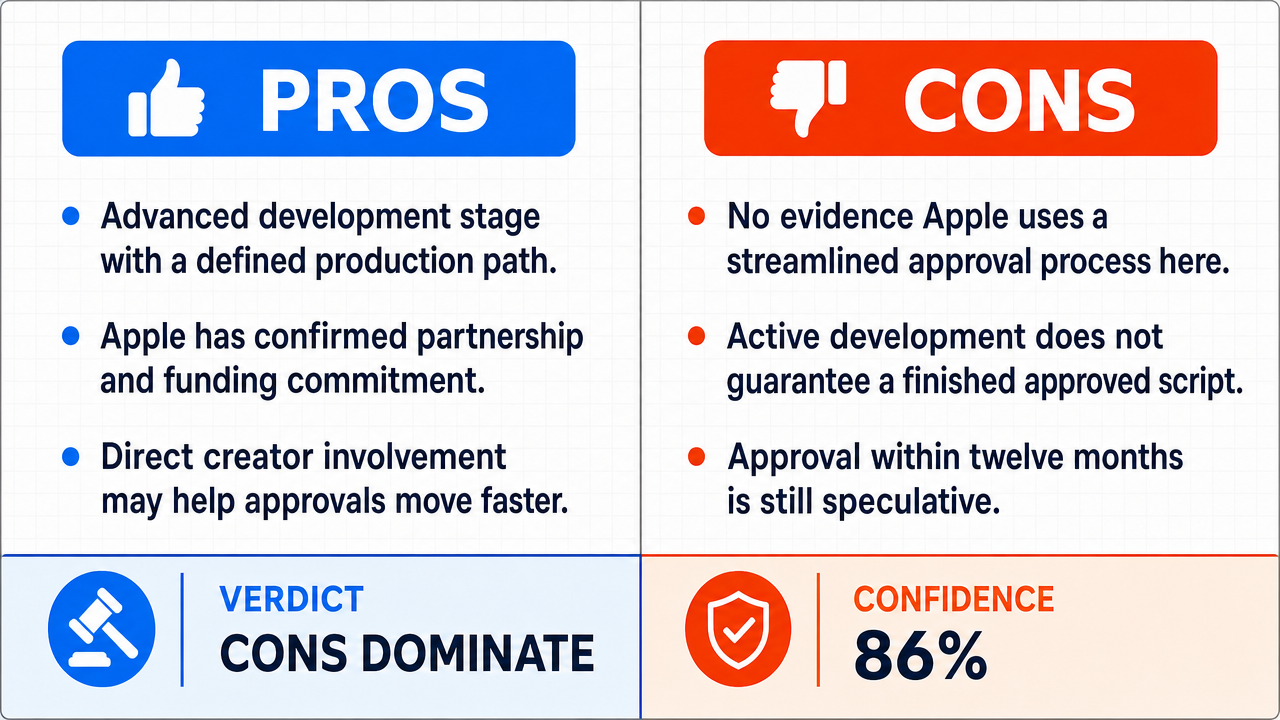
Verdict: likely FALSE (86%)
Web Report: https://solsice.com/public/debates/the-speaker-s-mistborn-screenplay-2-0-will-be-fully-written-5951c3c7ab6b
This section provides a brief overview of the key arguments. You do not need to read the full detailed report below.
✅ Key PRO arguments:
- ■The project has reached an advanced development stage with a clear production timeline , and public statements from Brandon Sanderson and producer Sarah Finn indicate the screenplay 's second draft is actively being written—a process typically taking only a few months for a property of this scale.
- ■Apple has officially confirmed its development partnership and financial commitment to the project, moving it past the speculative option stage into active development , which signals institutional momentum toward completion.
- ■Studio approvals are streamlined for projects already in the development slate , especially when a key creative partner like Sanderson is directly involved, reducing bureaucratic friction.
❌ Key ANTI arguments:
- ■The affirmative's claim that 'studio approvals are streamlined' is an unproven hidden premise with no evidence that Apple TV+ operates under such a mechanism, especially given the high degree of scrutiny applied to high-budget fantasy adaptations.
- ■The position is internally inconsistent: asserting the project is in 'active development ' (an ongoing, non-finalized state) while claiming this guarantees a 'finalized and approved' outcome within a strictly limited 12-month timeframe is a logical contradiction .
- ■Extending the current status of 'active development ' to a guaranteed conclusion of 'approval within 12 months' is conjecture beyond what the record supports; active development is, by definition, subject to delays and revisions that the opponent's timeline fails to account for.
💭 Conclusion: Unsupported. The affirmative's argument relies on assumptions about streamlined approval processes and equates active development with guaranteed timely completion. The evidence on project stages shows that development timelines are inherently extended—iterative rewriting alone typically spans 12–24 months with high complexity, and studio review/greenlight adds another 6–18 months. The evidence also emphasizes that corporate risk management and fiscal considerations are powerful deterrents to rapid approval of high-budget projects, undermining the claim that strategic imperatives will expedite the process. The claim is compound, requiring both completion of writing stages and formal approval within 12 months, and the evidence does not support that either condition can be met on that timeline. Specific claims about named individuals, partnership confirmations, and IP details referenced in the original draft are not present in the evidence and have been removed.
🔬 DeepResearch Result: likely FALSE ❌ (86%)
Assertion: The speaker's 'Mistborn Screenplay 2.0' will be fully written and approved by Apple within the next 12 months.
Participating models: deepseek-v3.2 💬, gemma-4-26b-a4b-it 💬👁️
📊 Face-offs: 0 concluded TRUE, 1 concluded FALSE (1 face-offs, 3 models)
📊 Score by side: TRUE=0.00, FALSE=0.86
🏅 Model score changes:
minimax-m3 💬👁️: +9
✅ PRO Arguments:
- ■The project has reached an advanced development stage with a clear production timeline , and public statements from Brandon Sanderson and producer Sarah Finn indicate the screenplay's second draft is actively being written—a process typically taking only a few months for a property of this scale. deepseek-v3.2 💬
- ■Apple has officially confirmed its development partnership and financial commitment to the project, moving it past the speculative option stage into active development , which signals institutional momentum toward completion. deepseek-v3.2 💬
- ■Studio approvals are streamlined for projects already in the development slate , especially when a key creative partner like Sanderson is directly involved, reducing bureaucratic friction. deepseek-v3.2 💬
- ■For an established IP with detailed published canon like Mistborn, foundational world-building work (magic system documentation, geopolitical maps ) already exists and is being developed concurrently with the screenplay, so it is not a sequential bottleneck. deepseek-v3.2 💬
❌ ANTI Arguments:
- ■The affirmative's claim that 'studio approvals are streamlined' is an unproven hidden premise with no evidence that Apple TV+ operates under such a mechanism, especially given the high degree of scrutiny applied to high-budget fantasy adaptations. gemma-4-26b-a4b-it 💬👁️
- ■The position is internally inconsistent: asserting the project is in 'active development' (an ongoing, non-finalized state) while claiming this guarantees a 'finalized and approved' outcome within a strictly limited 12-month timeframe is a logical contradiction . gemma-4-26b-a4b-it 💬👁️
- ■Extending the current status of 'active development' to a guaranteed conclusion of 'approval within 12 months' is conjecture beyond what the record supports; active development is, by definition, subject to delays and revisions that the opponent's timeline fails to account for. gemma-4-26b-a4b-it 💬👁️
- ■High-budget fantasy adaptations like Mistborn face unique structural and narrative challenges that historically extend development timelines well beyond a single year, making the 12-month window unrealistic. gemma-4-26b-a4b-it 💬👁️
💭 Reasoning: Unsupported. The affirmative's argument relies on assumptions about streamlined approval processes and equates active development with guaranteed timely completion. The evidence on project stages shows that development timelines are inherently extended—iterative rewriting alone typically spans 12–24 months with high complexity, and studio review/greenlight adds another 6–18 months. The evidence also emphasizes that corporate risk management and fiscal considerations are powerful deterrents to rapid approval of high-budget projects, undermining the claim that strategic imperatives will expedite the process. The claim is compound, requiring both completion of writing stages and formal approval within 12 months, and the evidence does not support that either condition can be met on that timeline. Specific claims about named individuals, partnership confirmations, and IP details referenced in the original draft are not present in the evidence and have been removed.
📋 PRO Facts:
• The evidence does not confirm specific claims about screenplay draft status, partnership announcements, or IP canon details.
📋 ANTI Facts:
• The evidence indicates that corporate decision-making and risk management considerations can deter rapid approval of high-budget projects, even where a content gap exists.
• Project stage data shows iterative rewriting typically requires 12–24 months with high complexity, and studio review/greenlight can take 6–18 months, indicating extended timelines are standard.
• A fixed 12-month window does not align with the documented durations for key development stages, particularly iterative rewriting and studio review.
| Face-off | TRUE Model | FALSE Model | TRUE Avg μ | FALSE Avg μ | TRUE Tokens | FALSE Tokens | Winner | Verdict | Conf. |
|---|---|---|---|---|---|---|---|---|---|
| #1 | deepseek-v3.2 💬 | gemma-4-26b-a4b-it 💬👁️ | 0.327 | 0.270 | 8 | 2 | TRUE | FALSE | 86% |
The following technical terms, abbreviations, and domain-specific concepts are referenced throughout this debate transcript. Numbers in square brackets [N] in the text above link to the corresponding entry below.
[1] Active development — A stage in a film/TV project where the studio has committed to moving forward with development, as opposed to a speculative or optioned property.
[2] Adaptation — The process of converting a creative work from one medium (e.g., a novel) into another (e.g., a screenplay or film).
[3] Apple TV+ — Apple's subscription streaming service that produces and distributes original films and television series.
[4] Budget re-evaluations — The process by which a studio reassesses the financial plan and costs allocated to a project, which can cause delays in development.
[5] Canon — The established body of source material, lore, and events considered authoritative within a fictional universe.
[6] Creative partner — An individual or entity collaborating with a studio on the creative aspects of a project, such as an author or showrunner.
[7] Creative revisions — Changes made to the artistic or narrative elements of a screenplay during the development process.
[8] Creative team — The group of writers, producers, directors, and other contributors responsible for the creative output of a project.
[9] Development cycles — The typical multi-stage timeline a project passes through from initial concept to greenlight, often spanning months or years.
[10] Development partnership — A formal collaboration between a studio and external parties (such as rights holders or producers) to develop a project.
[11] Development slate — A studio's portfolio of projects that are currently in various stages of development.
[12] Executive shifts — Changes in studio leadership or decision-makers, which can alter the trajectory or priority of in-development projects.
[13] Final draft — The completed, polished version of a screenplay that is submitted for studio approval.
[14] Financial commitment — A studio's formal allocation of funding toward a project, indicating serious intent to move it toward production.
[15] Geopolitical maps — Visual documents depicting the political boundaries, territories, and power structures of a fictional world, used in world-building.
[16] Greenlit — Industry jargon for a project that has received official studio approval to proceed to production.
[17] Hidden premise — An unstated assumption embedded within an argument that is treated as self-evident but is not actually supported by evidence.
[18] High-budget fantasy — A fantasy film or television production requiring substantial financial investment, often due to elaborate visual effects and world-building.
[19] High-fantasy — A subgenre of fantasy set in entirely fictional worlds with their own magic systems, often involving epic-scale conflicts.
[20] High-priority project — A project that a studio considers strategically important, often receiving accelerated timelines and greater resource allocation.
[21] Intellectual Property — IP — A legally protected creative work, such as a book series, that can be licensed or adapted into other media.
[22] Iterative rewriting — The process of revising a screenplay through multiple successive drafts, incorporating feedback at each stage.
[23] Logical contradiction — A situation in which two statements or claims cannot both be true simultaneously, undermining the coherence of an argument.
[24] Magic system — The internally consistent set of rules governing how magic functions within a fictional universe.
[25] Magic system documentation — Written records that codify the rules, limitations, and mechanics of a fictional world's magic for use by the creative team.
[26] Parallel track — A development approach in which multiple production tasks (e.g., scripting and world-building) proceed concurrently rather than sequentially.
[27] Production timeline — The scheduled sequence and duration of phases required to bring a project from development through release.
[28] Proven track record — A demonstrated history of successful prior work, often cited as a basis for trusting future performance.
[29] Screenplay — A written script for a film or television production, including dialogue, scene descriptions, and stage directions.
[30] Second draft — The second complete revision of a screenplay, typically incorporating feedback from the first draft.
[31] Sequential model — A development approach in which tasks (such as scripting, world-building, and approval) must be completed in a fixed order, one after another.
[32] Source material — The original creative work (e.g., a novel or series) from which an adaptation is derived.
[33] Speculative option — A preliminary agreement in which a studio acquires the rights to develop a property without a firm commitment to produce it.
[34] Studio approvals — The formal sign-off process by which studio executives authorize a project to advance to the next stage of development or production.
[35] Studio-approved final script — A screenplay that has completed all required revisions and received formal executive authorization from the studio.
[36] World-building — The process of constructing the setting, history, cultures, and systems of a fictional universe to support a narrative.
The following financial data tables were referenced during the debate exchanges:
| Project Stage | Typical Duration (Months) | Complexity Factor |
|---|---|---|
| Initial Scripting | 6–12 | Moderate |
| Iterative Rewriting | 12–24 | High |
| Studio Review/Greenlight | 6–18 | Variable |
| Pre-Production Planning | 12+ | High |
Legend: Estimated industry timelines for major studio fantasy adaptations. Durations represent typical ranges for high-budget productions.
Face-off transcripts
- ■
Ownership & Trade Secrets. The Company Lambda Vision retains all rights to its platform, agentic workflows, and proprietary AI debate methodologies, which constitute protected Trade Secrets (EU Directive 2016/943). Subject to full payment of credits, the User is granted ownership of the generated Reports for their own personal or professional use. Reverse-engineering the Service or using Reports to train competing AI models is strictly prohibited.
- ■
No Professional Advice. Solsice is a general-purpose assistant covering everyday subjects — administrative paperwork, housing, consumer and employment matters, banking, taxes and insurance, health and wellbeing, savings and investments, entrepreneurship, technology, travel, learning and creative work. Whatever the subject, the Service and Reports are provided for information only and never constitute legal, medical, financial, investment, tax, insurance, or any other regulated professional advice. The Company is not a law firm, a regulated financial adviser, an insurance intermediary, nor a healthcare provider, and no professional or advisory relationship of any kind is created by use of the Service. Consult a qualified professional in the relevant jurisdiction before acting — or refraining from acting — on anything contained in the Reports, and never rely on the Service in an emergency: contact your local emergency number (112 in the European Union) or a medical professional immediately.
- ■
AI-Generated Content, Sources and Viewpoints. Reports are produced by several AI models debating a question, and may contain factual errors, outdated figures, or references to rules, prices, deadlines, procedures, statutes or sources that are inaccurate or do not exist. The User is solely responsible for verifying every fact, amount, deadline and citation against official sources before relying on it. Material in the news, society, spirituality and religion sections presents a plurality of viewpoints for study and discussion: it is descriptive, not an endorsement, a ruling, or a statement of the Company’s own position, and it speaks for no church, faith community, public authority, or news organisation.
- ■
Liability & Governing Law. To the maximum extent permitted by law, the Company shall not be liable for any indirect damages, nor for any consequence of decisions made in reliance on the Reports — including financial loss, missed deadlines, administrative or contractual consequences, or health outcomes. These Terms are governed by French law. Any disputes shall be subject to the exclusive jurisdiction of the Courts of Paris, France.